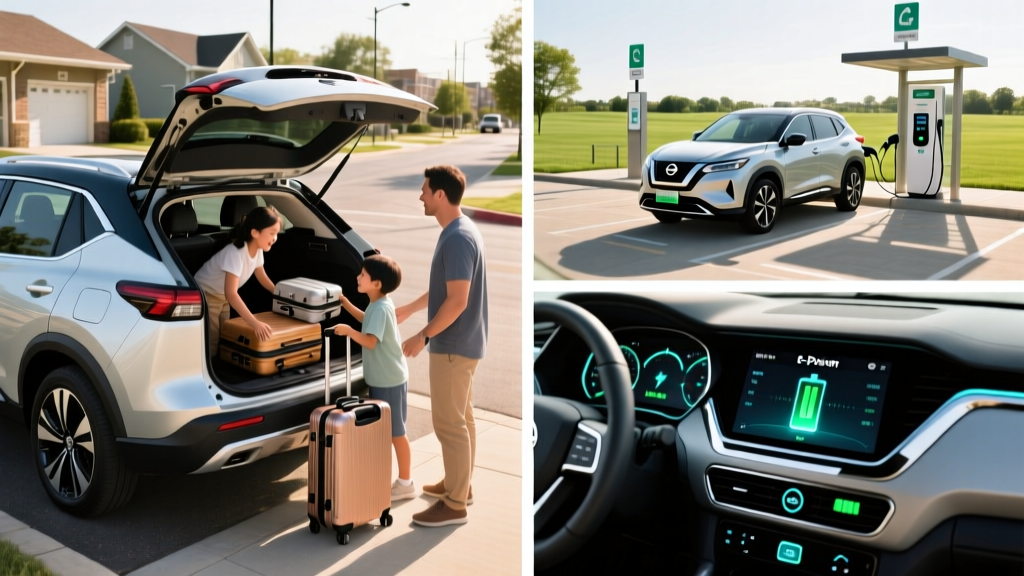
Nissan has been conspicuously absent from the US hybrid boom. While Toyota, Honda, and Hyundai flooded the market with conventional and plug-in hybrids, Nissan went all-in on battery electric vehicles with the Leaf and Ariya. That changes for the 2026 model year. The Nissan Rogue e-Power and Kicks e-Power are arriving in US showrooms with a fundamentally different hybrid architecture than anything else on the market — a series-hybrid system where the gasoline engine never drives the wheels directly.
If you've been searching for a nissan new us market hybrid, here's everything you need to know about the e-Power lineup: real-world MPG expectations, how the powertrain works, pricing, tax credit eligibility, and whether this unconventional approach makes sense for your driving routine.
What Is Nissan e-Power? HEV vs PHEV Clarified
Before diving into specs, it's critical to understand what Nissan's e-Power system actually is — and what it isn't. The e-Power is a conventional hybrid (HEV), not a plug-in hybrid (PHEV). You never plug it in. The gasoline engine charges the onboard battery, and electric motors drive the wheels 100% of the time.
e-Power (HEV) vs Plug-In Hybrid — Key Differences
| Feature | Nissan e-Power (HEV) | Typical PHEV (e.g., Toyota RAV4 Prime) |
|---|---|---|
| Plug-in charging | No — gas engine charges battery | Yes — plug in for electric-only miles |
| Electric-only range | ~1-2 miles at low speed | 30-42 miles typical |
| Battery size | ~2.0 kWh (small buffer) | 18-22 kWh |
| Driving feel | Full EV torque, no gear shifts | EV mode then blended gas/electric |
| Federal tax credit (§30D) | Not eligible | Up to $7,500 (if eligible) |
| Home charging needed | No | Yes, to maximize value |
The e-Power's defining trait: the 1.5L turbocharged three-cylinder engine acts exclusively as a generator. It produces electricity that either powers the electric drive motor directly or charges the small lithium-ion buffer battery. The engine speed is decoupled from vehicle speed, meaning it can run at its most efficient RPM regardless of how fast you're driving. This is the same principle used in diesel-electric locomotives and the Chevrolet Volt's range-extended mode — but in a vehicle you never need to plug in.
2026 Nissan Rogue e-Power: Specs, MPG, and Pricing
The Rogue e-Power is Nissan's volume play. It slots into the compact SUV segment against the Toyota RAV4 Hybrid, Honda CR-V Hybrid, and Hyundai Tucson Hybrid, but drives unlike any of them.
| Specification | Value |
|---|---|
| Powertrain | 1.5L turbo 3-cyl generator + front electric motor |
| Combined system output | 201 hp / 250 lb-ft torque |
| Drivetrain | FWD standard; e-4ORCE AWD available (dual motor) |
| AWD combined output | 213 hp |
| Battery | ~2.0 kWh lithium-ion (NMC chemistry) |
| EPA MPG (FWD combined) | 42 MPG combined (est. 44 city / 39 highway) |
| EPA MPG (AWD combined) | 39 MPG combined (est. 41 city / 37 highway) |
| Fuel tank | 14.5 gallons |
| Total range | ~570-610 miles |
| 0-60 mph | ~7.8 seconds (FWD) |
| Cargo volume | 36.5 cu ft (rear seats up) |
| Base MSRP (S trim FWD) | $33,590 |
| AWD premium | +$1,500 |
| Hybrid battery warranty | 8 years / 100,000 miles |
Real-World MPG vs EPA Estimates
Series-hybrids like the e-Power behave differently than parallel hybrids (Toyota, Honda). Because the electric motor handles all propulsion, you get strong low-speed efficiency — the engine can shut off entirely during coasting and low-load city driving. Expect the Rogue e-Power to meet or slightly exceed its EPA city rating in stop-and-go traffic, where the engine runs at optimal RPM only when needed.
Highway driving is where the e-Power gives back some efficiency. At sustained 70-80 mph speeds, the energy conversion chain (engine → generator → motor → wheels) introduces losses that parallel hybrids avoid by mechanically coupling the engine to the wheels. On a 300-mile highway trip at 75 mph, expect roughly 35-37 MPG — below the EPA highway estimate. This is the trade-off of the series-hybrid architecture.
EPA combined: 42 MPG (FWD) | Real-world mixed driving: 38-43 MPG | Highway-heavy (75 mph): ~35-37 MPG | City-heavy: 43-46 MPG. Cold weather (below 32°F) reduces efficiency by approximately 8-12% due to cabin heating load and engine running more frequently for warmth.
2026 Nissan Kicks e-Power: The Budget Hybrid Crossover
The redesigned Kicks e-Power targets buyers who want hybrid efficiency below $30,000. It's smaller than the Rogue — think subcompact crossover — but the e-Power system is tuned for even better city efficiency thanks to the lighter vehicle weight.
| Specification | Value |
|---|---|
| Powertrain | 1.5L naturally aspirated 3-cyl generator + electric motor |
| Combined system output | 141 hp / 206 lb-ft torque |
| Drivetrain | FWD standard; AWD available |
| EPA MPG (FWD combined) | 45 MPG combined (est. 48 city / 41 highway) |
| Fuel tank | 11.5 gallons |
| Total range | ~515 miles |
| 0-60 mph | ~9.2 seconds |
| Base MSRP (S trim) | $28,890 |
| Hybrid battery warranty | 8 years / 100,000 miles |
The Kicks e-Power's 48 MPG city estimate is genuinely impressive for a crossover. For urban commuters covering 15-30 miles daily in traffic, this is where the e-Power system shines brightest — the engine barely runs, and regenerative braking recaptures energy at every stop.
How Does e-Power Compare to Rival Hybrids?
The compact hybrid SUV segment is stacked. Here's how the Rogue e-Power stacks up against the benchmarks on paper:
| Model | Type | EPA Combined MPG | Combined HP | Starting MSRP |
|---|---|---|---|---|
| Nissan Rogue e-Power FWD | Series HEV | 42 MPG | 201 hp | $33,590 |
| Toyota RAV4 Hybrid | Parallel HEV | 39 MPG | 219 hp | $33,445 |
| Honda CR-V Hybrid | Parallel HEV | 40 MPG | 204 hp | $34,395 |
| Hyundai Tucson Hybrid | Parallel HEV | 38 MPG | 226 hp | $33,990 |
| Toyota RAV4 Prime (PHEV) | PHEV | 94 MPGe / 38 MPG gas | 302 hp | $44,905 |
The Rogue e-Power's combined MPG leads the non-plug-in segment, though the margin narrows on highway-heavy routes where the Toyota and Honda parallel systems are more efficient. The e-Power's 250 lb-ft of instant electric torque gives it a notably different acceleration feel from competitors — there's no transmission hunting for gears, just linear electric pull from a stop.
Tax Credits and Incentives for Nissan Hybrids
Here's the straightforward answer: the Nissan Rogue e-Power and Kicks e-Power do not qualify for the federal §30D clean vehicle tax credit. Under current IRS rules, the §30D credit applies only to plug-in electric vehicles — battery electric vehicles (BEVs) and plug-in hybrids (PHEVs) with a minimum battery capacity of 7 kWh. The e-Power's ~2.0 kWh buffer battery falls far below that threshold, and it has no plug-in capability.
Federal §30D Tax Credit — Why e-Power Doesn't Qualify
- Battery capacity requirement: Minimum 7 kWh — e-Power has ~2.0 kWh ❌
- Plug-in capability: Required — e-Power cannot be plugged in ❌
- Vehicle type: Must be BEV or PHEV — e-Power is a series HEV ❌
Source: IRS §30D Clean Vehicle Credit
However, there are potential workarounds worth investigating:
- State-level incentives: A handful of states offer rebates for conventional hybrids. Check your state's energy office or DMV for current programs — these vary by jurisdiction and change frequently.
- Employer or utility rebates: Some utility companies and corporate fleet programs offer incentives for any electrified vehicle, including HEVs.
- Lower total cost of ownership: The Rogue e-Power's 42 MPG combined vs. a gas-only Rogue's 33 MPG combined saves roughly $450-$600 annually in fuel at 15,000 miles/year and $3.40/gallon regular unleaded.
Battery Longevity, Warranty, and Replacement Costs
Hybrid battery anxiety is the number one concern we hear from buyers switching from conventional gas cars. Here's the reality for Nissan's e-Power system:
Nissan e-Power Battery Warranty
Coverage: 8 years / 100,000 miles (whichever comes first)
Capacity threshold: Nissan warrants the hybrid battery against defects and capacity loss below 60% of original capacity during the warranty period.
What's covered: Battery module replacement, labor, and diagnostic fees at a Nissan dealer.
Transferable: Yes — the warranty follows the vehicle, not the original owner.
The e-Power's small ~2.0 kWh battery actually has a longevity advantage over larger PHEV and BEV batteries. Because the system uses a wide operating window with active thermal management, and because the battery is never deeply discharged (the engine kicks in to maintain charge), degradation is minimal. Nissan's e-Power system has been running in Japan since 2016 on the Note and Serena models, with no widespread reports of premature battery failure.
Battery Replacement Cost
If the hybrid battery fails out of warranty, expect a replacement cost of $2,000-$3,500 for the e-Power's small battery pack — significantly less than a PHEV ($5,000-$8,000) or BEV ($10,000-$20,000+) battery replacement. The small pack size is a cost advantage here. Independent hybrid shops are increasingly able to replace individual modules rather than the entire pack, which can reduce costs further.
For context, Toyota's hybrid batteries in the Prius and RAV4 Hybrid have demonstrated 150,000-200,000+ mile lifespans routinely. Nissan's e-Power architecture should offer comparable longevity given the shallow cycling and thermal management, though US-specific long-term data is still accumulating as these are new-to-market vehicles.
Who Should Buy a Nissan e-Power Hybrid?
Pros
- Best-in-class city MPG from the series-hybrid system
- EV-like driving feel — instant torque, no shift lag, quiet at low speeds
- No plug-in charging required — works for apartment/condo dwellers
- Lower battery replacement cost than PHEV/BEV
- Competitive pricing starting under $29K (Kicks) and $34K (Rogue)
- Strong regenerative braking enables one-pedal-like driving in traffic
Cons
- No federal tax credit eligibility
- Highway MPG lags parallel hybrids (Toyota, Honda) at sustained speeds
- Engine drone under hard acceleration (generator revs independently of speed)
- Limited US service history — long-term reliability data still building
- AWD fuel economy penalty is more pronounced than some competitors
- No electric-only highway driving capability
Hybrid vs PHEV vs EV — Which Fits You?
Choose the Nissan e-Power hybrid if: You don't have access to home or workplace charging, you drive mostly in city/suburban traffic, you want maximum MPG without ever thinking about plugs, and you want to spend under $35,000.
Choose a PHEV (like the RAV4 Prime or Tucson PHEV) if: You can charge at home (Level 2), your daily commute is under 35 miles round-trip (covering most days on electricity alone), and you want federal tax credit eligibility.
Choose a full BEV (like the Nissan Ariya or Hyundai Ioniq 5) if: You have reliable home charging, you want zero gasoline expenses, you qualify for the $7,500 federal credit, and your typical trips fall within 250 miles or you're comfortable with DC fast charging on road trips.
Frequently Asked Questions
How many MPG does the Nissan Rogue e-Power get?
The 2026 Nissan Rogue e-Power FWD is estimated at 44 city / 39 highway / 42 combined MPG. The AWD version drops to approximately 41 city / 37 highway / 39 combined. Real-world city driving may exceed EPA estimates thanks to the series-hybrid's efficiency at low speeds, while sustained highway driving above 70 mph typically yields 35-37 MPG.
Can the Nissan e-Power drive on electric only?
Only at very low speeds for roughly 1-2 miles. The e-Power's ~2.0 kWh battery is a small buffer, not a traction battery designed for extended electric-only driving. The gasoline generator will activate to maintain charge during any sustained driving. This is fundamentally different from a PHEV, which offers 30-40 miles of full electric range.
Does the Nissan e-Power hybrid need to be plugged in?
No. The e-Power is a conventional hybrid (HEV). The gasoline engine generates all the electricity the system needs. You fuel it like any other gas car — at a gas station. There is no charging port.
Is the Nissan e-Power hybrid reliable?
Nissan's e-Power system has been in production since 2016 in Japan, with over 1 million units sold globally across the Note, Serena, and Qashqai models. The series-hybrid architecture is mechanically simpler than a parallel hybrid — no multi-gear transmission, no clutch packs switching between gas and electric drive. The hybrid battery carries an 8-year/100,000-mile warranty. US-specific long-term data is still accumulating since these models are new to the American market for 2026.
What does a Nissan e-Power hybrid battery replacement cost?
Out-of-warranty replacement for the e-Power's ~2.0 kWh hybrid battery is estimated at $2,000-$3,500 including labor at a Nissan dealer. This is substantially less than PHEV or BEV battery replacements due to the small pack size. Individual module replacement at independent hybrid specialists may reduce costs further.
Does the Nissan Rogue e-Power qualify for any tax credit?
Not the federal §30D clean vehicle credit, which requires plug-in capability and a minimum 7 kWh battery. The e-Power qualifies as a conventional hybrid and does not meet these criteria. Some states, utilities, or employers may offer separate hybrid incentives — check your local programs. Consult a tax professional for eligibility guidance.
How does e-Power differ from Toyota's hybrid system?
Toyota uses a parallel hybrid system (Toyota Hybrid System / THS) where both the gasoline engine and electric motor can mechanically drive the wheels through a planetary gearset. Nissan's e-Power is a series hybrid — only the electric motor drives the wheels, and the engine acts solely as a generator. This gives the e-Power a more EV-like driving feel but sacrifices some highway efficiency compared to Toyota's direct mechanical coupling.
Fuel economy figures cited from fueleconomy.gov (EPA estimates) and Nissan North America press materials. Tax credit information sourced from IRS.gov. Specifications reflect 2026 model year data available at time of publication. Always verify current pricing and incentive eligibility with your local Nissan dealer and a qualified tax professional.