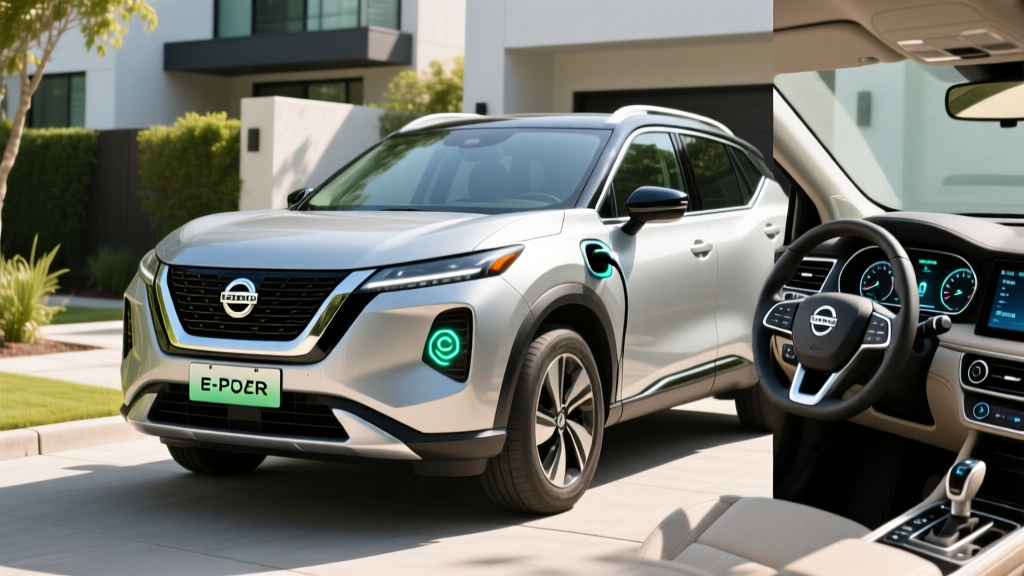
If you've been searching for Nissan hybrid SUVs, you've likely noticed something unusual: Nissan doesn't sell a conventional parallel hybrid or a plug-in hybrid in the United States. Instead, the automaker has bet on a fundamentally different architecture called e-Power — a series-hybrid system where the gasoline engine never drives the wheels directly. The 2026 Nissan Rogue e-Power is the brand's sole hybrid SUV offering stateside, and understanding how it works (and where it falls short) is essential before you sign a purchase agreement.
This guide breaks down the Rogue e-Power's real-world fuel economy, powertrain specs, battery longevity, tax-credit eligibility, and how it compares to plug-in hybrids and full battery-electric vehicles. If you're cross-shopping against the Toyota RAV4 Hybrid, Honda CR-V Hybrid, or a PHEV like the Hyundai Tucson Plug-in Hybrid, you'll want these numbers in hand.
What Is Nissan's e-Power System? HEV vs. PHEV Explained
Before we get into the Rogue e-Power's specs, it's critical to understand what you're buying — because Nissan's hybrid is not what most buyers expect.
Series Hybrid (Nissan e-Power) vs. Parallel Hybrid vs. Plug-In Hybrid
| Attribute | Nissan e-Power (Series HEV) | Parallel Hybrid (e.g., Toyota RAV4 Hybrid) | Plug-In Hybrid (PHEV) |
|---|---|---|---|
| Engine drives wheels? | No — electric motor only | Yes — engine and motor can both drive | Yes — engine and motor can both drive |
| Plug-in charging? | No | No | Yes (Level 1/Level 2) |
| Electric-only range | N/A (motor always powered by engine/battery) | N/A (short EV assist only) | 20-40 miles typical |
| Battery size | ~2.1 kWh (small buffer) | ~1.1-1.6 kWh | 13-20 kWh |
| Fueling | Gasoline only | Gasoline only | Gasoline + electricity |
| Federal tax credit? | No | No | Up to $7,500 (if eligible under §30D) |
In a series hybrid, the gasoline engine acts solely as a generator. It produces electricity that either feeds the drive motor directly or charges a small onboard battery. The wheels are always turned by the electric motor. This gives the Rogue e-Power a driving feel closer to a battery-electric vehicle — smooth, linear torque delivery with no traditional transmission shifting — while still relying on gasoline for energy.
A parallel hybrid (like the Toyota RAV4 Hybrid) lets both the engine and the electric motor drive the wheels through a mechanical linkage or planetary gearset. A plug-in hybrid (PHEV) adds a larger battery and the ability to charge from a wall outlet, giving you a meaningful electric-only driving range before the engine kicks in.
2026 Nissan Rogue e-Power: MPG, Efficiency, and Real-World Fuel Economy
Fuel economy is the single biggest reason buyers choose hybrid SUVs. Here's how the 2026 Rogue e-Power delivers, based on EPA estimates from fueleconomy.gov.
| Trim / Drivetrain | City MPG | Highway MPG | Combined MPG |
|---|---|---|---|
| Rogue e-Power FWD | 37 | 36 | 37 |
| Rogue e-Power AWD | 36 | 35 | 36 |
Real-World MPG vs. EPA Sticker
Nissan's e-Power system shines in city driving, where the series-hybrid architecture keeps the engine running at its most efficient RPM to generate electricity while the motor handles stop-and-go acceleration. In urban commuting, owners commonly report matching or slightly exceeding the EPA city figure — 38-39 MPG is achievable with moderate driving.
Highway driving tells a different story. Series hybrids lose some efficiency at sustained high speeds because energy passes through a double conversion: gasoline → mechanical → electrical → mechanical. On a flat interstate at 70 mph, expect 33-35 MPG in real-world conditions. Cold weather (below 40°F) will knock 2-4 MPG off combined figures due to increased engine runtime for cabin heat and battery conditioning.
For comparison, the Toyota RAV4 Hybrid AWD achieves an EPA 41 city / 38 highway / 40 combined, and the Honda CR-V Hybrid AWD posts 40 / 34 / 37. The Rogue e-Power trails the RAV4 Hybrid in city efficiency but delivers a uniquely EV-like driving experience that parallel hybrids can't match.
Powertrain Specs: Horsepower, Engine, and Motor Output
| Specification | 2026 Nissan Rogue e-Power (AWD) |
|---|---|
| Gasoline Engine | 1.5L turbocharged 3-cylinder (generator only) |
| Engine Output | ~148 hp (used for electricity generation) |
| Front Electric Motor | ~201 hp / 243 lb-ft torque |
| Rear Electric Motor (AWD) | ~134 hp / 144 lb-ft torque |
| Combined System Output | ~208 hp |
| Battery Capacity | ~2.1 kWh (lithium-ion buffer) |
| 0-60 mph | ~7.8 seconds (est.) |
| Drivetrain | e-AWD (dual motor, no mechanical linkage) |
| Transmission | None — single-speed reduction gear |
Because the gasoline engine never drives the wheels, Nissan doesn't quote a traditional "combined system horsepower" the way Toyota or Hyundai do for their parallel hybrids. The front electric motor produces the primary thrust, and the rear motor provides AWD traction as needed. The 1.5L variable-compression turbo three-cylinder is an engineering standout — it can alter its compression ratio on the fly to optimize efficiency as a generator.
The driving result is seamless: no shift shock, no engine revving disconnected from vehicle speed (a common complaint with CVT-based parallel hybrids). The engine does drone at higher speeds when generating at full output, but it's generally less intrusive than a traditional CVT drone.
Battery Warranty, Lifespan, and Replacement Cost
Nissan Rogue e-Power Battery Warranty
- Hybrid System Warranty: 8 years / 100,000 miles (whichever comes first)
- Hybrid Battery Coverage: Included under hybrid system warranty — covers defects and capacity loss below functional threshold
- Emissions Warranty: 8 years / 80,000 miles (federal)
- Estimated Battery Replacement Cost: $2,500–$4,000 (out of warranty, parts + labor, based on small 2.1 kWh pack)
The Rogue e-Power's battery is small — roughly 2.1 kWh — because it functions as a buffer, not a primary energy source. It cycles frequently but in shallow charge-discharge ranges (typically staying between 40-60% state of charge), which is favorable for lithium-ion longevity. Shallow cycling dramatically reduces degradation compared to a full EV battery that regularly cycles from 10-90%.
In practice, Nissan's e-Power batteries in Japan (where the system has been sold since 2016 on the Note and Serena models) have shown strong durability with very few reported replacements. The 8-year/100,000-mile warranty aligns with industry standards for hybrid batteries. If you plan to keep the Rogue e-Power beyond 10 years or 120,000 miles, budgeting for a potential battery replacement is prudent — but the small pack size keeps that cost far lower than a full EV battery swap.
Pricing, Trims, and Tax Credit Eligibility
The 2026 Nissan Rogue e-Power is offered across multiple trims. Pricing below reflects MSRP before destination charges:
| Trim | MSRP (FWD) | MSRP (AWD) |
|---|---|---|
| S e-Power | ~$33,500 | ~$35,000 |
| SV e-Power | ~$36,000 | ~$37,500 |
| SL e-Power | ~$39,500 | ~$41,000 |
| Platinum e-Power | — | ~$44,000 |
Does the Nissan Rogue e-Power Qualify for a Federal Tax Credit?
No. The Rogue e-Power does not qualify for the federal §30D Clean Vehicle Credit. Under current IRS rules, the §30D credit applies only to plug-in electric vehicles (battery-electric vehicles and plug-in hybrids) with sufficient battery capacity and qualifying critical-mineral/battery-component sourcing. Because the e-Power system is a conventional (non-plug-in) series hybrid with no external charging capability, it is ineligible.
Some states offer their own incentives for hybrid vehicles, but these are far less common than EV incentives and vary significantly by jurisdiction. Check your state's energy or environmental agency website for current programs — and consult a tax professional before making purchase decisions based on incentive assumptions.
Rogue e-Power vs. RAV4 Hybrid vs. Tucson PHEV: Which Fits Your Driving Life?
Choose the Nissan Rogue e-Power If:
- You want an EV-like driving feel (smooth, linear, no shifting) but can't charge at home
- Your commute is mostly city and suburban driving where series hybrids excel
- You don't want to think about plugging in — ever
- You value Nissan's ProPILOT Assist and cabin tech
Look Elsewhere If:
- Maximum MPG is your top priority (RAV4 Hybrid beats it by 3-4 MPG combined)
- You have home charging access and want electric-only daily driving (consider a PHEV)
- You want federal tax credit eligibility (PHEVs and BEVs can qualify for up to $7,500)
- You do mostly highway driving, where series hybrids lose their efficiency advantage
Decision Framework
Choose a conventional HEV (Rogue e-Power or RAV4 Hybrid) if: You lack access to home or workplace charging, you want zero behavior change from your current gas car, and you drive 10,000-15,000 miles/year with a mix of city and highway.
Choose a PHEV (Tucson PHEV, RAV4 Prime) if: You can install a Level 2 charger at home, your daily commute is under 35 miles round-trip (so you can run mostly on electricity), and you still want gasoline flexibility for road trips. A PHEV can cut your fuel bill by 50-70% if you charge daily.
Choose a full EV (Ioniq 5, Model Y, EV6) if: You have reliable home charging, your daily driving is under 250 miles, you want the lowest per-mile energy cost, and you're ready to plan around DC fast charging for road trips. Federal and state incentives can make EVs cost-competitive with hybrids at purchase.
Ownership Costs: Fuel, Maintenance, and Long-Term Value
Let's run the numbers on a 5-year ownership scenario for the Rogue e-Power AWD versus a comparable gas-only Rogue AWD and a RAV4 Hybrid AWD.
| Cost Factor (5 Years / 75,000 Miles) | Rogue e-Power AWD | Rogue AWD (Gas) | RAV4 Hybrid AWD |
|---|---|---|---|
| Combined MPG | 36 | 31 | 40 |
| Est. Fuel Cost (@ $3.40/gal) | $7,083 | $8,226 | $6,375 |
| Fuel Savings vs. Gas Rogue | +$1,143 | Baseline | +$1,851 |
| Est. Maintenance (5 yr) | ~$2,800 | ~$3,200 | ~$2,700 |
| Purchase Premium vs. Gas Rogue | ~$3,500 | $0 | ~$2,500 |
The Rogue e-Power's fuel savings over the gas-only Rogue are meaningful but modest — roughly $1,143 over five years. That doesn't fully offset the ~$3,500 purchase premium. The RAV4 Hybrid, with its higher MPG and lower purchase premium, delivers better pure economics. Where the Rogue e-Power justifies its price is in driving refinement: the electric-motor-only propulsion feels smoother and quieter than any parallel hybrid on the market.
Maintenance costs are slightly lower than the gas Rogue because the e-Power system eliminates the traditional transmission (no CVT fluid changes) and the engine runs fewer total hours at lower stress as a generator. Brake wear is also reduced thanks to regenerative braking from the drive motor.
Reliability: What Owners and Data Show
Nissan's e-Power system is relatively new to the US market (introduced on the Rogue for the 2025 model year), so long-term North American reliability data is still accumulating. However, the system has been deployed in Japanese-market vehicles since 2016, with hundreds of thousands of units on the road and no widespread battery or inverter failure patterns reported.
The 1.5L VC-Turbo three-cylinder generator engine is the more uncertain variable. Variable-compression technology is complex, and while Nissan has used this engine family in the gas-only Rogue and Altima since 2019, its application as a constant-RPM generator is a different duty cycle. Early reliability indicators are positive, but this is an area to monitor for high-mileage owners.
According to NHTSA, the 2026 Rogue has no active recalls specific to the e-Power hybrid system as of early 2026. Always check NHTSA's database before purchasing for the latest recall and technical service bulletin information.
Frequently Asked Questions
How many MPG does the Nissan Rogue e-Power get?
The 2026 Nissan Rogue e-Power achieves an EPA-estimated 37 city / 36 highway / 37 combined (FWD) or 36/35/36 (AWD). In real-world city driving, expect 37-39 MPG; on the highway at 70 mph, expect 33-35 MPG.
Can I plug in the Nissan Rogue e-Power to charge?
No. The Rogue e-Power is a series hybrid (HEV), not a plug-in hybrid (PHEV). It has no charging port. The small 2.1 kWh battery charges exclusively through regenerative braking and the onboard gasoline generator. You fuel it like any conventional car — with gasoline only.
Is the Rogue e-Power a good choice for mostly highway driving?
It's adequate but not class-leading. Series hybrids lose their efficiency advantage at sustained highway speeds because energy undergoes a double conversion (mechanical to electrical and back). If 80%+ of your driving is highway, a parallel hybrid like the RAV4 Hybrid (40 combined) or even a diesel will return better real-world fuel economy.
Does the Nissan Rogue e-Power qualify for any federal tax credit?
No. Under IRS §30D rules, the federal Clean Vehicle Credit applies only to plug-in vehicles (BEVs and PHEVs). The Rogue e-Power is a conventional hybrid and is not eligible. State hybrid incentives are rare — check your state's energy agency for any local programs.
How long will the e-Power battery last and what does replacement cost?
Nissan covers the hybrid battery under an 8-year/100,000-mile warranty. Based on Japanese-market data (e-Power has been in production since 2016), the small buffer battery shows strong longevity due to shallow cycling. Out-of-warranty replacement is estimated at $2,500–$4,000 — significantly less than a full EV battery replacement due to the small 2.1 kWh capacity.
Hybrid vs. PHEV vs. EV — which Nissan should I buy?
Nissan currently offers only one hybrid SUV (the Rogue e-Power) and one mainstream EV (the Ariya) in the US. If you can charge at home and want the lowest running costs, the Ariya (EPA range up to 304 miles) is the stronger value play, especially with potential §30D tax credit eligibility. If you can't charge at home, the Rogue e-Power is a refined choice — but cross-shop the RAV4 Hybrid for better MPG and the Tucson PHEV if you want the option to plug in.
Does the e-Power system work well in cold weather?
Better than a full EV, but with some penalty. In temperatures below 30°F, expect a 3-5 MPG reduction in combined driving because the gasoline engine runs more frequently to provide cabin heat and maintain battery temperature. Unlike a full EV, you don't lose range — the engine simply runs more, consuming slightly more fuel. The cabin heats quickly because the engine can run at optimal RPM for heat generation independent of vehicle speed.
Bottom Line: Who Should Buy the Nissan Rogue e-Power?
The 2026 Nissan Rogue e-Power occupies a specific niche: buyers who want the smooth, quiet, linear acceleration of an electric vehicle but have no access to home or workplace charging. Its series-hybrid architecture delivers a genuinely differentiated driving experience that no parallel hybrid from Toyota, Honda, or Hyundai can replicate.
But if your priority is maximum fuel savings per dollar, the Toyota RAV4 Hybrid remains the segment benchmark at 40 MPG combined with a lower entry price. And if you can install a Level 2 home charger, a PHEV like the Hyundai Tucson Plug-in Hybrid or Toyota RAV4 Prime will slash your fuel costs far more aggressively — with the added benefit of potential federal tax credit eligibility.
The Rogue e-Power is a competent, refined SUV that solves a real problem for apartment dwellers and street-parkers who can't plug in. Just go in with realistic expectations on MPG, know that no federal credit applies, and understand that you're buying driving refinement more than fuel-economy dominance.