Does Nissan Have a Hybrid in 2026?
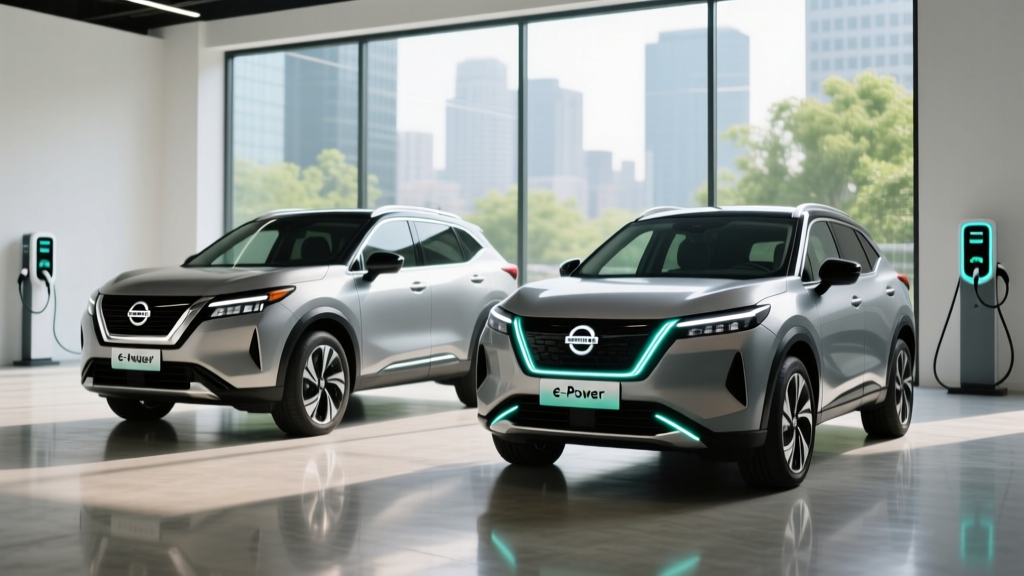
Yes. Nissan offers hybrid vehicles in the U.S. market for 2026, but not in the way most buyers expect. Rather than a conventional parallel hybrid like the Toyota RAV4 Hybrid, Nissan uses its proprietary e-Power series-hybrid system — where a gasoline engine exclusively generates electricity while an electric motor drives the wheels at all times. The result is an EV-like driving feel without a plug.
As of the 2026 model year, the Nissan lineup includes two e-Power models available in the United States: the Nissan Rogue e-Power (compact SUV) and the Nissan Kicks e-Power (subcompact crossover). Neither is a plug-in hybrid (PHEV), and neither qualifies for the federal §30D EV tax credit. But both deliver meaningful fuel-economy gains over their gas-only counterparts, particularly in city driving.
Below, we break down exactly how Nissan's e-Power system works, what real-world MPG you can expect, battery longevity, and whether a Nissan hybrid makes sense for your next purchase — or if a PHEV or full BEV is a better fit.
HEV vs PHEV vs BEV: Where Nissan Fits
Before diving into specs, it's essential to understand the three electrification categories — because Nissan occupies a specific niche.
| Feature | HEV (Conventional Hybrid) | PHEV (Plug-In Hybrid) | BEV (Battery Electric) |
|---|---|---|---|
| Plug-in charging? | No — refuels with gas only | Yes — plugs in + gas tank | Yes — plugs in only |
| Electric-only range | None (motor assists engine) | 20–50 miles typical | 200–400+ miles |
| Battery size | 0.5–2.0 kWh | 10–25 kWh | 50–120+ kWh |
| Federal tax credit (§30D) | Not eligible | Up to $7,500 (if criteria met) | Up to $7,500 (if criteria met) |
| Nissan example (2026) | Rogue e-Power, Kicks e-Power | None currently offered | Leaf, Ariya |
Nissan's e-Power system is technically a series hybrid (HEV). The gasoline engine never mechanically drives the wheels — it acts solely as an onboard generator, producing electricity that either charges the small lithium-ion battery or feeds the electric drive motor directly. This architecture gives Nissan hybrids their signature EV-like torque delivery and one-pedal driving capability, while still relying entirely on gasoline for energy.
2026 Nissan Rogue e-Power: Specs, MPG, and Pricing
The Rogue e-Power is Nissan's highest-volume hybrid offering. It slots into the compact SUV segment against the Toyota RAV4 Hybrid, Honda CR-V Hybrid, and Hyundai Tucson Hybrid — though its series-hybrid architecture makes its driving character distinctly different.
| Specification | Detail |
|---|---|
| Powertrain | 1.5L VC-Turbo 3-cyl generator + front electric motor |
| Combined system output | 201 hp / 225 lb-ft torque (motor-driven) |
| Drivetrain | FWD standard; e-Power AWD available (dual-motor) |
| Battery capacity | ~1.8 kWh lithium-ion (buffer-type, not plug-in) |
| EPA MPG (combined) | 37 MPG combined (FWD); 36 MPG (AWD) |
| EPA city / highway | 39 city / 35 highway (FWD) |
| 0–60 mph | ~7.8 seconds (FWD) |
| Cargo volume | 36.5 cu ft (rear seats up) / 74.1 cu ft (folded) |
| Starting MSRP | ~$33,500 (SV e-Power trim) |
| Federal tax credit | Not eligible (HEV — not a PHEV or BEV) |
Real-World MPG: What to Actually Expect
The EPA rates the Rogue e-Power FWD at 39 city / 35 highway / 37 combined MPG (fueleconomy.gov). In real-world driving, the series-hybrid architecture creates an interesting split:
- City driving: Expect to meet or slightly exceed the 39 MPG city sticker. The electric motor handles stop-and-go efficiently, and the engine-generator only runs at its optimal RPM to replenish the small battery.
- Highway driving: Expect 32–34 MPG at sustained 70–75 mph speeds. Series hybrids lose some efficiency at constant high speeds compared to parallel hybrids (like the RAV4 Hybrid), because energy passes through an extra conversion step (mechanical → electrical → mechanical).
- Cold weather: Anticipate a 5–10% drop in winter months. The engine runs more frequently to maintain cabin heat and battery temperature, reducing its optimal-RPM efficiency.
Overall real-world expectation: 33–37 MPG combined, depending on your city/highway mix and climate. That's a meaningful improvement over the gas-only Rogue's 30 MPG combined, but falls slightly short of the RAV4 Hybrid's 41 MPG combined.
2026 Nissan Kicks e-Power: Specs, MPG, and Pricing
The redesigned Kicks e-Power brings Nissan's series-hybrid system to the subcompact crossover segment — a price-sensitive category where fuel economy matters more than ever.
| Specification | Detail |
|---|---|
| Powertrain | 1.2L 3-cyl generator + front electric motor |
| Combined system output | 134 hp / 206 lb-ft torque (motor-driven) |
| Drivetrain | FWD standard; e-Power AWD available |
| Battery capacity | ~1.5 kWh lithium-ion (buffer-type) |
| EPA MPG (combined) | 40 MPG combined (FWD) |
| EPA city / highway | 42 city / 38 highway (FWD) |
| 0–60 mph | ~9.2 seconds |
| Cargo volume | 25.3 cu ft (rear seats up) / 54.0 cu ft (folded) |
| Starting MSRP | ~$25,500 (SV e-Power trim) |
| Federal tax credit | Not eligible (HEV) |
The Kicks e-Power's smaller engine and lighter platform yield stronger MPG numbers than the Rogue. In city-heavy commutes, owners have reported hitting 43–45 MPG in moderate temperatures — a genuine advantage for urban drivers who rack up miles in stop-and-go traffic.
How Nissan's e-Power System Actually Works
Nissan's e-Power is fundamentally different from the parallel-hybrid systems used by Toyota, Honda, and Hyundai. Here's the critical distinction:
This architecture delivers several driving characteristics that parallel hybrids can't match:
- Instant torque from stop: The electric motor provides full torque at zero RPM, giving brisk, linear acceleration off the line.
- One-pedal driving (e-Pedal): Lift off the accelerator and regenerative braking slows the vehicle significantly — enough for most city stops without touching the brake pedal.
- Quiet operation at low speeds: At parking-lot speeds or in EV mode, the engine stays off entirely, running on battery alone for short distances.
- No range anxiety: You refuel at any gas station. The ~13-gallon tank in the Rogue gives roughly 480 miles of total range.
The trade-off is highway efficiency. Because energy must convert from mechanical (engine) to electrical (generator) and back to mechanical (motor), there's an inherent efficiency loss at sustained high speeds — where a parallel hybrid can simply lock the engine to the wheels via a direct mechanical connection.
Battery Warranty, Reliability, and Replacement Cost
Longevity Expectations
Because e-Power uses a small buffer battery (1.5–1.8 kWh) that cycles shallowly — never fully depleting or fully charging — degradation is minimal compared to a full BEV battery. The battery operates in a narrow state-of-charge window (roughly 40–80%), which is the least stressful range for lithium-ion chemistry.
Based on Nissan's e-Power track record in Japan (where the system launched in 2016 on the Note e-Power) and Toyota's comparable hybrid data, expect the e-Power battery to last well beyond 150,000 miles before any meaningful capacity loss. Many first-generation Toyota Prius hybrid batteries exceeded 200,000 miles with original packs.
Battery Replacement Cost
If replacement is needed out of warranty, the e-Power battery pack is substantially cheaper than a full EV battery. Expect $2,000–$3,500 for the battery module itself, plus labor. This is a fraction of the $10,000–$20,000+ cost associated with BEV battery replacements — another advantage of the small-buffer HEV approach.
The 1.5L VC-Turbo generator engine in the Rogue follows standard Nissan powertrain maintenance intervals. Because the engine operates at optimal RPM rather than varying with vehicle speed, internal wear may actually be lower than a conventional gas engine. Nissan's powertrain warranty covers the engine for 5 years / 60,000 miles.
Tax Credits and Incentives: What You Actually Get
This is where Nissan's HEV strategy faces a headwind. Under current IRS §30D Clean Vehicle Credit rules:
- Conventional hybrids (HEVs) do not qualify for the federal $7,500 tax credit. The credit applies only to plug-in electric vehicles (PHEVs and BEVs) with a battery capacity of at least 7 kWh.
- The Nissan Rogue e-Power's ~1.8 kWh battery is well below the 7 kWh threshold.
- Nissan does not currently sell a PHEV in the U.S. market.
| Model | Type | Battery kWh | §30D Credit Eligible? |
|---|---|---|---|
| Rogue e-Power | HEV | ~1.8 kWh | No |
| Kicks e-Power | HEV | ~1.5 kWh | No |
| Leaf | BEV | 40–60 kWh | Potentially (subject to sourcing rules) |
| Ariya | BEV | 63–91 kWh | Potentially (subject to sourcing rules) |
Some states offer separate hybrid incentives or HOV-lane access for HEVs, but these vary widely by jurisdiction. Check your state's energy office or DMV for current programs. Nissan dealers may also offer manufacturer rebates on e-Power models — ask about current incentives at purchase time.
Nissan Hybrid vs. the Competition
The Rogue e-Power doesn't exist in a vacuum. Here's how it stacks up against the segment benchmarks:
| Model | Type | EPA Combined MPG | HP | Starting MSRP | §30D Credit |
|---|---|---|---|---|---|
| Nissan Rogue e-Power | Series HEV | 37 MPG | 201 hp | ~$33,500 | No |
| Toyota RAV4 Hybrid | Parallel HEV | 41 MPG | 219 hp | ~$32,700 | No |
| Honda CR-V Hybrid | Parallel HEV | 40 MPG | 204 hp | ~$34,600 | No |
| Hyundai Tucson PHEV | PHEV | 38 MPG + 33 mi electric | 261 hp | ~$39,500 | Up to $7,500 |
| Toyota RAV4 Prime | PHEV | 38 MPG + 42 mi electric | 302 hp | ~$44,500 | Up to $7,500 |
The Rogue e-Power's advantage isn't raw MPG — the RAV4 Hybrid and CR-V Hybrid both edge it out. Instead, Nissan's selling points are the EV-like driving character (instant torque, one-pedal regen, quiet low-speed operation) and the availability of the e-Power system at a competitive price point without the premium of a PHEV.
Pros
- EV-like instant torque and one-pedal driving
- No plug-in required — gas station convenience
- 37 MPG combined (Rogue); 40 MPG (Kicks)
- Competitive starting price
- Strong 8yr/100k hybrid battery warranty
- Low battery replacement cost ($2k–$3.5k)
Cons
- Highway MPG trails RAV4/CR-V Hybrid by 4–6 MPG
- No federal tax credit eligibility
- No PHEV option in Nissan's U.S. lineup
- Engine generator noise under hard acceleration
- Slightly higher MSRP than gas-only Rogue
Who Should Buy a Nissan Hybrid — And Who Shouldn't
Decision Framework
Choose the Nissan Rogue or Kicks e-Power if:
- You drive mostly in the city or suburbs (stop-and-go maximizes series-hybrid efficiency)
- You want an EV-like driving feel but can't install a home charger
- You live in an apartment or lack reliable charging access
- You want lower fuel costs without the upfront premium of a PHEV
- You plan to keep the vehicle 8+ years (warranty covers the hybrid system)
Look at a PHEV (RAV4 Prime, Tucson PHEV) instead if:
- You can charge at home and want 30–40 miles of daily electric-only driving
- You want to qualify for the $7,500 federal tax credit
- Your commute is under 40 miles round-trip (you could rarely use gas)
Consider a full BEV (Leaf, Ariya, Ioniq 5) if:
- You have reliable home Level 2 charging
- You want zero tailpipe emissions and the lowest per-mile fuel cost
- Your daily driving is under 250 miles and you road-trip infrequently
- You want maximum federal and state incentives
Frequently Asked Questions
How many MPG does the Nissan hybrid get?
The 2026 Nissan Rogue e-Power is EPA-rated at 39 city / 35 highway / 37 combined MPG (FWD). The smaller Kicks e-Power achieves 42 city / 38 highway / 40 combined MPG. In real-world city driving, expect to meet or slightly exceed these numbers; on sustained highway trips, expect 2–4 MPG below the highway sticker.
Does Nissan make a plug-in hybrid?
Not in the U.S. market as of 2026. Nissan's electrified strategy centers on e-Power series hybrids (HEVs) and full battery-electric vehicles (Leaf, Ariya). If you want plug-in capability with a gas backup, you'll need to look at competitors like the Toyota RAV4 Prime or Hyundai Tucson PHEV.
Do I need to plug in a Nissan e-Power hybrid?
No. The Nissan e-Power system is a conventional hybrid (HEV). You refuel exclusively at gas stations. The small lithium-ion battery charges through regenerative braking and the onboard engine-generator — it has no plug and no electric-only driving range beyond a few hundred yards at very low speeds.
Is the Nissan hybrid system reliable?
Nissan's e-Power system has been in production since 2016 (Japan market) and has accumulated billions of real-world miles. The series-hybrid architecture is mechanically simpler than a parallel hybrid — no complex transmission, no clutch engagement between engine and wheels. The 8-year/100,000-mile hybrid system warranty (10yr/150k in CARB states) provides strong coverage, and battery replacement costs are relatively low at $2,000–$3,500.
Does the Nissan Rogue hybrid qualify for any tax credit?
No. Under IRS §30D rules, the federal Clean Vehicle Credit applies only to plug-in electric vehicles (PHEVs and BEVs) with battery capacity of at least 7 kWh. The Rogue e-Power's ~1.8 kWh battery does not meet this threshold. Some states may offer separate incentives for hybrid vehicles — check your state's energy office for current programs.
What's the difference between Nissan e-Power and Toyota's hybrid system?
Toyota uses a parallel hybrid system (Hybrid Synergy Drive) where both the engine and electric motor can mechanically drive the wheels through a planetary gearset. Nissan's e-Power is a series hybrid where only the electric motor drives the wheels — the engine acts solely as a generator. This gives Nissan a smoother, more EV-like feel but sacrifices some highway efficiency compared to Toyota's direct mechanical coupling.
How far can the Nissan hybrid go on a full tank?
The Rogue e-Power has a ~13.2-gallon fuel tank, yielding approximately 488 miles of total range at the EPA combined rating of 37 MPG. The Kicks e-Power, with its ~11.5-gallon tank and 40 MPG combined, delivers roughly 460 miles between fill-ups.
Sources: EPA Fuel Economy, IRS §30D Clean Vehicle Credit, Nissan USA.