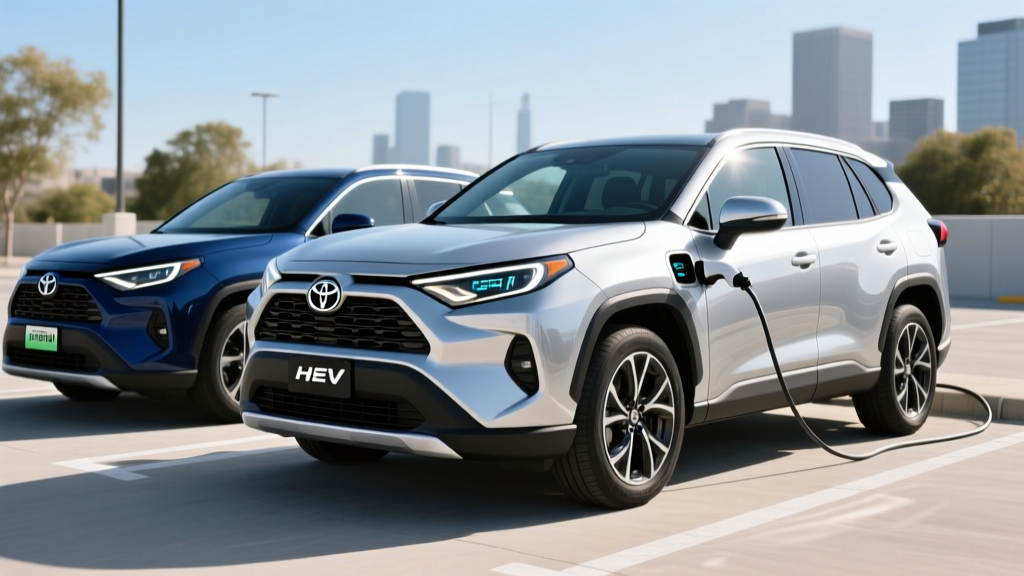
If you're researching the new Toyota RAV4 Hybrid for the 2026 model year, you're looking at one of the most proven and best-selling electrified SUVs in the United States. Toyota has offered a hybrid RAV4 since 2016, and the current generation pairs a 2.5-liter four-cylinder engine with electric motors for exceptional city efficiency and standard all-wheel drive. But there's a critical fork in the road: the conventional RAV4 Hybrid (HEV) and the plug-in RAV4 Prime (PHEV). They share a nameplate and a platform, but their powertrains, fuel economy, pricing, and tax-credit eligibility diverge significantly.
This guide breaks down the exact EPA numbers, real-world expectations, battery longevity, and ownership math for both versions of the 2026 RAV4 Hybrid lineup — so you can choose the one that actually fits your driving pattern and budget.
HEV vs PHEV: Which RAV4 Hybrid Is Which?
The terminology trips up a lot of first-time hybrid buyers, so let's clarify it up front:
RAV4 Hybrid (HEV)
A conventional hybrid. It has a small battery (~1.6 kWh) that charges itself through regenerative braking and the gasoline engine. You never plug it in. It cannot drive on electric power alone for more than a mile or two at very low speeds. The electric motors assist the engine to dramatically reduce fuel consumption, especially in stop-and-go city driving.
RAV4 Prime (PHEV)
A plug-in hybrid. It carries a much larger battery (~18.1 kWh usable) that you charge via a wall outlet or Level 2 charger. It can drive up to 42 miles on electricity alone before the gas engine kicks in. Once the battery is depleted, it operates exactly like a conventional hybrid. You can plug it in — and should, to capture the full efficiency benefit — but it still runs fine on gas alone.
The distinction matters for your daily routine, your fuel budget, and whether you qualify for a federal tax credit. Let's get into the numbers.
Fuel Economy: EPA Ratings and Real-World MPG
The 2026 RAV4 Hybrid carries over the proven 2.5-liter Dynamic Force engine paired with Toyota's eAWD system (a rear-mounted electric motor providing electronic all-wheel drive). Here's how the EPA rates both versions:
| Model | City MPG | Highway MPG | Combined MPG | Electric-Only Range | Total Range |
|---|---|---|---|---|---|
| RAV4 Hybrid (HEV) LE/XLE | 41 | 38 | 40 | N/A | ~570 mi |
| RAV4 Hybrid (HEV) Woodland Ed. | 38 | 35 | 37 | N/A | ~530 mi |
| RAV4 Prime (PHEV) | 40 MPG (hybrid mode) | 36 MPG (hybrid mode) | 38 MPG (hybrid mode) | 42 mi | ~600 mi |
| RAV4 Prime (PHEV) MPGe | 94 MPGe (combined, electric+gas) | 42 mi | ~600 mi | ||
Source: EPA Fuel Economy
Real-World MPG vs. the EPA Sticker
Toyota hybrids have a well-documented tendency to exceed their EPA city rating in real-world driving. The EPA city test cycle involves frequent stops, which is exactly where regenerative braking recaptures the most energy. In our experience and in owner-reported data from communities like Fuelly, the RAV4 Hybrid HEV routinely returns 42-44 MPG in mixed suburban driving with moderate stop-and-go traffic.
Highway driving is a different story. At sustained 70-80 mph speeds, the electric motors contribute less and the 2.5-liter engine does the heavy lifting. Expect 35-37 MPG on flat interstate runs, and potentially 33-34 MPG if you're driving into headwinds, climbing grades, or running the A/C hard in summer heat. Cold weather (below 30°F) typically knocks 3-5 MPG off combined figures because the engine runs more often to generate cabin heat and warm up the catalytic converter.
For the RAV4 Prime, the 42-mile electric-only range is EPA-verified and generally achievable in mild weather at speeds under 65 mph. In winter, expect that to drop to 32-36 miles due to battery chemistry limitations and cabin heating demands. Once the battery is depleted, the Prime returns roughly 36-38 MPG in hybrid mode — slightly less than the standard HEV because it's hauling an extra ~300 lbs of battery mass.
Powertrain Specs: Horsepower, Engines, and Motors
| Specification | RAV4 Hybrid (HEV) | RAV4 Prime (PHEV) |
|---|---|---|
| Engine | 2.5L 4-cyl Dynamic Force | 2.5L 4-cyl Dynamic Force |
| Engine HP | 176 hp | 177 hp |
| Front Electric Motor | 88 kW (118 hp) | 134 kW (180 hp) |
| Rear Electric Motor (eAWD) | 40 kW (54 hp) | 40 kW (54 hp) |
| Net Combined System HP | 219 hp | 302 hp |
| 0-60 mph | ~7.4 seconds | ~5.7 seconds |
| Drivetrain | eAWD (standard) | eAWD (standard) |
| Transmission | eCVT | eCVT |
| Battery Capacity | ~1.6 kWh (NiMH) | ~18.1 kWh usable (Li-ion) |
| Towing Capacity | 1,750 lbs | 2,500 lbs |
The Prime's 302 combined horsepower makes it one of the quickest compact SUVs in its class — gas, hybrid, or electric. That 5.7-second 0-60 time is genuinely quick for a family crossover, and the instant electric torque makes it feel even more responsive in daily driving than the number suggests.
Charging the RAV4 Prime: What PHEV Buyers Need to Know
The conventional RAV4 Hybrid (HEV) requires no charging whatsoever. You fuel it like any other car, and the hybrid system handles the rest.
The RAV4 Prime, however, benefits enormously from regular plug-in charging. Here's the charging breakdown:
| Charging Level | Power (kW) | 0-100% Time | Notes |
|---|---|---|---|
| Level 1 (120V household outlet) | ~1.4 kW | ~12 hours | Included charging cord; overnight top-up |
| Level 2 (240V, standard trim) | 3.3 kW | ~5.5 hours | SE trim; requires J1772 outlet or home charger |
| Level 2 (240V, XSE Premium) | 6.6 kW | ~2.5 hours | XSE with Premium package; faster onboard charger |
| DC Fast Charging | Not supported | N/A | No DC fast-charge port on RAV4 Prime |
Critical detail: The RAV4 Prime does not support DC fast charging. This is typical for PHEVs — the battery is small enough that Level 2 charging fully replenishes it in a few hours, and adding DC fast-charge hardware would increase cost and weight for minimal benefit. If your daily commute falls within the 42-mile electric range and you can charge at home overnight, you may go months between gas station visits.
For home Level 2 charging, a standard 240V NEMA 14-50 outlet installed by a licensed electrician typically costs $500-$1,500 depending on panel proximity and local permit requirements. A dedicated Level 2 EVSE (like a ChargePoint Home Flex or Emporia V2) runs $350-$700 for the unit itself.
Pricing, Trims, and Tax Credit Eligibility
Here's where the two RAV4 Hybrid variants diverge sharply:
| Model / Trim | 2026 MSRP (est.) | Federal Tax Credit |
|---|---|---|
| RAV4 Hybrid LE | ~$33,500 | None (HEV — not eligible under §30D) |
| RAV4 Hybrid XLE | ~$35,500 | None |
| RAV4 Hybrid XLE Premium | ~$37,800 | None |
| RAV4 Hybrid Woodland Edition | ~$37,200 | None |
| RAV4 Hybrid Limited | ~$40,500 | None |
| RAV4 Prime SE | ~$45,500 | Up to $7,500 (subject to eligibility) |
| RAV4 Prime XSE | ~$49,000 | Up to $7,500 (subject to eligibility) |
Source: Toyota RAV4 Hybrid official specifications. Pricing is estimated based on current model-year trends and may vary at time of purchase.
Federal Tax Credit Rules for the RAV4 Prime (§30D)
The conventional RAV4 Hybrid (HEV) does not qualify for the federal §30D Clean Vehicle Credit — that credit is reserved for plug-in electric vehicles with a minimum battery capacity of 7 kWh. The RAV4 Prime, with its 18.1 kWh battery, meets that threshold.
However, the full $7,500 credit is not automatic. Under current IRS rules, you must satisfy multiple requirements:
- Income caps: Modified AGI must not exceed $150,000 (single), $225,000 (head of household), or $300,000 (married filing jointly).
- MSRP cap: The vehicle's MSRP must not exceed $80,000 for SUVs — the RAV4 Prime clears this easily.
- Battery sourcing: A percentage of critical minerals and battery components must be sourced from the U.S. or free-trade-agreement countries. The credit splits into two halves ($3,750 for minerals, $3,750 for components), and you may qualify for only one half depending on the model year's supply chain.
- Point-of-sale transfer: As of 2024, you can transfer the credit to the dealer at purchase for an immediate price reduction, rather than waiting to claim it on your tax return.
- New vehicle: Must be purchased new; leased vehicles fall under a different commercial credit (§45W) that may pass savings through the lessor.
Always verify current-year eligibility at IRS.gov Clean Vehicle Credits and consult a tax professional before relying on the credit in your purchase decision. Sourcing requirements tighten annually.
Battery Longevity, Warranty, and Replacement Costs
Battery durability is the single most common concern among first-time hybrid buyers — and it's the area where Toyota has the longest track record in the industry.
Toyota Hybrid Battery Warranty
Coverage: 10 years / 150,000 miles (whichever comes first) for the hybrid battery on all 2020-and-newer Toyota hybrids, including the RAV4 Hybrid and RAV4 Prime.
What's covered: Battery capacity loss below a defined threshold, manufacturing defects, and related hybrid system components (inverter, electric motors, control module).
Transferable: Yes — the warranty transfers to subsequent owners at no cost.
Real-World Battery Longevity
Toyota's hybrid batteries are engineered conservatively. The HEV's small NiMH pack never sees deep discharge cycles — the hybrid system keeps it between roughly 40% and 80% state of charge at all times, which dramatically extends cycle life. It's common for Toyota hybrid batteries to last 15-20 years or 200,000+ miles without significant degradation. Taxi fleets using Toyota hybrids routinely report original batteries surviving past 300,000 miles.
The RAV4 Prime's larger lithium-ion battery operates under similar protective management — Toyota limits the usable window to ~18.1 kWh out of a gross capacity of ~22 kWh, maintaining a top and bottom buffer to prevent stress. Under normal use, expect minimal degradation over the first 10 years.
Battery Replacement Cost
If you do need an out-of-warranty replacement:
- RAV4 Hybrid (HEV) battery: $2,000-$4,000 for a refurbished or new unit, plus ~$500-$1,000 in labor. Independent hybrid specialists often offer lower prices than dealerships.
- RAV4 Prime (PHEV) battery: $8,000-$12,000+ for the larger lithium-ion pack, plus labor. This is significantly more expensive due to the larger capacity and more complex chemistry.
Given the 10-year/150,000-mile warranty and Toyota's historical reliability data, the probability of needing a battery replacement during typical first- or second-ownership periods is very low. IIHS and J.D. Power consistently rate the RAV4 Hybrid among the most reliable vehicles in its segment.
Who Should Choose the RAV4 Hybrid vs. an EV or Gas Car?
Choose the RAV4 Hybrid (HEV) if:
- You want maximum fuel savings with zero lifestyle changes — no charging, no plug, no range planning.
- You live in an apartment or lack access to home charging, making a PHEV or full EV impractical.
- Your budget is $33,000-$41,000 and you want a proven, reliable compact SUV with low running costs.
- You drive 12,000-15,000 miles/year and want to save roughly $800-$1,200/year in fuel vs. a comparable gas-only SUV.
Choose the RAV4 Prime (PHEV) if:
- You can charge at home (garage or driveway with a 120V or 240V outlet) and your daily commute is under 40 miles round-trip.
- You want to drive mostly on electricity for daily errands but still need a gas engine for road trips without charging-infrastructure anxiety.
- You value the 302 hp performance upgrade — the Prime is genuinely quick.
- You qualify for the federal tax credit, which can bring the effective price gap between the Prime and HEV down to $4,000-$8,000.
Choose a Full EV (BEV) instead if:
- You have reliable home Level 2 charging and want to eliminate gasoline entirely.
- Your daily driving is predictable, and you're comfortable planning around DC fast charging on road trips.
- You want the lowest per-mile fuel cost (electricity at $0.13/kWh averages ~$0.04/mile vs. the RAV4 Hybrid at ~$0.09/mile at $3.50/gal).
- You're considering models like the Tesla Model Y, Hyundai Ioniq 5, or Toyota bZ4X and want zero tailpipe emissions.
Pros and Cons at a Glance
Pros
- Class-leading city fuel economy (41 MPG HEV; 94 MPGe Prime)
- Standard eAWD on every trim — no FWD-only base model
- 10-year / 150,000-mile hybrid battery warranty
- RAV4 Prime's 302 hp and 5.7-second 0-60 are best-in-class
- Strong resale value — RAV4 Hybrids hold value better than most competitors
- Proven, mature hybrid technology with massive service network
- Prime qualifies for up to $7,500 federal tax credit (eligibility-dependent)
Cons
- HEV does not qualify for any federal tax credit
- RAV4 Prime has limited availability — high demand often means dealer markups
- Prime does not support DC fast charging
- Highway MPG drops noticeably at 75+ mph (expect 33-37 MPG)
- Infotainment system trails competitors in responsiveness and UI polish
- Cargo space slightly reduced in Prime due to larger battery (~33.5 cu ft vs. 37.6 cu ft in HEV)
- No third-row option — if you need 7 seats, look at the Highlander Hybrid
Frequently Asked Questions
How many MPG does the new Toyota RAV4 Hybrid get?
The 2026 RAV4 Hybrid (HEV) is EPA-rated at 41 city / 38 highway / 40 combined MPG on LE and XLE trims. In real-world suburban driving with moderate stops, owners frequently report 42-44 MPG. Highway-only driving at 75+ mph drops to roughly 35-37 MPG. The Woodland Edition, with its all-terrain tires, rates slightly lower at 38/35/37 MPG.
How far can the RAV4 Prime go on electric only?
The RAV4 Prime delivers an EPA-rated 42 miles of electric-only range on a full charge. This is sufficient for most daily commutes and errands. In cold weather (below 30°F), expect 32-36 miles due to reduced battery efficiency and cabin heating demands. Once the battery is depleted, the Prime operates as a conventional hybrid at roughly 38 MPG combined.
Does the RAV4 Hybrid qualify for a federal tax credit?
The conventional RAV4 Hybrid (HEV) does not qualify for the federal §30D Clean Vehicle Credit — it is not a plug-in vehicle. The RAV4 Prime (PHEV) may qualify for up to $7,500, depending on your income, the vehicle's battery sourcing compliance, and current IRS rules. Check IRS.gov for the latest eligibility requirements and consider consulting a tax professional.
Is the RAV4 Hybrid reliable, and what does a battery replacement cost?
The RAV4 Hybrid has an excellent reliability record, backed by Toyota's 10-year/150,000-mile hybrid battery warranty. Real-world data shows Toyota hybrid batteries commonly lasting 200,000+ miles without significant issues. An out-of-warranty HEV battery replacement runs $2,000-$4,000; the Prime's larger lithium-ion pack costs $8,000-$12,000+. The probability of needing replacement during the warranty period is very low based on historical data.
Hybrid vs. PHEV vs. EV — which is right for me?
Choose the HEV if you want fuel savings with no charging hassle and no access to home charging. Choose the Prime PHEV if you can charge at home, have a commute under 42 miles, and want electric daily driving with gas-engine backup for road trips. Choose a full EV if you want the lowest per-mile fuel cost, have home Level 2 charging, and are comfortable with DC fast charging on longer trips. The RAV4 Hybrid HEV is the safest choice for buyers who want simplicity; the Prime is the bridge to full electrification.
Do I need to plug in the RAV4 Hybrid?
No. The conventional RAV4 Hybrid (HEV) charges its own battery through regenerative braking and the gasoline engine. You never plug it in — just fill up with gas as normal. Only the RAV4 Prime (PHEV) benefits from plug-in charging, and even the Prime can operate solely on gasoline if you don't charge it (though you'd miss the efficiency and cost benefits of electric-only driving).