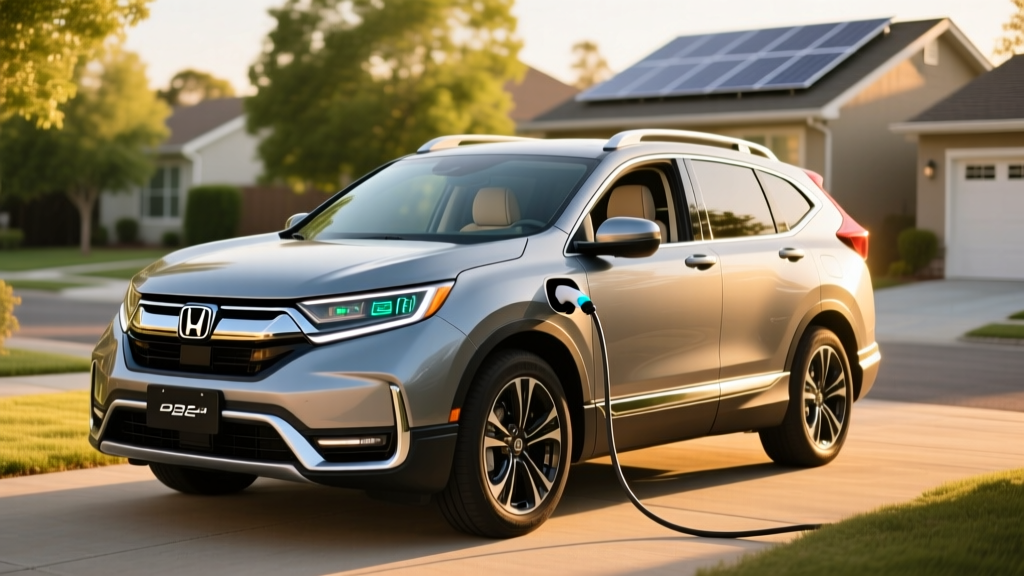
If you have been searching for a new Honda CR-V Hybrid, you are looking at one of the best-selling electrified SUVs in America — and for good reason. The CR-V Hybrid pairs a proven two-motor system with a 2.0-liter Atkinson-cycle engine to deliver exceptional city fuel economy without requiring you to change your driving habits or install a home charger. But with multiple trims, a front-wheel-drive option that pushes efficiency even higher, and a price that creeps into premium territory at the top end, buyers need to know exactly what they are getting.
This guide covers the 2026 Honda CR-V Hybrid lineup with the exact EPA numbers, real-world fuel economy expectations, powertrain details, pricing, and battery longevity data you need to make a confident decision.
EPA Fuel Economy: What the Numbers Actually Say
The CR-V Hybrid is available with either front-wheel drive (FWD) or all-wheel drive (AWD), and the drivetrain choice meaningfully affects efficiency. Here is the full EPA breakdown from fueleconomy.gov:
| Drivetrain | City MPG | Highway MPG | Combined MPG | Annual Fuel Cost* |
|---|---|---|---|---|
| FWD (Sport, Sport-L) | 43 | 36 | 40 | ~$1,550 |
| AWD (Sport, Sport-L, Sport Touring) | 40 | 34 | 37 | ~$1,675 |
*Based on 15,000 miles/year at $3.50/gallon. Your actual cost varies with local fuel prices and driving patterns.
Real-World MPG: City vs. Highway Reality
Hybrids excel in stop-and-go traffic, where regenerative braking recaptures energy and the electric motor handles low-speed propulsion. In real-world city driving, many CR-V Hybrid owners report matching or even slightly exceeding the EPA city rating of 40–43 MPG. The frequent braking events keep the battery charged, and the engine shuts off at stops entirely.
Highway driving tells a different story. At sustained speeds above 70 mph, the gasoline engine does most of the work, and aerodynamic drag dominates. Expect real-world highway fuel economy in the 32–35 MPG range for AWD models — roughly matching the EPA sticker but not the city advantage. On a 400-mile road trip at 75 mph, plan for approximately 12 gallons of fuel rather than the 11 gallons the EPA highway number might suggest.
Cold-weather note: In temperatures below freezing, expect a 10–15% reduction in fuel economy as the engine runs more frequently to generate cabin heat and warm the catalytic converter. This is normal hybrid behavior, not a defect.
Hybrid vs. PHEV vs. Full EV: Which CR-V Fits You?
Honda currently sells the CR-V Hybrid as a conventional hybrid (HEV). It does not plug in. There is no plug-in hybrid (PHEV) variant of the CR-V in Honda's 2026 US lineup. Here is how the three electrified categories compare so you can decide which approach fits your lifestyle:
HEV vs. PHEV vs. EV at a Glance
| Factor | CR-V Hybrid (HEV) | Typical PHEV SUV | Full EV SUV |
|---|---|---|---|
| Plugs in? | No | Yes (optional) | Yes (required) |
| Electric-only range | ~1 mile at low speed | 25–40 miles | 250–350 miles |
| Home charger needed? | No | Recommended | Essential |
| Fuel/energy cost per mile | ~$0.10 (gas) | ~$0.04 (electric) / $0.10 (gas) | ~$0.04 (electric) |
| Tailpipe emissions | Yes | Yes (when engine runs) | None |
| Federal tax credit (§30D) | Not eligible | Up to $7,500 (if eligible) | Up to $7,500 (if eligible) |
Choose the CR-V Hybrid if: You want dramatically better fuel economy than a gas car without changing your fueling routine, you lack access to home or workplace charging, or you take frequent long road trips where charging infrastructure is sparse.
Consider a PHEV or full EV if: You have reliable home Level 2 charging, your daily commute is under 30 miles (making a PHEV's electric-only range sufficient), and you want to minimize or eliminate gasoline use and qualify for federal tax incentives.
Powertrain: How the Two-Motor System Works
The 2026 CR-V Hybrid uses Honda's fourth-generation two-motor hybrid system. Here are the specifications:
| Specification | Detail |
|---|---|
| Engine | 2.0L DOHC Atkinson-cycle 4-cylinder |
| Engine output | 145 hp @ 6,100 rpm / 134 lb-ft torque |
| Electric motors | Two-motor system (propulsion + generator) |
| Combined system output | 204 hp / 247 lb-ft torque |
| Transmission | Electronic continuously variable (eCVT) |
| 0–60 mph | ~7.6 seconds (AWD) |
| Drivetrain options | FWD or Real-Time AWD™ |
| Towing capacity | 1,000 lbs (all trims) |
The system operates primarily in electric-drive mode at low and moderate speeds, where the propulsion motor moves the vehicle and the engine acts as a generator. At highway cruising speeds, a lock-up clutch connects the engine directly to the wheels for efficiency. The transition between modes is seamless and largely imperceptible from the driver's seat.
The 247 lb-ft of torque from the electric motor is available immediately, which gives the CR-V Hybrid a responsive, punchy feel around town that belies its 7.6-second 0–60 time. Passing maneuver on two-lane roads are confident.
Pricing and Trims: What You Will Actually Pay
The 2026 CR-V Hybrid is offered across three main trims, with the Sport and Sport-L available in FWD or AWD, and the Sport Touring exclusively AWD:
| Trim | Drivetrain | MSRP | Key Features |
|---|---|---|---|
| Sport | FWD | $35,850 | 18" wheels, 9" touchscreen, wireless Apple CarPlay/Android Auto, Honda Sensing suite |
| Sport | AWD | $37,350 | Same as FWD + Real-Time AWD |
| Sport-L | FWD | $38,450 | Leather-trimmed seats, power liftgate, heated front seats |
| Sport-L | AWD | $39,950 | Same as FWD + Real-Time AWD |
| Sport Touring | AWD | $42,350 | Bose 12-speaker audio, wireless charging, heated steering wheel, navigation, hands-free liftgate |
Destination charge: ~$1,395 additional. Prices reflect Honda's published MSRP; dealer pricing may vary.
Tax Credit Eligibility
The conventional CR-V Hybrid (HEV) does not qualify for the federal §30D Clean Vehicle Credit. That credit applies only to plug-in electric vehicles (PHEVs and BEVs) that meet battery sourcing, critical mineral, MSRP cap, and buyer income requirements per current IRS guidelines.
Some states and local utilities offer rebates for hybrid purchases, but these vary widely by jurisdiction. Check your state energy office and local utility for current programs. A tax professional can advise on any state-level tax benefits.
Battery Warranty, Longevity, and Replacement Cost
Hybrid battery longevity is consistently one of the top concerns for buyers moving from a conventional gas car. Honda addresses this with strong warranty coverage:
Honda CR-V Hybrid Battery Warranty
- Hybrid battery: 8 years / 100,000 miles (10 years / 150,000 miles in CARB states including CA, CO, CT, ME, MA, NJ, NY, OR, RI, VT, WA)
- Hybrid system components: 8 years / 100,000 miles
- Powertrain warranty: 5 years / 60,000 miles
- Limited vehicle warranty: 3 years / 36,000 miles
The warranty covers battery capacity loss below a defined threshold (typically around 60–70% of original capacity, per Honda's warranty documentation).
How Long Do CR-V Hybrid Batteries Actually Last?
Honda's hybrid system uses a relatively small lithium-ion battery pack (approximately 1.1 kWh usable). Because the system keeps the battery in a narrow state-of-charge window — typically between 40% and 80% — the cells experience far less stress than a full EV battery that cycles through its entire range daily.
Based on long-term data from Honda's hybrid lineup (including the Accord Hybrid and previous-generation CR-V Hybrid), most hybrid batteries last well beyond the warranty period. Failures before 150,000 miles are uncommon. Many owners report 200,000+ miles on the original battery with minimal degradation.
Battery Replacement Cost
If the hybrid battery does require replacement out of warranty, expect to pay between $2,000 and $4,000 for a new OEM battery pack including labor at a Honda dealership. Third-party remanufactured batteries are available for $1,200–$2,500 installed. This is significantly less than a full EV battery replacement, which can exceed $10,000–$15,000.
Who Should Buy the CR-V Hybrid — and Who Should Look Elsewhere
✓ Strong Fit
- Commuters with mixed city/highway driving who want 37–40 MPG without plugging in
- Apartment dwellers or renters without access to home charging
- Families who take regular road trips and need cargo space (36.3 cu ft behind rear seats, 76.5 cu ft folded)
- Buyers in snow-belt states who want AWD without the fuel penalty of a gas-only AWD SUV
- Those who plan to keep their vehicle 8–10+ years (strong reliability record, comprehensive hybrid warranty)
✗ Consider Alternatives
- Drivers who want zero tailpipe emissions — look at the Hyundai Ioniq 5, Tesla Model Y, or Ford Mustang Mach-E
- Those with home charging who want the lowest per-mile energy cost — a PHEV like the Toyota RAV4 Prime (42 miles electric-only) or a full EV saves more on fuel
- Heavy towing needs — the CR-V Hybrid's 1,000-lb tow rating is modest; the Toyota Highlander Hybrid or a truck-based PHEV may serve better
- Buyers seeking the federal $7,500 tax credit — the HEV does not qualify under §30D rules
Reliability and Safety Ratings
Honda's hybrid powertrain has earned a strong reliability reputation over multiple generations. The two-motor system has fewer wear components than a conventional automatic transmission — there is no torque converter, no traditional gear set, and no clutch packs to wear out. The eCVT is fundamentally simpler than a geared transmission.
For the 2026 model year, check the latest ratings from:
- IIHS (Insurance Institute for Highway Safety) — the CR-V has historically earned Top Safety Pick or Top Safety Pick+ ratings
- NHTSA (National Highway Traffic Safety Administration) — 5-star overall safety ratings are typical for the current generation
The Honda Sensing suite is standard on all trims and includes adaptive cruise control, lane-keeping assist, forward collision warning with automatic emergency braking, and traffic sign recognition. This is a Level 1 driver-assist system under SAE classification — it supports the driver but does not replace active steering and speed control.
Frequently Asked Questions
How many MPG does the new Honda CR-V Hybrid get?
The 2026 CR-V Hybrid FWD is EPA-rated at 43 city / 36 highway / 40 combined. The AWD version is rated at 40 city / 34 highway / 37 combined. In real-world city driving, many owners match or slightly exceed these numbers thanks to frequent regenerative braking. Highway fuel economy at sustained high speeds may drop 2–3 MPG below the EPA estimate.
Does the Honda CR-V Hybrid need to be plugged in?
No. The CR-V Hybrid is a conventional hybrid (HEV). It generates all its own electricity through regenerative braking and the gasoline engine. You fuel it exactly like a regular gas car — no charging cable, no home charger installation, no public charging network required.
Is there a plug-in hybrid (PHEV) version of the CR-V?
Not in the US market for 2026. Honda sells the CR-V exclusively as a conventional hybrid in America. If you want a compact SUV PHEV with electric-only range, the Toyota RAV4 Prime (42 miles EV range), Hyundai Tucson PHEV (33 miles), and Mitsubishi Outlander PHEV (38 miles) are the primary competitors. Note that Honda sells a CR-V e:PHEV in China and Europe, but it is not available in the United States.
Does the CR-V Hybrid qualify for any federal tax credit?
The conventional CR-V Hybrid does not qualify for the federal §30D Clean Vehicle Credit, which is limited to plug-in vehicles (PHEVs and BEVs) meeting battery sourcing and MSRP requirements. Some state and utility rebates may apply to hybrid purchases — check your local programs. Consult a tax professional for advice specific to your situation.
How long will the CR-V Hybrid battery last, and what does replacement cost?
Honda warranties the hybrid battery for 8 years / 100,000 miles (10 years / 150,000 miles in CARB states). Based on long-term data from Honda's hybrid fleet, most batteries last 150,000–200,000+ miles before significant degradation. Out-of-warranty replacement costs $2,000–$4,000 for an OEM pack or $1,200–$2,500 for a remanufactured unit installed.
How does the CR-V Hybrid compare to the Toyota RAV4 Hybrid?
Both are excellent choices. The RAV4 Hybrid AWD is EPA-rated at 41 city / 38 highway / 40 combined — slightly better highway efficiency than the CR-V AWD's 37 combined. The CR-V Hybrid offers a more refined interior, slightly more rear-seat legroom, and a more car-like driving feel. The RAV4 Hybrid has a higher tow rating (1,750 lbs vs. 1,000 lbs). Test-drive both and let the dealership pricing and your comfort preference decide.
Is the CR-V Hybrid good in snow?
The available Real-Time AWD system sends torque to the rear wheels when front-wheel slip is detected, providing confident traction in snow and rain. Combined with the hybrid system's smooth, electric-assisted torque delivery at low speeds, the CR-V Hybrid AWD performs well in winter conditions. Fit dedicated winter tires for best results in heavy snow.