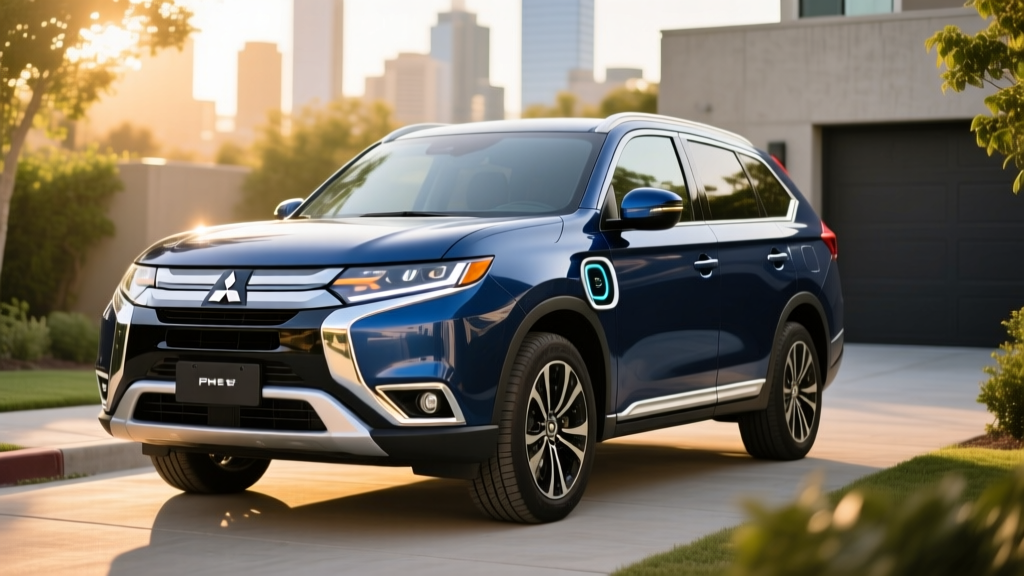
If you want a three-row plug-in hybrid SUV without paying luxury prices, the Mitsubishi Outlander PHEV remains one of the most accessible options on the market. For 2026, Mitsubishi continues to offer aggressive lease incentives on the Outlander PHEV, making it a compelling bridge between a conventional gas SUV and a full battery-electric vehicle. But lease deals are only as good as the vehicle underneath them. This guide breaks down exactly what you are getting — from electric-only range and charging speed to real-world fuel economy and tax credit eligibility — so you can evaluate any Outlander PHEV lease offer with confidence.
HEV vs PHEV: What the Outlander Plug-In Hybrid Actually Does
Before evaluating lease numbers, it is essential to understand what separates the Outlander PHEV from a conventional hybrid (HEV) like the Toyota RAV4 Hybrid.
| Feature | Conventional Hybrid (HEV) | Plug-In Hybrid (PHEV) |
|---|---|---|
| Plug-in charging | No — charges via engine and regen | Yes — plug in to access EV-only range |
| Electric-only range | 0–2 miles at low speed | 38 miles (Outlander PHEV EPA) |
| Battery size | ~1.0–1.6 kWh | 20.0 kWh usable (Outlander PHEV) |
| Federal tax credit | Not eligible | Up to $7,500 (subject to §30D rules) |
| Fuel economy after EV range | Consistent MPG always | 25 MPG combined (gas-only mode) |
The Outlander PHEV is a plug-in hybrid, meaning it has a substantially larger battery than a conventional hybrid and can be charged from an external power source. When fully charged, it drives up to 38 miles on electricity alone before the 2.4-liter gasoline engine engages. A conventional HEV, by contrast, never plugs in and offers only minimal electric assist. This distinction matters enormously for your daily commute and your fuel budget.
Outlander PHEV Powertrain and Performance Specs
The 2026 Outlander PHEV pairs a 2.4-liter Atkinson-cycle four-cylinder engine with twin electric motors — one on each axle — giving it standard all-wheel drive (what Mitsubishi calls S-AWC). Here is the complete spec breakdown:
| Specification | 2026 Outlander PHEV |
|---|---|
| Combined system horsepower | 248 hp |
| Gasoline engine | 2.4L I4 Atkinson (126 hp) |
| Front electric motor | 85 kW (114 hp) |
| Rear electric motor | 100 kW (134 hp) |
| Battery capacity (usable) | 20.0 kWh, lithium-ion (NMC) |
| EPA electric-only range | 38 miles |
| Total combined range (EV + gas) | ~420 miles |
| EPA MPGe (charge-sustaining + EV) | 64 MPGe |
| EPA MPG (gas-only mode) | 25 combined (24 city / 27 highway) |
| 0–60 mph | ~6.7 seconds |
| Drivetrain | Standard AWD (S-AWC) |
| Seating | Three rows / 7 passengers |
| Towing capacity | 1,500 lbs |
The combined 248 horsepower gives the Outlander PHEV confident acceleration, and the twin-motor AWD system provides genuine traction benefits in snow and rain without a mechanical driveshaft connecting the axles. The 6.7-second 0–60 time is respectable for a 4,800-pound SUV.
Charging: Speeds, Connectors, and the DC Fast Charge Advantage
One of the Outlander PHEV's most underrated features is its DC fast-charging capability — something many competing PHEVs lack. Here is how charging breaks down:
| Charging Level | Power | Time (0–100%) | Notes |
|---|---|---|---|
| Level 1 (120V household) | ~1.4 kW | ~14 hours | Emergency/trickle only |
| Level 2 (240V home/public) | ~3.7 kW (onboard charger limit) | ~5.5 hours | Ideal for overnight home charging |
| DC Fast Charge (CHAdeMO) | Up to ~22 kW | ~38 min (0–80%) | CHAdeMO connector; rare on PHEVs |
kW vs kWh reminder: kW (kilowatts) measures the rate of charging power — how fast energy flows into the battery. kWh (kilowatt-hours) measures the battery's total energy capacity. The Outlander's 20.0 kWh battery charged at 3.7 kW takes roughly 5.5 hours (20 ÷ 3.7 ≈ 5.4).
The CHAdeMO DC fast-charging port is a legacy connector standard that is being phased out in favor of CCS and NACS across the broader EV market. For a PHEV with a 20 kWh battery, DC fast charging is a convenience rather than a necessity — most owners will charge overnight on Level 2 and never need it. But if your commute exceeds the 38-mile EV range and you have access to a CHAdeMO station near your workplace, a midday top-up can extend your electric driving.
Real-World EV Range Expectation: The EPA rates the Outlander PHEV at 38 miles of electric-only range. In real-world driving, expect 32–36 miles in moderate temperatures with mixed city/highway use. In cold weather (below freezing), that figure can drop to 25–30 miles due to cabin heating demands and reduced battery efficiency. Highway-only driving at 70+ mph will also reduce EV range to roughly 28–32 miles.
Fuel Economy: EPA Numbers vs Real-World Results
| Driving Mode | City | Highway | Combined |
|---|---|---|---|
| Charge-depleting (EV + gas blended) | 64 MPGe (EPA) | ||
| Charge-sustaining (gas-only, battery depleted) | 24 MPG | 27 MPG | 25 MPG |
Understanding these two numbers is critical. The 64 MPGe figure applies when you start with a full battery and blend EV and gas driving over the first 38 miles. Once the battery depletes to its buffer threshold (roughly 10–12% State of Charge), the Outlander operates as a conventional hybrid, achieving 25 MPG combined.
Real-world MPG note: Plug-in hybrids typically exceed their EPA city MPG in stop-and-go traffic because regenerative braking recovers energy that would otherwise be lost. In our experience, city driving in gas-only mode can yield 26–28 MPG, while sustained highway driving at 75 mph may drop to 24–25 MPG. If you charge daily and commute under 38 miles, you may use almost no gasoline for weeks.
2026 Lease Pricing and Federal Tax Credit Impact
The 2026 Mitsubishi Outlander PHEV is available in four trims: ES, SE, SEL, and GT. Here is the MSRP landscape and how leasing interacts with federal incentives:
| Trim | MSRP (approx.) | Typical Lease Offer Range |
|---|---|---|
| ES (base) | $41,640 | $299–$379/mo, $2,500–$3,500 due at signing |
| SE | $44,240 | $339–$419/mo, $2,500–$3,999 due at signing |
| SEL | $47,840 | $389–$459/mo, $3,000–$4,500 due at signing |
| GT | $51,440 | $439–$519/mo, $3,500–$5,000 due at signing |
Note: Lease offers vary by region, dealer, credit tier, and current Mitsubishi Motors promotional programs. Always confirm current numbers with your local dealer.
How the Federal Tax Credit Works with Leasing
Under current IRS §30D rules, the Outlander PHEV may qualify for up to $7,500 in federal clean vehicle credits, but eligibility depends on several factors:
- MSRP cap: SUVs must have an MSRP at or below $80,000 (all Outlander PHEV trims qualify)
- Buyer income cap: Modified adjusted gross income must not exceed $150,000 (single), $225,000 (head of household), or $300,000 (joint filers)
- Battery sourcing: A percentage of critical minerals and battery components must meet North American sourcing requirements — this percentage increases annually, and eligibility can change mid-year
- Point-of-sale transfer: The credit can be transferred to the dealer at purchase, reducing the sale price directly
The leasing advantage: When you lease a vehicle, the tax credit technically goes to the lessor (the financing company), not to you. However, most manufacturers — Mitsubishi included — typically pass the credit value through as a "lease cash" or "capital cost reduction" incentive, effectively lowering your monthly payment. This means that even buyers whose income exceeds the §30D cap can often benefit from the credit when leasing. Confirm with your dealer that the lease cash is being applied to your specific deal.
For the most current sourcing and eligibility details, check fueleconomy.gov and consult a tax professional.
Battery Warranty, Reliability, and Replacement Costs
Mitsubishi PHEV Battery Warranty: 10 years / 100,000 miles (whichever comes first) for the high-voltage traction battery, with a capacity retention threshold of approximately 70%. If the battery degrades below this level within the warranty period, Mitsubishi will repair or replace it at no cost.
The Outlander PHEV benefits from Mitsubishi's long-standing warranty coverage, which is among the best in the segment. The 10-year/100,000-mile powertrain and battery warranty provides meaningful peace of mind for a vehicle you may lease for 36 months and then decide to purchase.
Reliability context: Mitsubishi's PHEV system has been in production since 2013 (first in the original Outlander PHEV), giving it one of the longest track records of any plug-in hybrid SUV. The 2.4-liter Atkinson-cycle engine is mechanically simple and under-stressed. Common maintenance items are typical: brake pad life is extended significantly thanks to regenerative braking, and the engine runs less often, reducing oil degradation.
Battery replacement cost: If you purchase the vehicle and keep it beyond the warranty period, a full traction battery replacement currently costs between $8,000 and $12,000 depending on labor rates. However, PHEV batteries experience less stress than full EV batteries because they operate in a narrower State of Charge window (the system maintains a buffer), which typically results in slower degradation. Many Outlander PHEV batteries from the 2014–2018 model years are still functioning with 80–85% capacity retention at 100,000+ miles.
Outlander PHEV vs Full EV vs Gas SUV: Which Fits You?
Choose the Outlander PHEV if:
- Your daily commute is under 40 miles and you can charge at home
- You need three rows and AWD but want to minimize fuel costs
- You take road trips where charging infrastructure is sparse
- You want EV-like daily driving without full EV range commitment
Choose a full EV (e.g., Kia EV9, Tesla Model Y) if:
- Your daily driving is under 250 miles and you have reliable home charging
- You want zero gasoline expenses and minimal drivetrain maintenance
- You prioritize the lowest per-mile fuel cost and strongest acceleration
Choose a gas SUV or conventional HEV if:
- You cannot charge at home or at work
- Your budget is tighter and the PHEV premium does not pencil out
- You tow frequently (the Outlander PHEV's 1,500-lb limit is modest)
Pros and Cons at a Glance
Pros
- 38 miles of EV range covers most daily commutes
- Standard AWD with twin electric motors — genuine all-weather capability
- Three-row seating in a PHEV — rare in this price range
- DC fast charging (CHAdeMO) is a PHEV rarity
- 10-year/100,000-mile battery warranty
- Lease cash often passes through the federal tax credit value
Cons
- 25 MPG in gas-only mode is unimpressive for a hybrid
- CHAdeMO connector is a legacy standard with shrinking infrastructure
- Level 2 onboard charger limited to 3.7 kW (slow for a 20 kWh battery)
- 1,500-lb towing capacity is low for a three-row SUV
- Third row is tight for adults on longer trips
- Interior materials lag behind competitors like the Hyundai Tucson PHEV
Frequently Asked Questions
How many MPG does the Mitsubishi Outlander PHEV get?
The EPA rates the Outlander PHEV at 64 MPGe when combining electric and gas driving over the first 38 miles. Once the battery is depleted, it operates as a conventional hybrid at 25 MPG combined (24 city / 27 highway). In real-world city driving with regenerative braking, gas-only MPG can reach 26–28.
How far can the Outlander PHEV go on electric only?
The EPA estimates 38 miles of electric-only range. In real-world conditions, expect 32–36 miles in mild weather and 25–30 miles in freezing temperatures or at sustained highway speeds above 70 mph.
Does the Outlander PHEV qualify for the federal tax credit?
It may qualify for up to $7,500 under IRS §30D, depending on battery sourcing requirements, buyer income limits, and the $80,000 MSRP cap for SUVs. When leasing, the credit typically passes to the lessor but is applied as lease cash to reduce your payment. Always verify current eligibility at irs.gov and with your dealer.
Is the Outlander PHEV reliable and what does a battery replacement cost?
Mitsubishi's PHEV system has been in production since 2013 and is generally reliable. The high-voltage battery is warrantied for 10 years/100,000 miles at a ~70% capacity retention threshold. Out-of-warranty battery replacement runs $8,000–$12,000, though real-world degradation data suggests most PHEV batteries retain 80%+ capacity well past 100,000 miles due to the system's conservative charge buffer.
Can I charge the Outlander PHEV at home?
Yes. On a standard 120V outlet (Level 1), a full charge takes roughly 14 hours. With a 240V Level 2 home charger, it takes about 5.5 hours — easily achievable overnight. A Level 2 charger installation typically costs $500–$2,000 depending on your electrical panel and wiring distance. Consult a licensed electrician for a site-specific quote.
Should I lease or buy the Outlander PHEV?
Leasing makes sense if you want to maximize the federal credit pass-through without worrying about income caps, plan to drive under 12,000–15,000 miles per year, and prefer to upgrade every 36 months. Buying makes sense if you drive high annual miles (lease penalties apply for excess mileage), plan to keep the vehicle 5+ years to benefit from the full battery warranty, or want to build equity. Run the numbers: compare the total lease cost (monthly payment × term + due at signing + disposition fee) against the purchase price minus applicable tax credits and projected fuel savings.