If you've been searching for a practical hybrid pit stop between a full battery-electric vehicle and a conventional gas SUV, the Mitsubishi Outlander PHEV has quietly become one of the most compelling options on the market. It's a plug-in hybrid that lets you drive most daily commutes on pure electricity, then seamlessly switches to its gasoline engine for longer road trips — eliminating range anxiety entirely.
For 2026, Mitsubishi continues to refine the Outlander PHEV with updated battery management software and expanded trim availability. But does it actually deliver on its EPA promises? Below, we break down every number that matters — from real-world MPG to DC fast-charging capability, battery longevity, and federal tax credit eligibility under current IRS §30D rules.
HEV vs PHEV: Where the Outlander Fits
Before we dig into the Outlander's specifics, it's critical to understand the distinction between a conventional hybrid (HEV) and a plug-in hybrid (PHEV), because the Outlander is strictly a PHEV.
Conventional Hybrid (HEV)
A conventional hybrid like the Toyota RAV4 Hybrid uses a small battery (typically 1–2 kWh) charged solely through regenerative braking and the gasoline engine. You never plug it in. It improves fuel economy — especially in city driving — but cannot drive on electric power alone for meaningful distances.
Plug-In Hybrid (PHEV)
A PHEV like the Outlander carries a much larger battery (20 kWh in this case) that you can plug in to charge. This gives you a genuine electric-only driving range — enough for most daily commutes — before the gasoline engine takes over. Think of it as an EV for short trips and a hybrid for long ones.
2026 Outlander PHEV Powertrain and Performance Specs
The 2026 Mitsubishi Outlander PHEV uses a twin-motor all-wheel-drive system paired with a 2.4-liter Atkinson-cycle four-cylinder engine. The result is a combined system output that balances efficiency with adequate power for a three-row family SUV.
| Specification | Value |
|---|---|
| Combined System Horsepower | 248 hp |
| Gasoline Engine | 2.4L 4-cyl Atkinson (126 hp) |
| Front Electric Motor | 114 hp (85 kW) |
| Rear Electric Motor | 134 hp (100 kW) |
| Battery Capacity (Gross / Usable) | 20.0 kWh / ~17.0 kWh usable |
| Battery Chemistry | Lithium-ion (NMC) |
| Drivetrain | S-AWC (twin-motor AWD) |
| 0–60 mph | ~7.1 seconds |
| Towing Capacity | 1,500 lbs |
| Seating | 7 passengers (3-row) |
The S-AWC (Super All-Wheel Control) system uses independent front and rear electric motors to vector torque side-to-side, giving the Outlander surprisingly confident traction in rain and light snow without relying on a mechanical driveshaft between axles.
Fuel Economy: EPA MPG, MPGe, and Real-World Numbers
The Outlander PHEV's efficiency is measured two ways: MPGe (miles-per-gallon-equivalent) when running on electricity, and conventional MPG when the gasoline engine is active. Here's the EPA breakdown:
| Mode | City | Highway | Combined |
|---|---|---|---|
| Charge-Depleting (EV Mode) | — | — | 64 MPGe |
| Charge-Sustaining (Hybrid Mode) | 26 MPG | 26 MPG | 26 MPG |
What does 64 MPGe actually mean? MPGe converts electrical energy consumption into a gasoline-equivalent figure so you can compare across powertrains. The Outlander consumes roughly 53 kWh per 100 miles in EV mode, which the EPA translates to 64 MPGe.
Real-World MPG vs. EPA Sticker
In mixed driving with regular plug-in charging, owners report achieving an effective 55–70 MPGe over a month of commuting — sometimes exceeding the EPA figure when trips stay under 35 miles. However, once the battery depletes on a long highway trip, expect the gasoline engine to deliver closer to 24–27 MPG at sustained 70+ mph speeds. Cold weather (below 30°F) reduces EV-mode range by roughly 20–30%, dropping electric-only distance to around 26–30 miles.
Electric-Only Range and Total Driving Range
The EPA rates the 2026 Outlander PHEV at 38 miles of electric-only range. That figure assumes moderate temperatures, mixed city/suburban driving, and no extreme HVAC use.
Once the battery is depleted, the gasoline engine kicks in seamlessly and the Outlander operates as a conventional hybrid. With a 14.8-gallon fuel tank and 26 MPG in hybrid mode, you get approximately 385 miles of gasoline range, bringing the total combined range to roughly 420+ miles on a full charge and full tank.
For context, the average American one-way commute is about 16 miles according to the U.S. Census Bureau. That means the Outlander's 38-mile EV range comfortably covers a round-trip commute for most drivers — you'd burn zero gasoline on typical workdays if you charge at home overnight.
Charging: Level 1, Level 2, and DC Fast Charging
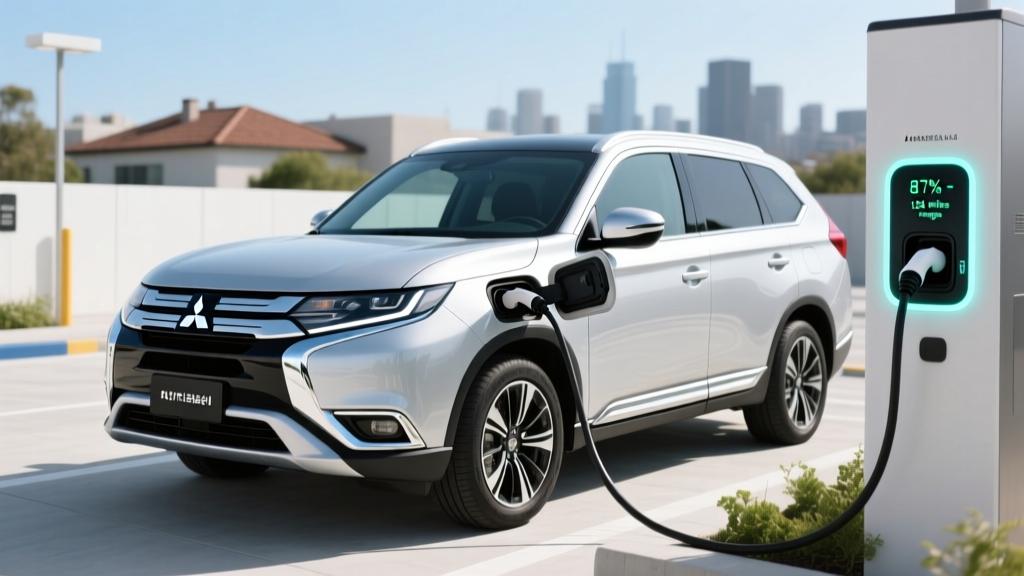
One of the Outlander PHEV's strongest selling points is that it supports DC fast charging — a feature still absent from many competing PHEVs like the Toyota RAV4 Prime. Here's the full charging breakdown:
| Level | Power (kW) | 0–100% Time | Connector |
|---|---|---|---|
| Level 1 (120V household) | ~1.4 kW | ~14 hours | J1772 |
| Level 2 (240V home/public) | ~3.8 kW (onboard limit) | ~5 hours | J1772 |
| DC Fast Charge | ~22 kW peak (CHAdeMO) | 0–80% in ~38 min | CHAdeMO |
Important caveats on charging: The Outlander's onboard charger maxes out at 3.8 kW on Level 2, which is modest by 2026 standards — even a 32-amp Level 2 circuit won't charge it any faster. The DC fast-charging port uses the CHAdeMO connector, which is increasingly rare at new public stations as the industry standardizes on CCS1 and NACS. Before relying on DC fast charging for road trips, verify CHAdeMO availability along your route using apps like PlugShare.
kW vs. kWh reminder: kW (kilowatts) measures the rate of charging — like water flow from a hose. kWh (kilowatt-hours) measures the battery's total energy capacity — like the size of the tank. The Outlander has a 20 kWh battery and charges at up to 22 kW on DC.
Pricing, Trims, and Tax Credit Eligibility
The 2026 Mitsubishi Outlander PHEV starts at approximately $41,440 MSRP for the ES trim and climbs to around $50,000 for the fully loaded SEL Platinum Edition (including destination charges).
| Trim | MSRP (est.) |
|---|---|
| ES | $41,440 |
| SE | $44,640 |
| SEL | $47,440 |
| SEL Platinum Edition | ~$50,000 |
Federal Tax Credit Eligibility (§30D)
Under current IRS §30D rules, the Outlander PHEV may qualify for up to $7,500 in federal tax credits — but eligibility depends on several factors that change frequently:
- MSRP cap: SUVs must be priced at or below $80,000 (all Outlander PHEV trims qualify).
- Buyer income cap: Modified AGI must not exceed $150,000 (single), $225,000 (head of household), or $300,000 (joint).
- Battery sourcing: Critical minerals and battery components must meet escalating domestic-content thresholds. Mitsubishi's supply chain compliance for 2026 should be verified at the point of sale, as these requirements tighten annually.
- Point-of-sale transfer: As of 2024, eligible buyers can transfer the credit to the dealer for an immediate price reduction rather than waiting to claim it on their tax return.
Always confirm current eligibility with your dealer and consult a tax professional before relying on the credit. State incentives (like those in California, Colorado, or New York) may stack on top.
Battery Warranty, Reliability, and Replacement Cost
Mitsubishi PHEV Battery Warranty
Mitsubishi covers the Outlander PHEV's high-voltage battery for 10 years / 100,000 miles (whichever comes first), with a capacity retention threshold of approximately 70%. The broader powertrain warranty covers 10 years / 100,000 miles, and the vehicle limited warranty runs 5 years / 60,000 miles.
This is one of the strongest hybrid battery warranties in the segment, matching Hyundai and Kia while exceeding Toyota's 8-year/100,000-mile hybrid battery coverage.
Reliability: Mitsubishi's PHEV system has been in production since 2013 (first in the original Outlander PHEV), giving it one of the longest track records of any plug-in hybrid platform. The current-generation system has proven durable, with few widespread failure modes reported across owner forums and reliability surveys.
Battery replacement cost: If the high-voltage battery requires replacement outside of warranty, expect a cost in the range of $8,000 to $12,000 including parts and labor at a Mitsubishi dealership. However, NMC lithium-ion batteries in PHEV applications — which undergo shallower discharge cycles than full EVs — typically retain 85–90% capacity at 100,000 miles based on industry-wide degradation data. Full replacement before 150,000 miles is uncommon.
Outlander PHEV vs. Full EV vs. Gas SUV: Who Should Choose What?
Decision Framework
Choose the Outlander PHEV if:
- Your daily commute is under 35 miles round-trip and you can charge at home
- You regularly take road trips of 200+ miles where charging infrastructure is sparse
- You need three-row seating and AWD but want to reduce fuel costs
- You're not ready to commit to a full EV but want meaningful electric driving
Choose a full EV (e.g., Tesla Model Y, Hyundai Ioniq 5) if:
- You have reliable home Level 2 charging
- Your typical trips are under 250 miles or you're comfortable with DC fast-charging stops
- You want the lowest per-mile fuel cost and minimal maintenance
Choose a conventional gas SUV if:
- You cannot charge at home (apartment, street parking, no garage)
- You frequently tow over 3,000 lbs
- Upfront purchase price is the primary constraint
Pros and Cons at a Glance
Pros
- 38 miles EV range covers most daily commutes
- DC fast charging (rare for PHEVs)
- Standard twin-motor AWD
- Three-row seating in a compact SUV footprint
- 10-year/100,000-mile battery warranty
- Strong V2L (vehicle-to-load) capability for camping/emergency power
Cons
- CHAdeMO DC connector is increasingly uncommon
- 3.8 kW Level 2 onboard charger is slow for 2026
- Third row is tight for adults
- 26 MPG hybrid mode trails the RAV4 Hybrid's ~39 MPG
- 1,500-lb towing limit is below most competitors
- Tax credit eligibility depends on evolving sourcing rules
Frequently Asked Questions
How many MPG does the Outlander PHEV get?
The EPA rates it at 64 MPGe combined in electric mode and 26 MPG combined when running on gasoline alone. Real-world results vary: expect 55–70 MPGe if you charge daily and keep trips short, or 24–27 MPG on long highway drives after the battery depletes. Source: fueleconomy.gov.
How far can the Outlander PHEV go on electric only?
The EPA rates it at 38 miles of electric-only range. In mild weather with city driving, some owners report 40+ miles. In cold weather (below 30°F) or at sustained highway speeds, expect 26–32 miles before the gasoline engine engages.
Does the Outlander PHEV qualify for a tax credit?
It may qualify for up to $7,500 under IRS §30D, subject to buyer income limits ($150K single / $300K joint), the $80K MSRP cap for SUVs, and battery critical-mineral sourcing requirements. Eligibility rules tighten annually — verify at purchase and consult a tax professional. State incentives may apply separately.
Is the Outlander PHEV reliable and what does battery replacement cost?
Mitsubishi's PHEV platform has been in production since 2013 and has a solid reliability record. The battery is warrantied for 10 years / 100,000 miles. Out-of-warranty replacement runs approximately $8,000–$12,000, but PHEV batteries undergo shallow cycles and typically retain 85–90% capacity at 100,000 miles.
Can I charge the Outlander PHEV at a Tesla Supercharger?
No. The Outlander PHEV uses a J1772 connector for Level 1/Level 2 AC charging and a CHAdeMO connector for DC fast charging. Tesla Superchargers use NACS and are not compatible without adapters, and no CHAdeMO-to-NACS adapter currently exists for DC charging.
Hybrid vs PHEV vs EV — which fits me?
If you have home charging and a commute under 35 miles but also take long road trips, the PHEV is the ideal hybrid pit stop between a gas car and a full EV. If you never want to think about charging, a conventional HEV (like the RAV4 Hybrid) works. If you want the lowest running cost and have reliable charging access, a full EV is the better long-term play.