Does Mitsubishi Still Make Hybrid Cars?
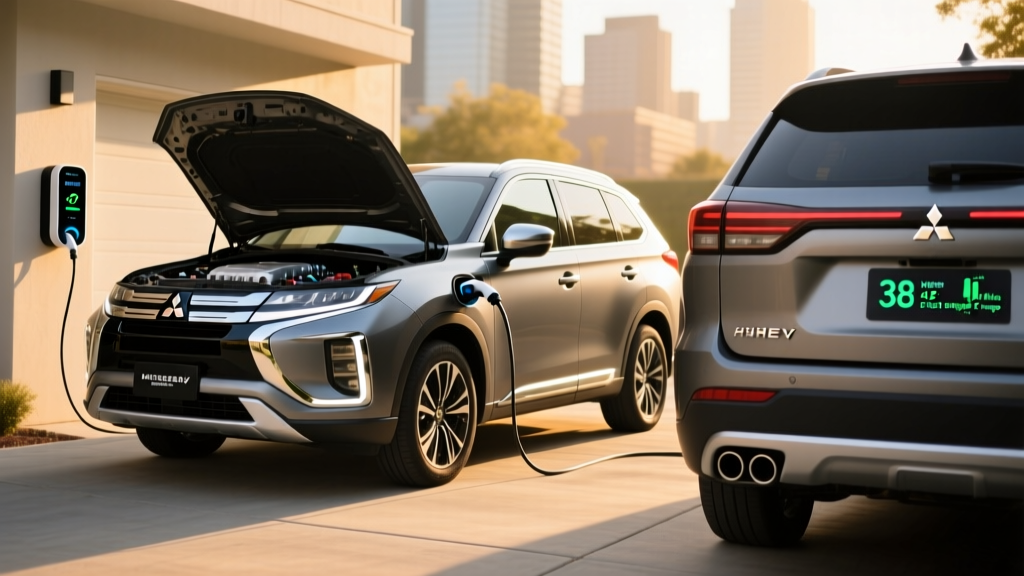
If you've been searching for Mitsubishi hybrid cars, the conversation in 2026 essentially centers on one vehicle: the Mitsubishi Outlander PHEV. It's the brand's sole electrified offering in the U.S. market and one of the few plug-in hybrid compact SUVs that pairs standard all-wheel drive with three rows of seating. Mitsubishi discontinued the conventional hybrid variant of the Outlander after the 2024 model year, so every new electrified Mitsubishi you can buy today is a plug-in hybrid — meaning it has a charge port, a meaningful electric-only range, and a gasoline engine for longer trips.
That distinction matters. Many shoppers search for "Mitsubishi hybrid" expecting a Toyota Prius-style conventional hybrid (HEV) that never plugs in. Mitsubishi's strategy is different: it skipped the HEV segment entirely to focus on a PHEV that can function as a daily electric commuter and a gas-powered family hauler on road trips.
HEV vs PHEV: Understanding Mitsubishi's Approach
Conventional Hybrid (HEV): A small battery (typically 1-2 kWh) recharges via regenerative braking and the engine. You never plug it in. Electric-only driving is limited to brief low-speed bursts. Think Toyota RAV4 Hybrid.
Plug-in Hybrid (PHEV): A larger battery (15-25 kWh) charges from a wall outlet or public charger, delivering 30-40+ miles of electric-only range before the gas engine kicks in. The Outlander PHEV falls here.
Mitsubishi's bet is that most American commutes are under 40 miles round-trip. If you charge at home nightly, the Outlander PHEV operates as an EV on weekdays and a hybrid on weekends — without the range anxiety of a fully electric vehicle on long trips.
2026 Outlander PHEV: Powertrain and Performance Specs
The 2026 Mitsubishi Outlander PHEV carries over the major powertrain revision introduced with the current generation. Here's what's under the hood — and under the floor:
| Specification | 2026 Outlander PHEV |
|---|---|
| Powertrain | 2.4L 4-cylinder Atkinson-cycle engine + dual electric motors (front & rear) |
| Combined System Horsepower | 248 hp |
| Combined System Torque | 332 lb-ft |
| Drivetrain | Standard AWD (S-AWC — Super All-Wheel Control) |
| Battery Capacity (Total / Usable) | 20.0 kWh total / ~17.5 kWh usable |
| Battery Chemistry | Lithium-ion (NMC) |
| 0-60 mph | ~7.5 seconds |
| Towing Capacity | 1,500 lbs |
| Seating | 3 rows / 7 passengers |
| Cargo (behind 3rd / 2nd / 1st row) | 11.7 / 33.5 / 78.5 cu ft |
The dual-motor setup means the rear axle is entirely electric — there's no mechanical driveshaft connecting the engine to the rear wheels. This gives the Outlander PHEV genuine all-wheel-drive capability with instant electric torque to the rear, which is noticeable in rain and light snow.
Fuel Economy and Electric-Only Range: The Real Numbers
This is where Mitsubishi hybrid cars either impress or disappoint, depending on how you use them. The EPA rates the 2026 Outlander PHEV as follows:
| Metric | EPA Rating |
|---|---|
| Electric-Only Range | 38 miles |
| Combined MPGe (electric + gas) | 64 MPGe |
| Gas-Only MPG (combined) | 26 MPG |
| Gas-Only MPG (city) | 25 MPG |
| Gas-Only MPG (highway) | 27 MPG |
| Total Combined Range (EV + gas) | ~420 miles |
Real-world range check: The EPA's 38-mile electric-only estimate is achievable in mild weather at city speeds. Expect 30-34 miles of electric range in mixed highway/city driving, and as low as 24-28 miles in freezing temperatures with cabin heat on. The gasoline engine will activate in very cold weather to provide heat, even if the battery isn't depleted — a common PHEV behavior that surprises first-time owners.
Once the battery depletes, the 26 MPG combined gas-only figure is competitive with non-hybrid compact SUVs but trails dedicated HEVs like the Toyota RAV4 Hybrid (39 MPG combined). This is the tradeoff: a PHEV gives you EV-like daily commuting but less impressive highway fuel economy once the battery is spent, partly due to the Outlander's 4,600+ lb curb weight.
Real-world MPG vs EPA: Owners who charge nightly and commute under 35 miles report using gasoline only on weekend road trips — effectively achieving 80-100+ MPGe on a lifestyle basis. Those who rarely charge and drive primarily on gas will see 24-27 MPG, right around the EPA estimate. The Outlander PHEV rewards plugging in; without regular charging, it's simply a heavy, moderately efficient SUV.
Charging the Outlander PHEV: Speeds, Connectors, and Costs
The 2026 Outlander PHEV charges via a J1772 connector (standard for non-Tesla PHEVs and EVs at Level 1 and Level 2). A notable feature for a PHEV: it also supports DC fast charging via CHAdeMO. This is increasingly rare as most competitors have dropped CHAdeMO in favor of CCS or NACS, but it means you can top up at compatible DC stations on road trips.
| Charging Level | Power (kW) | Time (0-100%) | Notes |
|---|---|---|---|
| Level 1 (120V household outlet) | ~1.4 kW | ~14-16 hours | Emergency/trickle only |
| Level 2 (240V, home or public) | ~3.7 kW (onboard charger limit) | ~5-5.5 hours | Overnight home charging |
| DC Fast Charge (CHAdeMO) | Up to ~22 kW | ~38 min (0-80%) | Rare connector; limited stations |
The 3.7 kW onboard charger is the bottleneck. Even if you connect to a 7.2 kW or 11.5 kW Level 2 station, the Outlander PHEV will only accept 3.7 kW. That means a full charge takes roughly 5 hours regardless of your home charger's capacity. For most owners charging overnight, this is perfectly adequate — you plug in at bedtime and wake up to a full battery. But if you're hoping to top up mid-day at a public Level 2 charger, you'll only add about 15 miles of electric range per hour of charging.
CHAdeMO reality check: DC fast charging a 20 kWh PHEV battery is a niche use case. Electrify America and most networks are phasing out CHAdeMO connectors in favor of CCS and NACS. If DC fast charging on road trips matters to you, the Outlander PHEV's CHAdeMO port may become less useful over time. For daily use, Level 2 home charging is all you need.
Pricing, Trims, and Tax Credit Eligibility
The 2026 Mitsubishi Outlander PHEV starts at approximately $41,640 (ES trim, including destination) and climbs to around $50,000+ for the top SEL Platinum Edition. Key trims include:
- ES: ~$41,640 — base with 7-passenger seating, S-AWC, 8-inch display
- SE: ~$44,640 — adds synthetic leather, heated front seats, power liftgate
- SEL: ~$47,640 — genuine leather, panoramic sunroof, upgraded audio
- SEL Platinum Edition: ~$50,640 — premium package with Nappa leather, advanced ADAS
Federal Tax Credit: §30D Eligibility
The Outlander PHEV may qualify for up to $7,500 under the IRS §30D Clean Vehicle Credit, but eligibility is not automatic. Per current IRS guidelines, you must meet all of the following:
- MSRP cap: Vehicle base MSRP must not exceed $80,000 for SUVs (Outlander PHEV qualifies)
- Buyer income cap: AGI must not exceed $150,000 (single), $225,000 (head of household), or $300,000 (joint)
- Battery sourcing: Critical minerals and battery components must meet phased-in percentage thresholds for North American/free-trade-partner sourcing — these thresholds increase annually and can affect credit amount
- Point-of-sale transfer: As of 2024, you can transfer the credit to the dealer for an upfront price reduction rather than claiming it at tax time
Because battery sourcing requirements tighten each year, the exact credit amount ($3,750, $7,500, or $0) can change. Always verify current eligibility on fueleconomy.gov before purchasing. Consult a tax professional for your specific situation.
No conventional hybrid (HEV) qualifies for the federal §30D credit — this is a PHEV/EV-only incentive. Some states offer additional rebates for PHEVs; check your state's energy office or AFDC's state incentive database for details.
Battery Warranty, Reliability, and Replacement Cost
Mitsubishi PHEV battery warranty: 10 years / 100,000 miles (whichever comes first) for the high-voltage traction battery. This covers defects and capacity loss below a defined threshold (typically ~70% state of health). The standard vehicle warranty is 5 years / 60,000 miles bumper-to-bumper and 10 years / 100,000 miles powertrain.
Mitsubishi's 10-year/100,000-mile powertrain and battery coverage is among the longest in the industry — matching Hyundai/Kia and exceeding Toyota's 8-year/100,000-mile hybrid battery warranty. This matters because PHEV battery replacement is expensive.
Battery replacement cost: If the high-voltage battery fails outside warranty, expect a replacement cost between $8,000 and $12,000 including parts and labor at a Mitsubishi dealer. However, PHEV batteries are smaller and less stressed than full EV batteries, and real-world failure rates are low. The 20 kWh pack in the Outlander is cycled less deeply than an EV battery (you rarely drain it to true zero thanks to the gas-engine buffer), which generally supports longevity.
Reliability track record: The current-generation Outlander PHEV (introduced for 2023) is still building its long-term reliability record. Mitsubishi as a brand scores mid-pack in J.D. Power dependability studies and Consumer Reports reliability ratings. The PHEV powertrain itself — a series-parallel system Mitsubishi has refined since the original 2013 Outlander PHEV in Japan — is well-proven globally. The main concerns owners report are related to infotainment software and interior build quality, not the hybrid system.
Who Should Buy the Mitsubishi Outlander PHEV?
Choose the Outlander PHEV if:
- You need 7-passenger seating and standard AWD in an electrified vehicle
- You can charge at home nightly (Level 1 or Level 2) and your daily commute is under 35 miles
- You take 3-6 road trips per year and don't want to plan around DC fast chargers
- You want a long factory warranty (10 yr / 100k mi powertrain + battery)
- You want to reduce gas consumption without committing to a full EV
Look elsewhere if:
- You can't charge at home or at work — a PHEV driven only on gas is a heavy, less-efficient SUV
- You prioritize fuel economy above all — the Toyota RAV4 Hybrid (HEV) gets 39 MPG combined without plugging in
- You want a longer electric-only range — the Toyota RAV4 Prime offers 42 miles EV, and the Hyundai Tucson PHEV offers 33 miles with a more modern interior
- You want cutting-edge infotainment or ADAS — Mitsubishi's tech is functional but a generation behind Korean and German rivals
- You need fast Level 2 charging — the 3.7 kW onboard charger is slow for mid-day top-ups
Pros
- 38 miles EPA electric-only range covers most commutes
- Standard AWD with electric rear axle — genuine all-weather capability
- 3-row / 7-passenger seating (rare in PHEV compact SUVs)
- 10-year / 100,000-mile battery and powertrain warranty
- CHAdeMO DC fast charging (niche but unique)
- Competitive pricing vs. RAV4 Prime and Tucson PHEV
Cons
- 26 MPG gas-only is unimpressive once the battery depletes
- 3.7 kW onboard charger limits Level 2 speed
- CHAdeMO DC connector is being phased out at public stations
- Third-row seat is tight — best for children only
- Infotainment and interior materials lag behind segment leaders
- Brand reliability perception trails Toyota and Hyundai
Outlander PHEV vs. the Competition
The Outlander PHEV doesn't exist in a vacuum. Here's how it stacks up against the two PHEVs most buyers cross-shop:
| Spec | Mitsubishi Outlander PHEV | Toyota RAV4 Prime | Hyundai Tucson PHEV |
|---|---|---|---|
| EV Range (EPA) | 38 mi | 42 mi | 33 mi |
| Gas-Only MPG (combined) | 26 MPG | 38 MPG | 35 MPG |
| Combined HP | 248 hp | 302 hp | 261 hp |
| Battery (usable) | ~17.5 kWh | ~14.9 kWh | ~10.4 kWh |
| AWD | Standard | Standard | Standard |
| 3rd Row | Yes | No | No |
| Starting MSRP | ~$41,640 | ~$44,500 | ~$39,000 |
| Battery Warranty | 10 yr / 100k mi | 10 yr / 150k mi (CA/PZEV states); 8 yr / 100k mi (federal) | 10 yr / 100k mi |
The RAV4 Prime wins on performance and gas-only efficiency but commands a higher price and lacks a third row. The Tucson PHEV is more affordable with a more modern interior but offers less electric range. The Outlander PHEV's niche is clear: 7-passenger seating + AWD + 38 miles of EV range at a sub-$42K starting price.
Frequently Asked Questions
How many MPG does the Mitsubishi Outlander PHEV get?
The EPA rates it at 64 MPGe combined when using both electric and gas power, and 26 MPG combined (25 city / 27 highway) when running on gasoline alone after the battery is depleted. Real-world gas-only MPG closely matches the EPA estimate. Owners who charge daily and commute under 35 miles may go weeks between fill-ups.
How far can the Outlander PHEV go on electric only?
The EPA rates it at 38 miles of electric-only range. In real-world mixed driving, expect 30-34 miles. In freezing weather with cabin heat, that can drop to 24-28 miles. The gasoline engine may activate in cold weather for cabin heat even before the battery is fully depleted.
Do Mitsubishi hybrid cars need to be plugged in?
The current Mitsubishi Outlander PHEV is a plug-in hybrid — yes, it has a charge port and benefits greatly from being plugged in nightly. However, it will still operate as a conventional hybrid (using the gas engine and regenerative braking) if you never plug it in. You just lose the 38 miles of electric-only range and the associated fuel savings. Mitsubishi does not currently sell a conventional (non-plug-in) hybrid in the U.S.
Is the Mitsubishi Outlander PHEV reliable?
Mitsubishi's PHEV system has been in global production since 2013 and is mechanically well-proven. Brand-level reliability ratings are mid-pack. The 10-year / 100,000-mile powertrain and battery warranty provides strong coverage. The most commonly reported issues relate to infotainment software, not the hybrid drivetrain.
What does it cost to replace the Outlander PHEV battery?
Out-of-warranty high-voltage battery replacement runs approximately $8,000-$12,000 at a Mitsubishi dealer. However, the battery is covered for 10 years / 100,000 miles, and PHEV batteries generally experience slower degradation than full EV batteries due to shallower charge cycles and the gas-engine buffer.
Does the Mitsubishi Outlander PHEV qualify for a tax credit?
It may qualify for up to $7,500 under the federal §30D Clean Vehicle Credit, subject to buyer income limits ($150K single / $300K joint AGI), MSRP caps ($80K for SUVs), and battery sourcing requirements that tighten annually. The credit can be transferred to the dealer at point of sale for an immediate price reduction. Always verify current eligibility on fueleconomy.gov and consult a tax professional.
Hybrid vs PHEV vs EV — which is right for me?
HEV (conventional hybrid): Best if you can't charge at home and want better MPG with zero behavior change. No plug, no range anxiety. Example: Toyota RAV4 Hybrid.
PHEV (plug-in hybrid): Best if you can charge at home, commute under ~40 miles, and still want gas flexibility for road trips. Example: Mitsubishi Outlander PHEV.
BEV (full electric): Best if you have reliable home charging, drive under 250-300 miles daily, and want the lowest operating cost and zero tailpipe emissions. Example: Hyundai Ioniq 5, Tesla Model Y.
Can the Outlander PHEV charge at Tesla Superchargers?
No. The Outlander PHEV uses a J1772 connector for Level 1/2 charging and CHAdeMO for DC fast charging. Tesla Superchargers use the NACS connector. There is no adapter that allows a CHAdeMO/J1772 PHEV to charge at a NACS Supercharger. You'll use networks like ChargePoint, EVgo, or Electrify America (CHAdeMO-equipped stations) for public charging.