The Mini PHEV Lineup in 2026: Countryman SE All4 at a Glance
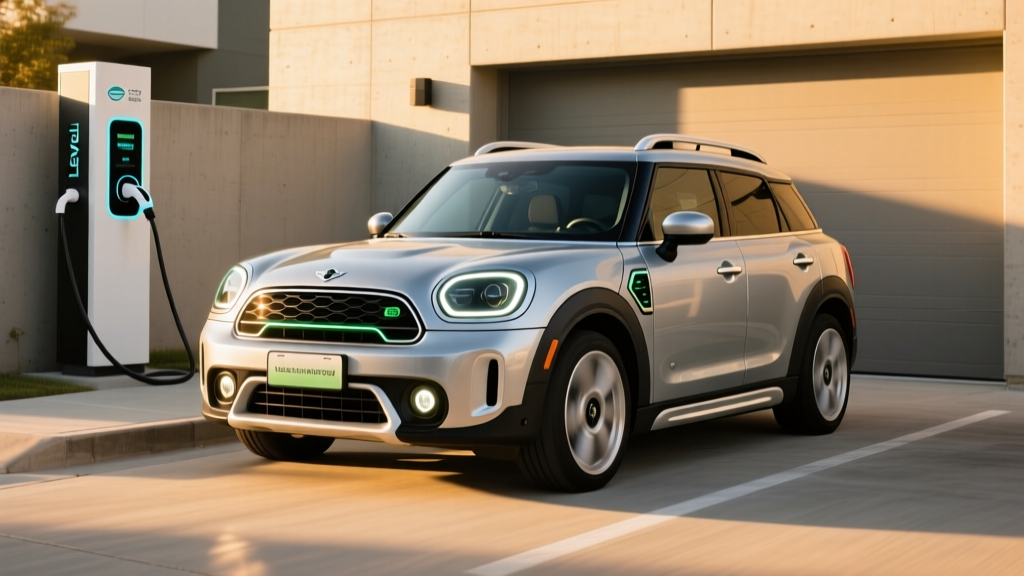
Mini's plug-in hybrid strategy centers on one vehicle for the US market: the Countryman SE All4. Now in its third generation on the BMW FAAR platform, the 2026 Countryman SE All4 pairs a 1.5-liter turbocharged three-cylinder engine with a more powerful electric motor and a larger 21.2 kWh (gross) battery pack. The result is a meaningful step up in electric-only range and combined output over the outgoing model.
If you've searched for a Mini PHEV and found conflicting information about trims, ranges, and whether Mini still sells a plug-in hybrid at all, this guide resolves those questions with exact EPA data, real-world efficiency observations, charging logistics, and federal tax credit eligibility under current IRS §30D rules.
| Spec | Value |
|---|---|
| Powertrain | 1.5L turbo 3-cyl + electric motor (All4 AWD) |
| Combined Horsepower | 326 HP |
| Combined Torque | 354 lb-ft |
| 0–60 mph | 5.4 seconds |
| Battery (gross / usable) | 21.2 kWh / ~17.5 kWh |
| Battery Chemistry | NMC (nickel manganese cobalt) |
| EPA Electric-Only Range | ~30 miles |
| Total Combined Range | ~400 miles (gas + electric) |
| EPA Combined MPGe | ~62 MPGe (electric + gas combined) |
| EPA MPG (charge-sustaining) | ~29 city / 31 hwy / 30 combined |
| Level 2 Charging (max) | 7.4 kW (AC) |
| DC Fast Charging | Not available |
| 10–100% Level 2 Time | ~2 hours 45 minutes |
| Base MSRP (SE All4) | $41,900 |
| Hybrid Battery Warranty | 8 years / 80,000 miles |
How Many MPG Does the Mini PHEV Get?
The answer depends on how you drive it — specifically, whether you charge regularly. In charge-sustaining mode (battery depleted, running as a conventional hybrid), the 2026 Countryman SE All4 achieves an EPA-estimated 29 MPG city / 31 MPG highway / 30 MPG combined, per fueleconomy.gov.
| Driving Mode | City | Highway | Combined |
|---|---|---|---|
| Charge-Sustaining (gas only) | 29 MPG | 31 MPG | 30 MPG |
| Charge-Depleting (electric) | 62 MPGe (combined) | ||
Real-world observations: In mixed city driving with regular Level 2 charging, owners commonly report effective economy of 60–80 MPGe over a given month, since many daily commutes fall within the 30-mile electric envelope. On long highway road trips where the battery depletes within the first 30 miles, expect the charge-sustaining figure of roughly 28–30 MPG — slightly lower if carrying heavy cargo or driving in cold weather below 35°F, where engine efficiency drops and cabin heating demands fuel.
For context, the non-hybrid gas-only Countryman S All4 returns about 27 MPG combined. The PHEV's advantage is most pronounced in stop-and-go city traffic, where regenerative braking and electric-only operation eliminate idling fuel burn entirely.
Electric-Only Range: How Far Can the Mini PHEV Go Without Gas?
The EPA rates the 2026 Countryman SE All4 at approximately 30 miles of electric-only range. That figure assumes moderate temperatures, gentle acceleration, and speeds under 55 mph.
Real-World Electric Range Expectations:
- Ideal conditions (60–75°F, city driving, light load): 28–32 miles
- Highway at 70 mph: 22–26 miles (aerodynamic drag drains battery faster)
- Cold weather (below 30°F): 18–23 miles (battery resistance increases, cabin heating activates engine or PTC heater)
- Hot weather with A/C: 25–28 miles
The 21.2 kWh gross battery yields roughly 17.5 kWh of usable capacity. Mini, like BMW, reserves a buffer at both the top and bottom of the state-of-charge window to protect long-term battery health. This is standard practice across the industry and explains why a "21.2 kWh" battery doesn't deliver 21.2 kWh of driving energy.
For a daily commute of 20–25 miles round trip, the Countryman PHEV can operate entirely on electricity — provided you plug in each evening. This is the core value proposition: weekday electric driving with weekend road-trip flexibility.
HEV vs PHEV vs EV: Which Mini (or Electrified Vehicle) Fits You?
Mini does not currently sell a conventional hybrid (HEV) in the US — the Countryman is available as a gas model, the SE All4 plug-in hybrid, or the fully electric Countryman SE. Understanding the distinction matters before you buy.
| Factor | HEV (Conventional Hybrid) | PHEV (Plug-In Hybrid) | BEV (Battery Electric) |
|---|---|---|---|
| Plug-in Required? | No — charges via regen and engine | Yes — for electric-only miles | Yes — sole energy source |
| Electric-Only Range | 0–2 miles (low-speed assist only) | 25–40 miles (typical) | 200–350+ miles |
| Tailpipe Emissions (electric mode) | N/A (always burns fuel) | Zero in EV mode | Zero |
| Charging Infrastructure Needed | None | Level 1 or 2 recommended | Level 2 home charger essential |
| Federal Tax Credit (2026) | None (discontinued for most HEVs) | Up to $3,750–$7,500 if eligible | Up to $7,500 if eligible |
| Best For | No plug access, want better MPG | Home charging + road trip flexibility | Home charging, daily driving <250 mi |
Choose the Mini Countryman SE All4 PHEV if:
- You can install or already have a Level 2 (240V) charger at home
- Your daily commute is under 30 miles round trip
- You take road trips of 200+ miles regularly and don't want to plan charging stops
- You want Mini styling and AWD with some electric benefit
Choose the fully electric Countryman SE instead if:
- Your daily driving is under 200 miles and you have reliable home charging
- You want to eliminate oil changes, spark plugs, and gas station visits entirely
- You prioritize maximum federal tax credit (BEVs often qualify more easily than PHEVs under §30D sourcing rules)
Choose a gas-only Countryman S All4 if:
- You lack any charging access (apartment, street parking, no garage)
- The PHEV's ~$5,000 price premium over gas models doesn't pencil out for your mileage
Charging the Mini PHEV: What You Need to Know
The Countryman SE All4 accepts up to 7.4 kW on Level 2 AC charging. It does not support DC fast charging — a common limitation among compact PHEVs. The battery is simply too small to justify the cost and weight of a DC fast-charge system.
| Level | Voltage | Max Power | Time (0–100%) | Miles Added per Hour |
|---|---|---|---|---|
| Level 1 (standard outlet) | 120V | ~1.4 kW | ~14 hours | ~5 miles EV range/hr |
| Level 2 (home/public AC) | 240V | 7.4 kW | ~2 hours 45 min | ~12 miles EV range/hr |
| DC Fast Charge | N/A | Not supported | N/A | N/A |
Practical charging reality: Most PHEV owners charge overnight on Level 1 or Level 2 and wake up to a full battery every morning. A standard 120V outlet adds roughly 5 miles of electric range per hour — adequate if you only need 20–25 miles and plug in for 10+ hours. A Level 2 home charger (240V, 32A circuit) fills the battery in under 3 hours, which is useful if you want to charge mid-day between errands.
Home Level 2 installation typically costs $800–$2,500 depending on your electrical panel capacity, distance from panel to garage, and local permit requirements. If your panel is already near capacity (common in older homes), a panel upgrade can add $1,500–$3,000. Always get a quote from a licensed electrician before purchasing a charger.
Powertrain and Driving Dynamics
The 2026 Countryman SE All4 pairs a 1.5-liter turbocharged three-cylinder engine (producing 170 HP on its own) with an electric motor integrated into the rear axle (190 HP). Combined system output is 326 HP and 354 lb-ft of torque, routed through BMW's All4 all-wheel-drive system.
The electric motor drives the rear wheels while the engine drives the front, creating an on-demand AWD layout. In pure electric mode, the Countryman operates as a rear-wheel-drive vehicle. When you demand full acceleration or the system detects front-wheel slip, the engine engages seamlessly.
The 0–60 mph sprint takes 5.4 seconds — genuinely quick for a compact crossover and substantially faster than the gas-only Countryman S All4 (roughly 7.1 seconds). The instant torque from the electric motor gives strong around-town responsiveness, and the transition between electric and gas power is among the smoothest in the PHEV segment.
One practical note: the PHEV's battery and power electronics add roughly 350–400 lbs compared to the gas model. You feel this in cornering — the Countryman SE All4 is competent but not as nimble as its lighter siblings. For a daily driver and family hauler, the trade-off is worthwhile.
Pricing, Trims, and Federal Tax Credit Eligibility
The 2026 Mini Countryman SE All4 starts at $41,900 MSRP (including destination). Well-equipped models with the Premium Plus package, panoramic roof, and driver-assistance features typically land in the $46,000–$50,000 range.
Federal §30D Tax Credit — PHEV Eligibility Checklist (2026 Rules):
- Vehicle MSRP cap: SUVs/crossovers must be under $80,000 (Countryman qualifies)
- Buyer income cap: AGI must not exceed $150,000 (single), $225,000 (head of household), or $300,000 (joint filers)
- Battery capacity: Must be at least 7 kWh (Countryman's 21.2 kWh qualifies)
- Critical minerals requirement: Percentage of battery minerals must be sourced from US or FTA partners (phasing up annually — check IRS.gov for current-year thresholds)
- Battery component sourcing: Percentage of components manufactured/assembled in North America (also phasing up)
- Point-of-sale transfer: Eligible buyers can transfer the credit to the dealer for an upfront price reduction
What this means in practice: PHEVs face stricter battery-sourcing requirements than in prior years. The Countryman SE All4 may qualify for $3,750 or $7,500 depending on whether it meets one or both sourcing thresholds in the current model year. Mini's US site and your dealer's F&I department can confirm the exact credit amount for your VIN. Do not assume full $7,500 eligibility without verification — sourcing rules tighten annually, and some PHEVs that qualified in 2024 no longer do.
Additionally, some states offer their own PHEV rebates (California's CVRP, for instance, has periodically included PHEVs at reduced amounts). Check your state energy office for current programs.
Reliability, Battery Warranty, and Long-Term Costs
2026 Mini Countryman SE All4 — Hybrid Battery Warranty:
- Duration: 8 years / 80,000 miles (federally mandated minimum for emissions-related components, which includes the hybrid battery)
- Coverage: Battery capacity retention must remain above approximately 70% of original capacity. If degradation exceeds this threshold within the warranty period, BMW/Mini replaces or refurbishes the pack at no cost.
- Extended in CARB states: In California and states adopting CARB emissions standards, hybrid battery coverage extends to 10 years / 150,000 miles.
Is the Mini PHEV reliable? The current-generation Countryman is still relatively new, so long-term reliability data specific to this powertrain is limited. However, the underlying BMW FAAR platform and 1.5L turbo three-cylinder are proven across the BMW and Mini lineup. The PHEV system shares architecture with the BMW X1 xDrive28e and 2 Series Active Tourer PHEV, both of which have been on European roads since 2022 without widespread battery failure reports.
PHEV batteries are smaller and undergo shallower charge cycles than full EV batteries, which generally translates to slower degradation. Most PHEV owners will never see battery capacity drop below the warranty threshold during typical ownership (8–10 years).
Out-of-warranty replacement cost: If the high-voltage battery requires replacement after the warranty expires, expect a cost in the $8,000–$12,000 range (parts and labor). This is significantly less than a full EV battery replacement because the pack is smaller. However, industry data suggests most hybrid batteries last well beyond their warranty period — Consumer Reports notes that hybrid battery failures before 150,000 miles are uncommon.
Maintenance advantages: The PHEV's regenerative braking reduces wear on friction brake pads (often lasting 80,000+ miles). The engine runs less frequently, potentially extending oil-change intervals under the vehicle's condition-based service system. Budget for standard maintenance: synthetic oil changes every 10,000 miles, cabin air filter, brake fluid checks, and tire rotation.
Pros
- 30-mile electric range covers most daily commutes
- 326 HP provides genuinely quick acceleration (5.4s 0–60)
- No range anxiety — gas engine covers 400+ total miles
- AWD standard via electric rear axle
- Qualifies for HOV lane access in several states
- Premium interior with Mini's latest infotainment
Cons
- No DC fast charging capability
- Electric range drops to ~20 miles in cold weather
- MSRP premium of ~$5,000 over gas Countryman S All4
- Federal tax credit eligibility uncertain due to sourcing rules
- Heavier than gas model — slightly less agile in corners
- Cargo space marginally reduced vs gas model (battery under floor)
Who Should Buy the Mini PHEV?
The 2026 Countryman SE All4 PHEV is best suited for a specific buyer profile: someone who wants a premium compact crossover with Mini's distinctive design, has access to home or workplace charging, drives fewer than 35 miles on most weekdays, but regularly takes longer weekend trips where a pure EV would require route planning around chargers.
If you live in an apartment without charging access, the PHEV premium is harder to justify — you'll rarely use the electric motor and would be better served by the gas-only Countryman S All4 at a lower price. Conversely, if you have reliable Level 2 charging and your daily driving rarely exceeds 25 miles, the fully electric Countryman SE (with ~240 miles of range) eliminates gas entirely and likely qualifies for a larger tax credit.
The PHEV occupies a practical middle ground: electric for the daily grind, gas for the open road, and no single point of failure if charging infrastructure lets you down.
Frequently Asked Questions
How many MPG does the Mini PHEV get on gas alone?
When the battery is depleted and the Countryman SE All4 operates as a conventional hybrid, it achieves an EPA-estimated 29 MPG city, 31 MPG highway, and 30 MPG combined. Real-world results vary with driving style, terrain, and temperature — expect 27–31 MPG in mixed use.
How far can the Mini Countryman PHEV go on electric only?
The EPA estimates 30 miles of electric-only range under ideal conditions. In real-world driving, expect 22–28 miles depending on speed, temperature, and terrain. Highway driving and cold weather reduce this figure to as low as 18–22 miles.
Does the Mini PHEV qualify for the $7,500 federal tax credit?
It may qualify for $3,750 or $7,500 depending on current-year battery sourcing requirements under IRS §30D. The vehicle meets the MSRP cap (under $80,000 for SUVs) and battery capacity threshold (over 7 kWh), but critical mineral and component sourcing rules change annually. Verify eligibility for your specific VIN with your dealer or at IRS.gov.
Can I charge the Mini PHEV on a regular household outlet?
Yes. A standard 120V Level 1 outlet charges the Countryman PHEV at roughly 1.4 kW, adding about 5 miles of electric range per hour. A full charge from empty takes approximately 14 hours. For daily use (20–30 miles), plugging in overnight on Level 1 is sufficient. A Level 2 (240V) charger reduces full-charge time to about 2 hours 45 minutes.
Is the Mini PHEV battery expensive to replace?
Out-of-warranty replacement runs approximately $8,000–$12,000. However, the battery is covered by an 8-year/80,000-mile warranty (10 years/150,000 miles in CARB states), and PHEV batteries typically experience slower degradation than full EV batteries due to shallower charge cycles. Most owners will never need a replacement.
How does the Mini PHEV compare to a full EV like the Countryman SE?
The PHEV offers 30 miles of electric range plus 370+ miles of gas range for road-trip flexibility. The fully electric Countryman SE provides ~240 miles of all-electric range, lower running costs, and likely a larger federal tax credit — but requires charging planning on trips beyond its range. If your daily drive is under 30 miles and you charge at home, both work. The PHEV is the safer choice if you frequently drive 200+ miles without overnight charging access.
Does the Mini PHEV require premium fuel?
Mini recommends premium unleaded (91 octane or higher) for the 1.5L turbo engine to achieve full performance and efficiency. The engine will run on regular (87 octane) with slightly reduced power and fuel economy.