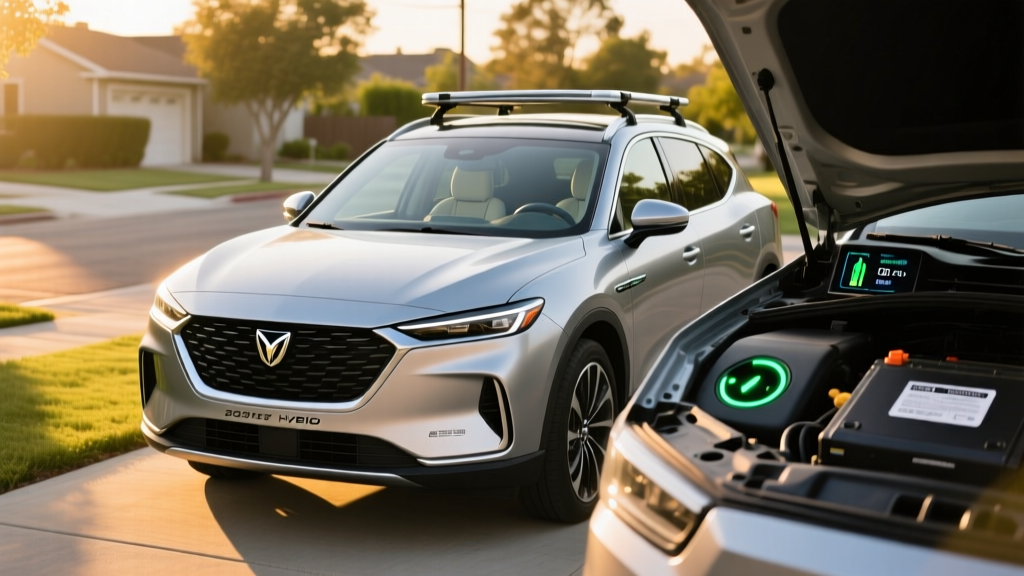
The Mercury Mariner Hybrid was Ford's compact hybrid SUV offering during the late 2000s, sold under the now-defunct Mercury brand. Built on the same platform as the Ford Escape Hybrid, the Mariner Hybrid combined a 2.5-liter four-cylinder engine with an electric motor and a nickel-metal hydride (NiMH) battery pack. Mercury was discontinued after the 2011 model year, making the Mariner Hybrid a used-market-only proposition in 2026 — but its proven powertrain and strong city MPG still attract budget-conscious buyers looking for a fuel-efficient small SUV without plugging in.
This guide covers everything a prospective used buyer needs to know: real-world fuel economy, battery longevity and replacement costs, how the Mariner Hybrid compares to modern hybrids and PHEVs, and whether it still holds up as a daily driver.
HEV vs PHEV: What the Mariner Hybrid Is (and Isn't)
Before diving into specs, it's critical to understand what type of hybrid the Mariner is. The Mercury Mariner Hybrid is a conventional hybrid electric vehicle (HEV), not a plug-in hybrid (PHEV). This distinction matters because it affects how you fuel it, what tax credits apply, and what driving experience to expect.
| Feature | HEV (Mariner Hybrid) | PHEV | BEV (Full EV) |
|---|---|---|---|
| Plugs in to charge? | No — charges via engine & regen | Yes — Level 1/2 | Yes — Level 1/2/DC |
| Electric-only range | ~0 miles (motor assists only) | 20–50 miles typical | 200–400+ miles |
| Fuel source | Gasoline only | Gasoline + electricity | Electricity only |
| Federal tax credit (§30D) | Not eligible | Up to $7,500 (varies) | Up to $7,500 (varies) |
| Best for | No home charging access | Short commutes + road trips | Home charging + low running cost |
The Mariner Hybrid charges its battery exclusively through regenerative braking and the gasoline engine. You never plug it in. You simply fill it with gas at any station and drive. The electric motor assists during acceleration, enables low-speed electric-only crawling (typically under ~25 mph for short distances), and recaptures energy during braking. This makes it ideal for drivers who want better fuel economy without changing their fueling habits.
Mercury Mariner Hybrid Fuel Economy: EPA and Real-World MPG
The Mariner Hybrid's headline selling point was — and remains — its fuel efficiency, particularly in city driving where the hybrid system shines.
| Model Year | City MPG | Highway MPG | Combined MPG |
|---|---|---|---|
| 2010–2011 (2.5L) | 34 | 31 | 33 |
| 2008–2009 (2.3L) | 34 | 30 | 32 |
Source: fueleconomy.gov — U.S. Department of Energy
Real-World MPG vs EPA Estimates
Conventional hybrids like the Mariner often exceed their EPA city rating in real-world stop-and-go traffic. The electric motor handles low-speed acceleration where gas engines are least efficient, and regenerative braking recaptures energy that would otherwise be lost as heat. Owners frequently report 34–38 MPG in city driving.
Highway driving is a different story. At sustained speeds above 65 mph, the gasoline engine does nearly all the work, and the Mariner's aerodynamics and weight work against it. Expect 27–30 MPG on the highway — slightly below the EPA estimate. Cold weather reduces efficiency further, typically by 5–10%, as the engine runs longer to warm the cabin and the battery's charge/discharge efficiency drops in low temperatures.
For a 15-gallon fuel tank, that translates to roughly 450–500 miles of real-world combined range — competitive with many modern compact SUVs and significantly better than the non-hybrid Mariner's ~22 MPG combined.
Powertrain Specs: Engine, Motor, and Combined Output
The Mariner Hybrid uses Ford's second-generation hybrid synergy drive system, closely related to the Toyota-sourced powertrain in the contemporary Escape Hybrid.
| Specification | Value |
|---|---|
| Engine | 2.5L Atkinson-cycle inline-4 |
| Engine horsepower | 156 hp @ 6,000 rpm |
| Electric motor | Permanent-magnet AC synchronous |
| Combined system output | 177 hp |
| Transmission | Electronic CVT (eCVT) |
| Drivetrain | FWD (AWD available) |
| Battery type | NiMH (nickel-metal hydride) |
| Battery capacity | ~1.8 kWh (not usable for EV range) |
| 0–60 mph | ~9.5 seconds |
| Towing capacity | 1,000 lbs (not rated for heavy towing) |
The Atkinson-cycle engine sacrifices some low-end torque for greater thermal efficiency, while the electric motor fills in the torque gap during acceleration. The eCVT is not a traditional belt-and-pulley CVT — it uses a planetary gearset to blend power from the engine and motor seamlessly, with no belts to wear or slip. This design has proven extremely durable in long-term use.
AWD models add a second, smaller electric motor on the rear axle that engages when slip is detected. This is an on-demand AWD system, not full-time, and it adds approximately 1 MPG of consumption versus FWD models.
Battery Reliability, Warranty, and Replacement Cost
Battery longevity is the single biggest concern for used hybrid buyers — and it's where the Mariner Hybrid has a strong track record.
Original Battery Warranty
Ford covered the Mariner Hybrid's NiMH battery with a 8-year/100,000-mile warranty (extended to 10 years/150,000 miles in California and states adopting CARB emissions standards). For a 2010–2011 model, factory warranty coverage has now expired as of 2019–2021.
How Long Do Mariner Hybrid Batteries Last?
NiMH batteries in Ford's second-generation hybrid system have demonstrated strong longevity. Data from owner forums, fleet operators, and independent mechanics show:
- Typical lifespan: 150,000–200,000 miles before significant capacity loss
- Capacity loss pattern: Gradual — expect ~10–15% loss at 150,000 miles, manifesting as a 2–3 MPG drop in city driving
- Catastrophic failure: Rare; most degradation is gradual cell imbalance
- Taxi/fleet data: Ford Escape Hybrids (identical powertrain) commonly reach 250,000+ miles with original batteries in taxi service
The Mariner's NiMH chemistry is less energy-dense than modern lithium-ion but more thermally stable and less prone to sudden capacity cliff degradation. The battery management system in these vehicles was conservative, keeping the state of charge in a narrow 40–80% window to maximize cycle life.
Battery Replacement Cost (2026 Estimates)
| Option | Cost Range | Notes |
|---|---|---|
| New OEM battery (Ford) | $3,000–$4,500 | Limited availability; may require dealer order |
| Remanufactured battery | $1,500–$2,500 | Replaced weak cells; 1–3 year warranty typical |
| Used/salvage battery | $500–$1,200 | Risky; unknown remaining life |
| Individual cell replacement | $300–$800 | Specialist shops only; requires cell balancing |
Because the Mariner shares its hybrid powertrain with the Ford Escape Hybrid (which sold in much higher volumes), aftermarket battery support remains available. Independent hybrid specialists in most metro areas can perform replacements. A remanufactured battery at $1,500–$2,500 installed is the most common path and typically restores original fuel economy.
Pricing: What a Used Mariner Hybrid Costs in 2026
As a discontinued model, the Mariner Hybrid is only available on the used market. Prices vary significantly by mileage, condition, and region.
| Model Year | Mileage Range | Price Range |
|---|---|---|
| 2010–2011 | 80,000–120,000 mi | $6,500–$9,500 |
| 2010–2011 | 120,000–160,000 mi | $4,500–$7,000 |
| 2008–2009 | 100,000–150,000 mi | $4,000–$6,500 |
| Any year | 150,000+ mi | $2,500–$4,500 |
Tax Credit Eligibility
The Mercury Mariner Hybrid does not qualify for the federal §30D new vehicle tax credit — it's no longer sold new, and conventional HEVs were never eligible for the full credit regardless. However, buyers should check:
- Used clean vehicle credit (§25E): The IRS offers up to $4,000 (30% of sale price) for qualifying used EVs and PHEVs purchased from a dealer for under $25,000. However, conventional HEVs like the Mariner Hybrid do not qualify — only BEVs and PHEVs are eligible. See IRS §25E guidelines.
- State incentives: A small number of states offer rebates for used hybrid purchases, but these are uncommon. Check your state's energy or environmental agency website.
Who Should Buy the Mariner Hybrid — And Who Shouldn't
The Mariner Hybrid occupies a specific niche in 2026: an affordable, proven, fuel-efficient compact SUV for buyers who can't or won't plug in.
Pros
- Strong city MPG (34+ real-world) with no plug-in required
- Proven, durable powertrain shared with high-volume Escape Hybrid
- Low purchase price ($4,000–$9,000 used)
- AWD available for snow-belt buyers
- Simple ownership — no charging equipment, no range anxiety
- NiMH battery has excellent longevity track record
Cons
- Discontinued brand — limited dealer support, Mercury-specific body parts scarce
- Dated interior technology (no Apple CarPlay, basic infotainment)
- Highway MPG mediocre (27–30 real-world)
- No electric-only driving range to speak of
- Slow acceleration (~9.5 sec 0–60)
- No federal tax credit eligibility
- Safety features outdated vs modern vehicles (no AEB, lane-keep, etc.)
Choose the Mariner Hybrid If:
- You want a cheap, fuel-efficient small SUV and don't have access to home or workplace charging
- Your driving is predominantly city/suburban stop-and-go where the hybrid system delivers maximum benefit
- You're comfortable buying a 15-year-old vehicle and budgeting for eventual battery replacement
- You need AWD for winter driving on a tight budget
Look Elsewhere If:
- You want modern safety technology (automatic emergency braking, blind-spot monitoring) — consider a 2020+ Toyota RAV4 Hybrid or Honda CR-V Hybrid instead
- You have home charging access and a short commute — a used PHEV like the Toyota RAV4 Prime or a new BEV like the Hyundai Kona Electric will deliver lower operating costs
- You drive mostly highway miles — the MPG advantage shrinks significantly, and a modern turbo gas SUV may match it
- You want warranty coverage — any remaining factory warranty has expired
Mariner Hybrid vs Modern Alternatives
For buyers cross-shopping the used Mariner Hybrid, here's how it stacks up against vehicles available in 2026:
| Vehicle | Type | Combined MPG | Approx. Price | Key Advantage |
|---|---|---|---|---|
| Mercury Mariner Hybrid (used) | HEV | 33 | $4,000–$9,500 | Lowest entry price |
| Toyota RAV4 Hybrid (2026) | HEV | 41 | $33,000–$42,000 | Best MPG, modern safety |
| Honda CR-V Hybrid (2026) | HEV | 40 | $35,000–$43,000 | Refined ride, strong cargo |
| Ford Escape Hybrid (2026) | HEV | 39 | $34,000–$41,000 | Direct successor, same lineage |
| Toyota RAV4 Prime (used 2021+) | PHEV | 94 MPGe / 38 gas | $30,000–$40,000 | 42 mi EV range + tax credit eligible |
The Mariner Hybrid's only clear advantage over modern competitors is price. A modern RAV4 Hybrid delivers 8 more MPG combined, far superior safety technology, a full factory warranty, and current infotainment — but costs $25,000+ more. If your budget is under $10,000 and you need a fuel-efficient SUV, the Mariner Hybrid remains a rational choice.
Ownership Costs: Fuel, Maintenance, and Insurance
Running costs are where the Mariner Hybrid justifies its existence over the non-hybrid Mariner.
| Cost Category | Mariner Hybrid | Non-Hybrid Mariner (22 MPG) |
|---|---|---|
| Fuel (at $3.40/gal) | $1,236 | $1,855 |
| Annual fuel savings | ~$619/year for the hybrid | |
| Insurance (avg) | $1,100–$1,400 | $1,100–$1,400 |
| Routine maintenance | $400–$600 | $400–$600 |
| Tires, brakes, misc. | $300–$500 | $300–$500 |
The hybrid system actually reduces brake wear because regenerative braking handles much of the deceleration, meaning brake pads and rotors last significantly longer than on the gas-only model. The eCVT has no transmission fluid to change on the same interval as a conventional automatic, further reducing maintenance costs.
Over five years of ownership at 12,000 miles annually, the fuel savings alone total approximately $3,100 — a meaningful return on the modest used-price premium the hybrid commands over the gas Mariner.
Frequently Asked Questions
How many MPG does the Mercury Mariner Hybrid get?
The 2010–2011 Mariner Hybrid is EPA-rated at 34 city / 31 highway / 33 combined MPG. Real-world city driving often yields 34–38 MPG thanks to the hybrid system's efficiency in stop-and-go traffic. Highway driving typically returns 27–30 MPG, slightly below the EPA estimate. The earlier 2008–2009 models with the 2.3L engine rate at 34/30/32.
Does the Mercury Mariner Hybrid need to be plugged in?
No. The Mariner Hybrid is a conventional HEV. Its NiMH battery charges through regenerative braking and the gasoline engine. You never plug it in — just fill it with regular unleaded gasoline.
How far can the Mariner Hybrid drive on electric power alone?
Effectively zero miles at meaningful speeds. The electric motor can propel the vehicle at very low speeds (under ~25 mph) for short distances — think parking lots and creeping traffic — but the battery is too small (~1.8 kWh) for any practical electric-only range. This is normal for conventional hybrids and is not a limitation; the system is designed for fuel-economy assist, not electric driving.
Is the Mercury Mariner Hybrid reliable?
Yes, with caveats. The hybrid powertrain itself (engine, eCVT, electric motors, battery) is proven and durable, with documented examples exceeding 200,000 miles. The planetary-gear eCVT is particularly robust. However, as a 15-year-old vehicle, non-powertrain components (suspension, electronics, interior trim) will show age. Mercury-specific body panels and trim can be harder to source than Ford Escape parts, though mechanical parts are widely available since the powertrain is shared.
What does a Mariner Hybrid battery replacement cost?
A remanufactured NiMH battery installed by an independent hybrid specialist typically costs $1,500–$2,500 in 2026. A new OEM battery from Ford runs $3,000–$4,500 but may have limited availability. Individual cell replacement by a specialist can cost as little as $300–$800 if only a few cells have failed. Most batteries last 150,000–200,000 miles before replacement is needed.
Does the Mariner Hybrid qualify for any tax credit?
No. The Mariner Hybrid is a conventional HEV and was never eligible for the federal §30D new vehicle tax credit. It also does not qualify for the §25E used clean vehicle credit, which applies only to BEVs and PHEVs. Some states may offer minor incentives for fuel-efficient used vehicles, but these are rare. Consult IRS guidelines and your state energy office for current programs.
Should I buy a Mariner Hybrid or a modern hybrid?
If your budget is under $10,000, the Mariner Hybrid offers strong city fuel economy at the lowest price point in the hybrid SUV segment. If you can spend $30,000+, a new Toyota RAV4 Hybrid or Ford Escape Hybrid delivers 8+ more MPG, modern safety features (AEB, lane-keeping, adaptive cruise), Apple CarPlay/Android Auto, and a full factory warranty. For buyers with home charging and short commutes, a used PHEV like the RAV4 Prime (42 miles EV range) offers even lower operating costs.
Is Mercury still in business?
No. Ford discontinued the Mercury brand after the 2011 model year. Mercury vehicles are no longer sold new, and dedicated Mercury dealerships no longer exist. However, Ford dealerships and independent mechanics can service the Mariner Hybrid since it shares its platform and powertrain with the Ford Escape Hybrid. Mercury-specific cosmetic parts (badges, unique grille, trim) may require salvage yards or online marketplaces.