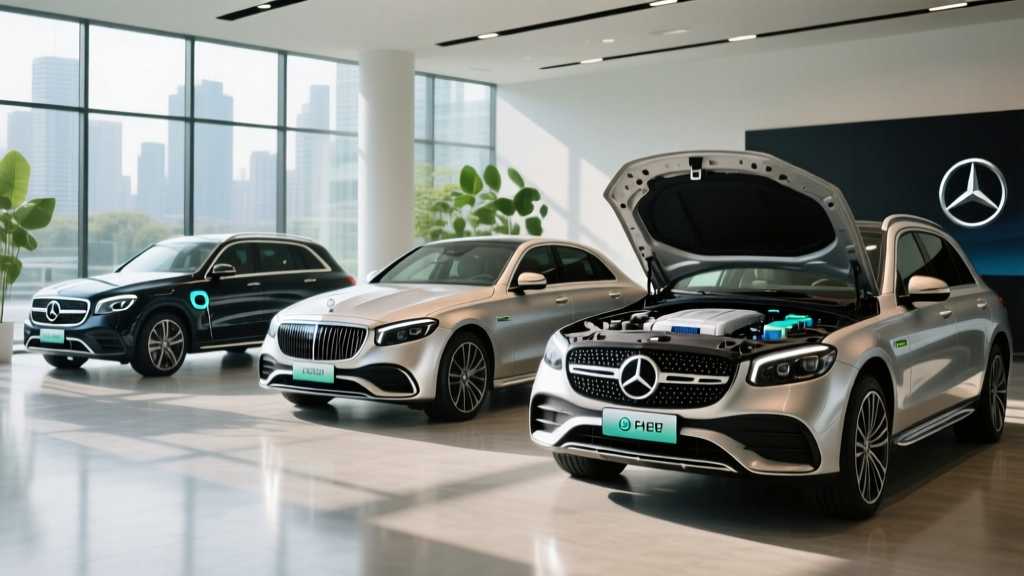
If you want three-pointed-star luxury without going fully electric, a hybrid vehicle Mercedes-Benz offers bridges the gap. For 2026, Mercedes sells three plug-in hybrid (PHEV) models in the U.S.: the S 580e sedan, the GLC 350e SUV, and the GLE 350e SUV. All three pair a turbocharged gasoline engine with a substantial electric motor and a large battery that delivers genuine electric-only commuting range — not just token hybrid assistance.
This guide breaks down each model's EPA numbers, real-world efficiency, charging capabilities, pricing, and tax-credit eligibility so you can decide which Mercedes PHEV fits your garage — or whether a full EV like the EQE or EQS makes more sense.
HEV vs PHEV: What Mercedes Actually Sells in 2026
Before diving into specs, let's clarify terminology. Mercedes-Benz does not currently sell a conventional hybrid (HEV) in the U.S. market — the kind that recharges its small battery solely through regenerative braking and never plugs in. Every electrified Mercedes you can buy stateside is a plug-in hybrid (PHEV), meaning it has a larger battery you charge from a wall outlet or public charger and that provides meaningful electric-only driving range.
Quick Distinction: HEV vs PHEV
| Feature | Conventional Hybrid (HEV) | Plug-in Hybrid (PHEV) |
|---|---|---|
| Plugs in? | No | Yes |
| Battery size | ~1–2 kWh | ~13–25 kWh |
| Electric-only range | 0–1 miles at low speed | 30–50+ miles |
| Federal tax credit | No | Up to $7,500 (if eligible) |
| Examples | Toyota Prius, Honda CR-V Hybrid | Mercedes S 580e, GLC 350e, GLE 350e |
Mercedes uses a 48-volt mild-hybrid system (EQ Boost) on many of its gas-only models like the E 350 and GLS 450. That system provides a small electric assist during acceleration and enables smooth stop-start, but it does not deliver electric-only driving and the car never plugs in. For the purposes of this guide, we're focused on the three true PHEVs where electrification meaningfully changes how you drive and fuel.
The 2026 Mercedes PHEV Lineup: Specs at a Glance
| Spec | S 580e Sedan | GLC 350e SUV | GLE 350e SUV |
|---|---|---|---|
| Powertrain | 3.0L turbo I6 + electric motor | 2.0L turbo I4 + electric motor | 2.0L turbo I4 + electric motor |
| Combined HP | 449 hp | 312 hp | 302 hp |
| 0–60 mph | 4.9 sec | 6.5 sec | 6.8 sec |
| Battery (usable) | ~22.0 kWh (NMC) | ~19.7 kWh (NMC) | ~19.7 kWh (NMC) |
| EPA Electric Range | ~40 mi | ~38 mi | ~37 mi |
| EPA Combined MPG (hybrid) | ~27 MPG | ~28 MPG | ~25 MPG |
| EPA MPGe (electric mode) | ~54 MPGe | ~56 MPGe | ~50 MPGe |
| Level 2 Charge Time (0–100%) | ~2.5 hr (7.4 kW) | ~2.25 hr (7.4 kW) | ~2.25 hr (7.4 kW) |
| DC Fast Charge | No | No | No |
| Base MSRP | ~$118,000 | ~$58,500 | ~$63,500 |
| Drivetrain | RWD | AWD (4MATIC) | AWD (4MATIC) |
Sources: fueleconomy.gov (EPA estimates), Mercedes-Benz USA. Specs reflect 2026 model year; verify exact figures at purchase as mid-year adjustments can occur.
How Many MPG Does a Mercedes Hybrid Get?
The answer depends on how you drive and whether you charge. Here's the EPA breakdown for each model:
| Model | City MPG | Highway MPG | Combined MPG | Combined MPGe |
|---|---|---|---|---|
| S 580e | ~25 | ~30 | ~27 | ~54 |
| GLC 350e | ~27 | ~30 | ~28 | ~56 |
| GLE 350e | ~23 | ~27 | ~25 | ~50 |
MPG vs MPGe explained: MPG measures fuel economy when the gasoline engine is running (battery depleted). MPGe (miles per gallon equivalent) measures efficiency when driving on electricity alone. The combined figure depends on how much of your driving happens in electric mode.
Real-World MPG vs EPA Sticker
Mercedes PHEVs — like most plug-in hybrids — tend to beat their EPA city estimates in real-world driving because regenerative braking recovers energy in stop-and-go traffic. On a commute with frequent stops, expect the GLC 350e to deliver 29–32 MPG city once the battery is depleted, slightly above its 27 MPG EPA rating.
Highway driving tells a different story. At sustained 75–80 mph speeds, the electric motor provides minimal assistance and the turbocharged engine does most of the work. The GLE 350e, the heaviest of the three, may return 24–26 MPG on the highway against its 27 MPG EPA estimate. Aerodynamic drag and weight work against it at speed.
The critical variable is charging frequency. If you plug in nightly and your round-trip commute is under 38 miles, the GLC 350e or GLE 350e might use gasoline only on weekend road trips. Owners who never plug in effectively drive a heavy, somewhat less efficient gas car — the battery becomes dead weight. PHEV economics only work if you actually plug in.
How Far Can a Mercedes PHEV Go on Electric Only?
The 2026 Mercedes PHEV lineup delivers between 37 and 40 miles of EPA-rated electric-only range, which covers the average American's daily round-trip commute of roughly 30–35 miles according to Federal Highway Administration data.
Electric-Only Range: EPA vs Real World
EPA ratings: S 580e ~40 mi | GLC 350e ~38 mi | GLE 350e ~37 mi
Real-world expectation: In mild weather (60–75°F) at city speeds, expect to match or slightly exceed EPA range. At highway speeds (70+ mph), expect 28–32 miles. In freezing temperatures with cabin heating, expect 24–30 miles — battery chemistry slows and HVAC loads draw from the same pack.
Total combined range (gas + electric): All three models exceed 400 miles total, with the S 580e's larger fuel tank pushing past 450 miles.
Mercedes equips these PHEVs with multiple drive modes: Electric (battery-only), Hybrid (system blends both), and Battery Hold (preserves charge for later use — useful for entering zero-emission zones or saving electric miles for city driving after a highway segment).
Charging: Level 2 Only, No DC Fast Charging
One limitation that surprises some buyers: none of the 2026 Mercedes PHEVs support DC fast charging. You're limited to Level 2 AC charging at a maximum rate of 7.4 kW via the J1772 connector (or NACS with adapter on newer builds).
Here's what charging looks like in practice:
- Level 1 (120V household outlet, ~1.4 kW): Full charge in approximately 13–15 hours. Viable if you park in a garage with a standard outlet and can charge overnight.
- Level 2 (240V, 7.4 kW home charger or public station): Full charge in roughly 2.25–2.5 hours. This is the intended use case — plug in when you get home, wake up to a full battery.
- DC fast charging: Not available. Mercedes reserves DC fast charging for its full EV lineup (EQE, EQS) and some international PHEV variants not sold in the U.S.
At 7.4 kW, a home Level 2 charger (such as a ChargePoint Home Flex or Mercedes-branded wallbox) is the practical standard. Installation on a 240V/40A circuit typically costs $800–$1,800 depending on your electrical panel's capacity and the run length from panel to garage. If your panel needs an upgrade to 200A service, add $1,500–$3,000.
The lack of DC fast charging means these PHEVs aren't designed for electric-mode road trips. On a long drive, the gasoline engine takes over seamlessly once the battery depletes — that's the whole PHEV value proposition. You won't be hunting for chargers on I-95.
Pricing and Federal Tax Credit Eligibility
Here's where the numbers get interesting — and complicated. Under current IRS §30D rules, PHEVs can qualify for up to $7,500 in federal tax credits, but eligibility depends on MSRP caps, buyer income limits, battery component sourcing, and critical mineral requirements.
§30D Federal Tax Credit Eligibility Checklist
- MSRP cap: SUVs (GLC 350e, GLE 350e) must be under $80,000; sedans (S 580e) under $55,000 — the S 580e exceeds the sedan cap and does NOT qualify
- Buyer income cap: AGI must not exceed $150,000 (single), $225,000 (head of household), or $300,000 (joint)
- Battery sourcing: Must meet critical-mineral and battery-component requirements that tighten annually — verify current-year compliance on IRS.gov
- Point-of-sale transfer: Eligible buyers can transfer the credit to the dealer at purchase, reducing the out-of-pocket price immediately
- Final assembly: Must occur in North America (all three models qualify)
Bottom line on credits: The GLC 350e (~$58,500 MSRP) and GLE 350e (~$63,500 MSRP) both fall under the $80,000 SUV cap and may qualify for up to $7,500, depending on your income and the current battery-sourcing rules. The S 580e, as a sedan priced above $55,000, does not qualify for the federal credit. Always verify eligibility with a tax professional and check fueleconomy.gov for the most current credit amounts before purchasing.
Effective Pricing After Potential Credits
| Model | Base MSRP | Potential Credit | Effective Price |
|---|---|---|---|
| GLC 350e 4MATIC | ~$58,500 | Up to $7,500 | ~$51,000 |
| GLE 350e 4MATIC | ~$63,500 | Up to $7,500 | ~$56,000 |
| S 580e | ~$118,000 | $0 | ~$118,000 |
Options and packages add quickly. A well-equipped GLC 350e with the AMG Line exterior, Pinnacle Trim, and Driver Assistance Package can reach $68,000–$72,000 before credits. The GLE 350e with the Exclusive Trim and MBUX Superscreen approaches $75,000.
Reliability, Battery Warranty, and Replacement Costs
Mercedes-Benz covers the high-voltage PHEV battery with a warranty of 6 years or 62,000 miles (whichever comes first), guaranteeing a minimum of 70% capacity retention. This is shorter than the 8-year/100,000-mile or 10-year/150,000-mile warranties offered by Toyota, Hyundai, and BMW on their hybrid and PHEV batteries — a point worth noting if long-term ownership is your plan.
Battery Warranty & Replacement Snapshot
Warranty: 6 years / 62,000 miles, ≥70% capacity retention
Estimated replacement cost: $12,000–$18,000 (battery pack + labor) based on current dealer pricing for Mercedes PHEV packs
Real-world degradation: NMC chemistry in Mercedes PHEVs has shown approximately 8–12% capacity loss over 5 years/60,000 miles in European fleet data — well within the warranty threshold
12V battery: These vehicles also have a conventional 12V battery for accessories; it may need replacement every 4–6 years (~$300–$500)
Mercedes PHEVs use NMC (nickel manganese cobalt) battery chemistry, which offers higher energy density than LFP (lithium iron phosphate) but degrades slightly faster over time and with repeated full-charge cycles. To maximize longevity:
- Set the charge limit to 80–90% for daily use; charge to 100% only before longer electric-range commutes
- Avoid leaving the vehicle at 0% or 100% state of charge for extended periods
- Use preconditioning when plugged in (available via the Mercedes me app) to warm or cool the battery before driving, reducing stress on the cells
Overall reliability of the Mercedes PHEV powertrain has been solid based on owner surveys, though the complexity of combining a turbocharged engine, electric motor, high-voltage battery, and associated power electronics means more potential failure points than either a pure EV or a conventional gas car. The IIHS and NHTSA have given the GLC and GLE strong safety ratings, and Mercedes includes its full suite of driver-assistance features (Active Brake Assist, Active Lane Keeping, Active Distance Assist DISTRONIC — a Level 2 SAE system requiring driver engagement) on all PHEV trims.
Mercedes PHEV vs Full EV vs Gas: Which Fits You?
Choosing between a Mercedes PHEV, a full battery EV (like the EQE or EQS), or a conventional gas model (like the E 350 or GLE 450) depends on your charging access, driving patterns, and tolerance for complexity.
Choose a Mercedes PHEV If:
- You can charge at home (garage or driveway with 240V access)
- Your daily commute is under 40 miles round-trip
- You take regular road trips where charging infrastructure is sparse
- You want electric commuting without range anxiety
- You want the potential $7,500 federal credit on a luxury SUV
Choose a Full EV (EQE/EQS) If:
- You have reliable home charging and good public DC fast-charger access
- You want minimal maintenance (no oil changes, no engine)
- You drive primarily in urban and suburban settings
- You want maximum federal credit eligibility ($7,500 on qualifying EVs)
- You want the quietest, smoothest powertrain experience
A conventional gas Mercedes (E 350, GLC 300, GLE 450) makes sense if you lack home charging access, drive mostly long highway routes, or prefer lower upfront cost and simpler mechanicals. The 48-volt EQ Boost system on those models provides mild efficiency gains without any plug-in requirement.
Decision Framework
GLC 350e: Best all-around PHEV value. Compact luxury SUV with AWD, ~38 mi electric range, and potential tax credit brings effective price near $51K. Ideal for urban/suburban families.
GLE 350e: Choose if you need the larger cabin, third-row option, and more cargo space. Slightly lower MPG and electric range, but similar PHEV benefits in a bigger package.
S 580e: A flagship luxury experience with the most electric range (~40 mi) and the smoothest I6 powertrain. No tax credit due to the sedan MSRP cap. For buyers who want S-Class prestige with a smaller carbon footprint on commutes.
Frequently Asked Questions
Does the Mercedes GLC 350e qualify for the $7,500 federal tax credit?
The GLC 350e falls under the $80,000 SUV MSRP cap and is assembled in North America, making it potentially eligible. However, you must also meet IRS income limits (under $300,000 AGI for joint filers) and the vehicle must satisfy current-year battery sourcing and critical mineral requirements. These sourcing rules tighten annually. Check IRS.gov and consult a tax professional before relying on the credit.
What happens if I never plug in my Mercedes PHEV?
The car drives normally as a hybrid, using the gasoline engine with some regenerative assistance. However, you'll get MPG in the mid-20s (GLE) to upper-20s (GLC) — not dramatically better than the non-hybrid GLC 300 or GLE 450 — while having paid a premium for the PHEV powertrain and carrying the extra weight of a depleted battery. The financial and environmental case for a PHEV collapses without regular charging.
Can I DC fast charge a Mercedes plug-in hybrid?
No. The 2026 S 580e, GLC 350e, and GLE 350e only accept Level 2 AC charging at up to 7.4 kW. A full charge takes about 2.25–2.5 hours. DC fast charging is reserved for the all-electric EQ lineup. This is a deliberate engineering choice — the smaller PHEV batteries aren't designed for the thermal stress of high-power DC charging.
How long will the Mercedes PHEV battery last?
Based on NMC chemistry degradation patterns, expect 85–92% capacity retention after 5 years and 60,000 miles. The battery is warranted for 6 years/62,000 miles at 70% minimum capacity. Real-world data from European Mercedes PHEV fleets suggests the pack should remain functional for 10–15 years before capacity loss makes electric-only range impractically short. Full replacement, if needed, runs $12,000–$18,000.
Is the Mercedes PHEV more reliable than a full EV?
Not necessarily. PHEVs combine a full internal combustion engine (turbo, injectors, exhaust, transmission) with a high-voltage electric system (battery, motor, power electronics, charging hardware). That's more components than either a pure EV or a pure gas car. Full EVs have fewer moving parts and typically lower maintenance costs. The PHEV advantage is flexibility, not simplicity.
Does the S 580e sedan qualify for any tax credit?
No. Under IRS §30D rules, sedans must have an MSRP under $55,000 to qualify for the new clean vehicle credit. The S 580e starts around $118,000, far exceeding that cap. No federal purchase incentive applies, though some states offer separate rebates that don't have MSRP caps — check your state's energy office for details.