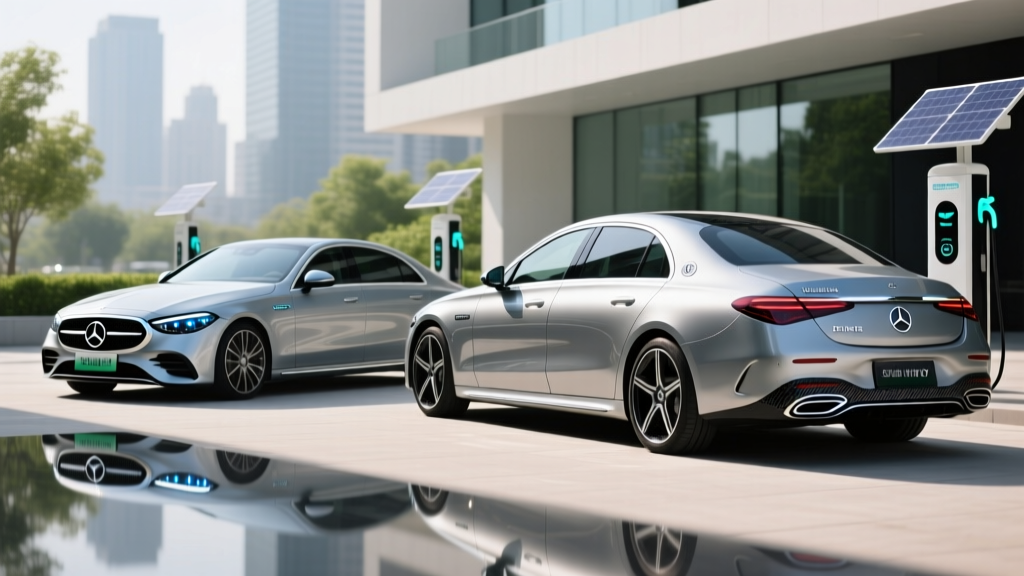
Mercedes-Benz has committed to plug-in hybrid electrification across its core sedan lineup, offering three distinct PHEV options in 2026: the compact C 300e, the midsize E 350e, and the flagship S 580e. Unlike conventional hybrids that recapture energy through regenerative braking alone, each of these is a plug-in hybrid electric vehicle (PHEV) — meaning you charge the battery externally to unlock meaningful electric-only driving range before the gasoline engine engages.
This guide breaks down every 2026 Mercedes hybrid sedan by the numbers: EPA-rated MPG and MPGe, electric-only range, battery capacity, charging speed, powertrain output, MSRP, and federal tax-credit eligibility under IRS §30D rules. We also address the questions hybrid shoppers actually ask — real-world efficiency, battery longevity, and whether a PHEV or a full BEV makes more sense for your driving pattern.
HEV vs PHEV: What Mercedes Actually Sells in 2026
Conventional Hybrid (HEV): Uses a small battery charged only by the engine and regenerative braking. No plug. Typical electric-only assist is under 1 mile. Examples: Toyota Camry Hybrid, Honda Accord Hybrid.
Plug-in Hybrid (PHEV): Carries a larger battery (typically 15–30 kWh) that charges via an external plug — Level 1 (120V), Level 2 (240V), or in some cases DC fast charging. Delivers 30–50+ miles of electric-only range before the gas engine starts. All three current Mercedes hybrid sedans fall into this category.
Mercedes does not currently offer a conventional (non-plug) HEV sedan in the U.S. market for the 2026 model year. Every electrified Mercedes sedan is a PHEV or a full battery-electric vehicle (BEV) under the EQ lineup. This matters because PHEV ownership requires access to charging — ideally a home Level 2 setup — to realize the efficiency and cost benefits.
2026 Mercedes Hybrid Sedan Specs at a Glance
| Spec | C 300e | E 350e | S 580e |
|---|---|---|---|
| Powertrain | 2.0L turbo I4 + electric motor | 2.0L turbo I4 + electric motor | 3.0L turbo I6 + electric motor |
| Combined Horsepower | 312 hp | 312 hp | 443 hp |
| Combined Torque | 406 lb-ft | 406 lb-ft | 516 lb-ft |
| Battery Capacity (gross / usable) | 25.4 kWh / ~21.5 kWh | 25.4 kWh / ~21.5 kWh | 28.6 kWh / ~23.5 kWh |
| EPA Electric-Only Range | ~46 mi | ~44 mi | ~40 mi |
| EPA Combined MPG (hybrid mode) | ~30 MPG | ~29 MPG | ~27 MPG |
| MPGe (electric + gas combined) | ~72 MPGe | ~68 MPGe | ~56 MPGe |
| Level 2 AC Charge (0–100%) | ~3.25 hrs at 7.4 kW | ~3.25 hrs at 7.4 kW | ~3.75 hrs at 7.4 kW |
| DC Fast Charge Capability | Optional (up to 60 kW) | Optional (up to 60 kW) | Optional (up to 60 kW) |
| 0–60 mph | 5.4 sec | 5.6 sec | 4.9 sec |
| Starting MSRP | ~$58,900 | ~$67,500 | ~$120,500 |
| Drivetrain | RWD (4MATIC available) | RWD (4MATIC available) | RWD (4MATIC available) |
Note: Specs reflect 2026 model-year manufacturer estimates and EPA data as of early 2026. Final EPA certification figures may vary slightly by trim and option package. Source: fueleconomy.gov and Mercedes-Benz USA.
Fuel Economy: EPA MPG and Real-World Expectations
| Model | City MPG | Highway MPG | Combined MPG | MPGe (Combined) |
|---|---|---|---|---|
| C 300e | ~33 | ~27 | ~30 | ~72 |
| E 350e | ~32 | ~26 | ~29 | ~68 |
| S 580e | ~29 | ~25 | ~27 | ~56 |
Real-world MPG context: The MPG figures above apply once the battery is depleted and the car operates in hybrid mode. In practice, PHEV efficiency depends heavily on your charging habits. If your daily commute is under 40 miles and you charge every night, you may use almost zero gasoline for weeks — effectively achieving 100+ MPGe in daily driving. On long highway road trips where the battery depletes within the first 40 miles, expect the combined MPG to settle near the EPA hybrid-mode figures, or slightly below in cold weather (engine runs more to provide cabin heat and maintain battery temperature).
Mercedes' hybrid sedans tend to slightly exceed their EPA city MPG in stop-and-go traffic, where regenerative braking recaptures the most energy. Highway MPG, however, often falls 2–4 MPG short of the sticker at sustained 75+ mph speeds, particularly with 4MATIC all-wheel drive adding drivetrain friction and weight.
Electric-Only Range and Daily Driving on Battery Power
All three 2026 Mercedes PHEV sedans deliver between 40 and 46 miles of EPA-rated electric-only range — enough to cover the average American's one-way commute (approximately 16 miles, per U.S. Census data) with substantial margin.
Real-World Electric Range Expectations:
- C 300e: EPA ~46 mi → expect 38–42 mi in mixed driving, 30–35 mi at sustained highway speeds or in sub-40°F weather
- E 350e: EPA ~44 mi → expect 36–40 mi mixed, 28–33 mi highway/cold
- S 580e: EPA ~40 mi → expect 33–37 mi mixed, 26–30 mi highway/cold
Cold weather reduces lithium-ion battery performance and increases cabin heating demand, which draws from the traction battery. Preconditioning the cabin while plugged in (via the Mercedes me connect app) mitigates this loss significantly.
The S 580e's slightly shorter electric range, despite its larger battery, reflects the sedan's greater mass (~5,100 lbs) and higher energy consumption per mile. The C 300e, at roughly 4,200 lbs, extracts the most range from a nearly identical battery pack.
Charging: Level 1, Level 2, and DC Fast Charge Options
Every 2026 Mercedes PHEV sedan comes standard with a Level 2 onboard charger rated at 7.4 kW (AC). This means a full charge from 0–100% takes approximately 3.25 to 3.75 hours using a 240V home charger or public Level 2 station.
Level 1 charging (standard 120V household outlet at ~1.4 kW) adds roughly 4–5 miles of electric range per hour. A full Level 1 charge takes 15–18 hours — viable for overnight top-ups if you drive fewer than 30 miles daily, but too slow for same-day turnaround.
DC fast charging is available as an option on all three models, supporting up to 60 kW on compatible CCS connectors. At this rate, a 10–80% charge takes approximately 25–30 minutes. This is a meaningful upgrade for drivers who want to charge during errands or on road trips, though it's worth noting that 60 kW is modest compared to full BEVs that accept 150–350 kW. PHEV batteries are smaller, so the total energy added is lower, but the charge curve still tapers significantly above 80% state of charge to protect battery health.
Mercedes uses the CCS1 connector standard for AC and DC charging on these PHEVs. With the industry's ongoing shift to NACS (the Tesla connector), Mercedes has confirmed future models will adopt NACS, but 2026 PHEV sedans retain CCS1. Adapters are available for Tesla Supercharger access where supported.
Battery Warranty, Longevity, and Replacement Cost
Mercedes-Benz High-Voltage Battery Warranty (2026):
- Coverage: 6 years or 62,000 miles (whichever comes first) for PHEV high-voltage batteries in the U.S. market
- Capacity threshold: Warranty applies if battery capacity falls below 70% of original capacity
- Extended coverage: Some states with California Air Resources Board (CARB) emissions rules mandate longer hybrid battery warranties — up to 10 years / 150,000 miles. Check your state's requirements.
Is the Mercedes hybrid battery reliable? Mercedes' fourth-generation PHEV system (introduced with the W206 C-Class and W214 E-Class) uses lithium-ion NMC (nickel manganese cobalt) cells with active liquid thermal management. This system maintains battery temperature within an optimal range, reducing degradation compared to passively cooled packs. Real-world data from earlier-generation Mercedes PHEVs (2019–2023) shows typical capacity retention of 88–93% after five years and 60,000 miles — well above the 70% warranty threshold.
Battery replacement cost: If a high-voltage battery requires full replacement outside of warranty, expect a cost between $12,000 and $18,000 including parts and labor at a Mercedes dealership, depending on the model. Individual module replacement (if only certain cells fail) can reduce this to $3,000–$6,000. Mercedes designs its PHEV batteries with serviceable modules rather than requiring full-pack replacement in most failure scenarios.
Maximizing battery lifespan: Avoid routinely charging to 100% unless you need the full range for a trip. Mercedes' onboard battery management system includes a built-in buffer (you can't truly charge to 100% or discharge to 0% at the cell level), which protects longevity. Setting the charge limit to 80–90% for daily use via the Mercedes me app further extends cycle life.
Federal Tax Credit Eligibility Under IRS §30D
The federal plug-in hybrid tax credit under IRS §30D applies to PHEVs that meet specific battery capacity, critical-mineral sourcing, MSRP, and buyer income requirements. Here is the 2026 eligibility landscape for Mercedes hybrid sedans:
- Maximum credit: Up to $7,500, split into $3,750 for critical-mineral sourcing and $3,750 for battery-component manufacturing requirements
- Buyer income caps: AGI must not exceed $150,000 (single), $225,000 (head of household), or $300,000 (joint filing)
- MSRP cap for sedans: Vehicle MSRP must not exceed $55,000 — this eliminates the E 350e (~$67,500) and S 580e (~$120,500) from federal credit eligibility
- C 300e eligibility: At ~$58,900 base MSRP, the C 300e also exceeds the $55,000 sedan cap in most trims. However, if optioned as a wagon or if Mercedes adjusts pricing, certain configurations may qualify. Always verify the specific VIN against the IRS qualifying-vehicles list.
- Point-of-sale transfer: If eligible, the credit can be transferred to the dealer at purchase, reducing your out-of-pocket cost immediately rather than waiting for a tax refund
- Battery sourcing rules: Critical minerals and battery components must meet escalating domestic-content thresholds. Mercedes sources battery cells from global suppliers, and compliance varies by build date and supply chain updates. Check fueleconomy.gov for the current qualifying-vehicle list.
Bottom line on tax credits: Most 2026 Mercedes hybrid sedans will not qualify for the full federal §30D credit due to MSRP caps. State and local incentives may still apply — for example, California's CVRP, Colorado's state credit, or utility-company rebates for home charger installation. Consult a tax professional and your state's energy office for current programs.
Mercedes Hybrid Sedan vs Full EV vs Gas: Which Fits You?
Choose a Mercedes PHEV sedan if:
- Your daily commute is under 40 miles round-trip and you can charge at home overnight
- You take regular road trips (200+ miles) and want zero range anxiety — the gas engine provides 350+ miles of total range
- You live in a region with unreliable public charging infrastructure and can't depend on DC fast chargers for daily needs
- You want Mercedes' latest interior technology, MBUX infotainment, and Level 2 driver-assist (Distronic/Active Distance Assist) in a proven sedan platform
Choose a full BEV (e.g., Mercedes EQE or EQS sedan) if:
- You have reliable home Level 2 charging and your daily driving is under 250 miles
- You want to eliminate gasoline costs entirely and reduce maintenance (no oil changes, fewer moving parts)
- You qualify for the full $7,500 federal credit on a qualifying BEV with compliant sourcing
Choose a conventional gas sedan if:
- You cannot install a home charger (apartment, no garage, electrical panel limitations)
- Your annual mileage is very low (under 8,000 miles), making the PHEV price premium hard to recoup
- You prefer to minimize upfront cost and are comfortable with current fuel prices
Pricing and Trim Breakdown
| Model | Base Trim | Starting MSRP | 4MATIC AWD Add-On | Estimated Out-the-Door |
|---|---|---|---|---|
| C 300e | Premium | ~$58,900 | +$2,500 | ~$62,000–$65,000 |
| E 350e | Premium | ~$67,500 | +$2,500 | ~$71,000–$76,000 |
| S 580e | Premium | ~$120,500 | +$2,800 | ~$126,000–$135,000 |
All three models qualify for Mercedes' standard new-vehicle warranty: 4 years / 50,000 miles bumper-to-bumper, plus the high-voltage battery warranty detailed above. Maintenance plans (prepaid service) are available and recommended given Mercedes dealership labor rates of $180–$250/hour in most metro areas.
Pros
- 40–46 miles of real electric-only range covers most commutes gas-free
- Luxury sedan refinement with MBUX, Burmester audio, and advanced ADAS
- No range anxiety — gas engine provides 350+ total miles for road trips
- DC fast-charge option (60 kW) enables practical on-the-go top-ups
- Strong combined horsepower (312–443 hp) with seamless gas/electric transitions
- Liquid-cooled battery with proven thermal management for longevity
Cons
- MSRP exceeds $55,000 sedan cap — most trims won't qualify for federal §30D credit
- PHEV battery reduces trunk space vs gas-only C/E/S-Class (roughly 2–3 cu ft loss)
- 6-year / 62,000-mile battery warranty is shorter than Toyota/Hyundai (10 yr / 150,000 mi in CARB states)
- 60 kW DC fast-charge peak is slow compared to modern BEVs (150–350 kW)
- Premium pricing — C 300e starts ~$12,000 above the gas C 300
- Requires home Level 2 charging to maximize value proposition
Frequently Asked Questions
How many MPG does a Mercedes hybrid sedan get?
In hybrid mode (battery depleted), the 2026 C 300e achieves approximately 30 MPG combined (33 city / 27 highway), the E 350e about 29 MPG combined, and the S 580e about 27 MPG combined. However, if you charge daily and commute under 40 miles, your effective fuel consumption can be far lower — many owners report using gasoline only on weekend road trips.
How far can a Mercedes PHEV go on electric only?
The C 300e leads the lineup with an EPA-rated ~46 miles of electric-only range, the E 350e delivers ~44 miles, and the S 580e provides ~40 miles. Real-world range drops to 30–38 miles depending on driving style, speed, and ambient temperature. All three support electric-only driving at speeds up to 87 mph before the engine engages.
Does the Mercedes C 300e or E 350e qualify for the $7,500 federal tax credit?
Most likely not. The §30D credit caps sedan eligibility at $55,000 MSRP, and both the C 300e (~$58,900) and E 350e (~$67,500) exceed that threshold. The S 580e (~$120,500) is far above it. State incentives may partially offset the cost — check your state's clean-vehicle rebate program and consult a tax professional for personalized guidance.
Is the Mercedes hybrid system reliable?
Mercedes' current fourth-generation PHEV architecture uses liquid-cooled NMC lithium-ion cells with modular serviceability. Early reliability data from 2022–2025 models shows low failure rates and typical capacity retention above 88% at five years. The main reliability consideration is the complexity of dual powertrains — you have both an internal combustion engine and a full electric drive system, which means more components that could theoretically require service compared to a pure BEV or a conventional gas car.
What does it cost to replace a Mercedes PHEV battery?
Full battery-pack replacement outside of warranty runs approximately $12,000–$18,000 at a Mercedes dealer. However, the modular design allows individual cell-module replacement at $3,000–$6,000 in most partial-failure scenarios. Given the liquid thermal management and Mercedes' built-in charge buffers, most PHEV batteries should outlast the vehicle's typical ownership cycle without requiring replacement.
Can I charge a Mercedes PHEV at a Tesla Supercharger?
2026 Mercedes PHEV sedans use the CCS1 connector. Tesla has opened select Supercharger stations to non-Tesla vehicles via the Magic Dock adapter (built into some V3 stalls) or through a CCS-to-NACS adapter. Charging speeds will be limited to the car's 60 kW DC maximum regardless of the station's capability. Check the Tesla app for compatible stations in your area.
Do I need to plug in a Mercedes hybrid every night?
You don't need to — the car will operate as a conventional hybrid if the battery is depleted, using the gasoline engine and regenerative braking. However, to capture the fuel-cost savings and electric-only driving benefits that justify the PHEV premium, nightly charging on a Level 2 home charger is strongly recommended. A standard 120V outlet (Level 1) works for overnight top-ups if your daily electric usage is under 25 miles.
Sources: fueleconomy.gov (EPA ratings), Mercedes-Benz USA (manufacturer specifications), IRS §30D Clean Vehicle Credits. All specifications and pricing are based on 2026 model-year data available at time of publication and are subject to change. Verify tax-credit eligibility for your specific VIN and filing status with a qualified tax professional.