Mercedes-Benz Plug-In Hybrids in 2026: The Lineup at a Glance
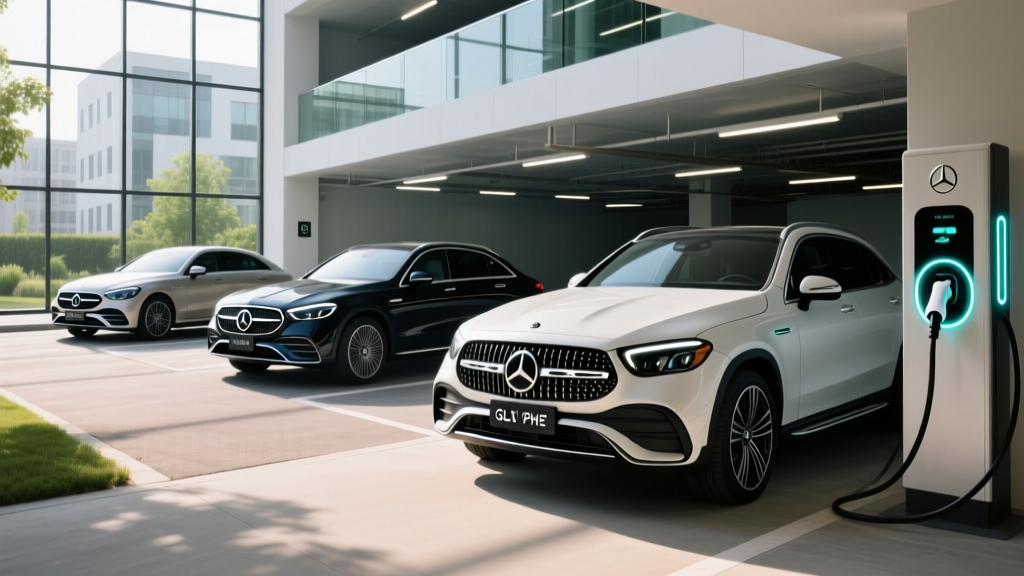
Mercedes-Benz offers one of the broadest plug-in hybrid (PHEV) lineups among luxury automakers, spanning compact SUVs, flagship sedans, and two-door coupes. For buyers searching for a Mercedes hybrid plug-in that bridges the gap between gas convenience and daily electric commuting, the 2026 lineup centers on three core models: the GLC 350e 4MATIC (compact luxury SUV), the S 580e 4MATIC (flagship sedan), and the CLE 350e 4MATIC (coupe). Each pairs a turbocharged gasoline engine with a substantial battery pack and electric motor, delivering 35–54 miles of EPA-rated electric-only range.
Unlike conventional hybrids (HEVs) such as the Toyota Prius—which recharge their small batteries solely through regenerative braking and the engine—these Mercedes PHEVs feature large lithium-ion packs you plug in overnight. That distinction matters enormously for daily driving economics and federal tax credit eligibility.
HEV vs. PHEV: What's the Difference?
| Feature | Conventional Hybrid (HEV) | Plug-In Hybrid (PHEV) |
|---|---|---|
| Plug in to charge? | No — self-charging via regen & engine | Yes — plug in for full electric range |
| Battery size | ~1–2 kWh | ~13–29 kWh (Mercedes lineup) |
| Electric-only range | ~1 mile or less at low speed | 35–54 miles (EPA) |
| Federal tax credit | None (expired for most) | Up to $3,750 under §30D (varies) |
| Best for | Drivers who can't charge at home | Drivers with home/work charging access |
GLC 350e 4MATIC: The Best-Selling Mercedes PHEV
The GLC 350e 4MATIC is the volume leader in the Mercedes plug-in hybrid lineup and one of the few luxury compact SUVs offering meaningful electric-only range. For the 2026 model year, it carries over the powertrain introduced with the current generation, pairing a 2.0-liter turbocharged inline-four with a permanently excited synchronous electric motor integrated into the nine-speed automatic transmission.
| Specification | Value |
|---|---|
| Combined System Output | 312 hp / 406 lb-ft torque |
| Gas Engine | 2.0L turbo I4 (215 hp) |
| Electric Motor | 134 hp (100 kW) |
| Battery (usable) | 19.1 kWh lithium-ion (NMC) |
| EPA Electric-Only Range | 39 miles |
| Total Combined Range | ~430 miles (gas + electric) |
| EPA MPGe (electric + gas) | 65 MPGe combined |
| EPA MPG (charge-sustaining) | 26 city / 29 highway / 27 combined |
| 0–60 mph | 6.2 seconds |
| AC Charging (Level 2) | 7.4 kW (0–100% in ~2.75 hours) |
| DC Fast Charging | Not available |
| Starting MSRP | $59,950 (incl. destination) |
| Federal Tax Credit (§30D) | Up to $3,750 (see eligibility below) |
Real-World Electric Range: What to Expect
The EPA rates the GLC 350e at 39 miles electric-only. In real-world mixed driving at moderate temperatures (65–75°F), expect 33–38 miles. Highway-dominant commutes at 70+ mph will drop that to roughly 28–32 miles. In freezing weather (below 32°F), plan for 24–28 miles due to cabin heating demands and reduced battery efficiency. Preconditioning the cabin while plugged in recovers 3–5 miles of range.
The GLC 350e does not support DC fast charging—a notable omission for a 2026 PHEV. However, for the vast majority of PHEV owners who charge at home or work overnight, the 7.4 kW Level 2 onboard charger fully replenishes the 19.1 kWh battery in under three hours. That's fast enough to "top off" during a workday.
S 580e 4MATIC: Flagship Sedan With 50+ Miles of EV Range
The S-Class has long been Mercedes' technology showcase, and the S 580e plug-in hybrid continues that tradition with one of the longest electric-only ranges of any luxury PHEV on the market. Under the hood sits a 3.0-liter turbocharged inline-six paired with a more powerful electric motor than the GLC's, yielding V8-rivaling acceleration with four-cylinder fuel consumption once the battery depletes.
| Specification | Value |
|---|---|
| Combined System Output | 443 hp / 443 lb-ft torque |
| Gas Engine | 3.0L turbo I6 (362 hp) |
| Electric Motor | 148 hp (110 kW) |
| Battery (usable) | 22.7 kWh lithium-ion (NMC) |
| EPA Electric-Only Range | 54 miles |
| Total Combined Range | ~490 miles |
| EPA MPGe (electric + gas) | 74 MPGe combined |
| EPA MPG (charge-sustaining) | 24 city / 28 highway / 26 combined |
| 0–60 mph | 5.0 seconds |
| AC Charging (Level 2) | 7.4 kW (~3.25 hours 0–100%) |
| DC Fast Charging | Not available |
| Starting MSRP | $120,850 (incl. destination) |
| Federal Tax Credit (§30D) | Not eligible (exceeds MSRP cap) |
The S 580e's 54-mile electric range is a standout figure. For many owners with a sub-40-mile round-trip commute, this means running on electricity five days a week and only firing up the inline-six for weekend road trips. The charge-sustaining MPG of 26 combined is also impressive for a 5,000-pound luxury sedan—comparable to a midsize four-cylinder sedan.
However, the S 580e's $120,850 starting price places it well above the IRS §30D MSRP cap of $80,000 for SUVs and $55,000 for sedans. No federal tax credit applies. State incentives may still be available depending on your jurisdiction—check your state's energy office or AFDC's state incentive database for specifics.
CLE 350e 4MATIC: The Coupe PHEV Option
New for the current generation, the CLE-Class coupe slots between the C-Class and E-Class in size and offers a plug-in hybrid variant that's rare in the two-door luxury segment. It shares its powertrain architecture with the GLC 350e but in a sleeker, lower-slung package.
| Specification | Value |
|---|---|
| Combined System Output | 312 hp / 406 lb-ft torque |
| Gas Engine | 2.0L turbo I4 (215 hp) |
| Electric Motor | 134 hp (100 kW) |
| Battery (usable) | 19.1 kWh lithium-ion (NMC) |
| EPA Electric-Only Range | 37 miles |
| Total Combined Range | ~410 miles |
| EPA MPGe (electric + gas) | 62 MPGe combined |
| EPA MPG (charge-sustaining) | 27 city / 30 highway / 28 combined |
| 0–60 mph | 5.9 seconds |
| AC Charging (Level 2) | 7.4 kW (~2.75 hours 0–100%) |
| DC Fast Charging | Not available |
| Starting MSRP | $62,500 (incl. destination) |
| Federal Tax Credit (§30D) | Up to $3,750 (see eligibility below) |
The CLE 350e sacrifices two miles of electric range versus the GLC 350e due to slightly different aerodynamics and weight distribution, but it compensates with a lower curb weight and quicker acceleration. For coupe enthusiasts who want electrified daily commuting without going full EV, this is one of the only options in its class.
Fuel Economy Deep Dive: Real-World MPG vs. EPA Stickers
Plug-in hybrid fuel economy is inherently variable—it depends entirely on how often you charge. Here's how to interpret the numbers:
| Model | EV Range | MPGe (w/ charge) | MPG (gas only) | Real-World Gas MPG* |
|---|---|---|---|---|
| GLC 350e | 39 mi | 65 MPGe | 27 combined | 28–32 city / 26–29 hwy |
| S 580e | 54 mi | 74 MPGe | 26 combined | 27–30 city / 25–28 hwy |
| CLE 350e | 37 mi | 62 MPGe | 28 combined | 29–33 city / 27–30 hwy |
*Real-world estimates based on PHEV owner data and testing patterns. Hybrids and PHEVs typically exceed EPA city ratings because regenerative braking recovers energy in stop-and-go traffic. Highway efficiency is closer to—or slightly below—EPA estimates due to aerodynamic drag at sustained speeds.
The MPGe figure (miles per gallon equivalent) only applies when you're driving on a full or partially charged battery. Once the battery depletes to its minimum state of charge (typically ~10–15% buffer), the car operates as a conventional hybrid, and the gas-only MPG number is what matters. This is why charging discipline is critical: a PHEV you never plug in is just a heavier, more expensive hybrid.
For owners who charge nightly and commute within the electric-only range, effective fuel consumption can drop to zero gallons for weekday driving, with gas used only for longer weekend trips. According to fueleconomy.gov, a GLC 350e owner who charges daily and drives 30 miles round-trip would use approximately 150 gallons of gasoline per year—versus 430 gallons in the gas-only GLC 300.
Charging: What You Need at Home
All three Mercedes PHEVs use a standard J1772 connector for AC charging and accept up to 7.4 kW on Level 2. None currently offer DC fast charging capability—a deliberate engineering trade-off that saves weight and cost, since most PHEV owners charge at home or work where DC speeds are unnecessary.
| Charging Level | Power (kW) | Time to Full (approx.) | Where You'll Use It |
|---|---|---|---|
| Level 1 (120V household) | ~1.4 kW | 13–16 hours | Emergency/trickle top-off |
| Level 2 (240V home/work) | 7.4 kW | 2.75–3.25 hours | Daily charging — primary method |
| DC Fast Charge | N/A | N/A | Not supported on 2026 models |
For home charging, a Level 2 wallbox (such as the Mercedes-Benz Home Wallbox or a third-party unit like ChargePoint or Emporia) connected to a 240V/40A circuit will fully replenish any of these PHEVs overnight. Installation typically costs $600–$1,500 for the electrician work plus $300–$700 for the charging unit itself, depending on your electrical panel's capacity and the run length from panel to garage. If your home requires a panel upgrade (common in older homes with 100A service), budget an additional $1,500–$3,000. Always consult a licensed electrician for final specifications.
Battery Warranty, Reliability, and Replacement Costs
Mercedes-Benz PHEV Battery Warranty
- High-voltage battery warranty: 6 years or 62,000 miles (whichever comes first), covering defects and capacity loss below 70% of original capacity.
- Federal mandate note: In California Air Resources Board (CARB) states, the hybrid battery warranty extends to 10 years / 150,000 miles per emissions-related component requirements.
- Powertrain warranty: 4 years / 50,000 miles (standard Mercedes limited warranty).
Mercedes uses NMC (nickel manganese cobalt) lithium-ion cells in its PHEV lineup—the same chemistry favored by most European and Korean automakers for its high energy density. NMC batteries typically experience 8–15% capacity degradation over 10 years under normal use, meaning a 19.1 kWh pack might hold ~16–17.5 kWh after a decade. Given the already modest electric-only range, this degradation translates to losing roughly 4–6 miles of EV range over the vehicle's life.
Should a battery replacement be needed out of warranty, expect costs in the range of $8,000–$14,000 for parts and labor, depending on the model. The S 580e's larger 22.7 kWh pack commands a premium. However, full battery replacement on PHEVs is uncommon—individual cell module replacements are sometimes possible at lower cost.
Reliability data for the current-generation GLC 350e and S 580e is still accumulating, as these models launched in the 2024–2025 timeframe. Mercedes-Benz as a brand scores mid-pack in Consumer Reports reliability rankings, and the added complexity of a plug-in hybrid powertrain (two propulsion systems, high-voltage components, charging hardware) introduces more potential failure points than a conventional gas car or a pure EV. That said, the electric motor and power electronics have proven highly reliable across the industry.
Tax Credit Eligibility: What You Can Actually Claim
Under the IRS §30D Clean Vehicle Credit, qualifying PHEVs can receive a federal tax credit of up to $7,500, split into two halves: $3,750 for meeting critical minerals sourcing requirements and $3,750 for battery component sourcing. As of 2026, the Mercedes-Benz GLC 350e and CLE 350e qualify for the $3,750 critical minerals half, but not the battery components half (due to battery cell sourcing from suppliers that do not yet meet domestic-content thresholds). The S 580e does not qualify at all, as its MSRP exceeds the §30D cap.
- MSRP cap: Sedans must be under $55,000; SUVs, vans, and trucks under $80,000. The GLC 350e ($59,950) and CLE 350e ($62,500, classified as a coupe/SUV) meet this cap. The S 580e ($120,850) does not.
- Buyer income limits: Modified AGI must not exceed $150,000 (single), $225,000 (head of household), or $300,000 (joint filers).
- Battery sourcing: The $3,750 critical minerals credit requires a percentage of critical minerals sourced from the U.S. or free-trade-agreement partners. The $3,750 battery components credit requires domestic manufacturing—Mercedes PHEVs currently do not meet this threshold.
- Point-of-sale transfer: You can elect to transfer the credit to the dealer at purchase, reducing your out-of-pocket cost immediately rather than waiting for tax filing.
- Verification: Always confirm eligibility on the IRS's official Clean Vehicle Credit list before purchasing, as sourcing compliance can change mid-year.
State incentives vary widely and change frequently. California, Colorado, Massachusetts, and several other states offer additional rebates or HOV-lane access for PHEVs with sufficient electric range. Consult your state's energy office or a tax professional for current local programs.
Who Should Choose a Mercedes PHEV vs. a Full EV or Gas Car?
Choose a Mercedes PHEV If:
- You have reliable home or workplace Level 2 charging access.
- Your daily commute is under 40–50 miles round-trip (fits within electric-only range).
- You regularly take road trips exceeding 250 miles and don't want to plan around DC fast-charger availability.
- You want the luxury, refinement, and dealer network of Mercedes-Benz without committing to full electrification.
- You live in an area with limited public charging infrastructure.
Choose a Full EV (BEV) Instead If:
- You want zero gasoline purchases and zero oil changes—ever.
- Your daily mileage is consistently high (50+ miles), making the PHEV's small battery feel limiting.
- You want access to the Tesla Supercharger network or 200+ kW DC fast charging for road trips.
- You want to maximize federal tax credits (many BEVs qualify for the full $7,500).
- You prioritize lower long-term maintenance costs (fewer moving parts).
Choose a Gas-Only Mercedes (or Conventional HEV) If:
- You have absolutely no access to charging at home or work.
- Your budget doesn't accommodate the PHEV price premium ($5,000–$10,000 over gas-only trims).
- You drive very few miles annually and fuel savings won't offset the higher purchase price.
Mercedes PHEV Pros
- 35–54 miles of real electric commuting range eliminates most gas use
- No range anxiety — gas engine provides 400+ miles of total range
- Refined, quiet electric driving in the luxury cabin you expect from Mercedes
- Regenerative braking delivers excellent city MPG when battery is depleted
- Eligible for partial federal tax credit (GLC, CLE)
- Strong acceleration from combined gas + electric powertrains
Mercedes PHEV Cons
- No DC fast charging on any model — limits road-trip electric driving
- Premium pricing: $60K–$121K starting MSRP
- Added powertrain complexity vs. pure EV or gas car (higher potential maintenance)
- Battery warranty (6 yr / 62K mi) is shorter than some competitors
- S 580e does not qualify for any federal tax credit
- Cargo space reduced vs. gas-only variants due to battery placement
Frequently Asked Questions
How many MPG does a Mercedes plug-in hybrid get?
Once the battery is depleted, the 2026 GLC 350e returns an EPA-estimated 27 MPG combined (26 city / 29 highway), the S 580e achieves 26 MPG combined (24 city / 28 highway), and the CLE 350e manages 28 MPG combined (27 city / 30 highway). When driving within the electric-only range, efficiency is measured in MPGe: 62–74 MPGe depending on the model. Real-world city MPG often exceeds EPA estimates by 1–4 MPG thanks to regenerative braking.
How far can a Mercedes PHEV go on electric only?
The EPA rates the S 580e at 54 miles, the GLC 350e at 39 miles, and the CLE 350e at 37 miles of electric-only range. Real-world range varies with temperature, speed, and terrain—expect 85–95% of EPA in mild conditions and 65–75% in freezing weather with cabin heating active.
Do Mercedes plug-in hybrids require special charging equipment?
No. They use the standard J1772 connector common to all non-Tesla EVs and PHEVs in North America. A standard 120V outlet provides trickle charging (13–16 hours to full), while a 240V Level 2 home charger fills the battery in under 3.5 hours. No DC fast charging hardware is needed or supported.
Is the Mercedes PHEV battery reliable, and what does replacement cost?
Mercedes covers the high-voltage battery for 6 years / 62,000 miles (10 years / 150,000 miles in CARB states). NMC lithium-ion batteries in PHEVs typically lose 8–15% capacity over a decade. Out-of-warranty replacement runs $8,000–$14,000 depending on the model, though full replacements are rare—individual module repairs are sometimes possible.
Does a Mercedes plug-in hybrid qualify for the federal tax credit?
The GLC 350e and CLE 350e qualify for a $3,750 partial credit under IRS §30D (critical minerals portion only), provided the buyer meets income caps ($150K single / $300K joint). The S 580e does not qualify due to its MSRP exceeding the $80,000 sedan/SUV cap. Credit rules are subject to change—always verify on irs.gov before purchase.
Should I buy a Mercedes PHEV or a full electric vehicle?
If you can charge at home and your commute fits within 35–54 miles, a Mercedes PHEV gives you electric daily driving with gas-powered road-trip freedom—ideal for one-car households or charging-desert regions. If you have reliable charging access, drive high daily miles, and want lower maintenance, a full EV like the Mercedes EQE or EQS (or competitors like the BMW iX) may be a better long-term fit.