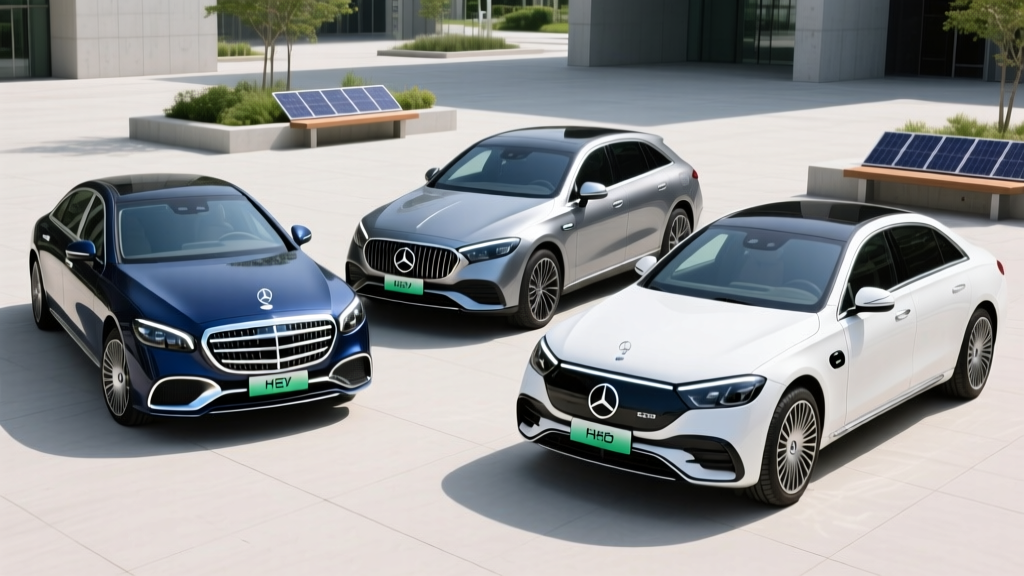
Short Answer: Yes, Mercedes-Benz Makes Both Hybrids and Plug-In Hybrids
If you've been searching whether Mercedes makes a hybrid, the answer is a definitive yes — and the 2026 lineup spans conventional hybrids (HEVs), mild-hybrid systems across nearly every model, and full plug-in hybrids (PHEVs) with meaningful electric-only range. Mercedes-Benz has electrified its core lineup more aggressively than most luxury competitors, embedding 48-volt mild-hybrid systems into models like the E-Class and S-Class while offering dedicated PHEV variants in the GLC, GLE, and S-Class families.
But "hybrid" means different things depending on the model. A conventional hybrid recharges its small battery through regenerative braking and the gas engine — no plug required. A plug-in hybrid (PHEV) carries a larger battery you charge from a wall outlet or public station, delivering 30–50 miles of electric-only driving before the gas engine takes over. Understanding which type Mercedes offers in which model is the key to making the right choice.
HEV vs PHEV: What's the Difference in the Mercedes Lineup?
| Feature | Conventional Hybrid (HEV) | Plug-In Hybrid (PHEV) |
|---|---|---|
| Plug-in charging? | No — self-charging via regen + engine | Yes — plug in at home or public station |
| Electric-only driving | Minimal (assist only, ~1 mi at low speed) | 30–50 miles on battery alone |
| Battery size | ~1–2 kWh (small buffer) | 19–28 kWh usable |
| Fuel economy advantage | Best in city stop-and-go | Near-zero fuel use if commutes are within EV range |
| Mercedes examples (2026) | S 580h, mild-hybrid E-Class/S-Class (ISG) | GLC 350e, GLE 350e, S 580e |
The 2026 Mercedes-Benz PHEV Lineup: Specs, Range, and Pricing
The plug-in hybrid models are where Mercedes delivers the most dramatic efficiency gains. Here's what's available for the 2026 model year in the U.S. market:
| Model | Powertrain | Combined HP | Battery (kWh) | EV Range (EPA) | Combined MPG (gas) | Base MSRP |
|---|---|---|---|---|---|---|
| GLC 350e 4MATIC SUV | 2.0L turbo I-4 + electric motor | 335 hp | 23.3 kWh (usable ~19) | ~39 mi | ~29 MPG | $60,550 |
| GLE 350e 4MATIC SUV | 2.0L turbo I-4 + electric motor | 381 hp | 23.3 kWh (usable ~19) | ~45 mi | ~26 MPG | $69,500 |
| S 580e Sedan | 3.0L turbo I-6 + electric motor | 502 hp | 28.6 kWh (usable ~22) | ~42 mi | ~28 MPG | $122,050 |
Sources: fueleconomy.gov, Mercedes-Benz USA. Specs reflect 2026 model-year EPA estimates where published; some figures are manufacturer-estimated pending final EPA certification.
How Many MPG Does a Mercedes Hybrid Get?
Fuel economy depends heavily on which hybrid system and how you drive. Here's the EPA breakdown for the core models:
| Model | City MPG | Highway MPG | Combined MPG | Combined MPGe (PHEV) |
|---|---|---|---|---|
| GLC 350e (charge-depleting) | — | — | — | ~66 MPGe |
| GLC 350e (charge-sustaining, gas only) | 27 | 31 | 29 | — |
| GLE 350e (charge-sustaining, gas only) | 24 | 28 | 26 | — |
| S 580e (charge-sustaining, gas only) | 25 | 31 | 28 | — |
| S 580h (conventional HEV) | 24 | 33 | 27 | — |
Real-world MPG note: Conventional hybrids like the S 580h often exceed their EPA city rating in stop-and-go traffic, where regenerative braking recaptures the most energy. On the highway, expect numbers closer to or slightly below the EPA highway figure. For PHEVs, your actual fuel consumption depends almost entirely on how often you recharge. If your daily commute is under 40 miles and you plug in nightly, you may use gas only on longer road trips — effectively achieving triple-digit MPGe in daily use.
Electric-Only Range: How Far Can a Mercedes PHEV Go Without Gas?
Mercedes has invested in larger PHEV batteries than most luxury competitors, and the payoff is genuine electric-only usability:
- GLC 350e: ~39 miles EPA electric-only — covers most commutes and school runs without the engine starting.
- GLE 350e: ~45 miles EPA electric-only — impressive for a 5,000-lb midsize SUV.
- S 580e: ~42 miles EPA electric-only — enough for chauffeured city driving in near-silence.
Real-world caveat: EPA electric-range tests include gentle acceleration and moderate climate-control use. Expect 10–20% less range in cold weather (below 40°F) due to cabin heating draw and reduced battery efficiency. Highway-speed driving at 70+ mph also shortens electric range, since the PHEV's electric motor works harder at sustained high speeds. In practice, plan for 30–35 usable electric miles from the GLC 350e in mixed winter driving.
Total combined range (electric + full gas tank) exceeds 400 miles for all three PHEV models, eliminating any range anxiety on road trips. Once the battery depletes, the gas engine seamlessly takes over — you'll never be stranded.
Charging a Mercedes PHEV: Speed, Connector, and Cost
One of the most important questions for PHEV buyers: how fast can you recharge, and what equipment do you need?
| Charging Level | Power (kW) | Time (0–100%) | Notes |
|---|---|---|---|
| Level 1 (120V household outlet) | ~1.4 kW | ~14–18 hours | Emergency/trickle only; not practical for daily use |
| Level 2 (240V home or public) | 7.4 kW (onboard charger) | ~3–3.5 hours | Ideal for overnight home charging |
| DC Fast Charge (CCS) | Up to 60 kW | ~30 min (10–80%) | GLE 350e and S 580e support DC; GLC 350e is AC-only in some trims |
Connector: All 2026 Mercedes PHEVs sold in the U.S. use the CCS1 connector for DC fast charging and the J1772 connector for Level 1/Level 2 AC charging. Mercedes has announced a transition to NACS (Tesla's connector) for future battery-electric models, but current PHEVs retain CCS/J1772.
Home charging setup: A Level 2 home charger (240V, 32–40A circuit) is the practical standard for PHEV ownership. Expect to pay $500–$800 for a quality Level 2 wallbox (ChargePoint Home Flex, Emporia Vue, or similar) and $500–$2,000 for professional electrician installation depending on panel proximity and local permit costs. If your electrical panel is maxed out, a panel upgrade can add $1,500–$3,000.
Cost to charge: At the U.S. average residential electricity rate of ~$0.17/kWh (EIA, 2025), fully recharging the GLC 350e's ~19 kWh usable battery costs roughly $3.23 — versus $10–$14 for the equivalent gasoline miles at $3.50/gallon. Over a year of daily commuting on electricity, the savings are significant.
Mercedes PHEV Battery Warranty & Replacement Cost
Mercedes-Benz covers PHEV high-voltage batteries for 6 years or 62,000 miles (whichever comes first) against defects and excessive capacity loss — typically defined as dropping below 70% of original capacity. Some states with California Air Resources Board (CARB) adoption may see extended coverage of up to 10 years/150,000 miles under emissions-component rules.
Replacement cost: Out-of-warranty PHEV battery replacement runs approximately $8,000–$14,000 depending on the model, including parts and labor. However, PHEV batteries experience less stress than full-EV batteries (smaller, shallower cycles, liquid-cooled), and real-world failure rates within the warranty period are low. The conventional hybrid (HEV) battery in the S 580h is smaller and less expensive to replace (~$3,000–$5,000) and typically lasts the life of the vehicle.
Does the Mercedes PHEV Qualify for a Federal Tax Credit?
This is where buyers need to pay close attention. Under current IRS §30D rules for 2026, the federal Clean Vehicle Credit offers up to $7,500 — but eligibility depends on battery sourcing, MSRP caps, and buyer income limits:
- MSRP cap: SUVs (GLC 350e, GLE 350e) must have an MSRP ≤ $80,000. Sedans (S 580e) must be ≤ $55,000. The S 580e exceeds the sedan cap and does not qualify.
- Buyer income cap: Adjusted gross income must be ≤ $150,000 (single), $225,000 (head of household), or $300,000 (joint filers).
- Battery sourcing: The $7,500 credit is split into two halves — $3,750 for critical-minerals sourcing and $3,750 for battery-component assembly. Mercedes PHEVs have historically struggled with the battery-component requirement due to overseas cell manufacturing. Expect partial credit ($3,750) for qualifying GLC/GLE 350e buyers, not the full $7,500.
- Point-of-sale transfer: Eligible buyers can transfer the credit to the dealer at purchase, reducing the upfront price rather than waiting for a tax refund.
Bottom line: The GLC 350e and GLE 350e may qualify for a partial $3,750 federal credit if your income falls within limits. Always verify current eligibility at irs.gov or consult a tax professional before purchasing, as sourcing rules and qualified-model lists update periodically.
Hybrid vs PHEV vs Full EV: Which Mercedes Fits Your Life?
Choosing between Mercedes' electrified options comes down to your driving pattern, charging access, and comfort with range planning:
Choose a Mercedes Conventional Hybrid (HEV) If:
- You have no access to home or workplace charging
- You want better fuel economy with zero behavior change — just drive and refuel normally
- Your driving is mostly city/stop-and-go, where hybrids shine
- Example: S 580h for luxury sedan buyers who want efficiency without plugging in
Choose a Mercedes PHEV If:
- You have (or can install) a Level 2 home charger
- Your daily commute is under 40 miles round-trip — you'll drive electric most days
- You want zero-emission daily driving but the flexibility of a gas engine for road trips
- You're not ready to commit to a full EV but want to reduce fuel costs and emissions significantly
- Example: GLC 350e for families who school-run and commute electrically but drive to the mountains on weekends
Choose a Full Battery EV (BEV) If:
- You have reliable home charging and your daily driving is under 250 miles
- You want the lowest operating cost and zero tailpipe emissions
- You're comfortable with public DC fast charging for road trips
- Example: Mercedes EQE or EQS sedan for buyers ready to go fully electric
Reliability and Ownership Considerations
Mercedes-Benz PHEVs add complexity — two powertrains, high-voltage electronics, and a charging system — compared to a conventional gas car. Here's what real ownership looks like:
Reliability: Mercedes PHEV powertrains have been in production since 2019 (third-generation PHEV architecture). The 2.0L turbo engine in the GLC/GLE 350e is a proven, widely used unit. The electric motor and power electronics have low failure rates. The primary risk areas are the high-voltage battery management system and onboard charger — both covered under the 6-year/62,000-mile warranty. Independent reliability data from IIHS and owner surveys show average-to-above-average ratings for the GLC and GLE PHEV variants.
Maintenance: PHEVs still require oil changes, brake fluid, and cabin filter replacements, but brake wear is significantly reduced thanks to regenerative braking. Many owners report 50–70% less brake pad wear compared to gas-only models.
Insurance: Expect insurance premiums 10–20% higher than equivalent gas-only Mercedes models, reflecting the higher repair cost of high-voltage components. Shop quotes before purchasing.
Depreciation: Luxury PHEVs depreciate faster than their gas counterparts in the first three years, partly due to rapid battery-tech advancement and buyer preference for newer electrified models. Plan for 45–55% value retention after 3 years, versus 50–60% for a comparable gas-only GLE.
Pros
- 39–45 miles of electric-only range covers most commutes
- Seamless transition to gas — no range anxiety on road trips
- Luxury interior, ride quality, and MBUX tech unchanged from gas models
- Significantly lower daily fuel cost when charging at home
- Partial federal tax credit eligibility ($3,750) for SUV models
- Reduced brake wear from regenerative braking
Cons
- $5,000–$10,000 price premium over gas-only equivalents
- Home Level 2 charger installation required for practical use
- Battery warranty (6yr/62k mi) is shorter than some competitors (Hyundai/Kia offer 10yr/100k)
- Cargo space slightly reduced due to battery placement
- Full $7,500 tax credit unlikely due to battery-sourcing rules
- Higher insurance and faster depreciation than gas models
Frequently Asked Questions
Does Mercedes make a conventional hybrid that doesn't need plugging in?
Yes. The S 580h is a conventional (non-plug-in) hybrid sedan that pairs a turbocharged inline-6 with an electric motor for a combined 429 hp and ~27 MPG combined. Additionally, nearly every 2026 Mercedes model with the inline-6 or inline-4 engine uses a 48-volt integrated starter-generator (ISG) mild-hybrid system, which provides seamless stop-start, brief torque assist, and minor efficiency gains — but this is not a full hybrid system and does not offer meaningful electric-only driving.
How far can the Mercedes GLC 350e go on electric power alone?
The 2026 GLC 350e delivers approximately 39 miles of EPA-rated electric-only range. In real-world mixed driving with climate control active, expect 30–35 miles, and somewhat less in cold weather. Once the battery depletes, the 2.0L turbo engine takes over seamlessly, providing ~29 MPG combined on gasoline.
Can I charge a Mercedes PHEV at a Tesla Supercharger?
Not currently. 2026 Mercedes PHEVs use CCS1/J1772 connectors. While Mercedes' future battery-electric models will adopt the NACS (Tesla) connector, current PHEVs require CCS-compatible DC fast chargers (Electrify America, EVgo, ChargePoint) or J1772 Level 2 stations. Adapters exist but are not recommended for routine DC fast charging.
Is the Mercedes PHEV battery reliable, and what does replacement cost?
Mercedes PHEV batteries are liquid-cooled and engineered for shallow-cycle use, which reduces degradation stress. The warranty covers 6 years or 62,000 miles against defects and capacity loss below 70%. Out-of-warranty replacement costs approximately $8,000–$14,000 depending on the model. Real-world data suggests most PHEV batteries outlast the warranty period without significant issues.
Does the Mercedes GLE 350e qualify for the $7,500 federal tax credit?
Partially. Under current IRS §30D rules, the GLE 350e (MSRP under the $80,000 SUV cap) may qualify for $3,750 of the $7,500 credit if the buyer meets income requirements. The full $7,500 is unlikely because the battery components do not fully meet U.S. sourcing requirements. Always verify at irs.gov before purchasing, as qualified-model lists update throughout the year.
Should I buy a Mercedes PHEV or a full EV like the EQE?
If you have home charging, a commute under 40 miles, and take road trips where charging infrastructure is sparse, the PHEV (GLC 350e or GLE 350e) offers the best of both worlds. If you have reliable charging, drive under 250 miles daily, and want the lowest operating cost, a full EV like the EQE or EQS eliminates gas entirely and has fewer moving parts to maintain. The PHEV is the pragmatic bridge; the EV is the destination.