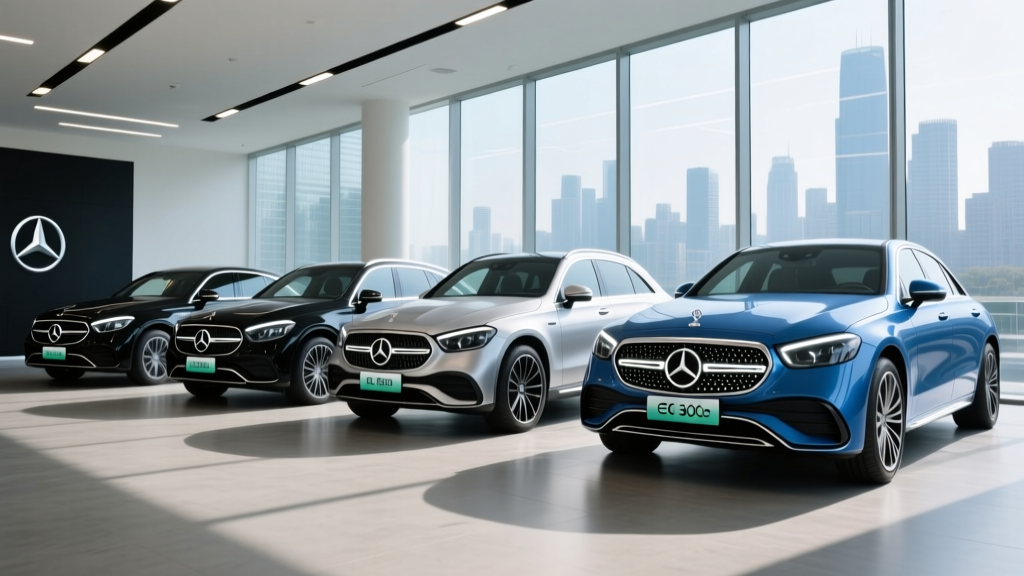
Mercedes-Benz has committed heavily to plug-in hybrid electric vehicles (PHEVs) as a bridge technology for buyers who want electric commuting without full range anxiety. For 2026, the Mercedes hybrid models lineup spans from the compact C-Class to the flagship S-Class, each pairing a turbocharged gasoline engine with a substantial electric motor and a battery large enough to cover most daily commutes on electricity alone.
Unlike conventional hybrids (HEVs) that you never plug in — think Toyota Prius — every current Mercedes hybrid is a PHEV. That means you can plug in to charge a larger battery for 30–50 miles of electric-only driving, then the gas engine takes over for longer trips. This guide breaks down the full 2026 lineup with exact EPA figures, real-world expectations, and ownership economics.
HEV vs PHEV: What Mercedes Actually Offers
Conventional Hybrid (HEV)
- How it works: Small battery (1–2 kWh) recharged by regenerative braking and the engine. Never plugged in.
- Electric-only range: Less than 1 mile at low speeds.
- Mercedes availability: Mercedes-Benz does not currently sell a conventional HEV in the US market. The brand uses 48-volt mild-hybrid systems (EQ Boost) on many gas models, but these are not true self-charging hybrids.
Plug-in Hybrid (PHEV)
- How it works: Larger battery (18–29 kWh) charged via plug or regenerative braking. Can drive on electricity alone for extended distances.
- Electric-only range: 30–51 miles EPA depending on model.
- Mercedes availability: This is what every current Mercedes hybrid model is. The lineup includes the C 300e, GLC 350e, S 580e, and the upcoming GLE 400e for 2026.
The distinction matters: if you see a Mercedes with "EQ Boost" or "EQ Power" badging, EQ Boost is a 48V mild-hybrid assist (not a PHEV), while EQ Power designates the full plug-in hybrid powertrain covered in this guide.
2026 Mercedes PHEV Lineup: Specs at a Glance
| Model | Powertrain | Combined HP | Battery (kWh) | EV Range (EPA) | Combined MPG (gas) | Base MSRP |
|---|---|---|---|---|---|---|
| C 300e Sedan | 2.0L turbo I4 + electric motor | 312 hp | 25.4 kWh | ~46 mi | ~54 MPGe / 32 MPG | $57,950 |
| GLC 350e 4MATIC | 2.0L turbo I4 + electric motor | 340 hp | 23.3 kWh | ~39 mi | ~54 MPGe / 30 MPG | $60,550 |
| S 580e 4MATIC | 3.0L turbo I6 + electric motor | 502 hp | 28.6 kWh | ~40 mi | ~53 MPGe / 27 MPG | $121,650 |
| GLE 400e 4MATIC (announced) | 2.0L turbo I4 + electric motor | 381 hp (est.) | 23.3 kWh | ~45 mi (est.) | TBD | ~$72,000 (est.) |
Note: GLE 400e specs are preliminary based on Mercedes-Benz announcements. Final EPA figures expected upon US delivery. All other specs reflect 2025–2026 model-year EPA data from fueleconomy.gov.
Fuel Economy: EPA Numbers vs Real-World MPG
| Model | EPA City | EPA Highway | EPA Combined (gas) | MPGe (electric+gas) | Real-World Expectation |
|---|---|---|---|---|---|
| C 300e | 33 MPG | 31 MPG | 32 MPG | 54 MPGe | 34–38 MPG city (regen-heavy), 28–30 MPG highway |
| GLC 350e | 31 MPG | 29 MPG | 30 MPG | 54 MPGe | 32–35 MPG city, 26–28 MPG highway |
| S 580e | 28 MPG | 26 MPG | 27 MPG | 53 MPGe | 29–32 MPG city, 24–26 MPG highway |
The key insight for Mercedes PHEV buyers: your actual fuel consumption depends almost entirely on your charging habits. A GLC 350e owner who charges at home every night and commutes 25 miles each way will burn perhaps 2 gallons per week. One who never plugs in gets a heavy luxury SUV that returns 26–28 MPG — still respectable, but nowhere near the MPGe sticker.
Electric-Only Range and Charging: What to Expect
Every current Mercedes PHEV uses a lithium-ion battery in the 23–29 kWh range, mounted low in the chassis. Here is what charging looks like in practice:
| Charging Level | Power (kW) | Time (0–100%) | Availability |
|---|---|---|---|
| Level 1 (120V household outlet) | ~1.4 kW | 14–20 hours | Any standard outlet; adequate for overnight top-ups |
| Level 2 (240V home/public) | 7.4–9.6 kW | 2.5–4 hours | Home wallbox or public Level 2 stations |
| DC Fast Charge (CCS) | Up to 60 kW (GLC/C-Class) Up to 60 kW (S 580e) |
~30 min (10–80%) | Available on all 2026 models; CCS1 connector |
A critical advantage of the 2026 Mercedes PHEV lineup: all models support DC fast charging, which is uncommon among luxury PHEVs. Many competitors (BMW X5 xDrive50e, for example) only offer Level 2 AC charging. At a 60 kW DC charger, you can replenish 10–80% in roughly 30 minutes — useful for topping up at a highway rest stop or a quick errand.
For daily use, a Level 2 home charger (240V, 32–40 amp circuit) is the sweet spot. Expect a full charge in about 3 hours on the C 300e and GLC 350e, or 3.5–4 hours on the S 580e with its larger 28.6 kWh pack. Home Level 2 installation typically costs $800–$2,000 depending on panel capacity and run length.
Powertrain Deep Dive: Engine Meets Electric Motor
Mercedes uses a P2 hybrid architecture across its PHEV lineup — the electric motor sits between the engine and the 9G-TRONIC automatic transmission. This allows pure electric driving, blended operation, or full combined power:
- C 300e: The 2.0L turbocharged inline-4 produces 201 hp, supplemented by a 127-hp electric motor integrated into the transmission. Combined output: 312 hp and 406 lb-ft of torque. 0–60 mph in approximately 5.7 seconds.
- GLC 350e: Same 2.0L engine paired with a 134-hp electric motor for 340 hp combined and 443 lb-ft. The 4MATIC all-wheel-drive system is standard. 0–60 mph in about 5.6 seconds.
- S 580e: The flagship pairs a 3.0L turbocharged inline-6 (362 hp) with a 148-hp electric motor. Combined output is a commanding 502 hp and 516 lb-ft. 0–60 mph in 4.9 seconds — remarkable for a full-size luxury sedan.
In all models, the electric motor provides instant torque from a standstill, making city driving feel responsive even before the turbo spools. The transition between electric and gas power is well-managed — most drivers won't notice the handoff unless accelerating hard.
Pricing, Tax Credits, and Ownership Costs
Mercedes PHEVs carry a premium over their gasoline counterparts, but the electric capability and reduced fuel consumption offset some of that cost over time.
| Model | Base MSRP | Federal §30D Tax Credit | Effective Price (after credit) |
|---|---|---|---|
| C 300e Sedan | $57,950 | Up to $3,750* | ~$54,200 |
| GLC 350e 4MATIC | $60,550 | Up to $3,750* | ~$56,800 |
| S 580e 4MATIC | $121,650 | Not eligible (MSRP cap) | $121,650 |
- Credit amount: Up to $7,500, but most Mercedes PHEVs qualify for $3,750 (meeting the critical minerals requirement but not the full battery component sourcing threshold).
- MSRP cap: Sedans must be under $55,000; SUVs/vans/trucks under $80,000. The S 580e exceeds the cap and is ineligible.
- Buyer income cap: AGI must not exceed $150,000 (single), $225,000 (head of household), or $300,000 (joint).
- Battery requirements: Minimum 7 kWh battery capacity — all Mercedes PHEVs exceed this easily.
- Point-of-sale transfer: Eligible buyers can transfer the credit to the dealer for an immediate price reduction at purchase.
Source: IRS §30D Clean Vehicle Credit. Consult a tax professional for personal eligibility.
On the ownership cost side, PHEV buyers should budget for higher insurance premiums (typically 10–20% above the gas equivalent due to the dual powertrain complexity) and the eventual cost of maintaining both an internal combustion engine and an electric drivetrain. Oil changes, spark plugs, and transmission fluid remain part of the service schedule.
Battery Warranty, Reliability, and Replacement Costs
- Coverage: 6 years or 62,000 miles (whichever comes first) for high-voltage battery capacity retention.
- Threshold: Warranty covers replacement if battery capacity drops below 70% of original capacity within the warranty period.
- Extended in some states: California and states adopting CARB standards may require 10 years/150,000 miles for PZEV/AT-PZEV components — check your state's specific requirements.
This is a notable weak point compared to competitors. Hyundai, Kia, and Toyota typically offer 10-year/100,000-mile hybrid battery warranties. Mercedes' 6-year/62,000-mile coverage is shorter than the industry norm and is something buyers should weigh carefully, especially for high-mileage drivers.
Battery replacement cost: If out of warranty, a Mercedes PHEV high-voltage battery replacement runs approximately $12,000–$18,000 depending on the model, including parts and labor. The S 580e's larger 28.6 kWh pack will be at the higher end of that range. Individual module replacement may be possible for isolated cell failures, reducing costs to $3,000–$6,000.
Reliability track record: Mercedes PHEV powertrains have shown moderate reliability in recent model years. The electric motor and power electronics are generally robust — it's the integration complexity (two complete powertrains, additional cooling circuits, high-voltage cabling) that introduces more potential failure points than a pure EV or a pure gas car. According to IIHS and owner surveys, the C 300e and GLC 350e have performed adequately, though not class-leading, in predicted reliability. The gasoline engines (M254 2.0L and M256 3.0L) are well-proven units.
Mercedes Hybrid vs Full EV vs Gas: Which Fits You?
Choose a Mercedes PHEV if:
- You commute 20–45 miles round-trip and can charge at home nightly
- You take regular road trips (200+ miles) where charging infrastructure feels uncertain
- You want meaningful electric driving without committing to a full EV
- You value the Mercedes luxury interior and driving dynamics but want lower daily fuel costs
Choose a full EV (e.g., Mercedes EQE, Tesla Model S) if:
- You have reliable home charging and rarely drive more than 250 miles in a single day
- You want the lowest per-mile energy cost (~$0.04–0.06/mile on home electricity vs $0.12–0.18/mile on gas)
- You prefer fewer maintenance items (no oil changes, no spark plugs, no exhaust system)
- You want the full federal tax credit (up to $7,500 for eligible EVs)
Choose a gas Mercedes (e.g., C 300, GLC 300) if:
- You cannot charge at home or at work
- You want the lowest upfront purchase price (gas models run $8,000–$15,000 less than PHEV equivalents)
- You drive mostly highway miles where the PHEV's electric range advantage diminishes
- You plan to keep the car beyond the battery warranty period and want to avoid replacement risk
Mercedes PHEV Pros
- 30–50 miles of genuine electric commuting eliminates most daily fuel use
- DC fast charging capability (rare among PHEVs) enables quick top-ups
- Combined powertrains deliver strong acceleration (312–502 hp)
- No range anxiety — gas engine covers any distance
- Regenerative braking reduces brake wear significantly
- Premium interior and advanced driver-assist tech across the lineup
Mercedes PHEV Cons
- Battery warranty shorter than most competitors (6 yr/62k mi vs 10 yr/100k mi)
- Trunk/cargo space reduced by battery placement (especially C 300e sedan)
- Maintenance complexity of two full powertrains
- Heavy curb weight affects tire wear and handling agility
- Premium pricing — PHEV trims add $8,000–$15,000 over gas equivalents
- S 580e does not qualify for federal tax credit due to MSRP cap
Frequently Asked Questions
How many MPG does a Mercedes hybrid get?
It depends on the model and your charging habits. The C 300e is EPA-rated at 32 MPG combined on gasoline alone and 54 MPGe when factoring in electric driving. The GLC 350e returns 30 MPG combined (gas) and 54 MPGe. The S 580e achieves 27 MPG combined (gas) and 53 MPGe. In real-world city driving with regular charging, expect to exceed the EPA gas-only MPG figures thanks to regenerative braking and electric assist. On highway-only trips with a depleted battery, expect 2–4 MPG below the EPA combined rating.
How far can a Mercedes PHEV go on electric only?
The C 300e offers approximately 46 miles of EPA-rated electric range, the GLC 350e about 39 miles, and the S 580e about 40 miles. Real-world electric range varies with temperature and driving style: expect 35–42 miles from the C 300e in mild weather, dropping to 30–35 miles in freezing conditions. Highway-speed electric driving depletes the battery faster than city driving due to higher energy demand and less regenerative braking opportunity.
Do Mercedes hybrids need to be plugged in?
Yes — every Mercedes hybrid sold in the US is a plug-in hybrid (PHEV), which means you get the most benefit by plugging in regularly. You can drive without ever plugging in (the gas engine and regenerative braking keep the battery minimally charged), but you'll forfeit the electric-only range and get only the gas-only MPG figures. Think of it like buying a smartphone and never charging it past 10% — it works, but you're missing the point.
Is the Mercedes PHEV battery reliable, and what does replacement cost?
Mercedes PHEV batteries use proven lithium-ion chemistry and are generally reliable within the warranty period. The high-voltage battery is covered for 6 years/62,000 miles against capacity loss below 70%. Out-of-warranty replacement costs approximately $12,000–$18,000 depending on the model. Module-level repairs may reduce this to $3,000–$6,000. For comparison, Toyota's hybrid battery warranty is 10 years/100,000 miles — a significant advantage for long-term ownership peace of mind.
Does a Mercedes hybrid qualify for a tax credit?
Some models do, with important caveats. The C 300e (sedan, MSRP $57,950) and GLC 350e (SUV, MSRP $60,550) may qualify for up to $3,750 under the federal §30D Clean Vehicle Credit, subject to buyer income limits ($150K single / $300K joint) and battery sourcing requirements. The S 580e, at $121,650, exceeds the MSRP cap and is not eligible. State incentives vary — California's CVRP, for example, has historically excluded PHEVs from its main rebate. Always verify current eligibility at irs.gov and your state's energy office before purchasing.
Can I DC fast charge a Mercedes PHEV?
Yes. All 2026 Mercedes PHEV models support DC fast charging via a CCS1 connector at up to 60 kW. A 10–80% charge takes approximately 30 minutes. This is a meaningful advantage over PHEVs from BMW, Audi, and Volvo, many of which only support Level 2 AC charging. However, 60 kW is modest compared to full EVs (which charge at 150–350 kW), so plan for slightly longer stops on road trips.
Mercedes PHEV vs a full EV like the EQE — which makes more sense?
If you have home charging and your daily driving stays under 250 miles, a full EV like the Mercedes EQE (EPA range ~305 miles) offers lower running costs, fewer maintenance items, and a smoother, quieter driving experience. Choose the PHEV if you frequently drive 300+ miles in a day, lack reliable public charging on your routes, or simply want the safety net of a gas engine. The PHEV is the pragmatic middle ground; the EV is the lower-cost long-term play if your lifestyle supports it.
Sources: US EPA fueleconomy.gov, IRS §30D Clean Vehicle Credit, Mercedes-Benz USA. All specs reflect 2025–2026 model-year data available at time of publication. Verify current pricing, credit eligibility, and specs with your dealer and tax professional before purchasing.