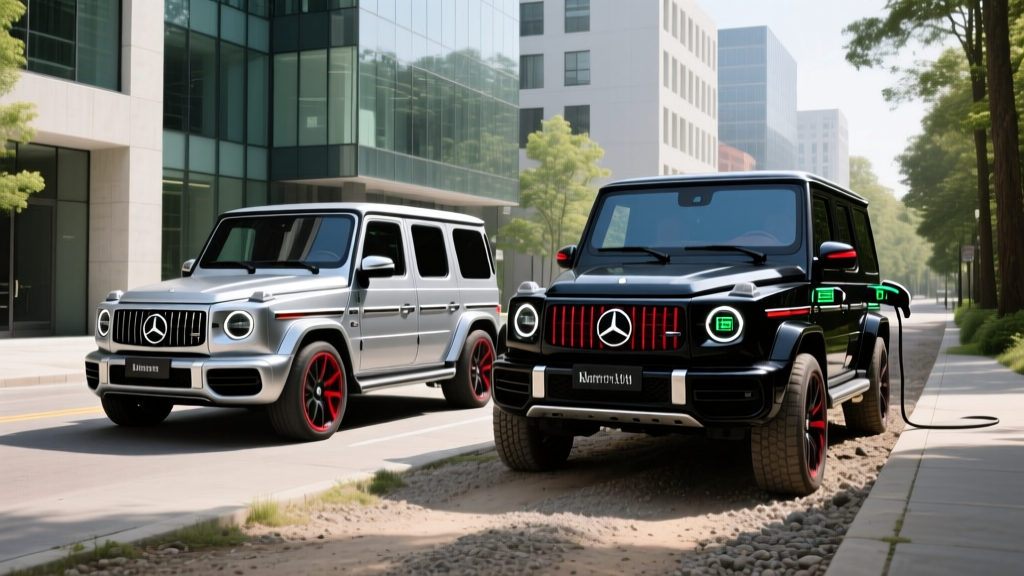
The Mercedes-Benz G-Class has long been an icon of rugged luxury, but its thirst for fuel has been equally legendary. For the 2026 model year, Mercedes offers the G Wagon with varying degrees of electrification — from the mild-hybrid G 550 and AMG G 63 to the fully electric G 580 with EQ Technology. If you're searching for a hybrid G Wagon, the answer depends on what you mean by "hybrid," because Mercedes has structured this lineup with distinct powertrain philosophies.
This guide breaks down every electrified G-Class variant available in 2026, with exact EPA figures, pricing, battery warranties, and tax-credit eligibility — so you can decide which version of this $150,000+ box on wheels actually fits your garage and your conscience.
Mild-Hybrid vs. Plug-In Hybrid vs. Full Electric: Which G Wagon Is Which?
Before diving into specs, it's critical to understand the terminology. Mercedes uses electrification across the 2026 G-Class lineup, but not all of it is the same:
| Type | How It Works | Plug In? | G Wagon Trims |
|---|---|---|---|
| Mild Hybrid (MHEV/HEV) | 48V system assists the gas engine; cannot drive on electric alone | No — refuels at gas station only | G 550, AMG G 63 |
| Plug-In Hybrid (PHEV) | Larger battery + electric motor; can drive on electric-only for a limited range | Yes — plugs into Level 2 or DC charger | Not offered in US for 2026 G-Class |
| Battery Electric (BEV) | Fully electric; four individual motors; zero tailpipe emissions | Yes — Level 2 home or DC fast charge | G 580 with EQ Technology |
The 2026 G 550 and AMG G 63 are mild hybrids — they use a 48-volt integrated starter-generator (ISG) that recovers energy during braking and provides a brief torque fill during acceleration. You never plug them in. The gasoline engine does all the primary work; the electric assist simply smooths stop-start and slightly improves efficiency.
A true plug-in hybrid G Wagon — one that could drive 25–40 miles on electricity alone before the gas engine kicks in — is not available in the United States for the 2026 model year. Mercedes has offered PHEV variants of the G-Class in certain European markets previously, but the US lineup currently skips directly from mild-hybrid to full electric.
The G 580 with EQ Technology is the all-electric G-Class. It replaces the V8 with four individually controlled electric motors and a large battery pack. This is the zero-emissions flagship — not a hybrid at all, but a critical part of the conversation for buyers considering an electrified G Wagon.
2026 G Wagon MPG: G 550 and AMG G 63 Fuel Economy
For mild-hybrid buyers, fuel economy remains a real-world consideration. The 48V system helps, but a 5,500-pound luxury box will always demand premium fuel. Here's what the EPA rates for the 2026 G-Class mild hybrids:
| Model | City MPG | Highway MPG | Combined MPG | Est. Range (mi) |
|---|---|---|---|---|
| 2026 Mercedes-Benz G 550 (Mild Hybrid) | 13 | 16 | 14 | ~360 |
| 2026 Mercedes-AMG G 63 (Mild Hybrid) | 12 | 15 | 13 | ~335 |
Real-world note: Mild hybrids like these tend to perform close to or slightly below their EPA estimates in mixed driving. The 48V system provides marginal gains — expect the ISG to assist during initial acceleration and to enable smoother engine stop-start at traffic lights, but don't anticipate Prius-like efficiency. In stop-and-go city driving, the G 550 may return 14–15 MPG thanks to regenerative assist, while sustained highway cruising at 75+ MPH typically yields 15–17 MPG. Cold weather and aggressive driving will push you toward the low end.
For context, filling the G 550's ~23-gallon tank at $4.50/gallon (premium required) costs roughly $103. At 14 MPG combined, you're spending approximately $0.32 per mile on fuel — compared to about $0.04–$0.06 per mile for home-charged electricity in a BEV like the G 580.
The Electric G 580 with EQ Technology: Range, Battery, and Charging
If you want a G Wagon that can actually run on electricity, the G 580 with EQ Technology is the answer. This is a full battery-electric vehicle (BEV), not a hybrid. Here's the full powertrain breakdown:
| Specification | 2026 G 580 with EQ Technology |
|---|---|
| Powertrain | Quad electric motors (one per wheel) |
| Total Horsepower | 579 hp |
| Total Torque | 859 lb-ft |
| 0–60 mph | 4.6 seconds |
| Battery Capacity (usable) | 116 kWh (NMC lithium-ion) |
| EPA Range | 239 miles |
| Real-World Range Expectation | ~190–215 mi highway; ~170–190 mi cold weather |
| Max DC Fast Charge Rate | 200 kW (CCS) |
| 10–80% DC Charge Time | ~32 minutes |
| Level 2 AC Charge Rate | 11 kW (~11 hours 0–100%) |
| Top Speed | 118 mph (electronically limited) |
Real-World Range Reality: The EPA rates the G 580 at 239 miles. In practice, expect 190–215 miles on highway road trips at 70–80 MPH, and potentially 170–190 miles in freezing temperatures. The G Wagon's brick-like aerodynamics (Cd ≈ 0.53) punish highway efficiency. Plan charging stops accordingly on trips over 180 miles.
The quad-motor setup enables features no gas G Wagon can match: individual wheel torque vectoring, a "G-Turn" tank-turn function that rotates the vehicle 360° in place, and "G-ROCK" low-speed crawling mode. The 116 kWh battery sits in a reinforced housing within the ladder frame, maintaining the G-Class's legendary off-road capability.
Charging the G 580 at Home and on the Road
At home on a Level 2 (240V) charger at 11 kW, a full 0–100% charge takes roughly 11 hours — plan for overnight charging. On a 200 kW DC fast charger (CCS connector), the G 580 peaks near 200 kW but tapers significantly above 80% state of charge, making the 10–80% sprint take approximately 32 minutes. That's competitive for a battery this large, though the 80–100% tail adds another 20+ minutes if you need a full charge on a road trip.
The G 580 uses a CCS1 connector. With Mercedes-Benz's expanding charging partnerships, G 580 owners can access the Tesla Supercharger network (with a NACS adapter, included or available from Mercedes) as well as Electrify America, EVgo, and ChargePoint networks.
2026 G-Class Pricing: What Each Electrified Variant Costs
| Model | Base MSRP | Federal Tax Credit Eligibility |
|---|---|---|
| 2026 G 550 (Mild Hybrid) | $149,950 | Not eligible — mild hybrid, not a PHEV or BEV |
| 2026 AMG G 63 (Mild Hybrid) | $184,900 | Not eligible — mild hybrid |
| 2026 G 580 with EQ Technology | $164,900 | Eligibility depends on sourcing & income — see below |
Federal Tax Credit: Does the G 580 Qualify?
The G 580 with EQ Technology is the only G-Class variant that could potentially qualify for the IRS §30D Clean Vehicle Credit of up to $7,500. However, eligibility is not guaranteed and depends on several factors:
- MSRP Cap: The G 580's base MSRP of ~$164,900 exceeds the §30D cap of $80,000 for SUVs. This alone disqualifies it from the federal credit.
- Buyer Income Limits: Even if the price were under the cap, adjusted gross income must not exceed $300,000 (joint filers), $225,000 (head of household), or $150,000 (single).
- Battery Sourcing: Critical minerals and battery components must meet phased-in domestic-content thresholds.
- Point-of-Sale Transfer: For qualifying vehicles, the credit can be transferred to the dealer at purchase to reduce the sale price.
Bottom line: At $164,900 MSRP, the G 580 with EQ Technology exceeds the $80,000 SUV price cap and does not qualify for the federal §30D tax credit. Neither the G 550 nor AMG G 63 qualify, as they are mild hybrids without plug-in capability. Always consult a tax professional and check the latest rules at IRS.gov before purchasing.
Some state-level incentives may still apply depending on your jurisdiction — check your state's environmental or energy agency for current rebate programs.
Powertrain Deep Dive: Engine, Motor, and Combined Output
Each G Wagon variant pairs its internal combustion or electric powertrain differently. Here's the mechanical breakdown:
G 550 Mild Hybrid
The G 550 uses a 3.0L turbocharged inline-six producing 443 hp and 413 lb-ft of torque, paired with a 48V integrated starter-generator that adds approximately 20 hp and 148 lb-ft of brief electric assist. A 9-speed automatic transmission routes power through the G-Class's permanent all-wheel-drive system with three locking differentials.
AMG G 63 Mild Hybrid
The G 63 features a hand-built 4.0L twin-turbo V8 generating 577 hp and 627 lb-ft, again with 48V ISG assist. The AMG-tuned 9-speed transmission and performance AWD system deliver a 0–60 time of approximately 4.3 seconds — remarkable for a vehicle weighing over 5,800 pounds.
G 580 with EQ Technology (Full Electric)
Four independent permanently-synchronous electric motors — one at each wheel — produce a combined 579 hp and 859 lb-ft. Each motor is individually controlled, enabling torque vectoring that no mechanical differential can match. The two-speed rear axle gearbox provides a low-range crawl ratio for off-road use, preserving the G-Class's legendary off-pavement capability.
Battery Warranty, Reliability, and Long-Term Ownership Costs
Battery & Powertrain Warranty Coverage
| Coverage | G 550 / G 63 (Mild Hybrid) | G 580 with EQ Technology (BEV) |
|---|---|---|
| New Vehicle Warranty | 4 years / 50,000 miles | 4 years / 50,000 miles |
| Powertrain Warranty | 4 years / 50,000 miles | 4 years / 50,000 miles |
| High-Voltage Battery Warranty | N/A (48V system covered under powertrain) | 8 years / 100,000 miles (capacity retention ≥70%) |
For the G 550 and G 63: The 48V mild-hybrid system is relatively simple — an integrated starter-generator and a small lithium-ion battery under the hood. There's no large traction battery to worry about. The 48V battery replacement, should it ever be needed outside of warranty, typically costs $500–$1,200. The complexity of the turbocharged engines (especially the twin-turbo V8 in the G 63) is a greater long-term maintenance concern than the mild-hybrid components.
For the G 580: The 116 kWh NMC battery is covered for 8 years or 100,000 miles against degradation below 70% of original capacity. Based on current NMC battery degradation data from similar Mercedes EQ platforms, expect roughly 8–12% capacity loss over the first 100,000 miles under normal use. A full battery replacement outside of warranty would be extremely costly — estimated at $25,000–$35,000 based on current NMC pack pricing for batteries of this capacity. However, most EV batteries outlast their warranty periods with manageable degradation.
Reliability outlook: The W465-generation G-Class (redesigned for 2025) is still early in its lifecycle, so long-term reliability data is limited. Mercedes-Benz's overall brand reliability scores from sources like Consumer Reports tend to be average to below-average. The mild-hybrid systems add modest complexity; the quad-motor G 580 represents entirely new technology with no direct historical precedent. Early adopters should budget for potential out-of-warranty repairs.
Hybrid vs. PHEV vs. Full EV: Which G-Class Fits You?
Choose the G 550 Mild Hybrid If:
- You want the classic G Wagon experience with a modernized inline-six
- You have no home charging access and don't want to rely on public chargers
- You prioritize proven mechanical simplicity over electrification
- You want the lowest entry price in the G-Class lineup (~$149,950)
Choose the AMG G 63 Mild Hybrid If:
- You want maximum performance and V8 sound in a G Wagon
- Fuel economy is a secondary concern at best
- You value AMG exclusivity and track the 0–60 time above all else
Choose the G 580 with EQ Technology If:
- You want a G Wagon with zero tailpipe emissions and silent operation
- You have reliable Level 2 home charging and drive under 200 miles/day
- You want cutting-edge quad-motor torque vectoring and G-Turn capability
- You're comfortable with a 239-mile EPA range and planning road trips around DC charging
Consider a Different Vehicle Entirely If:
- You need a true plug-in hybrid luxury SUV — look at the BMW XM, Porsche Cayenne E-Hybrid, or Range Rover PHEV instead
- You regularly drive 300+ miles between charging opportunities
- You need a third row or significant cargo capacity (the G-Class offers neither)
The absence of a PHEV G Wagon in the US market is a genuine gap. If you want to drive on electricity for your daily commute but keep gas-engine range for road trips, the G-Class doesn't currently offer that compromise. The closest alternatives in the luxury off-road PHEV space include the Range Rover P550e (est. 48 miles electric-only) and the Porsche Cayenne E-Hybrid (est. 35 miles electric-only).
5-Year Total Cost of Ownership: G 550 vs. G 580
To illustrate the running-cost difference between the mild-hybrid and fully electric G Wagon, here's an estimated 5-year / 75,000-mile ownership comparison:
| Cost Factor | G 550 (Mild Hybrid) | G 580 (Electric) |
|---|---|---|
| Purchase Price (MSRP) | $149,950 | $164,900 |
| Federal Tax Credit | $0 | $0 (exceeds MSRP cap) |
| Fuel/Energy (75,000 mi) | ~$24,100 (premium gas) | ~$5,600 (home charging avg) |
| Maintenance (est. 5 yr) | ~$4,500 | ~$2,200 |
| Insurance (est. 5 yr) | ~$22,000 | ~$24,500 |
| Estimated Depreciation | ~$65,000 | ~$80,000 |
| Est. 5-Year Total | ~$265,550 | ~$277,200 |
The G 580 saves substantially on fuel and maintenance but costs more upfront and may depreciate faster due to rapid EV technology evolution and the higher initial price. Insurance for the G 580 tends to be higher due to the specialized quad-motor powertrain and battery replacement cost. These figures are estimates — actual costs vary by location, driving habits, electricity rates, and market conditions. Consult Edmunds TCO or similar tools for personalized projections.
Pros and Cons at a Glance
Pros
- Unmatched off-road capability across all variants (three locking diffs on ICE; torque vectoring on G 580)
- Iconic design and resale-value retention — G-Class holds value better than nearly any luxury SUV
- G 580's quad-motor system offers capabilities (G-Turn, G-ROCK) no competitor can match
- Mild-hybrid ISG smooths stop-start and improves drivability without adding plug-in complexity
- Interior luxury, materials, and MBUX tech are flagship-level Mercedes
Cons
- No plug-in hybrid option in the US — you choose between gas-only assist or full electric
- G 550 and G 63 fuel economy remains poor (13–14 MPG combined) despite mild-hybrid assist
- G 580's 239-mile EPA range is short for a $165K vehicle; highway range drops to ~190–215 miles
- No federal tax credit on any variant — all exceed MSRP caps or lack qualifying powertrains
- Limited cargo space (~35 cu ft behind rear seats) and no third-row option
- Early-generation reliability unknowns, especially for the quad-motor G 580
Frequently Asked Questions
How many MPG does the hybrid G Wagon get?
The 2026 G 550 mild hybrid is EPA-rated at 13 city / 16 highway / 14 combined MPG. The AMG G 63 mild hybrid rates 12 city / 15 highway / 13 combined. Real-world results are typically within 1–2 MPG of these figures in mixed driving. The mild-hybrid system provides marginal efficiency gains — this is not a high-MPG vehicle.
How far can the electric G 580 go on a full charge?
The G 580 with EQ Technology has an EPA-estimated range of 239 miles on its 116 kWh battery. In real-world highway driving, expect 190–215 miles. In cold weather (below 32°F), range may drop to 170–190 miles. The G 580 is a BEV, not a hybrid — it has no gas engine backup.
Is there a plug-in hybrid G Wagon available in the US?
No. Mercedes-Benz does not offer a plug-in hybrid (PHEV) G-Class in the United States for the 2026 model year. The available options are mild-hybrid (G 550, G 63) or full electric (G 580). If you need PHEV capability in a luxury off-roader, consider the Range Rover P550e or Porsche Cayenne E-Hybrid.
Is the hybrid G Wagon reliable, and what does battery replacement cost?
The mild-hybrid 48V systems in the G 550 and G 63 are relatively simple, and the small 48V battery replacement costs roughly $500–$1,200 if needed. The G 580's 116 kWh NMC battery is warranted for 8 years / 100,000 miles (≥70% capacity). Out-of-warranty replacement is estimated at $25,000–$35,000. Long-term reliability data for the 2025+ redesigned G-Class is still limited.
Does the G Wagon qualify for any federal tax credit?
No G-Class variant qualifies for the federal §30D Clean Vehicle Credit. The G 550 and G 63 are mild hybrids, which are ineligible (only PHEVs and BEVs qualify). The G 580 is a BEV but its $164,900 MSRP exceeds the $80,000 SUV cap set by the IRS. State incentives may vary — check your local programs.
Can I charge the G 580 at home?
Yes. The G 580 accepts Level 2 AC charging at up to 11 kW via a J1772/CCS connector. A full 0–100% charge takes approximately 11 hours on a 48-amp Level 2 home charger. You'll need a 240V circuit (NEMA 14-50 or hardwired) installed by a licensed electrician — budget $800–$2,500 for installation depending on your electrical panel.
How fast does the G 580 charge on a DC fast charger?
The G 580 peaks at approximately 200 kW on a CCS DC fast charger. A 10–80% charge takes roughly 32 minutes. Charge speed tapers significantly above 80% to protect battery health, so plan for 50+ minutes if you need a full charge on a road trip.