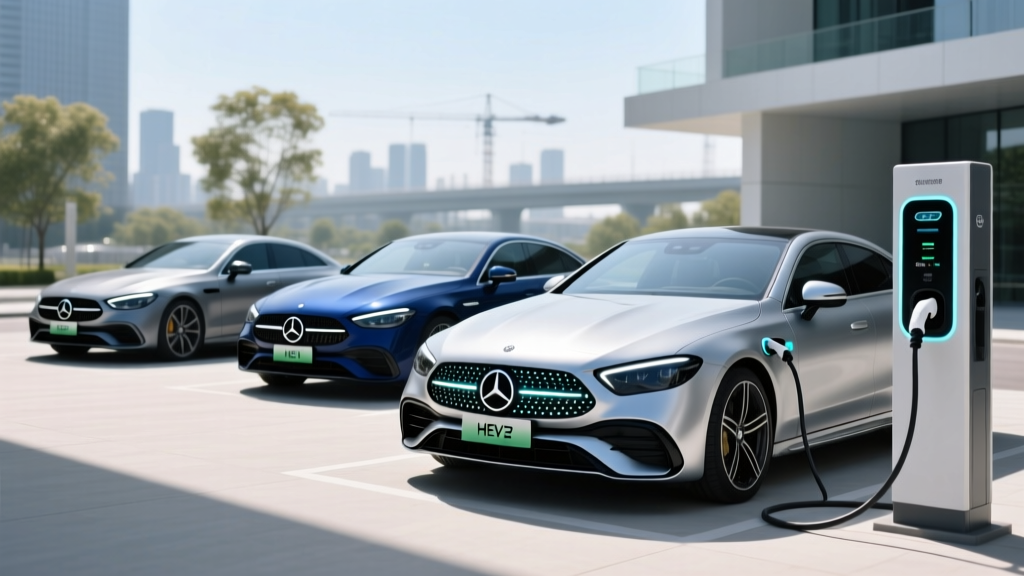
Mercedes-Benz has taken a distinctly different approach to electrification than most luxury rivals. While competitors have raced toward full battery-electric lineups, Mercedes continues to invest heavily in hybrid powertrains — both conventional hybrids (HEVs) that need no plug and plug-in hybrids (PHEVs) that offer meaningful electric-only commuting range. For 2026, the brand's hybrid strategy spans mild-hybrid assistance on most gasoline engines, full PHEV systems in the C-Class and GLC, and upcoming high-performance electrified AMG variants.
If you're researching Mercedes hybrid cars, the first decision is fundamental: do you want a vehicle that simply sips less fuel without changing your habits, or one that can handle your daily commute on electricity alone — provided you can plug in at home? This guide breaks down every current Mercedes hybrid option with exact EPA figures, real-world expectations, battery specifications, and total ownership costs.
HEV vs PHEV: What Mercedes Actually Offers in 2026
Before diving into specific models, it's critical to understand the two hybrid categories Mercedes sells, because they serve entirely different use cases and price points.
| Feature | Conventional Hybrid (HEV) | Plug-in Hybrid (PHEV) |
|---|---|---|
| Plug-in charging required? | No — charges via regenerative braking and engine | Yes — plug in for electric-only range |
| Electric-only driving | Very limited (under 1 mile at low speed) | 25–54 miles depending on model |
| Battery size | ~1–2 kWh (small buffer) | 19.5–25.4 kWh usable |
| Federal tax credit eligible? | No | Up to $3,750–$7,500 (see IRS §30D rules) |
| Best for | Drivers without home charging access | Home-charging commuters who road-trip occasionally |
| Price premium over gas model | Minimal ($0–$2,000) | $5,000–$10,000+ |
Mercedes labels its conventional hybrids with "mild hybrid" or EQ Boost branding — these use a 48-volt integrated starter-generator that adds a small electric assist but cannot propel the car on electricity alone. The true PHEV models carry the "e" suffix (C 300e, GLC 350e) and feature substantially larger batteries with dedicated electric motors capable of highway-speed electric driving.
2026 Mercedes PHEV Lineup: Specs, Range, and Pricing
The 2026 Mercedes plug-in hybrid lineup centers on two core models — the C 300e sedan and the GLC 350e SUV — both built on the modular MRA2 platform with fourth-generation PHEV architecture. These represent the most compelling Mercedes hybrid cars for buyers who can charge at home.
| Specification | 2026 C 300e Sedan | 2026 GLC 350e 4MATIC |
|---|---|---|
| Powertrain | 2.0L turbo I4 + electric motor | 2.0L turbo I4 + electric motor |
| Combined HP | 312 hp | 313 hp |
| Combined torque | 406 lb-ft | 406 lb-ft |
| Battery (usable) | 25.4 kWh (NMC) | 25.4 kWh (NMC) |
| EPA electric-only range | 54 miles | 48 miles |
| Total combined range | ~470 miles | ~440 miles |
| EPA MPG (gas, battery depleted) | 31 combined (29 city / 34 hwy) | 28 combined (26 city / 30 hwy) |
| MPGe (electric + gas) | 110 MPGe | 99 MPGe |
| AC charging (Level 2) | 7.4 kW (~3 hrs 0–100%) | 7.4 kW (~3 hrs 0–100%) |
| DC fast charging | Optional 60 kW (~25 min 10–80%) | Optional 60 kW (~25 min 10–80%) |
| 0–60 mph | 5.7 seconds | 6.2 seconds |
| Base MSRP | $57,950 | $61,500 |
| Battery warranty | 6 years / 62,000 miles | 6 years / 62,000 miles |
Real-world range note: The EPA's 54-mile electric rating for the C 300e is achievable in mild weather with city and suburban driving. Expect roughly 42–48 miles on the highway at 70 mph, and as low as 35–40 miles in freezing temperatures with cabin heating active. The GLC 350e, being heavier and less aerodynamic, typically delivers 38–44 real-world electric miles in mixed conditions.
Battery warranty alert: Mercedes provides a 6-year/62,000-mile high-voltage battery warranty for PHEV models, which is shorter than the 8-year/100,000-mile standard common among rivals like BMW and Toyota. The warranty covers defects and capacity loss below 70% of original capacity. Buyers planning long-term ownership should factor this into their decision. Replacement cost for the 25.4 kWh PHEV battery is estimated at $8,000–$12,000 out of warranty, based on dealer parts pricing for the MRA2 platform.
Mild-Hybrid Mercedes Models: The HEV Option
Most 2026 Mercedes-Benz gasoline models feature a 48-volt mild-hybrid system branded as EQ Boost or an integrated starter-generator (ISG). This system provides seamless stop-start, a small torque fill during acceleration (typically 15–20 hp for brief bursts), and modest efficiency gains. These are not plug-in vehicles — you fuel them like any conventional car.
Key 2026 mild-hybrid models include:
- E 350 (sedan/wagon): 2.0L turbo I4 + 48V ISG, 255 hp, EPA 27 combined (24 city / 33 hwy)
- GLE 350 4MATIC: 2.0L turbo I4 + 48V ISG, 255 hp, EPA 23 combined (20 city / 27 hwy)
- S 500 4MATIC: 3.0L turbo I6 + 48V ISG, 443 hp, EPA 24 combined (21 city / 30 hwy)
- GLS 450 4MATIC: 3.0L turbo I6 + 48V ISG, 375 hp, EPA 21 combined (19 city / 24 hwy)
These mild hybrids do not qualify for any federal EV tax credits. Their advantage is invisible efficiency — you'll see 1–3 MPG improvement over an equivalent non-hybrid powertrain, with no behavior change required. For buyers who cannot charge at home and want a Mercedes without range anxiety, these represent the path of least resistance.
Real-World MPG: What Owners Actually Report
Hybrid fuel economy in the real world often diverges from EPA estimates — but the direction of that divergence matters. Conventional hybrids and PHEVs operating in hybrid mode tend to exceed EPA city ratings because regenerative braking recovers more energy in stop-and-go traffic. Highway efficiency, however, often falls slightly below the sticker.
| Model | EPA Combined | Real-World Owner Avg | Notes |
|---|---|---|---|
| C 300e (charge-depleted) | 31 MPG | 29–33 MPG | City regen helps; highway aero hurts |
| GLC 350e (charge-depleted) | 28 MPG | 26–30 MPG | SUV weight penalty on highway |
| E 350 (mild hybrid) | 27 MPG | 26–29 MPG | Strong highway cruiser efficiency |
| GLE 350 (mild hybrid) | 23 MPG | 21–24 MPG | Heavy SUV; city driving drops to ~19 |
| S 500 (mild hybrid) | 24 MPG | 22–26 MPG | I6 + 48V is surprisingly efficient at cruise |
For PHEV owners who charge nightly and have commutes under 40 miles, the effective fuel consumption can be dramatically lower — many C 300e owners report visiting gas stations only for road trips, achieving effective consumption equivalent to 80–120 MPGe over months of mixed driving. The key variable is charging discipline: a PHEV that's never plugged in is simply a heavier, more expensive hybrid.
Charging the Mercedes PHEVs: Home, Public, and Speeds
The 2026 C 300e and GLC 350e both use a 25.4 kWh usable battery pack and accept AC Level 2 charging at 7.4 kW via a J1772 connector (with NACS adapter available for Tesla Supercharger access on newer builds). A full Level 2 charge from empty takes approximately 3 hours and 15 minutes.
DC fast charging is available as an option on 2026 PHEV models, supporting up to 60 kW peak — unusual for plug-in hybrids, most of which are AC-only. At 60 kW, a 10–80% charge completes in roughly 25 minutes. This is valuable for road-trip top-ups but not transformative given the relatively small battery.
Home charging cost: A full 25.4 kWh charge at the US average residential rate of $0.16/kWh costs approximately $4.06. That's roughly 54 electric miles for $4 — about 7.5 cents per mile, compared to roughly 15–18 cents per mile for a comparable gas-powered C-Class at $3.50/gallon.
Federal Tax Credit Eligibility for Mercedes PHEVs
Under current IRS §30D rules, qualifying plug-in hybrid vehicles can receive up to $7,500 in federal tax credits, but the actual amount depends on battery sourcing, critical mineral content, the buyer's tax liability, and vehicle MSRP caps. Here's the eligibility framework for 2026:
- MSRP cap: Vans/SUVs/pickups must be under $80,000; sedans under $55,000. The C 300e sedan at $57,950 base exceeds the sedan cap, which may limit credit eligibility unless optioned/structured differently.
- Income cap: Modified AGI must not exceed $150,000 (single), $225,000 (head of household), or $300,000 (joint).
- Battery sourcing: The $3,750 critical minerals component and $3,750 battery components component have escalating domestic-content thresholds. Mercedes PHEV battery sourcing compliance for 2026 should be verified at IRS.gov's qualified vehicle list.
- Point-of-sale transfer: Eligible buyers can transfer the credit to the dealer at purchase, reducing the purchase price directly rather than waiting for a tax refund.
The GLC 350e, classified as an SUV and priced under the $80,000 MSRP cap, is more likely to qualify for partial or full credit depending on battery sourcing compliance. Always confirm current eligibility before purchasing — rules change annually. Mild-hybrid Mercedes models (E 350, GLE 350, S 500, etc.) do not qualify for any federal EV or hybrid tax credit.
Mercedes Hybrid Reliability and Battery Longevity
Mercedes' fourth-generation PHEV system, introduced for the 2023 model year and carried into 2026, has proven more robust than the brand's earlier PHEV attempts. The 25.4 kWh battery uses NMC (nickel-manganese-cobalt) chemistry with active liquid thermal management, which helps mitigate degradation in extreme climates.
Based on owner data and Mercedes' engineering targets, PHEV battery degradation is expected to be approximately 8–12% over the first 5 years or 75,000 miles — meaning a C 300e that started with 54 miles of range might show 47–50 miles after that period. This is within normal parameters for liquid-cooled NMC packs.
The mild-hybrid 48-volt systems have a separate, smaller lithium-ion battery (typically 1–2 kWh) that is less stressed and rarely requires replacement. Mercedes covers the 48V battery under the standard 4-year/50,000-mile new-vehicle warranty, with the high-voltage PHEV battery covered for 6 years/62,000 miles.
Battery replacement cost estimates:
- PHEV 25.4 kWh main battery: $8,000–$12,000 (parts + labor, out of warranty)
- 48V mild-hybrid battery: $1,500–$3,000 (out of warranty)
- 12V auxiliary battery (all models): $300–$500
According to fueleconomy.gov, the C 300e carries an estimated annual fuel cost of $950 (assuming 15,000 miles/year, 55% city driving, and regular charging) — substantially below the $2,150 estimated for a gas-only C 300.
Hybrid vs PHEV vs Full EV: Which Mercedes Fits You?
Choose a Mercedes mild hybrid (HEV) if:
- You cannot install a home charger and lack reliable public charging nearby
- You want a Mercedes with slightly better fuel economy but zero behavior change
- Your budget doesn't accommodate the PHEV price premium
- You regularly take long road trips and don't want to plan around charging
Choose a Mercedes PHEV (C 300e / GLC 350e) if:
- You can install a Level 2 home charger and have a commute under 50 miles
- You want electric daily driving but need gas flexibility for weekend road trips
- You're in a region with high gas prices or cold winters where full-EV range drops significantly
- You want to reduce fuel costs without full EV commitment
Choose a full Mercedes EV (EQE, EQS, EQB) if:
- You have reliable home charging and your daily driving is under 250 miles
- You want zero tailpipe emissions and minimal maintenance
- You qualify for the full federal EV tax credit and want maximum incentives
- You're ready to use public DC fast charging for road trips
Frequently Asked Questions
How many MPG do Mercedes hybrid cars get?
The 2026 C 300e PHEV achieves 31 MPG combined (29 city / 34 highway) when the battery is depleted, and 110 MPGe when factoring in electric driving. The GLC 350e PHEV returns 28 MPG combined (26 city / 30 highway) and 99 MPGe. Mild-hybrid models like the E 350 get 27 MPG combined, and the GLE 350 gets 23 MPG combined. Source: fueleconomy.gov.
How far can the Mercedes PHEV go on electric only?
The 2026 C 300e has an EPA-rated 54 miles of electric-only range, while the GLC 350e is rated at 48 miles. Real-world expectations are 42–48 miles for the sedan and 38–44 miles for the SUV in mixed driving, with further reduction in extreme cold or sustained highway speeds.
Is the Mercedes PHEV battery reliable and what does replacement cost?
Mercedes' fourth-generation PHEV system has proven reliable since its 2023 introduction, with liquid-cooled NMC chemistry and an 8–12% degradation expectation over 5 years. The battery is warrantied for 6 years/62,000 miles. Out-of-warranty replacement is estimated at $8,000–$12,000 for the main PHEV battery pack.
Do Mercedes hybrid cars qualify for a tax credit?
Only the plug-in hybrid models (C 300e, GLC 350e) are potentially eligible for the federal §30D tax credit of up to $7,500, subject to MSRP caps ($55,000 for sedans, $80,000 for SUVs), buyer income limits, and battery sourcing requirements. The GLC 350e is more likely to qualify given its SUV classification and sub-$80,000 pricing. Mild-hybrid models receive no federal credit. Verify eligibility at IRS.gov before purchasing.
Do I need to plug in a Mercedes hybrid?
Only the PHEV models (those with the "e" suffix) benefit from plugging in. Mild-hybrid Mercedes models (E 350, GLE 350, S 500, etc.) charge their small 48-volt battery automatically through regenerative braking and the engine — they have no plug and require no charging behavior change.
Can the Mercedes PHEV DC fast charge?
Yes, the 2026 C 300e and GLC 350e offer optional 60 kW DC fast charging, reaching 10–80% in approximately 25 minutes. This is a notable advantage over most competing PHEVs, which are limited to AC Level 2 charging only.
Pros of Mercedes Hybrid Cars
- PHEVs offer 48–54 miles of genuine electric commuting range
- Optional DC fast charging on PHEVs is rare in the segment
- Luxury interior, MBUX tech, and driver-assist features across the lineup
- Mild hybrids add efficiency with zero lifestyle change
- Strong combined power (312+ hp) in PHEV models
Cons of Mercedes Hybrid Cars
- PHEV battery warranty (6yr/62k mi) is shorter than industry-standard 8yr/100k mi
- C 300e sedan may exceed the $55,000 MSRP cap for federal tax credit
- PHEV price premium of $5,000–$10,000+ over gas equivalents
- No conventional full-hybrid (HEV) option — it's mild hybrid or PHEV only
- Real-world electric range drops noticeably in cold weather and highway driving