Quick Verdict: The GLC 350e Bridges Two Worlds
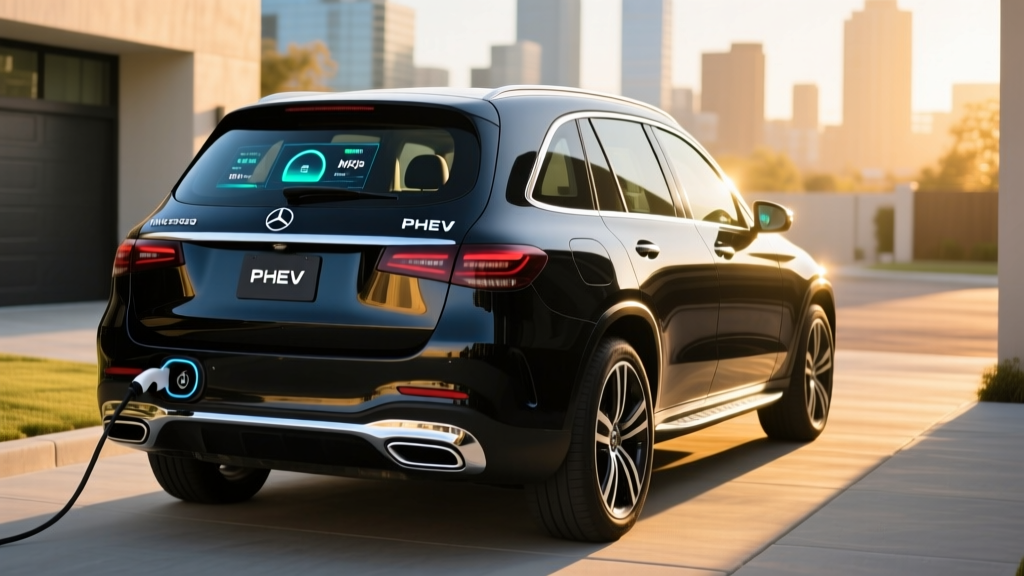
The 2026 Mercedes-Benz GLC 350e 4MATIC is the brand's mainstream Mercedes SUV plug in hybrid offering — and it makes a compelling case for buyers who want electric commuting without range anxiety on longer trips. With 39 miles of EPA-rated electric-only range, a combined 325 horsepower, and a starting MSRP of $59,250, the GLC 350e targets luxury compact SUV shoppers who aren't ready to commit to a full battery-electric vehicle but want meaningful fuel savings on daily drives.
Unlike a conventional hybrid (HEV), which generates electricity solely from regenerative braking and the engine, the GLC 350e is a plug-in hybrid electric vehicle (PHEV). That means you can plug it in overnight and start each morning with a full battery — turning your weekday commute into a zero-gas, all-electric trip while retaining a turbocharged gas engine for weekend road trips.
| Spec | 2026 GLC 350e 4MATIC |
|---|---|
| EPA Electric-Only Range | 39 miles |
| Total Combined Range (EV + Gas) | ~430 miles |
| Battery Capacity | 31.2 kWh (total) / ~23.4 kWh usable |
| Battery Chemistry | NMC (Nickel Manganese Cobalt) |
| MPGe (Electric Mode) | 56 MPGe combined |
| MPG (Gas-Only, Battery Depleted) | 25 city / 28 hwy / 26 combined |
| Combined System Horsepower | 325 HP |
| Combined System Torque | 516 lb-ft |
| 0-60 mph | 6.2 seconds |
| Max Level 2 AC Charge Rate | 7.4 kW |
| Level 2 Charge Time (0-100%) | ~3.25 hours |
| DC Fast Charging | Not available |
| Drivetrain | 4MATIC AWD |
| Base MSRP | $59,250 |
| Battery Warranty | 8 years / 100,000 miles |
HEV vs. PHEV: What's the Difference in the Mercedes Lineup?
Mercedes-Benz currently sells two types of electrified SUVs in the U.S., and the distinction matters for your wallet and your charging habits:
| Feature | Conventional Hybrid (HEV) | Plug-In Hybrid (PHEV) |
|---|---|---|
| Plug-In Charging? | No — self-charging via regen + engine | Yes — plug in to maximize electric range |
| Battery Size | Small (~1.5-2 kWh) | Large (31.2 kWh in GLC 350e) |
| Electric-Only Range | None (electric assist only) | 39 miles (GLC 350e) |
| Typical MPG Combined | Varies; mild-hybrid systems add ~1-2 MPG | 56 MPGe (EV mode); 26 MPG gas-only |
| Tax Credit Eligibility | No federal credit | Eligible under §30D if sourcing/income rules met |
| Example | Mercedes mild-hybrid 6-cylinder models | GLC 350e 4MATIC |
Key takeaway: The GLC 350e is a PHEV, not a conventional hybrid. To capture its fuel-economy advantage, you need access to a plug — ideally a home Level 2 charger or at minimum a standard 120V outlet. If you never plug it in, the GLC 350e operates as a heavy hybrid and its gas-only 26 MPG combined is actually worse than some conventional luxury SUVs, because the larger battery adds significant weight.
Electric-Only Range and Real-World MPG
The EPA rates the 2026 GLC 350e at 39 miles of electric-only range. That covers most daily commutes in the U.S. — the average one-way commute is approximately 16 miles, according to the Federal Highway Administration. Charge at home every night, and you could go weeks without visiting a gas station.
Real-World Range Expectations:
- EPA Sticker: 39 miles electric-only
- Warm weather, city/suburban driving (under 45 mph): 35-40 miles achievable
- Highway driving at 70 mph: Expect 28-32 miles (aerodynamic drag reduces EV efficiency at speed)
- Cold weather (below 32°F): 25-30 miles — battery chemistry is less efficient in cold, and cabin heating draws from the pack
Once the battery depletes below its usable threshold (roughly 12% State of Charge), the 2.0-liter turbocharged inline-four engine takes over. In gas-only mode, the EPA rates the GLC 350e at 25 city / 28 highway / 26 combined MPG. These numbers are unremarkable for a compact luxury SUV — the gas-only GLC 300 achieves 25/32/28 MPG — but remember that gas-only mode is the worst case for the PHEV. Most owners who charge daily will rarely operate in this mode.
Real-World MPG vs. EPA: What Owners Actually See
PHEVs introduce a variable that conventional cars don't have: your fuel economy depends entirely on how often you charge. An owner who charges nightly and drives 30 miles per day may use virtually no gasoline and see an effective rate above 100 MPGe over a month. An owner who never charges and drives 400 highway miles will see 26 MPG. The EPA's 56 MPGe combined figure assumes a mix of electric and gas driving over its standardized test cycle.
| Driving Scenario | Estimated Effective MPG / MPGe |
|---|---|
| Daily 30-mile commute, charged nightly | ~100+ MPGe (almost no gas used) |
| Mixed 45-mile day, charged nightly | ~60-75 MPGe |
| 300-mile road trip (gas-only after 39 mi) | ~26 MPG |
| Never plugged in (operating as heavy HEV) | ~26 MPG |
Charging: Level 2 Only, No DC Fast Charging
The GLC 350e accepts up to 7.4 kW on Level 2 AC charging via its onboard charger. A full 0-100% charge takes approximately 3.25 hours at that rate. On a standard 120V household outlet (Level 1), expect roughly 14-16 hours for a full charge — feasible for overnight top-ups if your daily electric use is modest, but not ideal for fully replenishing a depleted battery.
DC fast charging is not available on the GLC 350e. This is a significant limitation compared to some competitors — the BMW X5 xDrive50e, for instance, offers optional DC fast charging at up to 50 kW. If you plan to use public DC fast chargers during road trips to quickly replenish the battery, the GLC 350e cannot do this. For most PHEV owners, however, DC fast charging is less critical because the battery is small enough to fully charge at home or at a workplace Level 2 station in just a few hours.
| Charging Level | Power | Time (0-100%) | Miles of EV Range Added per Hour |
|---|---|---|---|
| Level 1 (120V household) | ~1.4 kW | ~14-16 hours | ~3-4 miles/hr |
| Level 2 (240V, 32A) | 7.4 kW (max) | ~3.25 hours | ~12-14 miles/hr |
| DC Fast Charge | N/A — not supported | N/A | N/A |
Home charging setup: Most GLC 350e owners will benefit from a Level 2 home charger installed on a 240V circuit. A 32-amp or 40-amp Wallbox or ChargePoint unit will fully replenish the battery overnight. Installation costs typically range from $500 to $2,000 depending on your electrical panel's capacity and the run length from panel to garage. According to fueleconomy.gov, Level 2 home charging costs roughly $0.04-$0.05 per electric mile at average U.S. electricity rates — a fraction of the $0.14-$0.18 per mile most luxury SUVs burn in gasoline.
Powertrain: 325 HP from Turbo Four + Electric Motor
The GLC 350e pairs a 2.0-liter turbocharged inline-four engine (producing approximately 215 HP on its own) with a permanently excited synchronous electric motor integrated into the transmission housing (adding roughly 134 HP). Combined system output is 325 HP and 516 lb-ft of torque, routed through a 9-speed automatic transmission to all four wheels via Mercedes' 4MATIC all-wheel-drive system.
The result is a 0-60 mph time of 6.2 seconds — brisk enough for confident highway merging and passing. The electric motor fills in the torque curve at low RPMs, eliminating the lag that smaller turbocharged engines typically exhibit. In EV mode, the GLC 350e is whisper-quiet and delivers smooth, linear acceleration up to its electric top speed of approximately 87 mph before the engine kicks in.
Driving modes include Electric, Hybrid, and Battery Hold. In Hybrid mode, the system intelligently blends electric and gas power to maximize efficiency over the full trip. Battery Hold mode preserves the electric charge for later use — useful if you want to save your EV miles for a low-emission zone or city driving after a highway stretch.
Pricing, Tax Credits, and Total Cost of Ownership
The 2026 GLC 350e 4MATIC starts at $59,250 (including destination charge). That's approximately $12,000 more than the gas-only GLC 300 4MATIC ($47,250), but the PHEV's fuel savings and potential tax credits narrow the gap significantly over time.
Federal §30D Tax Credit Eligibility
Under current IRS rules, PHEVs may qualify for up to $7,500 in federal tax credits under §30D clean vehicle provisions. However, eligibility depends on several factors that change frequently:
- MSRP Cap: SUVs must have an MSRP at or below $80,000. The GLC 350e qualifies at its base price, but a heavily optioned model could exceed the cap.
- Buyer Income Limits: Adjusted gross income must not exceed $150,000 (single), $225,000 (head of household), or $300,000 (joint filers).
- Battery Component & Critical Mineral Sourcing: A percentage of battery components must be manufactured or assembled in North America, and critical minerals must be sourced from the U.S. or free-trade-agreement partners. These thresholds tighten annually — check the DOE/FuelEconomy credit lookup tool for the specific model-year determination.
- Point-of-Sale Transfer: As of 2024, buyers can transfer the credit to the dealer at purchase, reducing the upfront price rather than waiting for a tax refund.
Important: Mercedes-Benz PHEV models have had inconsistent §30D eligibility in recent years due to battery-sourcing requirements. Confirm the GLC 350e's current credit status on fueleconomy.gov before purchasing, and consult a tax professional for your specific situation.
| 5-Year Cost Factor | GLC 350e PHEV | GLC 300 (Gas-Only) |
|---|---|---|
| Base MSRP | $59,250 | $47,250 |
| Estimated §30D Tax Credit | Up to $7,500 (verify eligibility) | $0 |
| Effective Purchase Price | ~$51,750 (if full credit applies) | $47,250 |
| Fuel / Electricity (5 yr, 60k mi) | ~$2,800 (assuming daily charging) | ~$8,400 (at 26 MPG, $3.65/gal) |
| Maintenance (5 yr) | ~$3,200 | ~$3,800 |
| Insurance (5 yr est.) | ~$11,500 | ~$10,200 |
| Estimated 5-Year Total | ~$69,250 | ~$69,650 |
The math reveals a tight race. If you qualify for the full $7,500 credit and charge daily, the GLC 350e reaches near cost-parity with the gas model over five years — while emitting far less CO₂ and providing a smoother, quieter daily drive.
Reliability, Battery Warranty, and Replacement Cost
Mercedes-Benz covers the GLC 350e's high-voltage battery with an 8-year / 100,000-mile warranty that guarantees the battery will retain at least 70% of its original capacity. If the battery degrades below that threshold within the warranty period, Mercedes will repair or replace it at no cost.
GLC 350e Battery Warranty Summary:
- Coverage: 8 years / 100,000 miles (whichever comes first)
- Capacity Guarantee: ≥70% of original capacity
- Chemistry: NMC — proven in millions of PHEV and EV deployments globally
- Out-of-Warranty Replacement Estimate: $8,000–$14,000 (parts + labor), based on current Mercedes PHEV battery pricing
In practice, PHEV batteries tend to outlast their warranty periods with manageable degradation. The GLC 350e's battery is relatively small (31.2 kWh total), and the vehicle's thermal management system keeps cell temperatures within optimal ranges during charging and discharging. Most owners report 5-10% capacity loss over the first five years — meaning your 39-mile EV range might become 35-37 miles by year five. This is normal and rarely a reason to replace the battery.
The conventional powertrain components (2.0L turbo engine, 9-speed transmission) are well-established in the Mercedes lineup. The inline-four M254 engine has been in production since 2021 with generally favorable reliability data. The main ownership risk is the higher complexity of having two complete powertrains — if something fails outside warranty, PHEV repairs can be costlier than either a pure EV or a conventional gas vehicle.
Pros and Cons of the GLC 350e
Pros
- 39 miles EV range covers most daily commutes without gasoline
- 325 HP and 516 lb-ft provide strong, smooth acceleration
- Luxury interior with MBUX infotainment and premium materials
- 4MATIC AWD standard — capable in rain and light snow
- Potential $7,500 federal tax credit narrows price gap with gas model
- Level 2 home charging fully replenishes battery overnight
- 8-year / 100,000-mile battery warranty
Cons
- Gas-only MPG (26 combined) is unremarkable when battery is depleted
- No DC fast charging — limits public charging utility on road trips
- $12,000 price premium over gas-only GLC 300 before credits
- Cargo space slightly reduced vs. gas GLC due to battery placement (~19 cu ft vs. 21.9 cu ft)
- Full EV range drops significantly in cold weather and at highway speeds
- §30D tax credit eligibility uncertain due to evolving sourcing rules
- Requires home charging access to realize fuel-economy benefits
Who Should Choose the GLC 350e PHEV vs. a Full EV or Gas Car?
Choose the GLC 350e PHEV if:
- You have home or workplace charging access
- Your daily driving is under 40 miles but you take road trips 3-5 times per year
- You want electric commuting but aren't confident in public charging infrastructure for longer trips
- You value Mercedes luxury, MBUX tech, and 4MATIC AWD
- You want to reduce gasoline consumption without committing to a full EV
Choose a full EV (e.g., Mercedes EQB or BMW iX) if:
- You have reliable home Level 2 charging
- Your daily driving is under 250 miles and you're comfortable planning DC fast-charge stops on road trips
- You want zero tailpipe emissions and minimal powertrain maintenance
- You want to maximize fuel savings — electricity costs ~$0.04-0.05/mile vs. $0.14-0.18/mile for gas
Choose the gas-only GLC 300 if:
- You lack access to any charging (apartment, street parking, no garage)
- You drive mostly highway miles where PHEV electric range offers minimal benefit
- You want the lowest upfront price and simplest powertrain
- Your annual mileage is very low, making fuel savings negligible
Frequently Asked Questions
How many MPG does the Mercedes GLC 350e plug-in hybrid get?
The EPA rates the 2026 GLC 350e at 56 MPGe combined when operating in electric mode, and 25 city / 28 highway / 26 combined MPG when the battery is depleted and the vehicle runs on gasoline alone. Your real-world effective fuel economy depends entirely on how often you charge — daily charging with a short commute can yield 100+ MPGe over a month, while never charging results in a flat 26 MPG.
How far can the GLC 350e go on electric only?
The EPA rates the GLC 350e at 39 miles of electric-only range. In real-world driving, expect 35-40 miles in warm city conditions, 28-32 miles at highway speeds, and 25-30 miles in cold weather (below 32°F) due to reduced battery efficiency and cabin heating demands.
Does the GLC 350e qualify for the $7,500 federal tax credit?
It may. Under current IRS §30D rules, the GLC 350e is potentially eligible for up to $7,500, subject to MSRP caps (under $80,000 for SUVs), buyer income limits, and battery-component/critical-mineral sourcing requirements. These sourcing rules tighten annually, so eligibility can change. Verify the specific model-year status on fueleconomy.gov and consult a tax professional before relying on the credit in your purchase decision.
Is the Mercedes GLC 350e hybrid reliable, and what does battery replacement cost?
The GLC 350e's powertrain combines proven components — the M254 turbo-four and the 9-speed transmission are widely used across the Mercedes lineup. The high-voltage battery is covered by an 8-year/100,000-mile warranty with a 70% capacity retention guarantee. Out-of-warranty replacement costs are estimated at $8,000–$14,000, though most PHEV batteries last well beyond their warranty period with only minor degradation (typically 5-10% over five years).
Can the GLC 350e use DC fast chargers?
No. The GLC 350e only supports AC charging — up to 7.4 kW on Level 2 (240V). A full charge takes about 3.25 hours on Level 2 or 14-16 hours on a standard 120V outlet. DC fast charging (the kind found at Electrify America or Tesla Supercharger stations) is not available on this model.
What's the difference between the GLC 350e and a conventional Mercedes hybrid?
The GLC 350e is a plug-in hybrid (PHEV) with a 31.2 kWh battery that provides 39 miles of electric-only driving when plugged in. A conventional hybrid (HEV) or mild-hybrid system — like the 48-volt EQ Boost found in some Mercedes models — cannot be plugged in and provides only electric assist to the engine, not standalone electric driving. The PHEV offers far greater fuel savings but requires charging infrastructure to realize its benefits.