Quick Verdict: The Mercedes GLC Hybrid for 2026
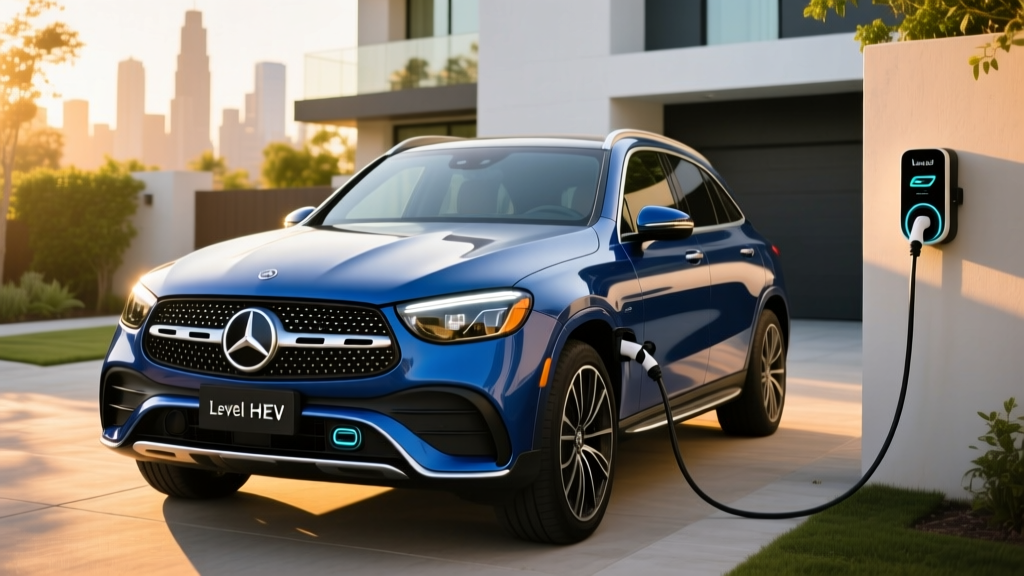
The 2026 Mercedes-Benz GLC 350e 4MATIC is a plug-in hybrid (PHEV) that pairs a turbocharged 2.0-liter four-cylinder with a 100 kW electric motor for a combined 313 horsepower and 406 lb-ft of torque. With an EPA-rated 37 miles of electric-only range and 56 MPGe when blending battery and gas, it targets luxury SUV buyers who want daily electric commuting without range anxiety on longer trips. Starting around $58,250 before destination, it sits in a competitive space against the BMW X3 xDrive30e and Volvo XC60 Recharge — but its DC fast-charging capability and refined powertrain integration give it an edge in the premium PHEV segment.
If you're searching for a Mercedes GLC hybrid, the GLC 350e is currently the only electrified GLC variant sold in the US market. Mercedes previously offered the GLC 300e in some regions as a conventional hybrid, but for American buyers in 2026, the plug-in GLC 350e 4MATIC is the model to evaluate.
| Spec | Value |
|---|---|
| Powertrain | 2.0L Turbo I4 + Electric Motor (PHEV) |
| Combined Horsepower | 313 HP |
| Combined Torque | 406 lb-ft |
| Battery (Usable) | ~25.4 kWh (NMC chemistry) |
| EPA Electric-Only Range | 37 miles |
| EPA MPGe (Electric + Gas) | 56 MPGe |
| EPA MPG (Gas Only, Charge-Depleted) | 28 city / 30 hwy / 29 combined |
| Total Combined Range | ~420 miles |
| 0–60 mph | 6.5 seconds |
| DC Fast Charge (Peak) | 60 kW (10–80% in ~30 min) |
| Level 2 Charge (7.4 kW) | 0–100% in ~3.5 hours |
| Drivetrain | 4MATIC AWD |
| Base MSRP | ~$58,250 |
| Federal Tax Credit (§30D) | Up to $3,750 (see eligibility below) |
| Battery Warranty | 6 years / 62,000 miles |
HEV vs PHEV: Understanding What You're Buying
Before diving deeper, it's critical to distinguish the two hybrid architectures — buyers often confuse them:
| Feature | Conventional Hybrid (HEV) | Plug-In Hybrid (PHEV) — GLC 350e |
|---|---|---|
| Plugs in to charge? | No — charges via regenerative braking and engine | Yes — plug in to maximize electric range |
| Electric-only range | 0–2 miles at low speed | 37 miles EPA |
| Battery size | ~1–2 kWh | ~25.4 kWh usable |
| Fuel economy advantage | Best in city stop-and-go | Best when daily driving is under electric range |
| Tax credit eligible? | No | Potentially — up to $3,750 under §30D |
The GLC 350e is a plug-in hybrid. That means you'll get the most value if you can charge at home or work regularly. Drive it without plugging in, and it functions as a heavy conventional hybrid — you'll still get roughly 29 MPG combined, but you're leaving the electric-range benefit on the table.
Fuel Economy: EPA Ratings and Real-World MPG
| Mode | City | Highway | Combined |
|---|---|---|---|
| Charge-Depleted (Gas Only) | 28 MPG | 30 MPG | 29 MPG |
| Blended (Electric + Gas) | 56 MPGe | ||
| Electric-Only Energy Consumption | ~38 kWh/100 mi | ||
Real-world expectations: The EPA's 29 MPG combined (gas-only) figure is measured with a depleted battery. In practice, PHEV owners who charge daily and drive under 37 miles rarely use gas at all during the workweek. For road trips where the battery depletes within the first 30–40 miles, expect real-world highway fuel economy closer to 26–28 MPG at 70–75 mph — the GLC 350e's added battery weight (~500 lbs over the gas-only GLC 300) works against it once the electric assist is exhausted.
City driving in charge-depleted mode actually favors the PHEV: regenerative braking recovers energy in stop-and-go traffic, and real-world city MPG can reach 30–32 MPG, slightly exceeding the EPA city estimate. This is typical of PHEVs and HEVs — EPA city tests don't fully capture regen benefits in heavy congestion.
Electric-Only Range and Charging
The GLC 350e's 25.4 kWh usable battery delivers an EPA-rated 37 miles of electric-only range. That's enough to cover the average American's one-way commute (roughly 16 miles each way, per Census data) with margin to spare — meaning many owners can complete weekday driving on electricity alone.
Real-World Electric Range Caveat: The 37-mile EPA figure assumes moderate temperatures and mixed driving. Expect 30–34 miles of electric range in cold weather (below 40°F) due to battery resistance and cabin heating demands. Highway-speed electric-only driving (70+ mph) will also reduce range to roughly 28–32 miles due to aerodynamic drag. In mild conditions around town, some drivers report reaching 38–40 miles.
Total combined range (electric + a full 16.4-gallon fuel tank) reaches approximately 420 miles, eliminating range anxiety on longer trips.
Charging Speeds and Connectors
One of the GLC 350e's advantages over some PHEV competitors is DC fast-charging support — unusual in this segment:
| Charging Level | Power | Time (10–80% or Full) | Connector |
|---|---|---|---|
| Level 1 (120V Household) | ~1.4 kW | ~18 hours (0–100%) | J1772 |
| Level 2 (240V Home/Public) | 7.4 kW | ~3.5 hours (0–100%) | J1772 |
| DC Fast Charge | 60 kW peak | ~30 min (10–80%) | CCS1 |
The 60 kW DC fast-charging capability means you can top up the battery during a lunch stop on a road trip — recovering 20+ miles of electric range in 15 minutes. While 60 kW is modest compared to full EVs (which can exceed 250 kW), it's a significant advantage over PHEVs limited to Level 2 only, such as the Toyota RAV4 Prime.
For home charging, a Level 2 wallbox (240V, 32A) will fully replenish the battery overnight in about 3.5 hours. Most PHEV owners find this more than adequate — plug in when you get home, and the battery is full by morning.
Powertrain and Performance
The GLC 350e's powertrain combines:
- 2.0-liter turbocharged inline-4: 215 HP, 258 lb-ft
- Electric motor (integrated in transmission): 100 kW (~134 HP), 325 lb-ft
- Combined system output: 313 HP, 406 lb-ft
Power routes through a 9-speed automatic transmission to Mercedes' 4MATIC all-wheel-drive system. The result is a 0–60 mph time of 6.5 seconds — respectable for a luxury compact SUV and noticeably quicker than the gas-only GLC 300 (6.8 seconds). The electric motor provides instant torque from a stop, making the GLC 350e feel responsive in city driving and highway merging.
Driving modes include Electric, Hybrid, and Sport. In Electric mode, the engine stays off entirely until the battery depletes or you demand full acceleration. Hybrid mode intelligently blends power sources based on route data from the navigation system — if you've entered a destination, the car can reserve battery for city driving at the end of your trip.
Pricing, Trims, and Tax Credit Eligibility
The 2026 GLC 350e 4MATIC starts at approximately $58,250 (including destination). Key trims and packages:
| Configuration | Approx. MSRP |
|---|---|
| GLC 350e 4MATIC (Base) | $58,250 |
| GLC 350e 4MATIC + Premium Package | $62,500 |
| GLC 350e 4MATIC + Pinnacle Trim | $66,800 |
| GLC 350e SUV (long wheelbase, if available) | $61,000 |
Federal Tax Credit Under IRS §30D
The GLC 350e may qualify for a partial federal tax credit under IRS §30D clean vehicle rules. Based on current 2026 guidance, the credit for the GLC 350e is up to $3,750 — reflecting the battery's critical-minerals and component-sourcing requirements. The full $7,500 credit requires meeting both the critical-minerals threshold ($3,750) and the battery-components threshold ($3,750); as of 2026, the GLC 350e's battery sourcing qualifies for one of these two prongs.
§30D Eligibility Requirements (2026):
- MSRP cap: SUVs must be under $80,000 — the GLC 350e qualifies at all trims
- Buyer income cap: Modified AGI ≤ $150,000 (single), $225,000 (head of household), $300,000 (joint)
- Battery sourcing: Critical minerals and component rules phase in annually — check fueleconomy.gov for current certification
- Point-of-sale transfer: You can transfer the credit to the dealer at purchase for an immediate price reduction, if eligible
- Tax liability: The credit is non-refundable — you must owe at least $3,750 in federal taxes to benefit (unless transferred at point of sale)
Always verify current credit eligibility on fueleconomy.gov before purchasing, as sourcing certifications can change mid-year. Consult a tax professional for your specific situation.
Reliability, Battery Warranty, and Replacement Cost
Mercedes-Benz High-Voltage Battery Warranty: 6 years / 62,000 miles (whichever comes first), covering defects and capacity loss below 70% of original capacity. This is shorter than the 8-year/100,000-mile warranties offered by Toyota, Hyundai, and BMW for their hybrid/PHEV batteries — a notable disadvantage for long-term ownership peace of mind.
Reliability outlook: Mercedes-Benz as a brand scores below average in long-term reliability surveys from Consumer Reports and J.D. Power, though the GLC specifically has performed better than the brand average. The PHEV powertrain adds complexity — two power sources, a high-voltage battery, and additional cooling systems — but the electric motor itself has far fewer moving parts than the internal combustion engine.
Battery replacement cost: If the high-voltage battery requires replacement out of warranty, expect a cost between $12,000 and $18,000 including parts and labor at a Mercedes dealer. This is a worst-case scenario; PHEV batteries in normal use typically retain 85–90% capacity after 8–10 years based on industry data. Mercedes' NMC chemistry is proven but does degrade faster than LFP (lithium iron phosphate) under sustained high-temperature or high-charge conditions.
Care tips to maximize battery life:
- Avoid routinely charging to 100% — set a daily charge limit of 80–90% when possible
- Minimize prolonged exposure to extreme heat (garage parking helps in summer)
- Use the vehicle's preconditioning feature to warm or cool the battery while still plugged in
- Don't let the battery sit at 0% for extended periods
Who Should Buy the Mercedes GLC 350e?
Choose the GLC 350e PHEV if:
- Your daily round-trip commute is under 35 miles and you can charge at home
- You want a luxury compact SUV with premium materials and MBUX tech
- You take regular road trips where a full EV's charging logistics feel limiting
- You value DC fast-charging capability for occasional mid-trip top-ups
- You want to reduce fuel costs without committing to a full BEV
Choose a full EV (e.g., Mercedes EQB, BMW iX3, Tesla Model Y) if:
- You have reliable home charging and rarely drive more than 250 miles in a day
- You want lower maintenance costs (no oil changes, fewer moving parts)
- You want to maximize the $7,500 federal tax credit (more full EVs qualify for the full amount)
Choose a conventional gas GLC 300 if:
- You cannot charge at home or work
- You want a lower purchase price (~$47,000 base)
- You don't want to manage charging routines
Pros
- 37-mile electric range covers most daily commutes
- DC fast-charging at 60 kW — rare for PHEVs
- 313 HP with smooth electric torque delivery
- Premium interior with latest MBUX infotainment
- No range anxiety on long trips
Cons
- Battery warranty only 6 years / 62,000 miles (shorter than rivals)
- $58,250 starting price — $11,000+ over gas GLC 300
- Tax credit only $3,750 (not the full $7,500)
- 29 MPG gas-only is modest for a hybrid (heavy battery weight)
- Cargo space slightly reduced vs gas GLC (battery placement)
Frequently Asked Questions
How many MPG does the Mercedes GLC hybrid get?
The 2026 GLC 350e PHEV is rated at 56 MPGe when blending electric and gas power, and 29 MPG combined (28 city / 30 highway) when operating on gasoline alone with a depleted battery. Real-world gas-only MPG can reach 30–32 in city driving thanks to regenerative braking, but expect 26–28 on the highway at higher speeds.
How far can the GLC 350e go on electric only?
The EPA rates the GLC 350e at 37 miles of electric-only range. Real-world range varies: expect 30–34 miles in cold weather, 28–32 miles at sustained highway speeds, and up to 38–40 miles in mild city conditions. Total combined range (electric + gas) is approximately 420 miles.
Does the Mercedes GLC hybrid qualify for a tax credit?
The GLC 350e may qualify for up to $3,750 under the federal §30D clean vehicle credit, subject to buyer income limits ($150K single / $300K joint), MSRP caps (under $80K for SUVs — all trims qualify), and battery-sourcing requirements. The credit can be transferred to the dealer at point of sale for an immediate price reduction. Always verify current eligibility on fueleconomy.gov and consult a tax professional.
Is the GLC 350e reliable, and what does battery replacement cost?
Mercedes-Benz scores below average in brand-wide reliability surveys, though the GLC platform has been better than the brand norm. The high-voltage battery is warranted for 6 years / 62,000 miles — shorter than Toyota's 10-year / 150,000-mile coverage. Out-of-warranty battery replacement costs approximately $12,000–$18,000. In practice, PHEV batteries typically retain 85–90% capacity after 8–10 years of normal use.
Do I need to plug in the GLC 350e?
You don't have to — the car will operate as a conventional hybrid using the gas engine and regenerative braking. However, to benefit from the 37-mile electric range and 56 MPGe rating, you should plug in regularly. Without plugging in, you'll get roughly 29 MPG combined and miss the primary value proposition of the PHEV.
Hybrid vs PHEV vs EV — which is right for me?
A conventional hybrid (HEV) like the Toyota RAV4 Hybrid requires no plugging in and improves MPG by 20–30% over gas-only — ideal if you lack charging access. A PHEV like the GLC 350e gives you 30–40 miles of electric range for daily commuting plus a gas engine for long trips — best if you can charge at home but aren't ready for full EV logistics. A full BEV (battery electric vehicle) like the Tesla Model Y offers the lowest operating costs and zero tailpipe emissions but requires reliable charging access and planning for long trips.
Can the GLC 350e DC fast charge?
Yes. The GLC 350e supports DC fast charging at up to 60 kW via a CCS1 connector, reaching 10–80% in approximately 30 minutes. This is a notable advantage over many competing PHEVs that are limited to Level 2 (240V) charging only.