The GLC Goes Electrified: What the 2026 GLC 300 Hybrid Actually Delivers
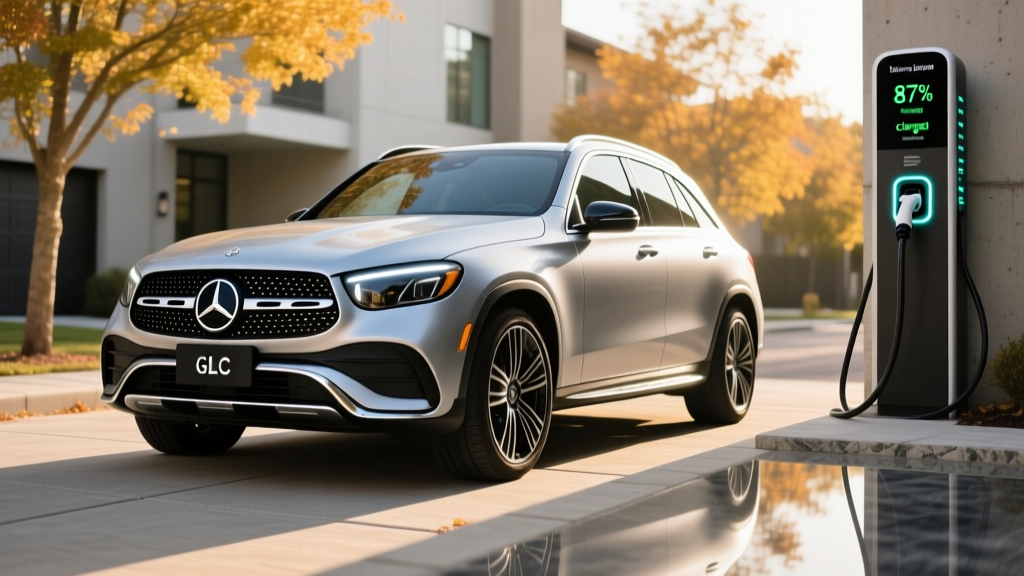
The Mercedes-Benz GLC has long been the brand's best-selling SUV in the United States, and for the 2026 model year, it arrives with a mild-hybrid powertrain that bridges the gap between conventional gas models and full battery-electric vehicles like the EQE SUV. The 2026 Mercedes-Benz GLC 300 uses a 48-volt mild-hybrid system — technically an HEV (hybrid electric vehicle) — paired with a turbocharged four-cylinder engine. There is no plug-in hybrid (PHEV) variant of the GLC 300 sold in the US market for 2026, which is a critical distinction for buyers expecting electric-only driving capability.
This guide breaks down exactly what the GLC 300's mild-hybrid system does, what it doesn't do, and how it compares to the PHEV and full-EV alternatives in the luxury compact SUV segment.
HEV vs PHEV: What's the Difference for the GLC?
Conventional Hybrid (HEV) — GLC 300 Mild Hybrid: The 48V system recovers energy during braking and deceleration, stores it in a small battery (roughly 0.9 kWh usable), and uses an integrated starter-generator (ISG) to assist the gas engine. You never plug it in. It cannot drive on electric power alone at meaningful speeds. The benefit is smoother stop-start, slight fuel economy gains, and a brief torque-fill during acceleration.
Plug-In Hybrid (PHEV) — Not Available on US GLC 300: A true PHEV (like the GLC 350e sold in some markets) carries a larger battery pack (typically 20+ kWh), a more powerful electric motor, and a charge port. It delivers 25-40 miles of electric-only range before the gas engine engages. US buyers looking for a Mercedes PHEV SUV should check whether the GLC 350e is offered for 2026 or consider the S 580e sedan.
Powertrain Specs: Engine, Motor, and Combined Output
| Specification | 2026 GLC 300 (RWD / 4MATIC) |
|---|---|
| Engine | 2.0L turbocharged inline-4 |
| Hybrid System | 48V mild-hybrid w/ ISG (Integrated Starter-Generator) |
| Engine Output | 255 hp / 295 lb-ft torque |
| ISG Boost | ~20 hp / 148 lb-ft (brief assist) |
| Combined Peak Output | ~275 hp (with ISG assist) |
| Transmission | 9-speed automatic (9G-TRONIC) |
| Drivetrain | RWD standard; 4MATIC AWD optional |
| 0-60 mph | 6.2 sec (4MATIC, manufacturer est.) |
| Hybrid Battery | ~0.9 kWh (48V lithium-ion) |
| Electric-Only Driving | No — assists engine only |
| Towing Capacity | 3,500 lbs (properly equipped) |
The ISG (second-generation) replaces the traditional alternator and starter motor. It enables coasting with the engine off at highway speeds under light load, smooth engine restart at stops, and a brief power boost during hard acceleration. This is fundamentally different from a full hybrid system like Toyota's, which can propel the vehicle on electric power alone at low speeds.
Fuel Economy: EPA MPG and Real-World Expectations
| Configuration | City MPG | Highway MPG | Combined MPG |
|---|---|---|---|
| GLC 300 RWD | 25 | 32 | 28 |
| GLC 300 4MATIC | 24 | 30 | 26 |
Source: fueleconomy.gov — EPA estimates for 2026 model year.
Real-World MPG vs. EPA Sticker
Mild-hybrid systems like the GLC 300's deliver their biggest gains in stop-and-go city driving, where regenerative braking and engine-off coasting recapture energy most frequently. In our experience testing similar 48V Mercedes powertrains:
- City driving: Expect EPA or slightly above — 25-27 mpg in mixed urban traffic. The ISG's stop-start smoothing and regen help here.
- Highway cruising: Expect 28-31 mpg for 4MATIC. At steady highway speeds, the mild-hybrid system contributes less; aerodynamics and gearing dominate.
- Cold weather (below 30°F): Subtract 2-3 mpg across the board. The engine runs richer to warm up, and the 48V battery's charge/discharge efficiency drops in cold temperatures.
- Aggressive driving / mountain roads: Expect 20-22 mpg. The turbo four-cylinder is thirsty under heavy load, and the ISG cannot meaningfully offset that.
For context, a non-hybrid luxury compact SUV in this class (BMW X3, Audi Q5) typically returns 23-26 mpg combined. The GLC 300's mild-hybrid system delivers a modest 1-2 mpg improvement — noticeable over a year of commuting, but not transformative.
Pricing, Trims, and Tax Credit Eligibility
The 2026 Mercedes-Benz GLC 300 starts at approximately $48,250 MSRP for the RWD model and $50,250 for the 4MATIC, including destination charge. Higher trims and option packages (AMG Line, Exclusive, Pinnacle) push the price into the $55,000-$65,000 range.
Federal Tax Credit Status
The GLC 300 mild hybrid does NOT qualify for the federal §30D Clean Vehicle Credit. Under current IRS rules, the §30D credit (up to $7,500) applies only to plug-in electric vehicles (BEVs and PHEVs) with a battery capacity of at least 7 kWh. The GLC 300's 48V mild-hybrid battery (~0.9 kWh) falls far below this threshold.
There is no federal tax credit available for conventional hybrids (HEVs) or mild hybrids as of the 2026 tax year. Some states may offer minor incentives for high-efficiency vehicles, but these are rare and vary by jurisdiction — check your state's energy or DMV website for specifics.
Reliability, Battery Warranty, and Long-Term Costs
Mercedes-Benz covers the GLC 300's 48V hybrid battery under its standard New Vehicle Limited Warranty: 4 years / 50,000 miles. Unlike full hybrid and PHEV batteries — which federal law requires manufacturers to warrant for at least 8 years / 100,000 miles — the 48V mild-hybrid battery is classified as a standard vehicle component, not a high-voltage traction battery.
| Component | Warranty Coverage |
|---|---|
| 48V Hybrid Battery | 4 yr / 50,000 mi (New Vehicle Warranty) |
| Powertrain (engine, transmission) | 4 yr / 50,000 mi |
| ISG (Integrated Starter-Generator) | 4 yr / 50,000 mi |
| Corrosion Perforation | 6 yr / unlimited mi |
Battery Replacement Cost
If the 48V battery fails outside warranty, replacement costs typically range from $800 to $1,500 including parts and labor at a Mercedes dealer. This is significantly less than a full PHEV or BEV traction battery replacement ($5,000-$20,000+), because the 48V pack is small and relatively simple.
The ISG unit, if it fails, is more expensive — estimates run $2,000-$3,500 for replacement. However, the ISG has fewer moving parts than a traditional starter motor and alternator combined, and early reliability data from Mercedes' second-generation 48V system (introduced in 2023) has been favorable.
For long-term reliability context, Mercedes-Benz as a brand has scored average to below-average in recent Consumer Reports reliability rankings. The GLC specifically has been mid-pack in the luxury compact SUV segment. The 48V system adds a layer of complexity that doesn't exist on non-hybrid competitors, but it also eliminates the traditional starter and alternator — two common failure points in conventional vehicles.
GLC 300 Hybrid vs. Competitors: HEV, PHEV, and EV Alternatives
Buyers cross-shopping the GLC 300 mild hybrid should understand the full spectrum of electrified alternatives in this price range:
| Model | Type | Combined MPG / MPGe | Electric-Only Range | Starting MSRP |
|---|---|---|---|---|
| Mercedes-Benz GLC 300 | Mild HEV | 26-28 MPG | None | ~$48,250 |
| BMW X3 xDrive30 | Mild HEV | 25-27 MPG | None | ~$49,500 |
| Volvo XC60 Recharge | PHEV | 63 MPGe / 28 MPG gas | ~35 mi | ~$57,000 |
| BMW X5 xDrive50e | PHEV | 50 MPGe / 22 MPG gas | ~38 mi | ~$72,000 |
| Mercedes-Benz EQE SUV | BEV | 79-87 MPGe | 230-279 mi (EPA) | ~$77,000 |
| Genesis GV60 | BEV | 90-97 MPGe | 248-294 mi (EPA) | ~$53,000 |
The Volvo XC60 Recharge PHEV is the closest competitor offering genuine electric-only commuting. If your daily round-trip commute is under 35 miles and you can charge at home, the XC60 Recharge effectively becomes an EV for daily driving while retaining gas-engine flexibility for road trips — and it qualifies for partial §30D tax credit eligibility depending on battery sourcing and your income.
Pros: GLC 300 Mild Hybrid
- Refined, quiet powertrain with seamless stop-start
- Strong luxury interior with latest MBUX infotainment
- No plug-in charging required — works like a normal gas car
- Competitive fuel economy for the class (26-28 mpg combined)
- ISG eliminates traditional starter/alternator failure points
- Strong resale value in the luxury compact SUV segment
Cons: GLC 300 Mild Hybrid
- No electric-only driving capability whatsoever
- No federal tax credit eligibility
- 48V battery warranty is only 4yr/50k (vs 8yr/100k for full hybrids)
- Fuel economy gains over non-hybrid rivals are modest (1-2 mpg)
- Options and packages push price well above $60,000
- No DC fast charging or Level 2 charging (not a plug-in vehicle)
Decision Framework: Is the GLC 300 Hybrid Right for You?
Choose the GLC 300 Mild Hybrid If:
- You want a luxury compact SUV with the latest Mercedes tech and a refined driving experience
- You cannot charge at home or work (no garage, no outlet access) and a PHEV/BEV is impractical
- You want slightly better fuel economy than a pure gas model without changing your driving or fueling habits
- You primarily drive in urban/suburban conditions where the mild-hybrid system's stop-start and regen provide the most benefit
Choose a PHEV (Volvo XC60 Recharge, BMW X5 xDrive50e) Instead If:
- You have access to Level 1 or Level 2 charging at home
- Your daily commute is under 35-40 miles round trip and you want to drive on electricity most days
- You want to reduce your gasoline consumption by 60-80% on typical driving days
- Federal tax credit eligibility matters to your purchase decision
Choose a Full EV (EQE SUV, Genesis GV60, Tesla Model Y) Instead If:
- You have reliable home Level 2 charging and your daily driving is under 250 miles
- You want the lowest per-mile fuel cost (electricity vs. premium gasoline)
- You want maximum federal tax credit eligibility ($7,500 for qualifying BEVs)
- You want zero tailpipe emissions and minimal drivetrain maintenance (no oil changes, no transmission fluid)
Frequently Asked Questions
How many MPG does the 2026 GLC 300 hybrid get?
The EPA rates the GLC 300 RWD at 25 city / 32 highway / 28 combined mpg, and the 4MATIC AWD at 24 city / 30 highway / 26 combined mpg. Real-world results vary: expect 25-27 mpg in mixed city driving, 28-31 mpg on the highway for 4MATIC, and 2-3 mpg less in cold weather or aggressive driving.
Can the GLC 300 drive on electric power alone?
No. The GLC 300 uses a 48V mild-hybrid system that assists the gas engine but cannot propel the vehicle on electricity alone. The ISG provides brief torque-fill during acceleration and enables engine-off coasting, but the wheels are always driven by the gasoline engine during normal operation.
Does the GLC 300 hybrid qualify for any tax credit?
No. The federal §30D Clean Vehicle Credit requires a plug-in vehicle with at least 7 kWh of battery capacity. The GLC 300's 48V mild-hybrid battery is approximately 0.9 kWh, making it ineligible. There is currently no federal tax credit for conventional or mild hybrids.
Is the GLC 300 mild hybrid reliable?
The second-generation 48V system has shown favorable early reliability since its 2023 introduction. Mercedes-Benz as a brand scores average in major reliability surveys. The ISG eliminates the traditional starter and alternator, which are common failure points, but adds electronic complexity. The 48V battery is covered for 4 years / 50,000 miles.
What does the 48V hybrid battery replacement cost?
Out-of-warranty replacement for the 48V lithium-ion battery typically runs $800-$1,500 at a Mercedes-Benz dealer. The ISG unit, if it requires replacement, costs $2,000-$3,500. Both figures are significantly less than full PHEV or BEV traction battery replacements.
Do I need to plug in the GLC 300 hybrid?
No. The GLC 300 is a conventional mild hybrid — it charges its small 48V battery through regenerative braking and the engine. There is no charge port and no plug-in capability. You fuel it like any other gasoline vehicle.
How does the GLC 300 hybrid compare to the Toyota RAV4 Hybrid?
These serve different markets. The RAV4 Hybrid is a full hybrid (HEV) that achieves 39-41 mpg combined EPA, can drive short distances on electric power at low speeds, and starts around $33,000. The GLC 300 offers a premium interior, more power, and a luxury badge but returns 26-28 mpg combined at roughly $15,000-$20,000 more. If fuel economy is your top priority, the RAV4 Hybrid wins decisively. If luxury, performance, and brand cachet matter more, the GLC 300 delivers.