Quick Verdict: The Mercedes E 350e PHEV at a Glance
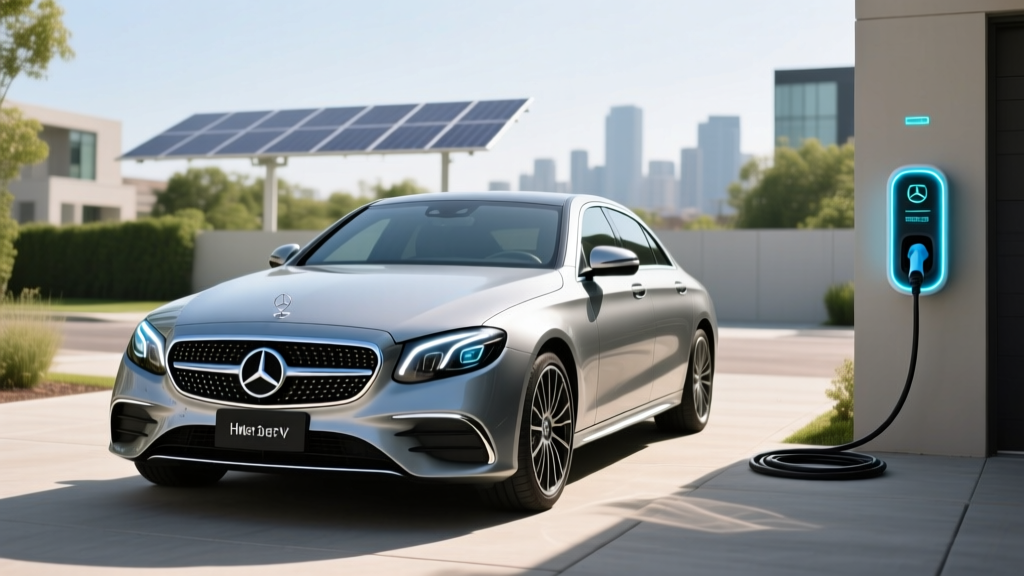
The 2026 Mercedes-Benz E 350e 4MATIC is a plug-in hybrid (PHEV) luxury sedan that bridges the gap between traditional gasoline motoring and full electrification. With an EPA-rated 39 miles of electric-only driving and a combined 309 horsepower, it serves buyers who want daily electric commuting without sacrificing the ability to take cross-country road trips without route planning.
For 2026, Mercedes continues the E-Class PHEV formula with a 2.0-liter turbocharged inline-four paired with a permanently excited synchronous electric motor, all routed through a 9-speed automatic transmission. The result is a sedan that can silently glide through city traffic on electrons, then fire up its combustion engine for highway passing power or extended touring.
| Specification | Value |
|---|---|
| Powertrain | 2.0L Turbo I-4 + Electric Motor (PHEV) |
| Combined Horsepower | 309 HP |
| Combined Torque | 406 lb-ft |
| Battery (usable) | 25.4 kWh (lithium-ion, NMC chemistry) |
| EPA Electric-Only Range | 39 miles |
| EPA MPGe (charge-sustaining + electric) | 68 MPGe combined |
| EPA MPG (gas only, charge-sustaining) | 29 city / 33 highway / 31 combined |
| Total Combined Range | ~440 miles (est.) |
| 0–60 mph | 5.9 seconds |
| DC Fast Charge Capable | Yes — up to 60 kW (CCS) |
| Level 2 Charge Time (0–100%) | ~3.25 hours at 7.4 kW |
| Base MSRP | $68,250 (E 350e 4MATIC Sedan) |
| Federal Tax Credit (§30D) | Up to $3,750 (see eligibility details) |
| Hybrid Battery Warranty | 6 years / 62,000 miles |
HEV vs PHEV: Understanding the E-Class Hybrid Lineup
A critical distinction for Mercedes E Series Hybrid shoppers: the E 350e is a plug-in hybrid (PHEV), not a conventional hybrid (HEV). Here's what that means in practice:
| Feature | Conventional Hybrid (HEV) | Plug-In Hybrid (PHEV) — E 350e |
|---|---|---|
| Battery Size | Small (~1–2 kWh) | Large (25.4 kWh usable) |
| Plug In to Charge? | No — self-charges via regen + engine | Yes — plug in for full electric range |
| Electric-Only Range | 0–1 mile at low speed | 39 miles (EPA) |
| Fuel Economy Benefit | Moderate MPG improvement | Major savings if you plug in daily |
| Tax Credit Eligibility | None (federal) | Potential §30D credit (up to $3,750) |
| Best For | Drivers who cannot charge at home | Drivers with home/work charging access |
Key takeaway: If you cannot plug in regularly, the E 350e's PHEV system still operates as a conventional hybrid once the battery depletes — but you're carrying 400+ lbs of battery weight you never use, which slightly reduces fuel economy versus a dedicated HEV. The PHEV only unlocks its value proposition when charged daily.
Fuel Economy and Electric Range: Real-World Expectations
The EPA rates the 2026 E 350e 4MATIC at 68 MPGe combined when operating in blended electric-gas mode with a full battery. Once the 39-mile electric range is exhausted, the car switches to charge-sustaining hybrid mode and delivers an EPA-estimated 31 MPG combined (29 city / 33 highway).
| Driving Mode | City | Highway | Combined |
|---|---|---|---|
| Electric + Gas (MPGe) | 71 MPGe | 64 MPGe | 68 MPGe |
| Gas Only / Charge-Sustaining (MPG) | 29 MPG | 33 MPG | 31 MPG |
Source: EPA Fuel Economy
Real-world MPG reality check: Like most PHEVs, the E 350e's actual fuel economy depends almost entirely on your charging habits. If your daily commute is under 35 miles round-trip and you charge every night, you may go weeks without burning gasoline — effectively achieving 100+ MPGe in practice. Conversely, if you never plug in, expect real-world highway fuel economy closer to 28–30 MPG due to the vehicle's 4,700-lb curb weight and all-wheel-drive drivetrain losses.
Cold weather reduces electric-only range by approximately 20–30% due to cabin heating demands and reduced battery efficiency. In sub-freezing conditions, expect roughly 27–32 miles of electric range instead of the EPA-rated 39.
Powertrain and Performance Details
The E 350e's powertrain pairs a turbocharged 2.0-liter inline-four (producing 201 HP and 236 lb-ft on its own) with a 127-HP electric motor integrated into the transmission housing. Combined system output reaches 309 HP and 406 lb-ft of torque.
The electric motor provides instant torque from 0 RPM, giving the sedan responsive off-the-line acceleration. Mercedes claims a 0–60 mph time of 5.9 seconds — brisk for a luxury sedan focused on efficiency rather than sport. The 9G-TRONIC 9-speed automatic transmission manages power delivery smoothly, and the 4MATIC all-wheel-drive system provides confident traction in inclement weather.
Driving modes include Electric (pure EV up to ~87 mph), Hybrid (blended), and a Battery Hold mode that preserves charge for later use — useful when entering a city center after highway driving.
Charging: Level 2, DC Fast Charge, and Times
The 2026 E 350e supports three charging methods, a notable advantage over many PHEV competitors that lack DC fast charging capability:
| Charging Level | Power | Connector | 0–100% Time | Miles Added per Hour |
|---|---|---|---|---|
| Level 1 (120V household) | ~1.4 kW | J1772 / CCS | ~18 hours | ~5 miles |
| Level 2 (240V home/public) | 7.4 kW | J1772 / CCS | ~3.25 hours | ~26 miles |
| DC Fast Charge | Up to 60 kW | CCS Combo | 10–80% in ~20 min | ~100+ miles (equiv.) |
Practical charging insight: The 60 kW DC fast-charging capability is rare in the PHEV segment and genuinely useful on road trips — a 20-minute stop at an Electrify America or EVgo station can replenish enough battery for 25–30 miles of electric driving through your destination city. However, at 60 kW peak, this is not comparable to full EV fast-charging speeds (200+ kW); the smaller battery simply doesn't need or accept higher rates.
For daily use, a Level 2 home charger (240V, 32A minimum) is ideal. Plugging in overnight ensures a full 39-mile electric range every morning. A standard Level 2 installation typically costs $800–$2,000 including equipment and electrician labor, depending on panel proximity and local permitting. (Consult a licensed electrician for your specific home assessment.)
Pricing, Trims, and Tax Credit Eligibility
The 2026 Mercedes-Benz E 350e 4MATIC Sedan starts at $68,250 (including destination charge). This positions it in the mid-tier of the E-Class lineup, above the E 350 (gas) and below the AMG variants.
Standard equipment includes MBUX infotainment with a 14.4-inch central display, 12.3-inch digital instrument cluster, heated front seats, ambient lighting, wireless Apple CarPlay/Android Auto, and a comprehensive suite of driver-assistance features including Active Distance Assist DISTRONIC (adaptive cruise), Active Lane Keeping, and Active Brake Assist.
Federal §30D Tax Credit for the E 350e
The E 350e may qualify for a partial federal tax credit under IRS §30D. For 2026, the credit structure is as follows:
- Up to $3,750 if the vehicle meets critical minerals sourcing requirements (battery components must meet escalating domestic-content thresholds)
- MSRP cap: Sedans must have an MSRP at or below $55,000 — the E 350e exceeds this cap and therefore does not qualify for the new-vehicle §30D credit
- Buyer income cap: Modified AGI must not exceed $150,000 (single) / $300,000 (joint filing)
- Point-of-sale transfer: Available for eligible vehicles, but the MSRP cap disqualifies this model
Source: IRS Clean Vehicle Credits
Bottom line: At $68,250 MSRP, the E 350e sedan exceeds the $55,000 sedan cap for the §30D new-vehicle credit. Buyers should check with their tax professional about potential state-level PHEV incentives, which vary by jurisdiction and may offer rebates regardless of MSRP. Some states (California, Colorado, New York, among others) offer additional PHEV rebates of $1,000–$4,000.
Reliability, Battery Warranty, and Long-Term Ownership
Hybrid Battery Warranty Coverage
Mercedes-Benz covers the E 350e's high-voltage lithium-ion battery under its Hybrid/EV Component Warranty: 6 years or 62,000 miles (whichever comes first). This is shorter than the 8-year/100,000-mile warranty offered by many competitors (Toyota, Hyundai, BMW) and below the 10-year benchmarks set by some brands.
The warranty covers battery capacity degradation below a specified threshold (typically 70% of original capacity) and defects in the electric motor, power electronics, and associated high-voltage components.
Battery replacement cost: If the high-voltage battery requires replacement out of warranty, expect a cost between $12,000 and $18,000 including parts and labor at a Mercedes dealership. This is a significant expense, though battery failures in modern PHEVs are statistically rare within the first 10 years of normal use.
Mercedes-Benz reliability ratings for the E-Class platform are generally average to above-average in industry surveys. The PHEV powertrain adds complexity (two power sources, high-voltage systems, additional cooling circuits) but benefits from Mercedes' extensive experience with hybrid systems dating back to the S 400 Hybrid in 2009. The 2.0L turbo engine (M254) is a proven design shared across the Mercedes lineup.
For long-term ownership peace of mind, consider an extended warranty that specifically covers high-voltage hybrid components beyond the factory 6-year term, especially if you plan to keep the vehicle past 62,000 miles.
Who Should Choose the E 350e PHEV vs a Full EV or Gas Car?
Choose the E 350e PHEV If:
- Your daily commute is 25–40 miles round-trip and you can charge at home overnight
- You regularly take road trips exceeding 300 miles and don't want to plan around charging stops
- You want a luxury sedan with electric daily driving but aren't ready to commit to a full BEV
- You live in an area with limited public DC fast-charging infrastructure
- You want the E-Class experience with reduced fuel costs and lower tailpipe emissions on daily drives
Consider a Full EV (e.g., EQE Sedan) Instead If:
- You have reliable home and workplace charging and rarely drive more than 250 miles in a day
- You want to eliminate gasoline costs and maintenance (no oil changes, spark plugs, or exhaust system)
- You prioritize maximum federal tax credit eligibility (the EQE may qualify depending on sourcing rules and MSRP)
- You prefer the quietness and instant torque of a pure electric drivetrain at all speeds
Consider the Gas-Only E 350 Instead If:
- You cannot charge at home or work (apartment living, no garage, no workplace chargers)
- Your budget is tighter — the E 350 starts ~$8,000 lower
- You drive mostly highway miles where the PHEV's electric range offers minimal benefit
- You want to avoid the long-term maintenance complexity of a dual-powertrain vehicle
Frequently Asked Questions
How many MPG does the Mercedes E 350e hybrid get?
The EPA rates the 2026 E 350e at 68 MPGe combined when using both electric and gas power. In charge-sustaining (gas-only) mode after the battery depletes, it achieves 29 city / 33 highway / 31 combined MPG. Real-world results vary significantly based on charging frequency — daily plug-in users may burn very little gasoline, while those who never charge will see closer to 28–30 MPG in mixed driving.
How far can the E 350e drive on electric power alone?
The EPA rates the E 350e at 39 miles of electric-only range. In real-world conditions — particularly cold weather or sustained highway speeds above 70 mph — expect 27–35 miles. The electric motor can propel the car up to approximately 87 mph before the gasoline engine must engage.
Does the Mercedes E Series Hybrid qualify for a federal tax credit?
Unfortunately, the E 350e sedan's MSRP of $68,250 exceeds the $55,000 sedan cap set by the IRS §30D clean vehicle credit rules for 2026. This means it does not qualify for the federal new-vehicle tax credit. However, state-level incentives may still apply — check your state's energy office or DMV for current PHEV rebate programs. Always consult a tax professional for your specific situation.
Is the E 350e reliable, and what does battery replacement cost?
The E-Class PHEV platform benefits from Mercedes' long hybrid experience, and major powertrain failures are uncommon in normal use. The high-voltage battery is warranted for 6 years / 62,000 miles. Out-of-warranty battery replacement costs approximately $12,000–$18,000 at a dealership. This warranty is shorter than competitors like BMW (8 years/80,000 miles) and Hyundai (10 years/100,000 miles), which is a consideration for long-term owners.
Can the E 350e charge at DC fast-charging stations?
Yes — the E 350e supports DC fast charging at up to 60 kW via a CCS Combo connector. This allows a 10–80% charge in approximately 20 minutes, which is uncommon among PHEVs and useful for road trips. Most PHEV competitors only support Level 2 (AC) charging.
What is the total driving range of the E 350e?
Combining the 39-mile electric range with the gasoline tank (approximately 17.4 gallons), the E 350e offers an estimated total range of roughly 440 miles before needing to refuel or recharge. This eliminates the range anxiety some drivers associate with full EVs while still providing meaningful electric driving for daily commutes.
How does the E 350e compare to the Mercedes EQE electric sedan?
The EQE 350+ is a fully electric sedan with an EPA range of approximately 305 miles and a starting MSRP around $75,000. It offers a quieter ride, fewer moving parts, and potentially lower maintenance costs — but requires commitment to charging infrastructure. The E 350e is the better choice if you frequently drive beyond 300 miles in a day or lack reliable charging access.