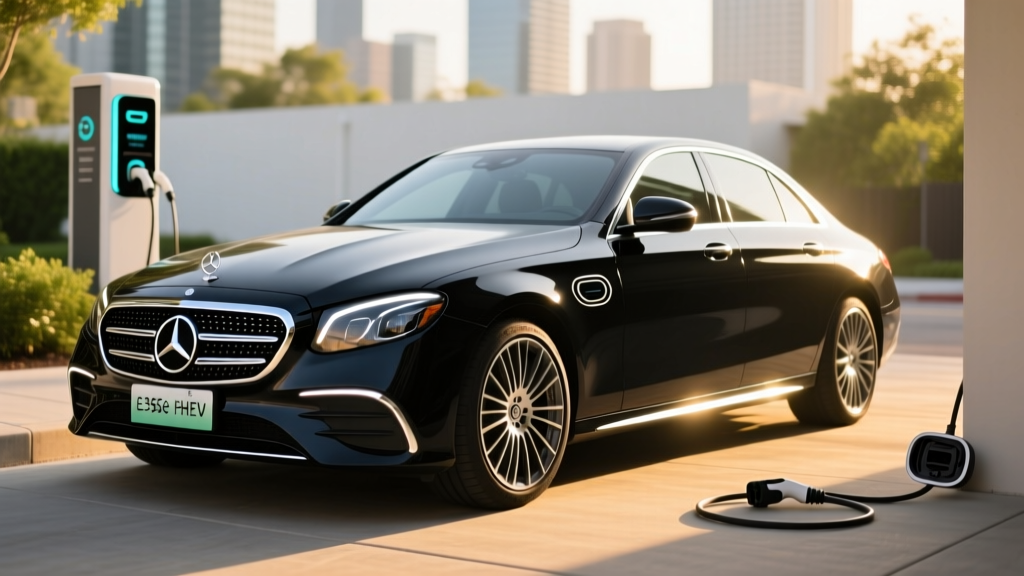
If you want the refinement and technology of a Mercedes-Benz E-Class without committing fully to a battery-electric vehicle, the brand's plug-in hybrid lineup offers a compelling middle ground. The current-generation Mercedes-Benz E-Class hybrid cars — headlined by the E350e 4MATIC plug-in hybrid — blend a turbocharged four-cylinder engine with a powerful electric motor and a sizable battery pack that enables genuine electric-only commuting. For the 2026 model year, the E-Class PHEV carries forward the architecture introduced with the W214 generation, offering meaningful electric range, rapid DC fast-charging capability unusual among luxury PHEVs, and the cabin technology Mercedes is known for.
This guide breaks down everything a buyer needs to know: EPA fuel economy, real-world MPG and range expectations, powertrain specs, charging logistics, pricing, tax-credit eligibility, and whether the E-Class PHEV is the right electrified choice for your daily driving pattern.
E350e PHEV vs. Conventional Hybrid: What Mercedes Actually Offers
Before diving into specs, it's important to clarify what Mercedes-Benz sells in the E-Class hybrid lineup for the U.S. market. The E350e is a plug-in hybrid electric vehicle (PHEV), not a conventional hybrid (HEV). Here's the practical difference:
| Feature | Conventional Hybrid (HEV) | Plug-in Hybrid (E350e PHEV) |
|---|---|---|
| Plugs in to charge? | No — self-charging via engine & regen | Yes — AC Level 2 or DC fast charge |
| Electric-only range | 0–2 miles at very low speed | ~25 miles (EPA est.) |
| Battery size | ~1–2 kWh | 25.4 kWh (gross) / ~21 kWh usable |
| Gas engine needed? | Always blended with motor | Only after battery depletes (or under heavy load) |
| Federal tax credit | None | Potential partial credit (see below) |
| Regenerative braking | Mild regen | Strong regen; near one-pedal in EV mode |
Mercedes does not currently offer a non-plug-in HEV variant of the E-Class in the United States. If you want an E-Class hybrid, the E350e PHEV is your option. In other markets, mild-hybrid (MHEV) six-cylinder models exist, but these are not sold stateside and do not offer meaningful electric-only operation.
Powertrain, Horsepower, and Driving Dynamics
The E350e 4MATIC pairs a 2.0-liter turbocharged inline-four gasoline engine with a permanently excited synchronous electric motor integrated into the 9G-TRONIC nine-speed automatic transmission. Combined output is substantial:
| Specification | 2026 E350e 4MATIC PHEV |
|---|---|
| Gas engine | 2.0L turbo I4, ~201 HP / 295 lb-ft |
| Electric motor | ~127 HP / 325 lb-ft |
| Combined system output | 312 HP / 406 lb-ft |
| 0–60 mph | ~5.8 seconds |
| Drivetrain | 4MATIC all-wheel drive |
| Transmission | 9-speed automatic (9G-TRONIC) |
| Battery (gross / usable) | 25.4 kWh / ~21 kWh |
| Battery chemistry | NMC (nickel manganese cobalt) |
| Top speed (EV mode) | ~87 mph |
| Cargo volume | ~12.7 cu ft (trunk; battery reduces space slightly) |
The electric motor's placement between the engine and transmission means it can drive the car independently in EV mode, assist under acceleration, or act as a generator during regenerative braking. In practice, the E350e pulls away from stoplights on electric power alone in most normal driving, with the gas engine engaging seamlessly when you demand more power or when the battery depletes. The transition is one of the smoothest in the luxury PHEV segment.
Fuel Economy: EPA Numbers and Real-World MPG
The E350e is rated by the EPA in two ways: MPGe (miles per gallon equivalent, measuring efficiency when using both electricity and gasoline) and MPG (when operating as a conventional hybrid after the battery is depleted). MPGe is useful for comparing total energy consumption across electrified vehicles; MPG matters once you've used up your electric range.
| Metric | City | Highway | Combined |
|---|---|---|---|
| MPGe (charge-sustaining + electric) | — | ~65 MPGe | |
| MPG (hybrid mode, battery depleted) | ~27 | ~33 | ~29 MPG |
Real-world expectations: In city driving with a full charge and a commute under 25 miles, many owners will burn little to no gasoline on weekdays, effectively achieving 100+ MPGe. On longer highway trips where the battery depletes within the first 25 miles and the remaining distance is covered in hybrid mode, expect combined fuel economy closer to 27–30 MPG — respectable for a 4,700-pound luxury sedan but not class-leading among hybrids. Cold weather (below 40°F) will reduce electric range by roughly 15–25%, shrinking the electric portion of your commute and pushing blended economy lower.
Charging: AC, DC Fast Charge, and Times
One area where the E350e stands apart from most luxury PHEV competitors is DC fast-charging capability. Most PHEVs in this segment only support AC Level 2 charging, which is fine for overnight home charging but impractical for topping up on the go. The E350e offers an optional DC fast-charge port (CCS connector), a genuine differentiator.
| Charging Level | Power (kW) | Connector | 0–100% Time | Availability |
|---|---|---|---|---|
| Level 1 (120V household) | ~1.4 kW | J1772 | ~15 hours | Included cord |
| Level 2 (240V home/public) | ~7.4 kW | J1772 / CCS | ~3.25 hours | Standard |
| DC Fast Charge | Up to ~50 kW | CCS1 | ~30 min (10–80%) | Optional (DC charge package) |
Key distinction — kW vs. kWh: The battery stores 25.4 kWh of energy (think of it as the "tank size"). The onboard charger or DC fast charger delivers power measured in kW (think of it as the "pump speed"). A 7.4 kW Level 2 charger refills the ~21 kWh usable battery in roughly 3 hours. The 50 kW DC option can add 10–80% in about 30 minutes — useful if you want to recharge during a lunch stop on a road trip and drive the next leg on electricity.
For most owners, a home Level 2 charger (240V, 32A or 40A circuit) is the primary charging method. Plug in when you get home, and the car is fully charged by morning. Installation costs for a Level 2 home setup typically range from $500 to $2,000 depending on electrical panel proximity and local permit requirements. We recommend consulting a licensed electrician for a site-specific quote.
Pricing, Trims, and Federal Tax Credit Eligibility
The 2026 Mercedes-Benz E350e 4MATIC starts at an MSRP of approximately $67,500 (including destination). A well-optioned example with the Premium package, MBUX Superscreen, and the DC fast-charge package can reach $78,000–$82,000.
- Battery capacity: Must be ≥ 7 kWh — the E350e qualifies (25.4 kWh)
- MSRP cap: Sedans must be ≤ $55,000 — the E350e at ~$67,500 exceeds this cap and does NOT qualify for the new-vehicle §30D credit
- Income cap: AGI ≤ $150K single / $300K joint filers
- Battery sourcing: Critical minerals and battery component requirements must be met
- Point-of-sale transfer: Available for eligible vehicles, but moot if MSRP cap is exceeded
Source: IRS §30D Clean Vehicle Credit. Always verify current-year rules with a tax professional.
Bottom line on incentives: The E350e's MSRP disqualifies it from the federal new-vehicle tax credit. However, some states offer their own rebates or HOV lane access for PHEVs regardless of price — check your state's energy or DMV website. If you're considering a used E-Class PHEV from a prior model year, the separate used clean-vehicle credit (up to $4,000, with a $25,000 MSRP cap for used vehicles) is unlikely to apply given residual values, but it's worth confirming for older models.
Reliability, Battery Warranty, and Replacement Costs
Mercedes-Benz provides a hybrid battery warranty of 6 years or 62,000 miles (whichever comes first) for the high-voltage traction battery, covering defects and capacity loss below a specified threshold (typically 70% of original capacity). This is slightly shorter than the 8-year/100,000-mile hybrid battery warranties offered by some competitors like Toyota and Hyundai — a point worth noting for long-term ownership planning.
Battery replacement cost: If the high-voltage battery requires replacement out of warranty, expect a cost in the range of $12,000–$18,000 including parts and labor at a Mercedes dealership. In practice, NMC batteries in PHEVs with active thermal management (which the E350e has) tend to degrade slowly — most owners report minimal range loss within the first 5–6 years of normal use. Keeping the battery between 20–80% state of charge when possible and avoiding frequent DC fast-charging sessions will help maximize longevity.
For general reliability, the W214-generation E-Class is still early in its lifecycle. Mercedes-Benz as a brand scores in the mid-to-lower tier in long-term reliability surveys from sources like Consumer Reports, and the added complexity of a PHEV powertrain (high-voltage system, charge electronics, electric motor, plus a turbocharged engine and nine-speed transmission) means more potential failure points than a simpler HEV or pure EV. Extended warranty coverage is worth considering if you plan to keep the vehicle beyond the factory warranty period.
E-Class PHEV vs. Full EV vs. Gas: Which Is Right for You?
- Your daily commute is under 25 miles round-trip and you can charge at home overnight
- You want electric commuting most days but need gasoline flexibility for road trips (no charging-desert anxiety)
- You value the E-Class's luxury, ride quality, and MBUX tech but aren't ready for a full EV
- You drive 10,000–15,000 miles/year with a mix of short commutes and occasional long trips
- You have reliable home Level 2 charging and your typical daily driving is under 250 miles
- You want the lowest per-mile fuel cost and minimal maintenance (no oil changes, fewer moving parts)
- You drive in a region with robust public DC fast-charging infrastructure
- You cannot charge at home (apartment, street parking, no garage outlet access)
- Your driving is predominantly long highway trips where PHEV electric range is negligible
- You want a lower purchase price and simpler powertrain
Pros, Cons, and the Real Ownership Picture
- Genuine 25-mile electric range covers most daily commutes gas-free
- DC fast-charge option is rare and valuable among luxury PHEVs
- 312 HP combined output delivers confident acceleration
- Smooth, nearly imperceptible engine/motor transitions
- MBUX Superscreen and latest-gen driver-assist tech
- Quiet, refined ride quality expected of the E-Class
- MSRP exceeds $55K federal tax-credit cap — no §30D credit
- Battery warranty (6 yr/62K mi) trails competitors' 8–10 year coverage
- Trunk space reduced vs. gas E-Class due to battery placement
- Hybrid-mode MPG (~29 combined) is average for the segment
- DC fast-charge package is an extra-cost option, not standard
- Brand reliability ratings remain mid-pack
Frequently Asked Questions
How many MPG does the Mercedes-Benz E350e hybrid get?
In hybrid mode (after the battery is depleted), the E350e achieves approximately 27 city / 33 highway / 29 combined MPG per the EPA. When factoring in electric driving with regular charging, the combined rating is approximately 65 MPGe. Your actual blended economy depends heavily on how much of your driving is covered by the 25-mile electric range.
How far can the E350e go on electric only?
The EPA estimates approximately 25 miles of electric-only range. In real-world conditions — accounting for climate control use, highway speeds, and battery aging — expect 20–23 miles in moderate weather and 17–20 miles in cold conditions. The electric motor can propel the car up to about 87 mph in EV mode, so highway driving on electricity is possible, albeit at reduced range.
Does the E350e PHEV qualify for any tax credit?
Unfortunately, the E350e does not qualify for the federal §30D new clean vehicle credit because its MSRP (~$67,500) exceeds the $55,000 sedan cap. Some state-level incentives or utility rebates for PHEV purchases or home charger installation may still apply — check your state energy office and local utility. Always consult a tax professional for your specific situation. See IRS guidelines.
Is the E-Class hybrid reliable? What does battery replacement cost?
The PHEV powertrain adds complexity over a conventional gas car, and Mercedes-Benz as a brand scores mid-pack in long-term reliability surveys. The high-voltage battery is warrantied for 6 years/62,000 miles. Out-of-warranty battery replacement runs approximately $12,000–$18,000. With proper care (avoiding extreme states of charge, using thermal preconditioning), NMC batteries in thermally managed systems typically retain 85–90%+ capacity after 5–6 years.
Do I need to plug in the E350e, or does it charge itself?
The E350e is a plug-in hybrid, meaning you can plug it in to charge the battery from the grid — and you should, to take advantage of the 25-mile electric range. However, if you don't plug it in, the car will still operate as a conventional hybrid, using the gas engine and regenerative braking to maintain a small battery charge. You'll just miss out on the electric-only commuting benefit and will see fuel economy closer to 29 MPG combined rather than the 65 MPGe blended figure.
Can the E350e DC fast charge?
Yes, but only if equipped with the optional DC fast-charging package. With it, the E350e can accept up to approximately 50 kW via a CCS1 connector, enabling a 10–80% charge in roughly 30 minutes. Without this option, charging is limited to Level 2 AC at 7.4 kW (~3.25 hours for a full charge). We recommend the DC option if you take regular road trips and want to recharge on the go.
Hybrid vs. PHEV vs. EV — which E-Class should I choose?
The U.S. E-Class lineup offers the E350e PHEV as the sole hybrid option. If you want a fully electric Mercedes in a similar size class, consider the EQE sedan (EPA range ~260–300 miles depending on trim). If you don't want to plug in at all, the conventional E350 with a 48V mild-hybrid system offers modest efficiency gains without PHEV complexity. The E350e PHEV is the right choice if your routine involves short electric commutes plus occasional long trips where you don't want to rely on charging infrastructure.
For official EPA fuel economy data, visit fueleconomy.gov. For the latest Mercedes-Benz E-Class specifications and pricing, see the Mercedes-Benz USA E-Class page.