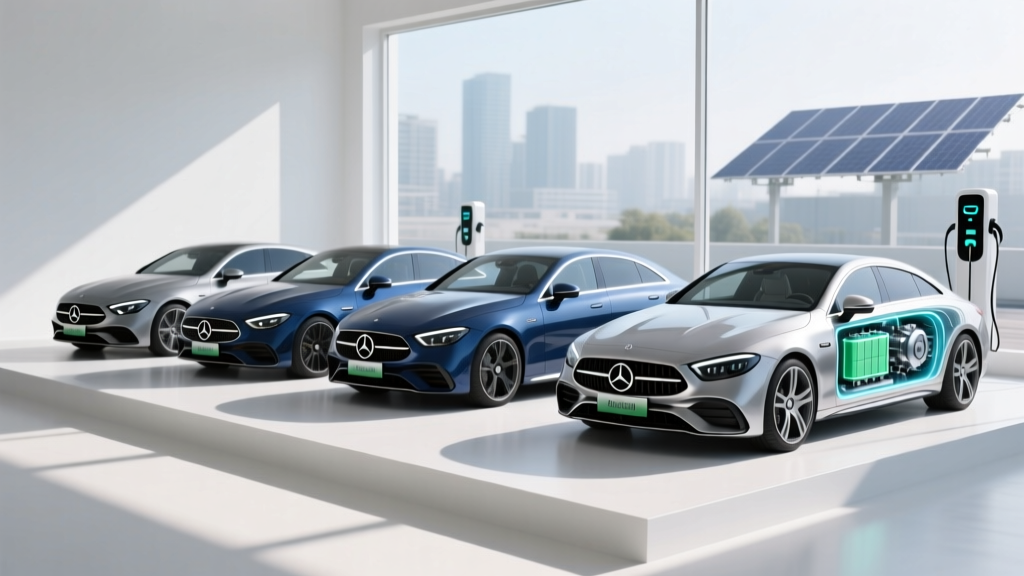
Mercedes-Benz offers one of the broadest electrified lineups among luxury automakers, spanning conventional hybrids (HEVs) that never need a plug and plug-in hybrids (PHEVs) that deliver real electric-only commuting range. For 2026, the brand's hybrid strategy centers on its fourth-generation PHEV powertrain — pairing a turbocharged gasoline engine with a more powerful electric motor and a larger battery — alongside mild-hybrid (48-volt EQ Boost) assistance on most of its gas models. If you're researching Mercedes-Benz hybrid cars, this guide breaks down every current option with exact EPA figures, pricing, and ownership realities.
HEV vs PHEV: What Mercedes-Benz Actually Sells in 2026
Before diving into specific models, it's critical to understand the two distinct hybrid categories in the Mercedes-Benz lineup. Confusing them is the most common mistake buyers make.
| Feature | Conventional Hybrid (HEV) | Plug-in Hybrid (PHEV) |
|---|---|---|
| Needs to plug in? | No — recharges via regenerative braking and engine | Yes — plug in for electric-only range |
| Electric-only driving | Minimal (low-speed assist only) | 30–54 miles EPA (model dependent) |
| Battery size | ~1–2 kWh (small buffer) | 25.4 kWh (usable) in 2026 models |
| Charging hardware | None needed | Level 2 AC (standard); DC fast charge (optional) |
| Federal tax credit | Not eligible under §30D | Up to $7,500 if all §30D criteria met |
| Best for | Drivers who want better MPG without changing habits | Commuters with home/work charging who want EV-like daily driving |
Mercedes-Benz designates its plug-in hybrids with an "e" suffix (e.g., S 580e, GLC 350e). Models with EQ Boost or mild-hybrid systems are conventional gas vehicles with a small 48-volt motor that assists during acceleration and enables smoother stop-start — they are not plug-in vehicles and do not offer meaningful electric-only range.
2026 Mercedes-Benz PHEV Lineup: Specs, Range, and MPG
The 2026 Mercedes-Benz plug-in hybrid lineup uses the brand's fourth-gen PHEV architecture: a 2.0-liter turbocharged inline-four paired with a permanently excited synchronous electric motor integrated into the 9G-TRONIC automatic transmission. The battery pack is a 25.4 kWh (usable capacity) lithium-ion unit mounted beneath the trunk, which does reduce cargo space slightly compared to gas-only variants.
| Model | Combined HP | Battery (usable kWh) | EPA Electric Range | EPA Combined MPGe | EPA MPG (gas only) | 0–60 mph | Base MSRP |
|---|---|---|---|---|---|---|---|
| S 580e 4MATIC Sedan | 469 hp | 25.4 | 48 mi | 57 MPGe | 28 combined | 5.0 sec | $118,900 |
| GLC 350e 4MATIC SUV | 312 hp | 25.4 | 39 mi | 54 MPGe | 27 combined | 6.1 sec | $59,850 |
| GLE 350de 4MATIC SUV | 362 hp (diesel+elec) | 25.4 | 45 mi | 56 MPGe | 29 combined | 6.3 sec | $67,500 |
| C 350e Sedan | 312 hp | 25.4 | 54 mi | 62 MPGe | 30 combined | 5.9 sec | $55,400 |
Sources: fueleconomy.gov (EPA), Mercedes-Benz USA. Specs reflect 2026 model year. MPGe applies when combining electric and gasoline operation; gas-only MPG applies once the battery is depleted.
Charging the PHEVs: Level 2 and DC Fast Charging
Every 2026 Mercedes-Benz PHEV comes standard with an onboard AC charger rated at 3.7 kW (single-phase), which replenishes the 25.4 kWh battery from 0–100% in approximately 7 hours on a standard Level 2 home outlet. An optional 11 kW onboard charger (available on S 580e and GLE 350de) cuts that to roughly 2.5 hours.
DC fast charging is available as an option on the S 580e and GLE 350de, supporting up to 60 kW via CCS1 connector. At that rate, a 10–80% charge takes approximately 25 minutes. The GLC 350e and C 350e do not offer DC fast charging — they are limited to AC charging only. This is a meaningful limitation for road-trippers who want to top up at highway rest stops.
| Charging Level | Power (kW) | 0–100% Time | Miles of Range Added per Hour |
|---|---|---|---|
| Level 1 (120V household) | 1.4 kW | ~18 hours | ~5 mi/hr |
| Level 2 (240V, standard 3.7 kW) | 3.7 kW | ~7 hours | ~14 mi/hr |
| Level 2 (240V, optional 11 kW) | 11 kW | ~2.5 hours | ~40 mi/hr |
| DC Fast Charge (optional, CCS1) | 60 kW peak | 10–80% in ~25 min | N/A (burst) |
Real-world charging note: The 60 kW DC peak is only sustained between roughly 10–50% state of charge. Above 60% SoC, the charge curve tapers significantly, dropping to 30 kW and below by 80%. Plan accordingly on road trips — charging from 80–100% on DC is disproportionately slow and usually not worth the wait.
Fuel Economy: EPA vs Real-World MPG
Plug-in hybrid fuel economy is highly dependent on how often you charge. The EPA publishes two figures: MPGe (which accounts for electric operation) and gas-only MPG (which applies once the battery is depleted). Here's what real ownership typically looks like:
| Model | EPA Combined (gas) | Real-World City (gas) | Real-World Highway (gas) | Daily EV Commute Scenario |
|---|---|---|---|---|
| S 580e | 28 MPG | 26–29 MPG | 30–32 MPG | 40-mi commute: mostly electric, ~300 MPG equivalent |
| GLC 350e | 27 MPG | 25–28 MPG | 28–30 MPG | 30-mi commute: entirely electric, zero gas on weekdays |
| C 350e | 30 MPG | 29–33 MPG | 31–34 MPG | 45-mi commute: ~90% electric with nightly charge |
| GLE 350de | 29 MPG (diesel) | 28–31 MPG | 32–35 MPG | 35-mi commute: entirely electric, diesel rarely engages |
Key insight: If your daily round-trip commute fits within the EPA electric range and you charge nightly, you may visit a gas station once every 6–8 weeks. The gas engine and its associated MPG figures become largely irrelevant for daily use. However, on long road trips where the battery depletes within the first 40 miles, you're driving a heavy luxury vehicle on gasoline alone — expect real-world highway MPG to match or slightly fall below EPA figures due to the added battery weight (~400–500 lbs more than gas-only variants).
Battery Warranty, Longevity, and Replacement Cost
Mercedes-Benz PHEV Battery Warranty (2026): 6 years or 62,000 miles (whichever comes first) against defects and capacity loss below 70% of original capacity. This is shorter than the 8-year/100,000-mile warranty offered by most competitors (Toyota, Hyundai, BMW) and shorter than the 10-year/150,000-mile coverage in CARB states for some brands.
Mercedes-Benz PHEV batteries use NMC (nickel manganese cobalt) chemistry, which offers high energy density in a compact package but is more sensitive to thermal stress and high state-of-charge storage than LFP chemistry found in some competitors. Real-world degradation data from European fleets of the previous-gen (2020–2023) PHEV models suggests approximately 8–12% capacity loss over 5 years / 60,000 miles under normal use — meaning most owners will remain well above the 70% warranty threshold.
Battery replacement cost: A full high-voltage battery replacement for a Mercedes-Benz PHEV currently ranges from $12,000 to $18,000 depending on the model, including parts and labor at a dealership. Individual module replacement (if only certain cells degrade) can reduce this to $4,000–$7,000. Mercedes-Benz does not currently offer a refurbished battery exchange program in the US, unlike BMW.
Tax Credit Eligibility Under IRS §30D
Mercedes-Benz PHEVs may qualify for the federal plug-in vehicle tax credit under IRS §30D, but eligibility is far from guaranteed. The credit can be up to $7,500, split into two halves ($3,750 for battery component manufacturing + $3,750 for critical minerals sourcing). Here's what determines whether you qualify:
- MSRP cap: Vans, SUVs, and pickup trucks must be under $80,000 MSRP. Sedans must be under $55,000. This immediately disqualifies the S 580e ($118,900) and most GLE 350de configurations.
- Buyer income cap: Modified adjusted gross income must not exceed $150,000 (single), $225,000 (head of household), or $300,000 (joint filing).
- Battery sourcing: Battery components must be manufactured or assembled in North America (phase-in percentages increase annually). Critical minerals must be sourced from the US or a free-trade-agreement country. Mercedes-Benz sources battery cells from CATL (China) and Farasis (China/Germany), which complicates critical-mineral compliance.
- FEOC exclusion: Vehicles with battery components from a "foreign entity of concern" (primarily Chinese-owned companies) are disqualified entirely starting 2024 for components and 2025 for critical minerals.
- Point-of-sale transfer: If eligible, the credit can be transferred to the dealer at purchase, reducing your out-of-pocket cost immediately rather than waiting for tax filing.
Bottom line for 2026: The C 350e sedan ($55,400) sits right at the sedan MSRP cap and may qualify for partial credit ($3,750) depending on the buyer's income and the specific model year's sourcing compliance. The GLC 350e ($59,850) falls under the $80,000 SUV cap but its battery sourcing remains a variable. Always verify current eligibility on the fueleconomy.gov tax credit lookup before purchasing. Consult a tax professional for your specific situation — rules change frequently.
Who Should Choose a Mercedes-Benz Hybrid — and Who Shouldn't
Mercedes-Benz PHEVs Are Great For
- Commuters with home or workplace Level 2 charging and a sub-50-mile round trip
- Luxury buyers who want electric daily driving but need gas range for long road trips
- Company-car drivers whose employers reimburse fuel but not electricity
- Drivers in regions with extreme cold where full-EV range drops 30–40%
- Those not ready to commit to full EV infrastructure
Consider a Full EV Instead If
- You drive more than 60 miles daily and can't charge mid-day
- You want zero engine maintenance (no oil changes, no spark plugs, no transmission fluid)
- You prioritize maximum cargo space (PHEV battery intrudes on trunk)
- You want the full $7,500 tax credit — BEVs from other brands have clearer eligibility
- You plan to keep the car 10+ years and want the longest battery warranty available
Mercedes-Benz Mild Hybrids (EQ Boost): What They Actually Do
Many Mercedes-Benz gasoline models — including the E 350, GLC 300, and GLE 450 — feature a 48-volt integrated starter-generator branded as EQ Boost. This system adds a brief 20-hp electrical assist during hard acceleration, enables seamless engine stop-start, and powers accessories when the engine is off. However, it provides no electric-only driving range and does not plug in. It is not a hybrid in the conventional or plug-in sense — it's a mild efficiency enhancement that improves real-world fuel economy by roughly 1–2 MPG compared to a non-hybrid equivalent.
These models do not qualify for any federal plug-in vehicle tax credit. Their fuel economy advantage is modest: the 2026 GLC 300 with EQ Boost achieves 26 MPG combined versus an estimated 24–25 MPG without the system.
Hybrid vs PHEV vs Full EV: Decision Framework for Mercedes-Benz Buyers
Choose a Mercedes-Benz PHEV if: You have reliable home charging, your commute is under 50 miles round-trip, you take 4+ road trips per year exceeding 200 miles, and you want a luxury sedan or SUV without range anxiety.
Choose a full EV (e.g., EQE, EQS) if: You have home Level 2 charging, your daily driving is under 250 miles, you want minimal long-term maintenance, and you can access the full federal tax credit on eligible BEV models.
Choose a mild-hybrid gas model (EQ Boost) if: You have no charging access at home or work, you drive high annual mileage in areas with sparse charging infrastructure, and you want a lower purchase price with a modest efficiency bump.
Frequently Asked Questions
How many MPG does a Mercedes-Benz hybrid get?
It depends on the model and whether you're using electric or gasoline power. The 2026 C 350e PHEV achieves 30 MPG combined on gasoline alone and 62 MPGe when combining electric and gas operation. The S 580e gets 28 MPG gas-only and 57 MPGe combined. The GLE 350de (diesel-electric) achieves 29 MPG gas-only and 56 MPGe. Real-world city driving in gas-only mode often matches or slightly exceeds EPA figures thanks to regenerative braking, while highway driving at 75+ mph may fall 1–3 MPG below the sticker.
How far can Mercedes-Benz PHEVs drive on electric only?
EPA-rated electric-only range for 2026 models: C 350e — 54 miles; S 580e — 48 miles; GLE 350de — 45 miles; GLC 350e — 39 miles. Real-world range varies: expect 10–15% less in cold weather (below 40°F) due to cabin heating demands and reduced battery efficiency, and 5–10% less at sustained highway speeds above 70 mph. City driving with frequent regenerative braking often matches or slightly exceeds EPA range.
Is the Mercedes-Benz PHEV battery reliable, and what does replacement cost?
Mercedes-Benz PHEV batteries have proven generally reliable, with degradation data from European fleets showing 8–12% capacity loss over 5 years. The warranty covers 6 years/62,000 miles against capacity falling below 70%, which is shorter than most competitors. A full battery replacement costs $12,000–$18,000 at a dealership, though module-level repair can reduce this. The shorter warranty period is a legitimate concern for second owners and high-mileage drivers.
Does any Mercedes-Benz hybrid qualify for a federal tax credit?
Potentially — but it's model-specific and buyer-specific. Under IRS §30D, the vehicle must meet MSRP caps ($55,000 for sedans, $80,000 for SUVs), the buyer must meet income limits, and the battery must satisfy North American sourcing and critical-mineral requirements. The S 580e is too expensive. The C 350e and GLC 350e fall within MSRP caps but battery sourcing compliance varies by model year. Always check fueleconomy.gov and consult a tax professional before relying on credit eligibility in your purchase decision.
Can I charge a Mercedes-Benz PHEV at a Tesla Supercharger?
Not directly. Mercedes-Benz PHEVs use the CCS1 connector for DC fast charging (where equipped) and the J1772 connector for Level 2 AC charging. Tesla Superchargers use the NACS connector. You would need a CCS-to-NACS adapter (available from Tesla and third parties) for DC charging at Supercharger stations that support non-Tesla vehicles. For Level 2 AC charging, a J1772-to-NACS adapter or a standard J1772 public charger will work.
Should I buy a Mercedes-Benz PHEV or a full EV like the EQE?
If you can charge at home and your daily driving stays under 250 miles, the EQE sedan (EPA range up to 305 miles) offers a smoother, quieter, lower-maintenance experience with no gas engine to service. Choose the PHEV if you regularly drive 200+ miles in a single day, lack reliable charging on common routes, or live in an area with extreme winters where BEV range loss is a concern. The PHEV is a bridge solution; the EQE is a destination — but only if your infrastructure supports it.