If you have searched for the meaning of a hybrid car, you have probably found conflicting answers. Some sources describe a vehicle that never plugs in. Others describe one that drives like an EV for 30–40 miles before a gas engine kicks on. Both are technically correct — but they describe two fundamentally different powertrains with different use cases, costs, and incentives.
This guide cuts through the confusion. We will define exactly what a hybrid car is, separate conventional hybrids (HEVs) from plug-in hybrids (PHEVs), and give you the hard numbers — MPG, kWh, electric-only range, pricing, and tax credit eligibility — you need to decide which one fits your driving life in 2026.
What Is the Meaning of a Hybrid Car? The Core Definition
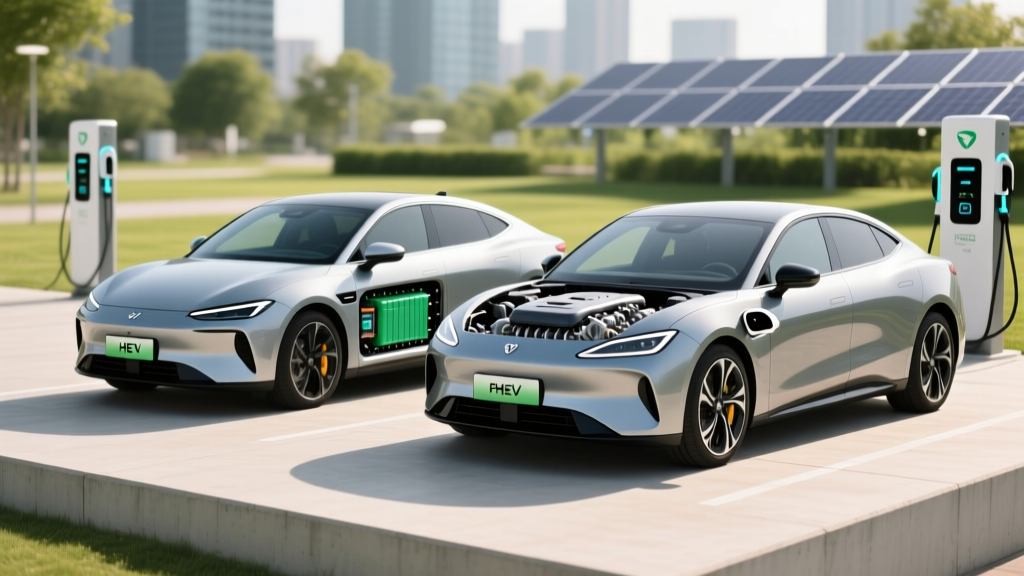
At its simplest, a hybrid car is any vehicle that combines an internal combustion engine (ICE) with at least one electric motor and a battery pack to move the vehicle. The electric motor assists the engine, recovers energy during braking (regenerative braking), and in some cases can drive the vehicle on electricity alone for short distances.
That broad definition covers two distinct categories that buyers frequently conflate:
Conventional Hybrid (HEV)
A self-charging hybrid with a small battery (typically 1.0–1.6 kWh). You never plug it in. The battery charges through regenerative braking and the gas engine. The electric motor assists during acceleration and enables brief electric-only movement at low speeds. Think: Toyota Prius, Honda CR-V Hybrid, Hyundai Tucson Hybrid.
Plug-In Hybrid (PHEV)
A hybrid with a much larger battery (typically 13–25 kWh) that you plug in to charge. It can drive 25–50 miles on electricity alone before the gas engine activates, effectively functioning as an EV for daily commutes and a hybrid for longer trips. Think: Toyota RAV4 Prime, Jeep Wrangler 4xe, Chrysler Pacifica Hybrid.
The distinction matters enormously for fuel costs, charging requirements, and whether you qualify for federal tax credits.
HEV vs PHEV: Side-by-Side Comparison
Before we get into specific models, here is how the two powertrain types stack up across the metrics that matter most:
| Attribute | Conventional Hybrid (HEV) | Plug-In Hybrid (PHEV) |
|---|---|---|
| Battery size | 1.0–1.6 kWh | 13–25 kWh |
| Plugs in? | No — self-charging | Yes — Level 1 or Level 2 |
| Electric-only range | ~1 mile at low speed | 25–50 miles (EPA) |
| EPA fuel economy | 40–57 MPG combined | 30–38 MPG (gas mode) + 80–105 MPGe (electric) |
| Charging time (full) | N/A — self-charging | 2–5 hours (Level 2); 8–14 hours (Level 1 / 120V) |
| DC fast charging? | No | Mostly no (Mitsubishi Outlander PHEV is a rare exception) |
| Federal tax credit (§30D) | Not eligible | $3,750–$7,500 (if sourcing & income rules met) |
| Price premium over gas model | $1,000–$3,000 | $5,000–$10,000 |
Fuel Economy Breakdown: Real MPG Numbers for Top 2026 Hybrids
Hybrid fuel economy varies widely by model, drivetrain, and driving conditions. Below are EPA figures for some of the most popular hybrids and PHEVs on sale in 2026, sourced from fueleconomy.gov.
| Model (2026) | City MPG | Hwy MPG | Combined MPG | EV Range (PHEV) | Combined MPGe |
|---|---|---|---|---|---|
| Toyota Prius (HEV) | 57 | 56 | 57 | — | — |
| Toyota Prius Prime (PHEV) | 52 (gas) | 48 (gas) | 52 (gas) | 44 mi | 127 MPGe |
| Honda CR-V Hybrid (HEV) | 43 | 36 | 40 | — | — |
| Toyota RAV4 Prime (PHEV) | 40 (gas) | 36 (gas) | 38 (gas) | 42 mi | 94 MPGe |
| Hyundai Tucson Hybrid (HEV) | 38 | 38 | 38 | — | — |
| Chrysler Pacifica Hybrid (PHEV) | 29 (gas) | 30 (gas) | 30 (gas) | 32 mi | 82 MPGe |
Real-World MPG Note: Conventional hybrids routinely exceed their EPA city estimates in stop-and-go driving because regenerative braking recovers more energy at low speeds. The Prius HEV, for example, often returns 60+ MPG in urban traffic. Highway MPG tends to drop below the EPA sticker at sustained 75+ mph speeds, where aerodynamic drag dominates and the electric motor provides less benefit. Expect ~50–52 MPG highway in a Prius at 75 mph — roughly 8–10% below the 56 MPG EPA highway figure.
How Plug-In Hybrids Work: Electric Range, Charging, and Powertrains
PHEVs deserve a deeper look because they blur the line between gas car and EV. Here is how the key specs break down using the 2026 Toyota RAV4 Prime as a representative example:
| 2026 Toyota RAV4 Prime — PHEV Spec Snapshot | |
|---|---|
| Battery | 18.1 kWh (usable ~14.5 kWh), lithium-ion NMC |
| Electric-only range | 42 miles (EPA) |
| Total combined range | ~600 miles (electric + 11.4-gal tank) |
| Powertrain | 2.5L 4-cyl + front & rear electric motors; 302 hp combined |
| Level 2 charge time (0–100%) | ~2.5 hours at 6.6 kW (240V / 32A) |
| Level 1 charge time (120V) | ~12 hours at 1.4 kW |
| DC fast charging | Not supported |
| Base MSRP | $44,900 (SE trim) |
Understanding kW vs kWh: The battery capacity is measured in kWh (kilowatt-hours) — that is the total energy stored, like the size of a gas tank. The charge rate is measured in kW (kilowatts) — that is how fast energy flows into the battery, like the flow rate of a gas pump. A 6.6 kW charger filling a 14.5 kWh usable battery takes roughly 2.5 hours (14.5 ÷ 6.6 ≈ 2.2 hours, plus taper at the top).
Most PHEVs do not support DC fast charging. The Mitsubishi Outlander PHEV remains one of the few exceptions, accepting up to 22 kW DC — still far slower than a full EV's 150–350 kW capability. For PHEV owners, home Level 2 charging is the practical standard.
Hybrid and PHEV Pricing: MSRP, Tax Credits, and Real Costs
Here is what popular 2026 hybrids and PHEVs cost at base MSRP, and which ones may qualify for the federal §30D clean vehicle tax credit:
| Model | Base MSRP | §30D Credit Eligible? | Max Credit |
|---|---|---|---|
| Toyota Prius (HEV) | $29,450 | No | $0 |
| Toyota Prius Prime (PHEV) | $34,275 | Yes* | $3,750 |
| Toyota RAV4 Prime (PHEV) | $44,900 | Yes* | $3,750 |
| Ford Escape PHEV | $39,500 | Yes* | $3,750 |
| Jeep Wrangler 4xe (PHEV) | $51,790 | Yes* | $3,750 |
| Chrysler Pacifica Hybrid (PHEV) | $51,095 | Yes* | $7,500 |
*Eligibility for the §30D credit depends on battery component sourcing, critical minerals origin, buyer income caps, and MSRP limits (under $80,000 for SUVs/vans/pickups; under $55,000 for sedans). Credit amounts shown reflect 2026 rules where many Toyota/Jeep PHEVs qualify for the $3,750 battery-component half but miss the $3,750 critical-minerals half due to supply-chain sourcing. Always verify current eligibility at IRS.gov before purchasing. Credits can now be transferred to the dealer as a point-of-sale discount.
Key point: Conventional hybrids (HEVs) do not qualify for any federal tax credit. Only PHEVs and full BEVs with sufficient battery capacity (≥7 kWh) are eligible under §30D.
Battery Reliability, Warranty Coverage, and Replacement Costs
Battery longevity is the single most common concern among first-time hybrid buyers. Here is what the data shows:
Hybrid Battery Warranty — Industry Standard
Federal mandate: All hybrid and PHEV batteries sold in the US must carry a minimum warranty of 8 years / 100,000 miles (10 years / 150,000 miles in California and states that follow CARB emissions standards).
Toyota: 10 years / 150,000 miles on the hybrid battery for all 2020+ models, nationwide.
Hyundai / Kia: 10 years / 100,000 miles on hybrid and PHEV batteries.
Chrysler / Jeep (Stellantis): 8 years / 100,000 miles on PHEV battery packs.
Real-world degradation: Conventional hybrid batteries (1–2 kWh) experience minimal meaningful degradation because they operate in a narrow state-of-charge window — typically 40–80% SoC — which dramatically reduces wear. Toyota Prius taxis routinely pass 300,000+ miles on the original hybrid battery.
PHEV batteries face more stress because they cycle through a wider SoC range daily. However, manufacturers build in buffer capacity — a PHEV advertised with 18.1 kWh total may only make 14.5 kWh usable to protect longevity. Expect 10–15% capacity loss over 10 years of normal use, which translates to losing 4–6 miles of electric range from an original 42-mile rating.
Replacement costs if out of warranty:
- HEV battery (Prius-class): $2,000–$4,000 for a new OEM pack; $1,000–$2,000 for a refurbished unit
- PHEV battery (RAV4 Prime-class): $8,000–$12,000 for a new OEM pack
- PHEV battery (large pack, e.g., Wrangler 4xe): $10,000–$15,000
These costs are significant but rarely incurred during typical ownership. The vast majority of hybrid batteries outlast the vehicle itself.
Hybrid vs PHEV vs Full EV: Which Powertrain Fits You?
Choosing between an HEV, a PHEV, and a full battery-electric vehicle (BEV) comes down to three questions: Can you charge at home? How far do you drive daily? And how often do you take road trips over 250 miles?
Choose a Conventional Hybrid (HEV) If:
- You cannot charge at home (apartment, street parking, no garage)
- You want maximum MPG with zero behavior change
- Your budget is under $35,000
- You drive 15,000+ miles/year and want low fuel cost without plug-in logistics
- You plan to keep the car 10+ years and value proven reliability
Best picks: Toyota Prius (57 MPG), Honda CR-V Hybrid (40 MPG)
Choose a Plug-In Hybrid (PHEV) If:
- You can charge at home (Level 2 or even Level 1 / 120V)
- Your daily commute is under 40 miles round-trip (most PHEVs cover this on electricity alone)
- You take regular road trips and do not want to plan around public chargers
- You want EV-like daily driving with gas-car flexibility for weekends
- You want to reduce fuel consumption by 60–80% without range anxiety
Best picks: Toyota RAV4 Prime (42 mi EV), Toyota Prius Prime (44 mi EV)
Choose a Full EV (BEV) If:
- You can charge at home reliably (Level 2 strongly recommended)
- Your daily driving is under 250 miles (covers 95%+ of American drivers)
- You want zero tailpipe emissions and minimal maintenance
- You want access to the full $7,500 federal tax credit on eligible models
- You are comfortable planning road-trip charging stops
Best picks: Tesla Model Y, Hyundai Ioniq 5, Chevrolet Equinox EV
Honest trade-off: PHEVs carry two full powertrains — an engine and an electric motor with a large battery — which means more weight, more complexity, and higher maintenance costs than either a pure HEV or a pure BEV over 10+ years. If you never plug in a PHEV, you are hauling dead battery weight and getting worse MPG than a conventional hybrid. A PHEV only makes financial sense if you actually charge it regularly.
Pros and Cons of Hybrid Ownership
✓ Advantages
- HEV: No plug-in needed; works exactly like a gas car with 40–57 MPG
- HEV: Proven reliability — Toyota's hybrid system has 25+ years of real-world data
- PHEV: EV-like commuting (zero gas) with 500–600 mile total range
- PHEV: No range anxiety on road trips — gas stations everywhere
- Both: Regenerative braking reduces brake wear (pads often last 80,000+ mi)
- Both: Strong resale value — hybrids retain value better than most gas-only models
✗ Limitations
- HEV: No federal tax credit; smaller fuel savings vs PHEV if you could plug in
- HEV: Electric motor provides assist only — not a true EV experience
- PHEV: Higher upfront cost ($5,000–$10,000 premium over gas equivalent)
- PHEV: Requires home charging access to realize benefits
- PHEV: Two powertrains = more components that can eventually need service
- PHEV: Heavy — reduces efficiency when battery is depleted vs a lighter HEV
Frequently Asked Questions
How many MPG does a hybrid car get?
It depends on the model and type. The most efficient conventional hybrid, the 2026 Toyota Prius, achieves an EPA-rated 57 MPG combined (57 city / 56 highway). Compact SUV hybrids like the Honda CR-V Hybrid return around 40 MPG combined. PHEVs, when running on gasoline after the battery is depleted, typically achieve 30–52 MPG combined depending on the model. In real-world city driving, many hybrids exceed their EPA city numbers thanks to aggressive regenerative braking.
How far can a plug-in hybrid go on electric only?
Current 2026 PHEVs offer between 25 and 50 miles of EPA-rated electric-only range. The Toyota Prius Prime leads at 44 miles; the RAV4 Prime delivers 42 miles; the Ford Escape PHEV returns about 37 miles. In real-world conditions — especially in cold weather below 40°F or at highway speeds above 65 mph — expect 15–25% less than the EPA electric range figure. A 42-mile rated PHEV might deliver 32–35 miles of actual electric range in winter highway driving.
Do hybrid cars need to be plugged in?
Conventional hybrids (HEVs) do not plug in. They charge their small battery entirely through regenerative braking and the gasoline engine. Plug-in hybrids (PHEVs) do need to be plugged in to realize their electric-only range and fuel-cost savings, though they will still drive as a conventional hybrid if you never plug them in — just with worse MPG due to the extra battery weight.
Are hybrid cars reliable? What does battery replacement cost?
Hybrids from Toyota, Honda, and Hyundai/Kia have demonstrated excellent long-term reliability. Toyota's hybrid synergy drive system has been refined over 25+ years and is widely considered the most proven electrified powertrain on the market. Hybrid battery replacement costs range from $2,000–$4,000 for a conventional HEV to $8,000–$15,000 for a PHEV — but the vast majority of hybrid batteries last the lifetime of the vehicle, especially given the 8–10 year / 100,000–150,000 mile warranty coverage.
Does a hybrid qualify for any tax credit?
Conventional hybrids (HEVs) do not qualify for the federal §30D clean vehicle tax credit. Only plug-in hybrids (PHEVs) and full battery-electric vehicles (BEVs) with at least 7 kWh of battery capacity are eligible. Even among PHEVs, the actual credit ranges from $3,750 to $7,500 depending on battery sourcing requirements, and buyers must meet income caps ($150,000 single / $300,000 joint AGI). The vehicle MSRP must also be under $55,000 for sedans or $80,000 for SUVs, vans, and pickups. Verify current eligibility on IRS.gov before purchasing.
Is a hybrid worth it in 2026?
For most drivers who cannot charge at home, a conventional hybrid is the single most effective way to reduce fuel costs without changing any driving habits. The $1,000–$3,000 price premium over a gas-only model typically pays for itself in fuel savings within 2–4 years at 15,000 miles/year. For those with home charging and short commutes, a PHEV can eliminate gasoline consumption almost entirely on weekdays while preserving road-trip freedom. The right answer depends entirely on your charging access, daily mileage, and budget.