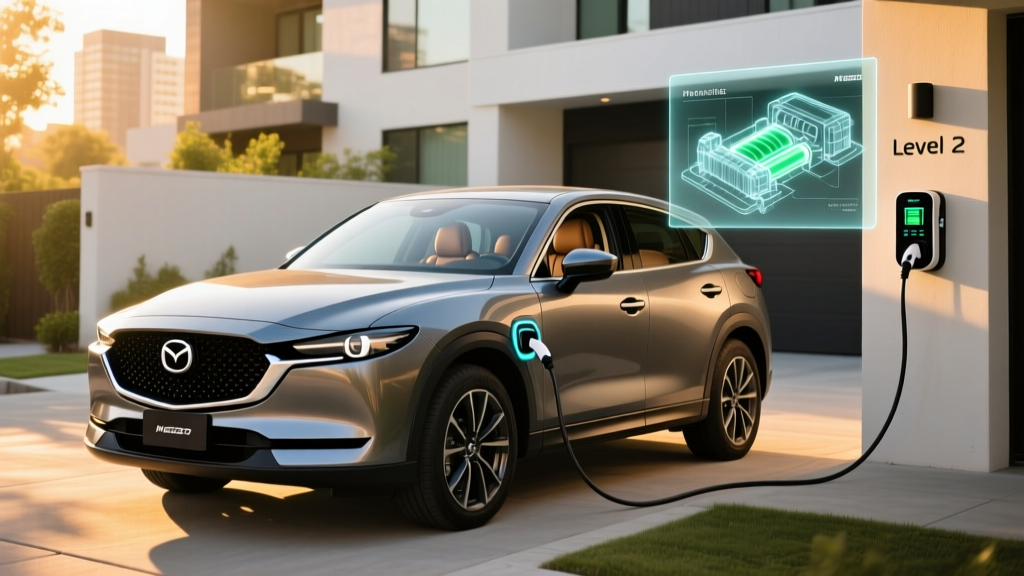
The Mazda CX-50 Hybrid Premium Plus occupies a specific niche: buyers who want Mazda's upscale interior and standard all-wheel drive without the range anxiety or charging logistics of a full battery-electric vehicle. For 2026, Mazda continues its partnership with Toyota's proven hybrid powertrain, pairing a 2.5-liter four-cylinder with electric motors to deliver 219 combined horsepower and an EPA-estimated 38 MPG combined. The Premium Plus trim sits near the top of the CX-50 Hybrid lineup, adding luxury touches that rival entry-level premium SUVs at a mainstream price.
This guide breaks down every number that matters — from real-world fuel economy to battery warranty coverage — and helps you decide whether the CX-50 Hybrid Premium Plus is the right electrified choice for your driving routine.
HEV vs PHEV: What the CX-50 Hybrid Actually Is
Before evaluating specs, it's critical to understand what the CX-50 Hybrid is — and what it isn't. The CX-50 Hybrid is a conventional hybrid electric vehicle (HEV), not a plug-in hybrid (PHEV). That distinction changes everything about how you own it.
Conventional Hybrid (HEV) — CX-50 Hybrid
- No plug required. The battery charges through regenerative braking and the gasoline engine.
- Small battery (~1.6 kWh usable). Stores just enough energy for short electric-assist bursts, not sustained electric-only driving.
- No electric-only range to speak of. The electric motor assists the engine at low speeds and during acceleration but cannot propel the vehicle alone for meaningful distances.
- No federal §30D tax credit. The IRS clean vehicle credit applies only to plug-in vehicles with ≥7 kWh battery capacity.
Plug-In Hybrid (PHEV) — e.g., Toyota RAV4 Prime
- Requires plugging in to realize its full efficiency and electric-range benefits.
- Larger battery (18–20+ kWh). Enables 30–42 miles of electric-only driving.
- Eligible for up to $7,500 federal tax credit if battery sourcing, MSRP caps, and buyer income limits are met.
- Heavier and more expensive due to the larger battery pack.
If you want to charge at home and drive 30+ miles on electricity before the engine kicks in, you need a PHEV, and Mazda doesn't currently offer a CX-50 PHEV. If you want better fuel economy with zero change to your fueling routine, the HEV is the correct choice.
Fuel Economy: EPA Ratings and Real-World MPG
The headline number for the 2026 CX-50 Hybrid Premium Plus is its EPA fuel economy rating. Because this powertrain is shared with the Toyota RAV4 Hybrid, the numbers are well-documented and reliable.
| Driving Cycle | EPA Estimate | Real-World Expectation |
|---|---|---|
| City | 39 MPG | 38–42 MPG (hybrids often exceed EPA in stop-and-go) |
| Highway | 37 MPG | 33–36 MPG (aerodynamic drag and sustained speed reduce hybrid advantage) |
| Combined | 38 MPG | 35–39 MPG depending on driving mix |
Why real-world MPG varies: Hybrid systems shine in city driving, where regenerative braking recaptures energy at every stoplight and the electric motor handles low-speed propulsion. On the highway, the gasoline engine does most of the work, and the CX-50's boxy, rugged styling creates more aerodynamic drag than sleeker crossovers. In cold weather (below 30°F), expect a 5–10% reduction as the engine runs more frequently to provide cabin heat and maintain battery temperature.
For context, the gas-only CX-50 with the turbo 2.5L engine returns 25 MPG combined. The hybrid's 38 MPG combined represents a 52% improvement in fuel efficiency — roughly $500–$700 per year in fuel savings for a driver covering 15,000 miles annually, depending on local gas prices.
Total Range: With a 14.8-gallon fuel tank and 38 MPG combined, the CX-50 Hybrid delivers approximately 560 miles of total range per fill-up. In mixed real-world driving, plan for 500–540 miles between stops.
Powertrain and Performance Specs
The CX-50 Hybrid uses Toyota's fifth-generation hybrid system, which Mazda licenses and integrates with its own chassis tuning and all-wheel-drive calibration. The result is a powertrain that feels distinctly Mazda in its steering and ride quality while delivering Toyota's proven hybrid efficiency.
| Specification | 2026 CX-50 Hybrid Premium Plus |
|---|---|
| Engine | 2.5L 4-cylinder (176 hp, 163 lb-ft) |
| Electric Motors | Front motor + rear motor (eAWD) |
| Combined System Output | 219 hp |
| Transmission | eCVT (electronically controlled continuously variable) |
| Drivetrain | Electronic AWD (eAWD) — standard |
| 0–60 mph | ~7.1 seconds |
| Battery Type | Lithium-ion, ~1.6 kWh (usable) |
| Towing Capacity | 1,500 lbs (hybrid); gas turbo model tows 3,500 lbs |
| Cargo Volume | 31.4 cu ft (rear seats up) / 56.4 cu ft (rear seats folded) |
Performance note: The 219 hp combined output gives the CX-50 Hybrid confident acceleration for merging and passing. The eCVT is smooth but can produce a droning sound under hard acceleration — a common trait in Toyota-derived hybrid systems. Mazda's chassis tuning, however, delivers sharper steering and a firmer ride than the RAV4 Hybrid, which matters on twisty roads.
Towing limitation: The hybrid powertrain is rated for only 1,500 lbs of towing capacity, compared to 3,500 lbs for the gas turbo CX-50. If you tow a small trailer or boat regularly, the hybrid is not the right configuration.
Premium Plus Trim: What You Get for the Money
The Premium Plus is the top-tier trim for the CX-50 Hybrid, and it packs features that would cost thousands more in a luxury-branded SUV. Here's the pricing breakdown:
| CX-50 Hybrid Trim | 2026 MSRP (est.) | Key Additions Over Base Hybrid |
|---|---|---|
| Select Hybrid | $35,395 | Base hybrid entry point |
| Preferred Hybrid | $37,795 | Power liftgate, heated front seats, leatherette |
| Premium Hybrid | $40,595 | Panoramic roof, Bose 12-speaker audio, navigation |
| Premium Plus Hybrid | $42,595 | Ventilated front seats, heated steering wheel, Nappa leather, head-up display, 360° camera |
At approximately $42,595, the Premium Plus Hybrid commands a $7,200 premium over the Select Hybrid base. The additions — Nappa leather, ventilated seats, head-up display, 360° surround camera — are typically found in vehicles priced above $50,000. The value proposition is strong if you want luxury features without stepping to a BMW X3 or Audi Q5.
Tax Credit and Incentive Eligibility
Federal Tax Credit: The CX-50 Hybrid does not qualify for the IRS §30D Clean Vehicle Credit. Under current law, only plug-in electric vehicles (BEVs and PHEVs) with a battery capacity of at least 7 kWh are eligible. The CX-50 Hybrid's ~1.6 kWh battery falls well short of this threshold.
This is the single biggest financial trade-off between choosing an HEV and a PHEV. A qualifying PHEV like the Toyota RAV4 Prime can receive up to $7,500 in federal tax credits (subject to MSRP caps of $80,000 for SUVs, buyer income limits, and critical mineral/battery component sourcing rules per IRS §30D guidelines). However, the RAV4 Prime's MSRP climbs above $45,000, and its availability has been constrained by high demand.
State-level incentives: Some states offer rebates or HOV lane access for hybrids, but these programs vary widely and change frequently. Check your state's energy office or department of environmental quality for current offerings. A few states (e.g., Colorado) have historically offered credits for efficient vehicles, but most incentive programs now focus exclusively on plug-in vehicles.
Battery Warranty, Reliability, and Replacement Cost
Hybrid battery longevity is the top concern for buyers new to hybrid ownership. Here's what the data shows:
| Warranty Item | Coverage |
|---|---|
| Hybrid Battery | 10 years / 150,000 miles (in CARB states); 8 years / 100,000 miles (federal standard) |
| Hybrid System Components | 8 years / 100,000 miles |
| Powertrain (engine, transmission) | 5 years / 60,000 miles |
| Bumper-to-Bumper | 3 years / 36,000 miles |
Reliability track record: The Toyota hybrid system powering the CX-50 Hybrid has been in continuous production since 1997 (Prius) and is widely regarded as one of the most reliable powertrains ever mass-produced. According to long-term fleet data and Consumer Reports reliability surveys, Toyota hybrid battery packs routinely last 150,000–200,000 miles before significant degradation. Failure before 100,000 miles is rare.
Battery replacement cost: If the hybrid battery does need replacement outside of warranty, expect to pay $2,500–$4,000 for a new OEM battery pack (parts and labor). Refurbished packs are available for $1,500–$2,500. This is dramatically less than EV traction battery replacement, which can exceed $10,000–$15,000.
Key reliability advantage: Because the hybrid battery is small (~1.6 kWh) and never deeply discharged (the system maintains a state-of-charge buffer between roughly 40–80%), cell degradation is minimal compared to full EVs that regularly cycle from 10–90% SoC.
Who Should Choose the CX-50 Hybrid Premium Plus?
Choose the CX-50 Hybrid Premium Plus if:
- You drive 12,000–20,000 miles per year and want to reduce fuel costs without changing your refueling habits
- You live in an area with limited public charging infrastructure and cannot install a home Level 2 charger
- You value AWD for snow or rain and want standard all-wheel drive without a fuel-economy penalty
- You want near-luxury interior quality (Nappa leather, ventilated seats, Bose audio) under $45,000
- You prefer a conventional SUV driving experience with proven, low-risk technology
Consider a PHEV instead if:
- You can charge at home and your daily commute is under 35 miles (you'd rarely use gas)
- You want to qualify for the $7,500 federal tax credit
- You want electric-only driving for short trips and silent, zero-tailpipe-emission neighborhood driving
Consider a full EV (BEV) instead if:
- You have reliable home charging and access to DC fast chargers for road trips
- You want the lowest per-mile "fuel" cost (electricity at $0.12/kWh ≈ $0.04/mile vs. gas at $3.50/gal ≈ $0.09/mile at 38 MPG)
- You want zero tailpipe emissions and minimal drivetrain maintenance (no oil changes, no spark plugs)
Pros, Cons, and the Competition
Pros
- 38 MPG combined with standard AWD — excellent for the class
- Premium Plus trim delivers luxury features at mainstream pricing
- Toyota-sourced hybrid system with outstanding reliability history
- ~560 miles of total range — fewer fuel stops on road trips
- No charging infrastructure required — works with your existing routine
- Mazda's driving dynamics: sharper steering and handling than most hybrid SUVs
Cons
- No federal tax credit eligibility (HEV limitation)
- 1,500-lb towing capacity — half of the gas turbo model
- eCVT drone under hard acceleration
- No plug-in hybrid variant available in the CX-50 lineup
- Premium Plus price approaches $45,000 with destination and options
- Slightly less cargo space than the RAV4 Hybrid (31.4 vs 37.6 cu ft)
Key competitors: The Toyota RAV4 Hybrid (39 MPG combined, lower starting price, more cargo room but less upscale interior) and the Honda CR-V Hybrid (40 MPG combined, spacious interior, less engaging to drive) are the primary alternatives. The CX-50 Hybrid wins on interior quality and driving dynamics; the RAV4 wins on practicality and PHEV availability.
Frequently Asked Questions
How many MPG does the CX-50 Hybrid Premium Plus get?
The EPA rates the 2026 CX-50 Hybrid at 39 MPG city, 37 MPG highway, and 38 MPG combined. In real-world driving, expect 35–39 MPG combined depending on your driving mix. City-heavy commutes often yield results at or above the EPA city rating thanks to regenerative braking.
Does the CX-50 Hybrid have electric-only range?
No. As a conventional hybrid (HEV), the CX-50 Hybrid cannot drive on electricity alone for meaningful distances. The electric motor assists the gasoline engine during acceleration and low-speed maneuvers, but sustained propulsion always involves the engine. If you need 30+ miles of electric-only driving, you need a PHEV.
Does the CX-50 Hybrid qualify for any tax credit?
The CX-50 Hybrid does not qualify for the federal §30D Clean Vehicle Credit because it is not a plug-in vehicle and its battery is well under the 7 kWh minimum threshold. Some states may offer minor incentives for efficient vehicles, but most hybrid-specific incentives have been phased out in favor of EV and PHEV programs.
Is the hybrid battery reliable and what does replacement cost?
Yes. The Toyota-derived hybrid system has over 25 years of proven reliability. Hybrid batteries are warrantied for 8 years/100,000 miles (10 years/150,000 miles in CARB states). Out-of-warranty replacement costs $2,500–$4,000 for an OEM pack. Most hybrid batteries last 150,000+ miles based on fleet data.
Hybrid vs PHEV vs EV — which is right for me?
Choose a conventional hybrid (HEV) if you want better fuel economy with zero lifestyle changes — no plugging in, no charging apps, no range planning. Choose a PHEV if you can charge at home and want 30–40 miles of electric commuting plus a gas engine for longer trips. Choose a full EV (BEV) if you have reliable home charging, want the lowest operating costs, and are comfortable planning DC fast-charging stops on road trips.
Can I tow with the CX-50 Hybrid?
Yes, but capacity is limited to 1,500 pounds — enough for a small utility trailer or a couple of dirt bikes, but not a boat or camping trailer. If you need 3,500-lb towing, the gas-only CX-50 Turbo is the better choice.
How does the CX-50 Hybrid compare to the RAV4 Hybrid?
Both share the same Toyota hybrid powertrain, so MPG and reliability are nearly identical. The CX-50 Hybrid offers a more upscale interior, sharper handling, and a more rugged exterior design. The RAV4 Hybrid provides more cargo space (37.6 vs 31.4 cu ft), a lower starting price, and the option of a PHEV variant (RAV4 Prime). See EPA comparisons at fueleconomy.gov.