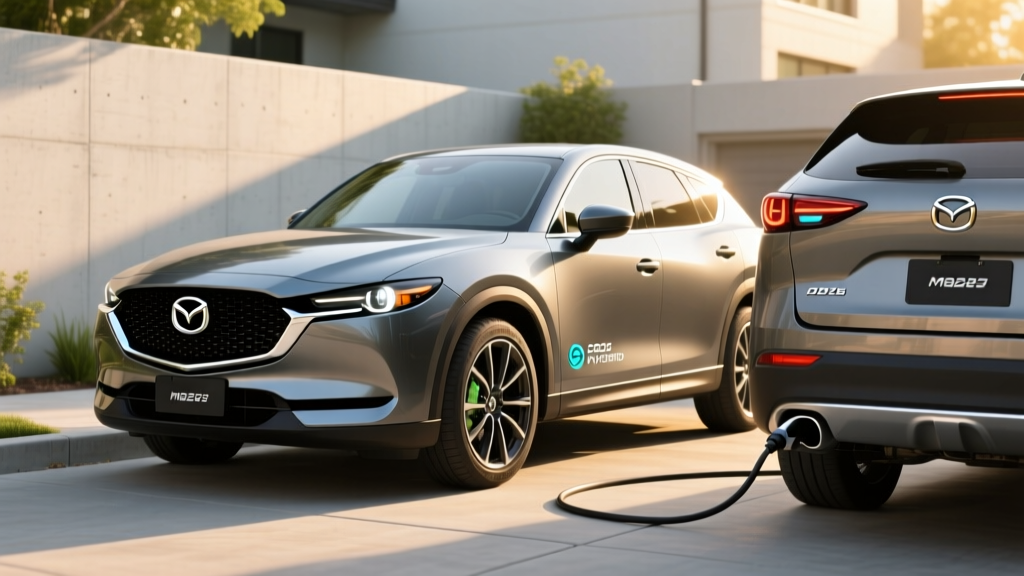
The Mazda CX-50 Hybrid pairs Mazda's design and chassis tuning with Toyota's proven hybrid powertrain, creating a compact SUV that delivers strong fuel economy without sacrificing driving dynamics. If you've been searching for Mazda CX-50 Hybrid MPG data to see if this crossover fits your daily commute and road-trip needs, this guide breaks down every number that matters — from EPA estimates to real-world expectations, powertrain specs, warranty coverage, and total cost of ownership.
| Spec | Value |
|---|---|
| Powertrain | 2.5L 4-cyl + electric motor (Toyota Hybrid System) |
| Combined Horsepower | 219 hp |
| EPA MPG (City / Hwy / Combined) | 39 / 37 / 38 |
| Drivetrain | AWD (electronic on-demand rear motor) |
| Battery Type | Sealed nickel-metal hydride (NiMH), ~1.6 kWh |
| 0-60 mph | ~7.8 sec (est.) |
| Towing Capacity | 1,500 lbs |
| Starting MSRP | ~$37,500 |
| Hybrid Battery Warranty | 10 years / 150,000 miles |
HEV vs PHEV: What the CX-50 Hybrid Actually Is
Before diving into fuel economy, it's critical to understand what the CX-50 Hybrid is — and what it isn't. This is a conventional hybrid electric vehicle (HEV), not a plug-in hybrid (PHEV). That distinction matters for how you use it, how you fuel it, and what incentives apply.
| Feature | Conventional Hybrid (HEV) | Plug-In Hybrid (PHEV) |
|---|---|---|
| Plug-in charging? | No — refuels with gas only | Yes — charges via outlet or charger |
| Electric-only range | Less than 1 mile at low speed | 20–45 miles typical |
| Battery size | ~1–2 kWh | ~13–25 kWh |
| Federal tax credit (§30D) | Not eligible | Up to $7,500 (if eligible) |
| Driving experience | Seamless gas + electric blend | EV-like on short trips, gas on longer ones |
| Best for | No home charging access, high-mileage drivers | Home chargers with short commutes |
The CX-50 Hybrid operates purely as a gas-electric hybrid. You never plug it in. The small battery recharges through regenerative braking and the gasoline engine. If you want plug-in capability from Mazda, you'd look at the CX-90 PHEV — a larger, more expensive three-row SUV. The CX-50 Hybrid is designed for buyers who want better fuel economy with zero lifestyle changes.
Mazda CX-50 Hybrid MPG: EPA Numbers and Real-World Results
| Driving Cycle | EPA Estimate | Real-World Expectation |
|---|---|---|
| City | 39 MPG | 38–42 MPG (hybrids often exceed EPA in stop-and-go) |
| Highway | 37 MPG | 34–36 MPG (aero drag and sustained speed reduce hybrid advantage) |
| Combined | 38 MPG | 36–39 MPG (varies by driving mix) |
The EPA rates the CX-50 Hybrid at 39 city / 37 highway / 38 combined MPG, according to fueleconomy.gov. These figures apply across all available trims, since AWD is standard.
Why City MPG Can Exceed the Sticker
Conventional hybrids shine in city driving. The electric motor handles low-speed acceleration — the most fuel-intensive part of any drive cycle — while regenerative braking recovers energy at every stoplight. In real-world urban commuting with frequent stops, many Toyota-sourced hybrid owners report 40+ MPG in warm weather. The CX-50 uses the same underlying hybrid system, so similar results are realistic.
Why Highway MPG Falls Short
At sustained 70–80 mph highway speeds, the gasoline engine does nearly all the work. The electric motor provides minimal assist, and the CX-50's boxy SUV profile creates more aerodynamic drag than a sedan like the Toyota Camry Hybrid. Expect highway fuel economy to land in the 34–36 MPG range on flat terrain. Mountain driving, heavy cargo loads, and cold weather will push it lower — potentially into the low 30s on steep grades or in sub-freezing temperatures.
Annual Fuel Cost Estimate
At 15,000 miles per year and $3.40/gallon regular unleaded (national average as of early 2026), the CX-50 Hybrid costs roughly $1,340 per year in fuel. Compare that to a gas-only compact SUV averaging 26 MPG combined, which would cost approximately $1,960 annually — a savings of about $620 per year with the hybrid.
Powertrain Deep Dive: Toyota Hybrid System Under a Mazda Skin
The CX-50 Hybrid uses Toyota's 2.5-liter Dynamic Force four-cylinder engine paired with two electric motor-generators and an electronic continuously variable transmission (eCVT). This is the same architecture found in the Toyota RAV4 Hybrid and Highlander Hybrid — one of the most widely deployed and thoroughly validated hybrid systems in the world.
Combined system output is 219 horsepower. The front motor-generator handles both propulsion and regenerative braking, while a second motor on the rear axle provides electronic AWD when traction demands it. There's no mechanical driveshaft connecting the front and rear axles — the rear motor engages on-demand, which improves efficiency during steady-state cruising.
Acceleration is adequate for daily driving: expect 0–60 mph in roughly 7.8 seconds. The eCVT delivers smooth, linear power delivery without the shift shock of a traditional automatic. However, under hard acceleration the engine can drone at high RPM — a characteristic of the eCVT design, not unique to Mazda. The trade-off for excellent fuel economy is that this powertrain prioritizes efficiency over sportiness.
Pricing, Trims, and Tax Credit Eligibility
The 2026 Mazda CX-50 Hybrid is offered across multiple trim levels. Pricing starts around $37,500 for the base Preferred Hybrid trim and climbs to approximately $43,000 for a fully loaded Premium Plus Hybrid. All trims come standard with AWD.
Federal Tax Credit: Not Eligible
Because the CX-50 Hybrid is a conventional HEV (not a plug-in), it does not qualify for the federal §30D Clean Vehicle Credit. That credit — up to $7,500 — applies only to battery electric vehicles (BEVs) and plug-in hybrids (PHEVs) that meet battery sourcing, MSRP cap, and buyer income requirements as outlined by the IRS.
Some states offer their own incentives for conventional hybrids, though these are increasingly rare as state programs shift toward zero-emission vehicles. Check your state's energy or environmental agency website for current programs.
Total Cost vs. Gas-Only CX-50
The gas-only CX-50 with the turbo engine starts around $33,000 and averages 25 MPG combined. The hybrid commands a roughly $4,500 premium at the base trim. At $620 annual fuel savings, the hybrid's price premium pays back in approximately 7.3 years at 15,000 miles per year. If you drive more than average, keep the vehicle long-term, or face higher local gas prices, the payback period shortens considerably.
Battery Warranty, Lifespan, and Replacement Cost
Hybrid Battery Warranty
Mazda covers the CX-50 Hybrid's battery pack for 10 years or 150,000 miles (whichever comes first) in all 50 states. This aligns with the industry standard for hybrid battery coverage and matches Toyota's warranty on its hybrid components. The warranty covers capacity loss and defects — if the battery fails within this period, replacement is covered at no cost to the owner.
How Long Do Hybrid Batteries Actually Last?
The CX-50 Hybrid's ~1.6 kWh NiMH battery pack operates in a narrow state-of-charge window — typically between 40% and 80%. The hybrid system never fully charges or fully depletes the battery, which dramatically reduces degradation stress. Toyota's hybrid battery packs routinely last 150,000–200,000+ miles before needing replacement, with many original packs still functioning in vehicles with over 250,000 miles.
NiMH chemistry, while less energy-dense than the lithium-ion packs in EVs, is extremely durable and tolerant of the shallow charge-discharge cycles that define hybrid operation. Degradation in a conventional hybrid is measured in small increments over many years — not the 10–15% capacity loss seen in EV batteries over similar timeframes.
Replacement Cost if Out of Warranty
If the hybrid battery does eventually need replacement outside the warranty period, expect to pay between $2,500 and $4,500 for a new or refurbished pack including labor. This is significantly less than an EV traction battery replacement ($8,000–$20,000+), because the hybrid battery is much smaller and simpler. Third-party hybrid battery refurbishers also offer reconditioned packs for $1,500–$2,500.
Who Should Buy the CX-50 Hybrid — and Who Shouldn't
Pros
- 38 MPG combined with no plug-in requirement
- Toyota-sourced hybrid system with proven long-term reliability
- Standard AWD across all hybrid trims
- 10-year / 150,000-mile hybrid battery warranty
- Strong resale value (hybrid SUVs retain value well)
- Premium interior and Mazda's driving dynamics
Cons
- No federal tax credit (HEV, not PHEV)
- eCVT drone under hard acceleration
- Towing limited to 1,500 lbs (vs. 3,500 lbs for turbo gas model)
- ~$4,500 price premium over gas-only CX-50
- No electric-only driving capability
- Rear cargo slightly reduced vs. non-hybrid (battery placement)
Decision Framework
Choose the CX-50 Hybrid if: You want 35–40 MPG in a stylish compact SUV, you don't have access to home charging, you plan to own the vehicle for 7+ years, and you value a proven hybrid powertrain with strong reliability data.
Choose the gas-only CX-50 if: You need maximum towing capacity (3,500 lbs with the turbo), you drive mostly highway miles where the hybrid advantage shrinks, or you want the lowest upfront price.
Choose a PHEV (like the CX-90 PHEV or RAV4 Prime) if: You have home Level 2 charging, your daily commute is under 35 miles round-trip, and you want to drive mostly on electricity while retaining gas flexibility for road trips.
Choose a full EV (like the Hyundai Ioniq 5 or Tesla Model Y) if: You have reliable home charging, you want zero tailpipe emissions, you want the lowest per-mile fuel cost, and you're eligible for the $7,500 federal tax credit.
Reliability Track Record: Toyota's Hybrid System in a Mazda
The CX-50 Hybrid's powertrain is sourced from Toyota, and this matters enormously for long-term reliability. Toyota has produced over 25 million hybrid vehicles globally since the Prius launched in 1997. The 2.5L hybrid system specifically has been in production since 2018 and powers the RAV4 Hybrid, Camry Hybrid, Highlander Hybrid, and Lexus NX 350h.
Common failure points in conventional hybrids are well-documented and rare. The eCVT transmission has no traditional clutch packs or torque converter — it's a planetary gearset with far fewer wear components than a conventional automatic. The electric motor-generators are essentially maintenance-free. The gasoline engine operates under less stress than in a non-hybrid application because the electric motor handles peak-load acceleration.
Mazda's own reliability ratings have improved significantly in recent years, and the CX-50's non-powertrain components (infotainment, interior, chassis) carry Mazda's standard 3-year/36,000-mile bumper-to-bumper and 5-year/60,000-mile powertrain warranties. For the hybrid-specific components, Toyota's engineering carries the load.
Frequently Asked Questions
How many MPG does the Mazda CX-50 Hybrid get?
The EPA rates the CX-50 Hybrid at 39 city / 37 highway / 38 combined MPG. In real-world driving, city commuters often see 40+ MPG thanks to regenerative braking, while highway-heavy drivers should expect 34–36 MPG.
Does the CX-50 Hybrid need to be plugged in?
No. The CX-50 Hybrid is a conventional HEV. It recharges its small battery through regenerative braking and the gasoline engine. You fuel it exclusively at gas stations, just like a regular car.
Is the Mazda CX-50 Hybrid reliable?
Yes. The hybrid powertrain is sourced from Toyota and uses the same 2.5L hybrid system found in the RAV4 Hybrid — one of the most reliable and widely produced hybrid systems in the world. The hybrid battery is warrantied for 10 years / 150,000 miles.
What does it cost to replace the CX-50 Hybrid battery?
Out of warranty, expect $2,500–$4,500 for a new or refurbished hybrid battery pack including labor. However, Toyota-sourced NiMH hybrid batteries routinely last 150,000–200,000+ miles, and most owners will never need a replacement.
Does the Mazda CX-50 Hybrid qualify for a tax credit?
No. The federal §30D Clean Vehicle Credit applies only to plug-in vehicles (BEVs and PHEVs). The CX-50 Hybrid is a conventional HEV and is not eligible. Check your state's energy office for any local hybrid incentives.
How does the CX-50 Hybrid compare to the RAV4 Hybrid?
Both use Toyota's 2.5L hybrid system and deliver similar MPG (RAV4 Hybrid: 41/38/40 EPA). The CX-50 Hybrid trades a slight MPG disadvantage for Mazda's more premium interior, sharper steering, and distinct exterior design. The RAV4 Hybrid offers more cargo space and a slightly lower starting price.
Can the CX-50 Hybrid tow?
Yes, but with a reduced rating. The CX-50 Hybrid is rated for 1,500 lbs of towing capacity, compared to 3,500 lbs for the turbocharged gas-only CX-50. If you regularly tow a small trailer or jet skis, the gas turbo model is the better choice.