Quick Verdict: A Premium PHEV That Bridges the Gap
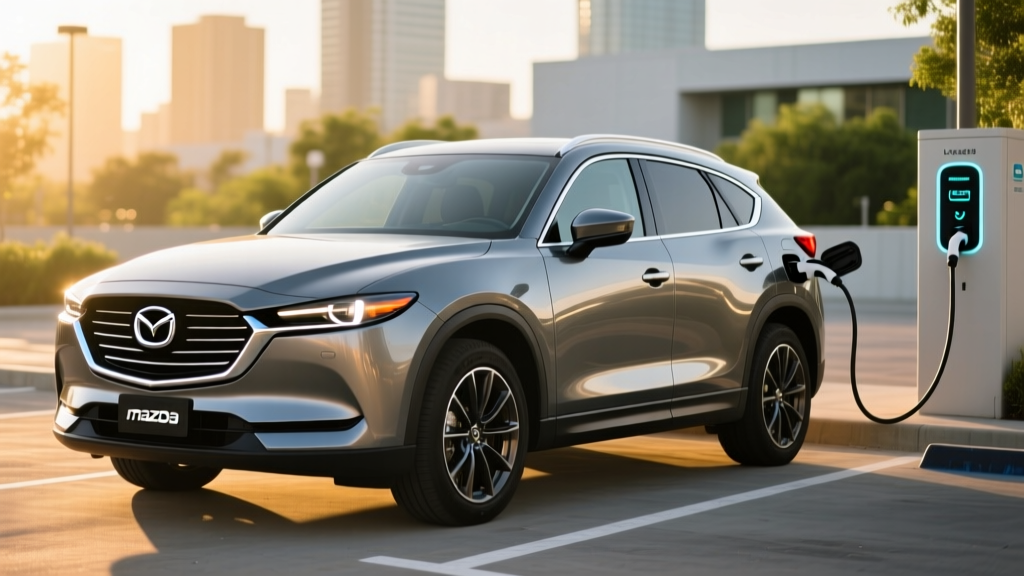
The Mazda CX-90 PHEV occupies a specific niche: families who want electric commuting but need the flexibility of a gas engine for road trips, wrapped in a near-luxury three-row crossover. With 26 miles of EPA-rated electric-only range and 327 combined horsepower, it targets buyers who aren't ready for a full battery-electric vehicle but want to reduce daily fuel consumption. The inline-six engine paired with a plug-in hybrid powertrain is unusual in a segment dominated by turbocharged four-cylinders, giving the CX-90 a driving character that sets it apart from the Toyota Highlander Hybrid and Kia Sorento PHEV.
| Specification | Value |
|---|---|
| EPA Electric Range | 26 miles |
| Total Combined Range | ~460 miles |
| MPGe (combined, electric+gas) | 56 MPGe |
| MPG (gas-only, combined) | 25 MPG |
| Battery Capacity | 17.8 kWh (gross) |
| Combined Horsepower | 327 hp / 460 lb-ft torque |
| Engine | 2.5L inline-4 + electric motor |
| 0-60 mph | ~6.3 seconds |
| Level 2 Charge Time (0-100%) | ~3.5 hours (7.2 kW onboard charger) |
| DC Fast Charging | Not available |
| Base MSRP | $51,470 (Preferred) |
| Battery Warranty | 8 years / 100,000 miles |
HEV vs PHEV: What's the Difference on the CX-90?
Mazda actually sells two hybrid flavors of the larger CX platform, and buyers frequently confuse them. Here's the critical distinction:
| Feature | CX-90 PHEV (Plug-In) | CX-90 I6 Turbo S (Mild Hybrid) |
|---|---|---|
| Must plug in to benefit? | Yes — for electric miles | No — self-charging only |
| Electric-only driving | Up to 26 miles | None (electric assist only) |
| Engine | 2.5L I-4 + electric motor | 3.3L turbo I-6 + 48V mild-hybrid |
| Combined output | 327 hp | 340 hp |
| EPA combined MPG | 25 MPG (gas) / 56 MPGe | 25 MPG |
| Federal tax credit eligible | Potential (see below) | No |
| Starting MSRP | $51,470 | $47,275 |
The conventional hybrid (HEV) system on the inline-six CX-90 uses a small 48-volt battery that recovers energy during braking and assists the engine — you never plug it in, and it cannot drive on electricity alone. The PHEV uses a much larger 17.8 kWh battery and a more powerful electric motor that can propel the vehicle at highway speeds without the engine running. If you have a place to plug in at home or work, the PHEV delivers meaningful fuel savings on short commutes. If you don't, you're paying extra weight and complexity for a system you won't use.
Fuel Economy: Real-World MPG vs EPA Estimates
| Mode | City | Highway | Combined |
|---|---|---|---|
| Charge-depleting (EV+gas) | — | — | 56 MPGe |
| Charge-sustaining (gas only) | 24 MPG | 27 MPG | 25 MPG |
The EPA rates the CX-90 PHEV at 56 MPGe when operating in its blended electric-plus-gas mode, but that number only applies while the battery has charge. Once the 26-mile electric buffer is depleted, the vehicle operates as a conventional hybrid, returning an EPA-estimated 25 MPG combined (24 city / 27 highway).
Real-world expectations: According to fueleconomy.gov, owners of similarly sized PHEV crossovers report wide variance depending on charging habits. If you charge nightly and commute under 25 miles, you may use almost no gasoline on weekdays. On a long highway road trip with a depleted battery, expect closer to 23-24 MPG at 70-75 mph — the aerodynamic penalty of a three-row SUV and the dead weight of the battery work against efficiency at sustained speed. In city driving with a depleted battery, regenerative braking helps the CX-90 PHEV match or slightly exceed its EPA city rating, a common trait among hybrids.
Electric Range Reality Check: The EPA rates 26 miles of electric-only driving. In cold weather (below 32°F), expect that to drop to roughly 18-20 miles due to cabin heating demands and reduced battery efficiency. In warm weather with moderate speeds, some drivers report 28-29 miles before the engine engages.
Powertrain Deep Dive: 327 Horsepower From an Inline-Four
The CX-90 PHEV pairs a naturally aspirated 2.5-liter inline-four engine (189 hp on its own) with a 173-hp electric motor integrated into the 8-speed automatic transmission. Combined system output is 327 horsepower and 460 lb-ft of torque — substantial for a family hauler, and the torque is available instantly from the electric motor, making the CX-90 PHEV feel quicker than its 6.3-second 0-60 time suggests in around-town driving.
Mazda's rear-biased all-wheel-drive system sends power primarily to the rear wheels under normal conditions, which gives the CX-90 a more engaging driving feel than front-drive-biased competitors. The transmission is a conventional 8-speed automatic with no CVT drone, a welcome choice for drivers who dislike the rubber-band sensation common in many hybrids.
The 17.8 kWh battery pack uses lithium-ion cells (NMC chemistry) mounted beneath the floor. This placement preserves interior space but does reduce ground clearance slightly compared to the non-hybrid CX-90.
Charging: Level 2 Only, No DC Fast Charging
This is the most important practical limitation to understand before buying:
| Charging Level | Power | Time (0-100%) | Notes |
|---|---|---|---|
| Level 1 (120V household) | ~1.4 kW | ~12-14 hours | Emergency/trickle only |
| Level 2 (240V home/public) | Up to 7.2 kW | ~3.5 hours | Primary charging method |
| DC Fast Charging | N/A | N/A | Not supported |
The CX-90 PHEV has a 7.2 kW onboard charger, meaning it can accept up to 7.2 kilowatts of AC power from a Level 2 station. A full charge from empty takes approximately 3.5 hours on a 240V Level 2 circuit. On a standard 120V household outlet (Level 1), expect 12-14 hours — usable if you park for long periods but impractical as a daily strategy.
No DC fast charging: Unlike the full-electric competition, the CX-90 PHEV cannot use CCS or NACS DC fast chargers. This is standard for most PHEVs — the battery is too small to justify the cost and complexity of DC fast-charge hardware. For a PHEV, home Level 2 charging is the intended use case. A basic 240V/32-amp home charger (such as a ChargePoint Home Flex or Emporia Vue) installed on a dedicated circuit will replenish the battery fully overnight, and most PHEV owners find this completely adequate.
Home Level 2 installation typically costs $600-$1,800 total (charger hardware plus electrician labor and permit), assuming your electrical panel has capacity. If a panel upgrade is needed, add $1,500-$3,000.
Pricing, Trims & Federal Tax Credit Eligibility
The 2026 Mazda CX-90 PHEV is available in four trims:
- Preferred: $51,470 MSRP
- Premium: $55,470 MSRP
- Premium Plus: $59,470 MSRP
- Premium Plus w/ Technology Package: $61,920 MSRP
All trims share the same powertrain and battery. The differences are interior materials, audio systems, and driver-assistance features.
Federal §30D Tax Credit — Key Requirements (2026 rules):
- Vehicle MSRP must be under $80,000 for SUVs — all CX-90 PHEV trims qualify on price.
- Buyer adjusted gross income must not exceed $150,000 (single) / $300,000 (joint filing).
- Battery components and critical minerals must meet phased-in domestic sourcing thresholds.
- Credit can be transferred to the dealer at point of sale as an immediate price reduction.
- The CX-90 PHEV has historically qualified for up to $3,750 (partial credit) due to battery sourcing rules. Confirm current eligibility on IRS.gov's qualified vehicle list before purchasing — this list updates frequently.
State incentives vary widely. States like California, Colorado, and Massachusetts may offer additional rebates or HOV lane access for PHEVs. Check your state's energy office or AFDC's state incentive database for current programs. These change annually and are outside the scope of this guide.
Battery Longevity, Warranty & Replacement Costs
Mazda PHEV Battery Warranty: 8 years or 100,000 miles (whichever comes first), covering defects and capacity loss below a specified threshold (typically 60-70% of original capacity). This is consistent with industry norms for PHEV batteries. In California Air Resources Board (CARB) states, the warranty extends to 10 years / 150,000 miles.
PHEV batteries are smaller and experience less stress than full EV batteries because they cycle through a narrower state-of-charge window — the vehicle's software maintains a buffer at both the top and bottom to protect cell longevity. Real-world data from earlier-generation PHEVs (Ford Fusion Energi, Toyota Prius Prime) suggests that high-voltage batteries routinely last 12-15 years before capacity loss becomes noticeable, and many outlast the vehicles themselves.
If replacement is needed: A CX-90 PHEV battery replacement is estimated at $6,000-$9,000 out of warranty, including parts and labor. This is significantly less than a full EV battery replacement because the pack is smaller (17.8 kWh vs. 75-100+ kWh). However, out-of-pocket replacement during the ownership period is rare — most degradation claims are handled under warranty.
To maximize battery life:
- Avoid leaving the vehicle at 100% charge for extended periods in hot weather.
- Use scheduled charging to time completion close to your departure.
- Don't worry about daily charging — PHEV batteries are designed for daily cycling.
Who Should Choose the CX-90 PHEV (And Who Shouldn't)
Pros
- Premium interior that rivals entry-luxury brands at a mainstream price
- 26-mile EV range covers most daily commutes engine-free
- 327 hp and rear-biased AWD deliver engaging driving dynamics
- No range anxiety — gas engine for road trips
- Conventional 8-speed automatic (no CVT)
- Three-row seating for families
Cons
- No DC fast charging — home Level 2 is essential
- 25 MPG gas-only is mediocre for a hybrid (blame the weight and I-4)
- Third row is tight for adults
- Premium trims push past $60K
- Electric range drops significantly in cold weather
- Tax credit eligibility is partial and subject to change
Choose the CX-90 PHEV if:
- You can install a Level 2 charger at home and your daily commute is under 30 miles round-trip.
- You want a premium-feeling three-row SUV but don't want to spend BMW X5 xDrive50e money.
- You take regular road trips where EV charging infrastructure is unreliable.
- You value driving dynamics and don't want a CVT.
Look elsewhere if:
- You can't charge at home — without plugging in, you're paying a premium for a 25 MPG SUV.
- You want maximum electric range — the RAV4 Prime offers 42 miles EV, the Tucson PHEV offers 33 miles.
- You're ready for a full EV — the Hyundai Ioniq 5, Tesla Model Y, or Kia EV9 offer 250-300+ miles of range with DC fast charging.
- You need a genuinely usable third row — look at the Kia EV9 or a minivan.
Frequently Asked Questions
How many MPG does the CX-90 PHEV get?
The EPA rates it at 56 MPGe in blended electric-and-gas operation, and 25 MPG combined (24 city / 27 highway) once the battery is depleted and it operates on gasoline alone. Real-world highway MPG at 75 mph tends to be 23-24 MPG.
How far can the CX-90 PHEV go on electric only?
The EPA rates 26 miles of electric-only range. In warm weather at moderate speeds, expect 27-29 miles. In freezing temperatures, expect 18-20 miles. The electric motor can propel the CX-90 up to approximately 87 mph before the engine must engage.
Hybrid vs PHEV vs EV — which is right for me?
A conventional hybrid (HEV) like the CX-90 I6 Turbo requires no plug-in and saves fuel through regenerative braking — best for drivers without home charging. A PHEV like the CX-90 PHEV offers a short electric commute with gas backup — best for home-chargers with mixed driving patterns. A full EV (BEV) like the Tesla Model Y eliminates gasoline entirely with 250-330 miles of range — best for drivers with reliable home charging who want the lowest operating cost and don't mind planning road-trip charging stops.
Is the CX-90 PHEV reliable, and what does battery replacement cost?
Mazda's PHEV powertrain is newer than Toyota's hybrid system, so long-term reliability data is still accumulating. The high-voltage battery is warrantied for 8 years / 100,000 miles (10/150,000 in CARB states). Out-of-warranty replacement is estimated at $6,000-$9,000, though most PHEV batteries last the life of the vehicle. Mazda's overall brand reliability ratings from Consumer Reports and J.D. Power have been solid in recent years.
Does the CX-90 PHEV qualify for a tax credit?
Under current IRS §30D rules, the CX-90 PHEV may qualify for a partial federal tax credit (historically up to $3,750) depending on battery component and critical mineral sourcing requirements that phase in annually. All trims fall under the $80,000 SUV MSRP cap, and buyer income limits apply ($150K single / $300K joint). The credit can be applied as a point-of-sale reduction at the dealership. Always verify current eligibility on the IRS qualified vehicles list before purchasing, as eligibility can change with little notice.
Do I need to install a home charger for the CX-90 PHEV?
You don't need one — a standard 120V outlet will charge the battery in 12-14 hours — but you really should. A 240V Level 2 home charger cuts that to about 3.5 hours and ensures the battery is full every morning. Without regular charging, the PHEV operates as a heavy, relatively inefficient 25 MPG SUV, negating the purpose of the powertrain. Budget $600-$1,800 for a basic home Level 2 installation (more if your electrical panel needs an upgrade).
How does the CX-90 PHEV compare to the Toyota RAV4 Prime?
The RAV4 Prime offers a significantly longer 42-mile EPA electric range, faster acceleration (5.7 seconds 0-60), and better gas-only MPG (38 combined). However, it's a smaller two-row crossover with a less premium interior and less cargo space. The CX-90 PHEV trades electric range for a third row, a more upscale cabin, and more engaging driving dynamics. They serve different buyers.