Is the Mazda CX-90 PHEV Worth Leasing in 2026?
The Mazda CX-90 PHEV occupies a narrow but compelling space: a three-row luxury plug-in hybrid that undercuts German rivals on price while delivering genuine electric-only commuting capability. For buyers searching for Mazda CX-90 PHEV lease deals, the math often works out favorably — monthly payments land below comparable BMW X5 xDrive50e or Volvo XC90 Recharge leases, and Mazda's interior quality has closed the gap significantly.
But a lease only makes financial sense if the powertrain matches your daily driving pattern. The CX-90 PHEV offers 26 miles of EPA-rated electric-only range and a combined 56 MPGe when the battery is charged. Once that battery depletes, it operates as a conventional hybrid returning 25 MPG combined. If your commute is under 25 miles round-trip and you can charge at home, you'll burn very little gasoline. If you regularly drive 60+ miles without charging access, you're paying a premium for battery capacity you won't use.
HEV vs. PHEV: Understanding What You're Leasing
Before evaluating lease offers, it's critical to understand the difference between a conventional hybrid (HEV) and a plug-in hybrid (PHEV) — the CX-90 is available only as a PHEV in its electrified form, but many shoppers cross-shop it with hybrid-only competitors.
| Feature | Conventional Hybrid (HEV) | Plug-In Hybrid (PHEV) |
|---|---|---|
| Plug in to charge? | No — charges via regenerative braking and engine | Yes — plug in for full electric range |
| Electric-only driving | Minimal (1-2 miles at low speed) | 20-40+ miles depending on model |
| Battery size | 1-2 kWh | 10-25+ kWh |
| Fuel cost savings | Moderate (better MPG) | High if charged daily (mostly electric commuting) |
| Federal tax credit | No | Potentially, up to $7,500 under §30D |
| Example | Toyota Grand Highlander Hybrid | Mazda CX-90 PHEV |
The CX-90 PHEV's 17.8 kWh lithium-ion battery pack (approximately 15.0 kWh usable) is the defining feature. You must plug it in regularly to realize its efficiency advantage. If you cannot install a Level 2 charger at home or lack workplace charging, a conventional hybrid like the Toyota Grand Highlander Hybrid (35 MPG combined, no plug required) may serve you better at lower cost.
Powertrain Specs: Horsepower, Battery, and Efficiency
| Specification | 2026 Mazda CX-90 PHEV |
|---|---|
| Engine | 2.5L inline-4 + electric motor |
| Combined Output | 323 hp / 369 lb-ft torque |
| Battery (total / usable) | 17.8 kWh / ~15.0 kWh |
| EPA Electric-Only Range | 26 miles |
| EPA Combined MPGe (charged) | 56 MPGe |
| EPA MPG (battery depleted) | 25 combined (24 city / 27 highway) |
| Total Combined Range | ~490 miles |
| 0-60 mph | ~6.5 seconds |
| Drivetrain | AWD (standard) |
| Level 2 Charging (240V) | ~2.5 hours (7.2 kW onboard charger) |
| DC Fast Charging | Not available |
| Towing Capacity | 3,500 lbs |
The 323 combined horsepower puts the CX-90 PHEV in legitimate performance territory for a three-row SUV. Mazda's inline-six mild-hybrid variant produces 340 hp, but the PHEV's instant electric torque makes it feel quicker in real-world city acceleration. The 8-speed automatic transmission is conventional — no CVT drone here.
Battery & Powertrain Warranty: Mazda covers the CX-90 PHEV's high-voltage battery for 8 years / 100,000 miles (96 months), with a capacity retention threshold of approximately 70% under federal emissions warranty requirements. The powertrain carries a 5-year / 60,000-mile warranty. Battery replacement cost, should it be needed out of warranty, typically ranges from $8,000 to $12,000 including labor, though real-world PHEV battery failures within the first 150,000 miles remain uncommon based on historical data from similar Mazda and Toyota hybrid systems.
Real-World MPG and Range: What to Actually Expect
| Driving Scenario | Expected Efficiency | Notes |
|---|---|---|
| City, battery charged | 80+ MPGe | Heavy regen in stop-and-go maximizes electric use |
| Highway, battery charged | ~45 MPGe | Electric range depletes faster above 65 mph |
| City, battery depleted | 27-29 MPG | Hybrid mode; regen helps in traffic |
| Highway, battery depleted | 24-26 MPG | Aerodynamic drag + 4,700-lb curb weight |
| Cold weather (below 32°F) | ~20 miles electric | Battery efficiency drops ~20-25%; cabin heating draws power |
The EPA's 26-mile electric range assumes moderate temperatures and mixed driving. In practice, expect 22-24 miles in warm weather and as few as 18-20 miles in freezing conditions. Highway driving at 75 mph will deplete the battery in roughly 18-20 miles — electric motors are less efficient at sustained high speeds than in stop-and-go traffic where regenerative braking recovers energy.
Once the battery is depleted, the 25 MPG combined figure is accurate for mixed driving. Owners who drive primarily on highways at 70+ mph report 23-24 MPG. This is respectable for a 4,700-pound AWD three-row SUV, but it trails the Toyota Grand Highlander Hybrid's 35 MPG combined — a reminder that PHEVs prioritize electric commuting over hybrid-only efficiency.
2026 Lease Pricing and Monthly Cost Breakdown
Mazda CX-90 PHEV lease deals in 2026 typically center on the following MSRP structure, though dealer markups and regional incentives vary:
| Trim | MSRP (2026) | Typical Lease (36 mo / 10k mi) | Due at Signing |
|---|---|---|---|
| Preferred Plus | $50,445 | $499 - $569/mo | $3,500 - $4,500 |
| Premium Plus | $55,950 | $579 - $649/mo | $4,000 - $5,000 |
| Premium Plus w/ Nappa Leather | $58,450 | $619 - $699/mo | $4,000 - $5,500 |
Lease payments fluctuate based on money factor (interest rate), residual value, and dealer participation. Mazda's captive finance arm typically sets residuals around 54-57% for 36-month CX-90 PHEV leases, which is competitive for the segment. Always negotiate the capitalized cost (sale price) rather than focusing solely on monthly payment — a lower cap cost reduces your total lease cost.
Lease vs. buy consideration: If you plan to keep the vehicle beyond 4-5 years, buying (and capturing any applicable tax credit) often yields lower total cost. Leasing makes sense if you want to upgrade before battery degradation becomes a concern or if you anticipate changing driving patterns.
Federal Tax Credit Eligibility for the CX-90 PHEV
- Credit amount: Up to $3,750 for the CX-90 PHEV (partial credit — battery sourcing requirements limit full $7,500 eligibility as of 2026)
- MSRP cap: SUVs must be under $80,000 — all CX-90 PHEV trims qualify
- Buyer income cap: AGI must not exceed $150,000 (single), $225,000 (head of household), or $300,000 (joint) per IRS §30D guidelines
- Battery sourcing: Critical minerals and battery component requirements phase in annually — verify current-year compliance on the fueleconomy.gov tax credit lookup
- Point-of-sale transfer: As of 2024+, you can transfer the credit to the dealer at purchase, reducing your out-of-pocket cost immediately
- Lease loophole: When you lease, the leasing company (not you) technically claims the credit under §45W commercial clean vehicle rules — some lessors pass savings through as a "lease cash" reduction, but this is not guaranteed. Ask the dealer whether Mazda Financial passes through any commercial credit.
The lease-vs-buy tax credit distinction matters enormously. When you purchase the CX-90 PHEV, the §30D credit can reduce your tax liability by up to $3,750 (subject to the sourcing rules above). When you lease, the credit goes to the leasing entity. Some manufacturers factor this into lease cash incentives; others do not. Always ask the dealer for a written breakdown of any lease incentives and whether they reflect a passed-through tax credit.
Charging at Home: What You Need to Know
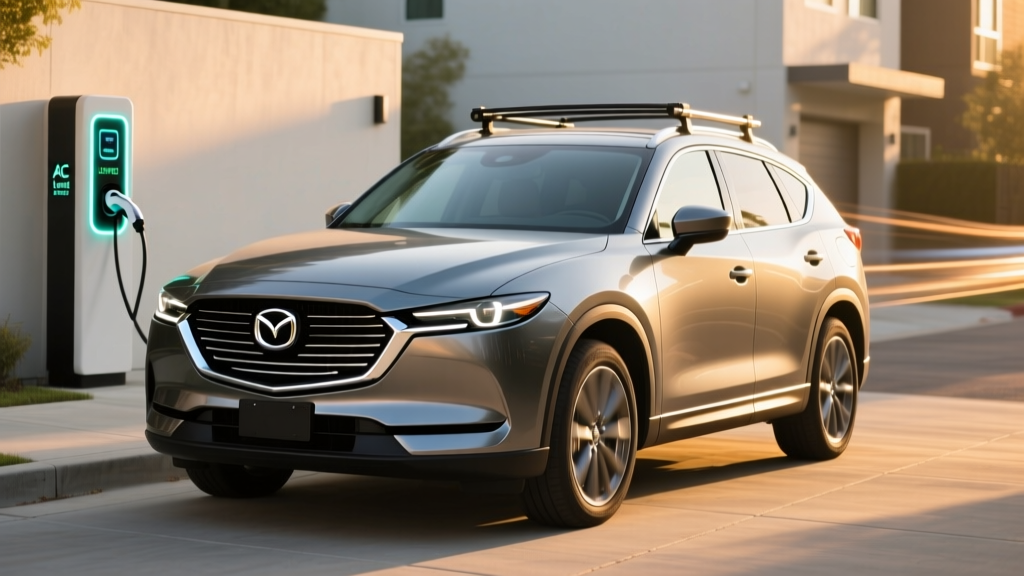
The CX-90 PHEV's 7.2 kW onboard charger means a Level 2 (240V) home charger will replenish the battery from empty to full in approximately 2.5 hours. A standard 120V household outlet (Level 1) takes roughly 7-8 hours — feasible for overnight charging if you drive less than 26 miles daily.
| Charging Level | Power | Time (0-100%) | Miles Added per Hour |
|---|---|---|---|
| Level 1 (120V outlet) | ~1.4 kW | ~7-8 hours | ~3-4 miles/hr |
| Level 2 (240V, 32A) | 7.2 kW (max) | ~2.5 hours | ~10-11 miles/hr |
| DC Fast Charge | N/A | N/A | Not supported |
Home Level 2 installation typically costs $500-$2,000 depending on your electrical panel's capacity and the distance from panel to garage. If your home has a 200-amp panel with available breaker slots, expect the lower end. A panel upgrade to 200A can add $1,500-$3,000. Always get a quote from a licensed electrician before committing to a lease or purchase — charging access is the single biggest factor in PHEV satisfaction.
Note that the CX-90 PHEV does not support DC fast charging. This is typical for PHEVs with smaller battery packs, but it means you cannot top up quickly on road trips. For longer drives, the gasoline engine handles propulsion once the battery is depleted — you simply refuel at any gas station.
Who Should Lease the CX-90 PHEV (and Who Shouldn't)
Lease the CX-90 PHEV if:
- Your daily round-trip commute is 25 miles or less
- You can install a Level 2 charger at home or have reliable workplace charging
- You want a three-row luxury SUV without the range anxiety of a full EV
- You take 2-4 road trips per year and want gasoline flexibility
- You prefer to swap vehicles every 3 years before long-term battery degradation concerns
Consider a full EV instead if:
- Your commute is under 20 miles and you want zero gasoline use
- You want DC fast charging for road trips (Kia EV9, Tesla Model X)
- You have home solar and want to eliminate fuel costs entirely
Consider a conventional hybrid (HEV) instead if:
- You cannot install a home charger (apartment, street parking)
- Your daily driving exceeds 50 miles consistently
- You want maximum MPG without plugging in (Toyota Grand Highlander Hybrid at 35 MPG combined)
Reliability and Long-Term Ownership
Mazda's 2.5L four-cylinder engine is one of the most proven powertrains in the brand's lineup, and the hybrid system shares architecture with Toyota's well-established hybrid synergy drive components. Mazda ranked in the upper third of Consumer Reports' 2025 brand reliability survey, and the CX-90 specifically has not shown systemic powertrain issues since its 2024 introduction.
The high-voltage battery is the primary long-term concern for any PHEV. Mazda's 8-year/100,000-mile battery warranty provides meaningful protection. Based on degradation data from similar 17-18 kWh PHEV packs (including the Toyota RAV4 Prime and Hyundai Tucson PHEV), expect approximately 10-15% capacity loss over 8 years of daily cycling — meaning your 26-mile electric range might decline to 22-23 miles by year 8. This is gradual and rarely renders the vehicle unusable.
According to NHTSA, the CX-90 PHEV carries no open recalls specific to the high-voltage system as of early 2026. Always verify current recall status before signing a lease.
Frequently Asked Questions
How many MPG does the Mazda CX-90 PHEV get?
With a fully charged battery, the EPA rates it at 56 MPGe combined. Once the battery is depleted, it operates as a conventional hybrid at 25 MPG combined (24 city / 27 highway). Real-world highway driving at 70+ mph typically yields 23-24 MPG in hybrid mode.
How far can the CX-90 PHEV go on electric only?
The EPA rates it at 26 miles of electric-only range. In warm weather with moderate driving, expect 22-24 real-world miles. In freezing temperatures or sustained highway speeds above 70 mph, expect 18-20 miles.
Does the Mazda CX-90 PHEV qualify for a tax credit?
It may qualify for up to $3,750 under the federal §30D clean vehicle credit, subject to battery sourcing requirements, buyer income caps, and MSRP limits (all trims clear the $80,000 SUV cap). When leasing, the credit technically goes to the leasing company — ask whether Mazda Financial passes savings through as lease cash. Verify current eligibility at fueleconomy.gov.
Is the CX-90 PHEV reliable, and what does battery replacement cost?
Mazda's 2.5L engine and hybrid components have strong reliability histories. The high-voltage battery carries an 8-year/100,000-mile warranty. Out-of-warranty battery replacement is estimated at $8,000-$12,000, though premature failures are uncommon in modern PHEV systems. Leasing for 3 years keeps you fully under warranty.
Can the CX-90 PHEV DC fast charge?
No. The CX-90 PHEV supports Level 1 (120V) and Level 2 (240V) AC charging only, with a maximum onboard charger rate of 7.2 kW. Full Level 2 charging takes approximately 2.5 hours. This is standard for PHEVs in this class.
Should I lease or buy the CX-90 PHEV?
Leasing makes sense if you want lower monthly payments, plan to upgrade within 3 years, and want to stay under full warranty coverage. Buying makes more sense if you qualify for the federal tax credit (which you can claim directly as a purchaser), plan to keep the vehicle 5+ years, and want to build equity. Run the numbers both ways with your dealer's finance department.