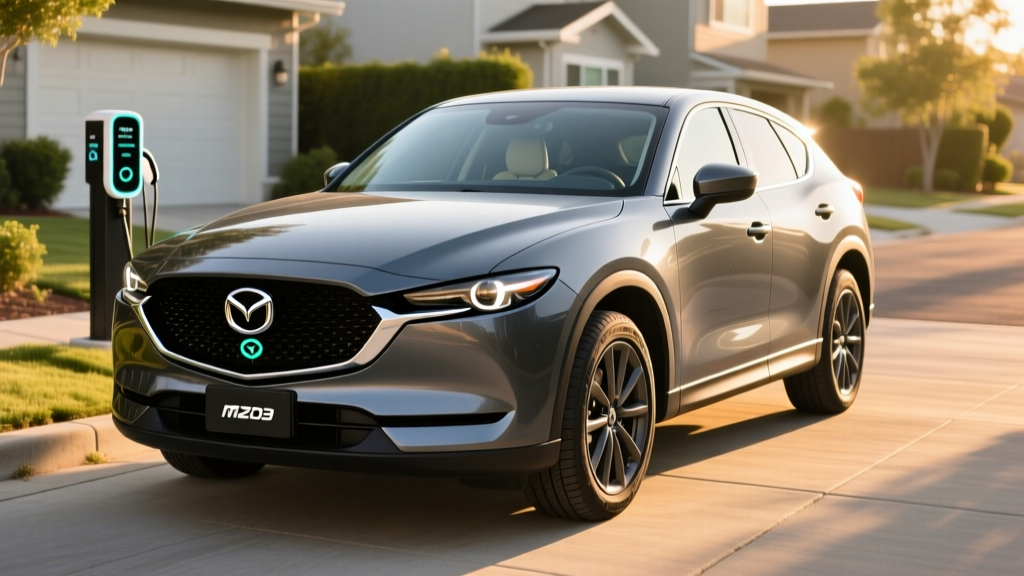
The Mazda CX-50 Hybrid pairs Mazda's rugged compact-SUV formula with Toyota's proven hybrid powertrain. The result is an SUV that delivers meaningful fuel savings without requiring a plug, a behavior change, or a steep learning curve. For buyers researching CX-50 Hybrid MPG, the headline number is strong, but real-world results — especially in city driving — tell an even more compelling story.
This guide covers the exact EPA figures, real-world expectations, powertrain details, pricing, warranty coverage, and how the CX-50 Hybrid stacks up against plug-in hybrids and full EVs so you can decide whether it's the right electrified vehicle for your daily routine.
EPA MPG and Real-World Fuel Economy
The CX-50 Hybrid uses Toyota's 2.5-liter four-cylinder hybrid system — the same architecture found in the RAV4 Hybrid and Camry Hybrid. Mazda publishes the following EPA estimates for the all-wheel-drive configuration (AWD is standard on every CX-50 Hybrid trim):
| Driving Cycle | EPA Estimate | Real-World Expectation |
|---|---|---|
| City | 39 MPG | 38–42 MPG (hybrids often beat EPA in stop-and-go) |
| Highway | 37 MPG | 34–37 MPG (sustained 75+ mph reduces regen benefit) |
| Combined | 38 MPG | 36–40 MPG depending on driving mix |
With a 15.9-gallon fuel tank, the CX-50 Hybrid delivers a total driving range of approximately 560–600 miles on a single fill-up — enough for most owners to visit a gas station once every two to three weeks.
HEV vs PHEV: Which CX-50 Is This?
The CX-50 Hybrid is a conventional hybrid electric vehicle (HEV). It does not have a plug, does not offer an electric-only driving mode beyond very low-speed maneuvers, and does not qualify for the federal §30D new clean vehicle tax credit (which applies only to plug-in vehicles with sufficient battery capacity).
| Feature | CX-50 Hybrid (HEV) | Typical Compact PHEV SUV | Full EV (BEV) |
|---|---|---|---|
| Plugs in? | No | Yes (Level 1/2) | Yes (Level 1/2/DC) |
| Electric-only range | ~1 mi at low speed | 25–42 mi | 230–350+ mi |
| Gasoline engine | 2.5L 4-cyl + e-motors | Yes + e-motors | None |
| Combined MPG / MPGe | 38 MPG | 35–40 MPG + 85–94 MPGe | 100–130 MPGe |
| Federal tax credit | Not eligible | Up to $7,500 (if eligible) | Up to $7,500 (if eligible) |
| Home charging needed | No | Recommended | Essential |
Mazda does not currently offer a CX-50 PHEV in the United States. If you want plug-in capability with a similar footprint, the Toyota RAV4 Plug-In Hybrid (42 miles electric-only, 94 MPGe combined) and the Ford Escape PHEV (37 miles electric-only) are the closest cross-shops. Both require access to a Level 2 home charger to realize their full efficiency benefit.
Powertrain Specs: Toyota Hybrid Under a Mazda Hood
The CX-50 Hybrid's powertrain is sourced directly from Toyota, a collaboration that gives Mazda access to one of the most field-proven hybrid systems on the road. Here are the exact specifications:
| Specification | Detail |
|---|---|
| Engine | 2.5L DOHC 4-cylinder (Atkinson cycle) |
| Electric motors | Front e-motor + rear e-motor (e-AWD) |
| Combined system horsepower | 219 hp |
| Transmission | ECVT (electronically controlled continuously variable) |
| Drivetrain | AWD standard (electronic rear axle) |
| Hybrid battery | ~1.6 kWh nickel-metal hydride (NiMH) |
| 0–60 mph | ~7.3 seconds (est.) |
| Towing capacity | 1,500 lbs (hybrid); non-hybrid turbo: up to 3,500 lbs |
| Fuel tank | 15.9 gallons |
| Total range | ~560–600 miles |
The 219-hp combined output is a meaningful step up from the CX-50's base 2.5L non-hybrid engine (187 hp) and is close to the turbocharged variant (227–256 hp). The electric motors provide instant torque from a stop, making the CX-50 Hybrid feel responsive in urban acceleration even though its peak horsepower trails the turbo model.
One trade-off: the hybrid's towing capacity drops to 1,500 pounds compared to the 3,500-pound rating on turbocharged CX-50 trims. If you tow a small trailer or jet ski regularly, the turbo gasoline model remains the better choice.
Pricing, Trims, and Tax Credit Eligibility
The CX-50 Hybrid is available across multiple trims. Pricing for the current model year starts in the low-to-mid $30,000s, which positions it competitively against the Toyota RAV4 Hybrid and Honda CR-V Hybrid:
| Trim Level | Approximate MSRP |
|---|---|
| Hybrid Preferred | ~$34,000 |
| Hybrid Premium | ~$37,500 |
| Hybrid Premium Plus | ~$40,500 |
MSRP figures are approximate and subject to change by model year. Destination charges, dealer options, and regional pricing may vary. Verify current pricing at MazdaUSA.com.
- The IRS §30D New Clean Vehicle Credit requires a plug-in electric vehicle with a minimum battery capacity of 7 kWh. The CX-50 Hybrid's ~1.6 kWh NiMH battery does not meet this threshold.
- Conventional hybrids (HEVs) have not qualified for the federal purchase credit since the original Toyota Prius credit phased out.
- Some states offer separate incentives for hybrids — check your state's energy office or AFDC state incentive database for local programs.
- For the full §30D rules including MSRP caps, income limits, and battery sourcing requirements, see IRS.gov §30D guidance.
Battery Warranty, Reliability, and Replacement Cost
Hybrid battery longevity is consistently one of the top concerns for first-time hybrid buyers. The CX-50 Hybrid benefits from Toyota's hybrid architecture, which has accumulated billions of real-world miles across the Prius, RAV4 Hybrid, and Camry Hybrid lineups over more than two decades.
- Hybrid battery: 8 years / 100,000 miles (10 years / 150,000 miles in CARB states including CA, NY, MA, and others)
- Powertrain warranty: 5 years / 60,000 miles
- Bumper-to-bumper: 3 years / 36,000 miles
The hybrid battery in the CX-50 is a relatively small ~1.6 kWh NiMH pack. Unlike large EV battery packs (60–100 kWh NMC or LFP), this battery operates within a narrow state-of-charge window managed by the hybrid control system — typically between 40% and 80% SoC. This shallow cycling dramatically reduces degradation. Toyota-sourced hybrid batteries routinely last 150,000–200,000+ miles before requiring replacement.
Replacement cost: If the hybrid battery does need replacement outside of warranty, expect a cost between $2,000 and $4,000 for a new OEM pack, with refurbished options available for $1,000–$2,000. This is a fraction of EV battery replacement costs ($10,000–$20,000+), largely because the pack is small and accessible.
On reliability more broadly, Mazda as a brand consistently ranks in the top tier of Consumer Reports and J.D. Power dependability studies. The Toyota hybrid system adds a track record that few powertrains can match. The CX-50 Hybrid should be among the lowest-risk electrified vehicles to own long-term.
How the CX-50 Hybrid Compares to Rivals
The compact hybrid SUV segment is competitive. Here is how the CX-50 Hybrid's key numbers stack up against its most common cross-shops, per fueleconomy.gov EPA data:
| Metric | Mazda CX-50 Hybrid | Toyota RAV4 Hybrid | Honda CR-V Hybrid |
|---|---|---|---|
| Combined MPG | 38 | 39–41 | 37–40 |
| City MPG | 39 | 41 | 40–43 |
| Highway MPG | 37 | 38 | 34–36 |
| Combined HP | 219 | 219 | 204 |
| AWD | Standard | Standard | Available |
| Cargo (behind 2nd row) | ~31 cu ft | ~37 cu ft | ~36 cu ft |
| Starting MSRP (AWD) | ~$34,000 | ~$33,000 | ~$36,000 |
The CX-50 Hybrid trades a small MPG penalty (1–2 MPG combined behind the RAV4 Hybrid) for Mazda's more premium interior materials, a longer wheelbase that translates to a smoother ride, and standard AWD across all trims. Cargo space is tighter than both rivals due to the CX-50's lower roofline and more wagon-like proportions. If maximum utility is your priority, the RAV4 Hybrid wins on volume. If driving feel and cabin quality matter more, the CX-50 Hybrid has the edge.
Pros
- 38 MPG combined with no plug-in required
- Toyota-sourced hybrid system with proven long-term reliability
- 219 hp — responsive acceleration for a hybrid SUV
- Premium interior materials relative to segment
- Standard AWD on all trims
- 560+ mile total range per tank
Cons
- Less cargo space than RAV4 Hybrid and CR-V Hybrid
- No PHEV option for electric-only commuting
- Towing limited to 1,500 lbs (turbo model: 3,500 lbs)
- Not eligible for federal §30D tax credit
- Infotainment lacks a touchscreen (rotary dial only)
Who Should Choose the CX-50 Hybrid vs a PHEV or EV?
The right electrified vehicle depends on your driving pattern, charging access, and budget. Use this decision framework:
- You cannot charge at home (apartment, street parking, no garage outlet)
- You want fuel savings with zero behavior change — just fill up with gas
- Your budget is under $40,000 and you need AWD
- You drive a mix of city and highway miles and want 38+ MPG without thinking about it
- You have Level 2 home charging and a commute under 40 miles round-trip
- You want to drive mostly on electricity on weekdays and take gas-powered road trips on weekends
- You qualify for the §30D tax credit (income and sourcing requirements met)
- You have reliable home Level 2 charging
- Your daily driving is under 250 miles and you road-trip infrequently
- You want the lowest per-mile fuel cost and minimal maintenance
- You qualify for the full $7,500 federal credit, bringing EV pricing close to hybrid
For many buyers — especially renters, condo owners, or those in areas with limited public charging infrastructure — the CX-50 Hybrid represents the lowest-friction path to meaningful fuel savings. You spend less at the pump every week without installing a charger, planning around battery range, or worrying about cold-weather range loss.
Frequently Asked Questions
How many MPG does the Mazda CX-50 Hybrid get?
The EPA rates the CX-50 Hybrid at 39 MPG city, 37 MPG highway, and 38 MPG combined. In real-world driving, many owners report exceeding the city estimate — 40 to 42 MPG is common in stop-and-go traffic where regenerative braking and electric motor assist are most effective. Highway-heavy commutes at 75+ mph typically return 34–37 MPG.
Does the CX-50 Hybrid need to be plugged in?
No. The CX-50 Hybrid is a conventional hybrid (HEV). It charges its small battery through regenerative braking and the gasoline engine. You never plug it in — you simply refuel at a gas station as you would with any other vehicle.
Is there a CX-50 plug-in hybrid (PHEV)?
Not in the United States as of the current model year. Mazda offers PHEV versions of the CX-90 (inline-six plug-in) but has not introduced a CX-50 PHEV. If plug-in capability is essential, the Toyota RAV4 Plug-In Hybrid is the closest alternative with a similar footprint and 42 miles of electric-only range.
Is the CX-50 Hybrid reliable?
The CX-50 Hybrid uses Toyota's hybrid system, which has been in continuous production since 1997 and powers millions of vehicles globally. The NiMH hybrid battery is warrantied for 8 years/100,000 miles (10 years/150,000 miles in CARB states). Mazda as a brand consistently ranks among the top in long-term dependability studies. The hybrid variant should be at least as reliable as the gasoline CX-50, if not more so, given the proven powertrain.
What does it cost to replace the CX-50 Hybrid battery?
Outside of warranty, a new OEM hybrid battery replacement runs approximately $2,000–$4,000. Refurbished or aftermarket packs can reduce this to $1,000–$2,000. Given that Toyota hybrid batteries commonly last 150,000–200,000+ miles, most owners will never face this expense.
Does the CX-50 Hybrid qualify for a tax credit?
The CX-50 Hybrid does not qualify for the federal §30D New Clean Vehicle Credit, which requires a plug-in vehicle with at least 7 kWh of battery capacity. Some states may offer hybrid-specific rebates or incentives — check the AFDC state incentive database for programs in your area.
How does the CX-50 Hybrid compare to the turbo CX-50?
The hybrid delivers 219 hp and 38 MPG combined. The turbocharged 2.5T CX-50 produces 227–256 hp (depending on fuel grade) but returns only about 25 MPG combined and requires premium fuel for maximum output. The turbo model also tows up to 3,500 lbs vs. the hybrid's 1,500-lb limit. If you prioritize fuel economy and don't tow, the hybrid is the clear pick. If you need towing capacity or maximum acceleration, stick with the turbo.