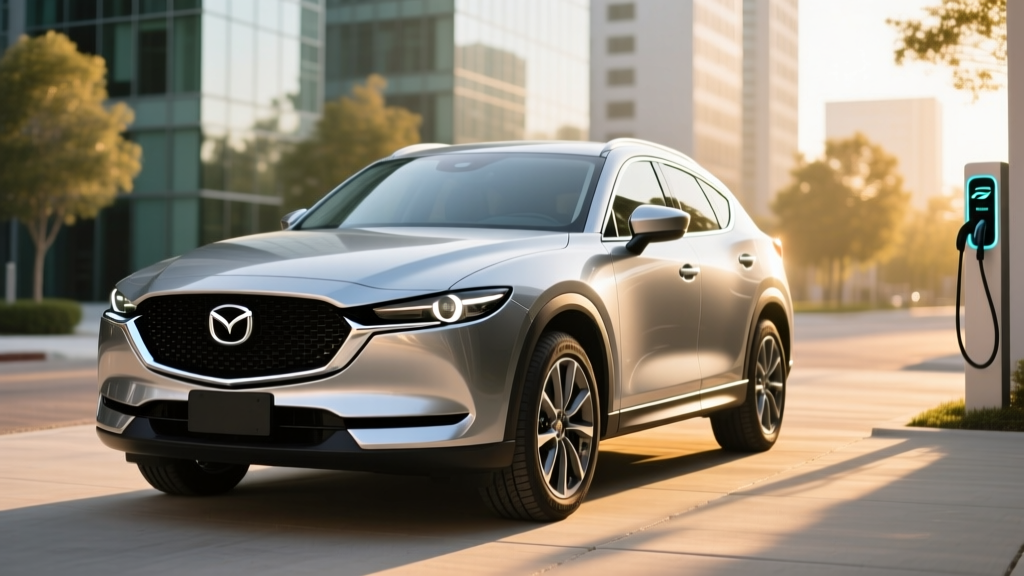
The Mazda CX-50 Hybrid pairs Toyota's proven hybrid powertrain with Mazda's rugged styling and all-wheel-drive capability, filling a specific niche for buyers who want hybrid efficiency without plugging in. If you've been searching for CX-50 Hybrid MPG data to decide whether this crossover fits your commute, this guide covers the exact EPA figures, real-world expectations, powertrain details, and ownership costs you need before heading to the dealership.
For 2026, Mazda continues the CX-50 Hybrid as a conventional hybrid electric vehicle (HEV)—not a plug-in. That distinction matters enormously for your daily routine, your wallet, and your expectations at the pump. Let's break down every number.
2026 Mazda CX-50 Hybrid MPG: The EPA Numbers
The headline figure is what brings most shoppers here. According to EPA data on fueleconomy.gov, the 2026 Mazda CX-50 Hybrid (AWD, the only drivetrain offered) posts the following fuel economy ratings:
| Driving Cycle | EPA MPG |
|---|---|
| City | 39 MPG |
| Highway | 37 MPG |
| Combined | 38 MPG |
Those numbers are strong for a compact crossover with standard all-wheel drive and a 219-horsepower powertrain. For context, the gas-only CX-50 Turbo with AWD returns roughly 25 MPG combined, meaning the hybrid delivers a roughly 50% improvement in overall fuel efficiency.
Real-World MPG vs. the EPA Sticker
Toyota-sourced hybrid systems have a well-documented tendency to exceed their EPA city rating in stop-and-go driving, where regenerative braking and electric-motor assist do the heavy lifting. In mixed suburban driving with frequent stops, owners commonly report 40–42 MPG on the CX-50 Hybrid's trip computer.
Highway driving tells a different story. At sustained 75–80 MPH speeds, the 2.5-liter engine carries more of the load, and the boxy, rugged exterior design creates additional aerodynamic drag. Expect highway fuel economy in the 34–36 MPG range on long interstate trips. Cold weather (below 35°F) can knock 2–4 MPG off combined figures due to longer engine warm-up cycles and increased battery internal resistance.
HEV vs. PHEV: What the CX-50 Hybrid Is (and Isn't)
A common point of confusion: the CX-50 Hybrid is a conventional hybrid (HEV), not a plug-in hybrid (PHEV). It has no charging port, no electric-only driving range, and no eligibility for the federal §30D EV tax credit. You fuel it like any other car and never need to think about charging infrastructure.
CX-50 Hybrid (HEV)
- No plug — refuels at gas stations only
- Small ~1.6 kWh battery (not user-serviceable)
- Electric motor assists the gas engine; no EV-only range
- No federal tax credit eligibility
- Lower purchase price than a PHEV equivalent
Typical PHEV (e.g., Toyota RAV4 Prime)
- Plug-in capable — Level 1 or Level 2 charging
- Larger ~18.1 kWh battery
- ~42 miles electric-only range before gas engine engages
- May qualify for §30D credit (if sourcing/income rules met)
- Higher MSRP; savings depend on charging habits
If you were hoping for a CX-50 PHEV with electric-only commuting capability, Mazda has not announced one for the 2026 model year. Buyers who want plug-in capability in this segment should cross-shop the Toyota RAV4 Prime (42 miles EV range), Hyundai Tucson PHEV (33 miles), or Mitsubishi Outlander PHEV (38 miles).
Powertrain Specs: Toyota Hardware, Mazda Tuning
The CX-50 Hybrid borrows its powertrain directly from the Toyota RAV4 Hybrid—one of the most proven hybrid systems on the road. Mazda integrates it with its own chassis tuning, steering calibration, and all-wheel-drive logic.
| Specification | 2026 Mazda CX-50 Hybrid |
|---|---|
| Engine | 2.5L 4-cylinder Atkinson-cycle |
| Electric Motor | Front + rear permanent-magnet motors |
| Combined System Output | 219 HP |
| Drivetrain | AWD (electronic rear motor, no mechanical driveshaft) |
| Transmission | eCVT (planetary gearset, not a belt CVT) |
| Hybrid Battery | ~1.6 kWh, Nickel-Metal Hydride (NiMH) |
| 0–60 MPH | ~7.2 seconds |
| Towing Capacity | 1,500 lbs |
| Fuel Tank | 15.9 gallons |
| EPA Combined MPG | 38 MPG |
The eCVT here is Toyota's planetary-gear design, which is fundamentally different from the rubber-belt CVTs found in some competitors. It has no belts to wear and is widely regarded as one of the most durable transmissions in production. The electronic AWD system uses the rear electric motor to send torque to the rear wheels when slip is detected or during hard acceleration—there's no mechanical driveshaft connecting the front and rear axles.
Pricing, Trims, and Tax Credit Eligibility
The 2026 CX-50 Hybrid is offered across multiple trims. Based on Mazda's current pricing structure:
- Preferred Hybrid: ~$35,395 MSRP (including destination)
- Premium Hybrid: ~$38,095 MSRP
- Premium Plus Hybrid: ~$41,595 MSRP
Federal Tax Credit: Not Eligible
Because the CX-50 Hybrid is a conventional HEV—not a plug-in vehicle—it does not qualify for the IRS §30D Clean Vehicle Credit (up to $7,500 for new EVs and PHEVs). The §30D credit requires a vehicle to have a battery capacity of at least 7 kWh and plug-in charging capability, per IRS guidelines. The CX-50 Hybrid's ~1.6 kWh NiMH battery and lack of a charge port disqualify it entirely.
Some states and local utilities offer small rebates for conventional hybrids, but these are increasingly rare as incentive programs shift toward plug-in vehicles. Check your state energy office or utility provider for any current programs.
Battery Warranty, Lifespan, and Replacement Cost
How Long Will the Hybrid Battery Last?
The CX-50 Hybrid uses Toyota's hybrid system, which has accumulated billions of real-world miles across the RAV4, Camry, and Prius fleets. Toyota's NiMH hybrid batteries routinely last 150,000–200,000+ miles before significant degradation. The battery in this system is small (~1.6 kWh) and is never deeply discharged—the hybrid control system keeps the state of charge in a narrow 40–80% window, which dramatically extends cell life.
Failure before 150,000 miles is uncommon but not unheard of. If replacement is needed out of warranty, expect a cost in the range of $2,000–$3,500 for a new OEM battery pack from a Mazda dealer, or $1,000–$1,800 for a refurbished unit from independent hybrid specialists. This is far less expensive than a full EV battery replacement.
General Reliability
The Toyota-sourced hybrid powertrain carries one of the strongest reliability records in the automotive industry. Mazda's own mechanical components (suspension, brakes, interior electronics) are generally well-regarded. The CX-50 Hybrid has fewer wear items than the turbocharged gas model—no turbocharger, no traditional starter motor, and regenerative braking extends pad life significantly.
Who Should Buy the CX-50 Hybrid (and Who Shouldn't)
Choose the CX-50 Hybrid if:
- You want 38+ MPG without changing your fueling habits (no plug needed)
- You don't have access to home or workplace Level 2 charging
- You want AWD capability for snow/rain with better fuel economy than gas-only crossovers
- You prefer Mazda's driving dynamics and interior materials over the RAV4 Hybrid
- You want a lower purchase price than a comparable PHEV
Look elsewhere if:
- You want electric-only commuting (consider a PHEV like the RAV4 Prime)
- You want to eliminate gas entirely (consider a full BEV like the Tesla Model Y or Hyundai Ioniq 5)
- You need to tow more than 1,500 lbs (the gas CX-50 Turbo tows up to 3,500 lbs)
- You want federal tax credit eligibility (only PHEVs and BEVs qualify under §30D)
How the CX-50 Hybrid Compares to Rivals
The CX-50 Hybrid's most direct competitor is the Toyota RAV4 Hybrid—the source of its powertrain. Here's how they stack up on key metrics:
| Metric | Mazda CX-50 Hybrid | Toyota RAV4 Hybrid |
|---|---|---|
| EPA Combined MPG | 38 MPG | 39 MPG |
| Combined HP | 219 HP | 219 HP |
| 0–60 MPH | ~7.2 sec | ~7.4 sec |
| Starting MSRP (AWD) | ~$35,395 | ~$34,485 |
| Cargo Volume | 31.4 cu ft | 37.6 cu ft |
| Towing | 1,500 lbs | 1,750 lbs |
| Hybrid Battery Warranty | 8 yr / 100k mi | 10 yr / 150k mi |
The RAV4 Hybrid edges out the CX-50 on cargo space, towing, and slightly better warranty coverage. The Mazda counters with a more premium interior, sharper steering feel, and a more rugged exterior design that resonates with outdoor-oriented buyers. On fuel economy alone, the two are nearly identical—which makes sense given the shared powertrain.
Frequently Asked Questions
How many MPG does the 2026 Mazda CX-50 Hybrid get?
The EPA rates the CX-50 Hybrid at 39 MPG city, 37 MPG highway, and 38 MPG combined. Real-world results typically range from 34–36 MPG on sustained highway drives to 40–42 MPG in stop-and-go city traffic.
Does the CX-50 Hybrid need to be plugged in?
No. The CX-50 Hybrid is a conventional HEV. It charges its small battery through regenerative braking and the gas engine. There is no charging port and no electric-only driving mode.
How far can the CX-50 Hybrid go on electric only?
The CX-50 Hybrid cannot drive on electric power alone for any meaningful distance. The electric motor assists the gas engine at low speeds and during acceleration, but the gas engine is always running or cycling on/off as needed. If you want electric-only range, you need a PHEV or a full BEV.
Is the CX-50 Hybrid reliable?
Yes. The Toyota-sourced hybrid system is among the most proven in the industry, with millions of units in service globally. The NiMH battery is conservatively managed and typically lasts 150,000+ miles. Mazda's 8-year/100,000-mile hybrid warranty (10 years/150,000 miles in CARB states) provides additional peace of mind.
What does a CX-50 Hybrid battery replacement cost?
Out-of-warranty replacement typically runs $2,000–$3,500 for a new OEM battery or $1,000–$1,800 for a refurbished unit. However, most Toyota-based hybrid batteries last well beyond the warranty period, making this a low-probability expense for most owners.
Does the CX-50 Hybrid qualify for a tax credit?
No. The federal §30D Clean Vehicle Credit requires plug-in capability and a minimum 7 kWh battery. The CX-50 Hybrid has neither. Check your state and local utility programs for any hybrid-specific rebates, though these are increasingly uncommon.
Hybrid vs. PHEV vs. EV: which should I choose?
If you lack home charging access and want maximum simplicity, the CX-50 Hybrid (HEV) is ideal—no behavior change needed. If you have a garage with a 240V outlet and a short commute, a PHEV like the RAV4 Prime lets you drive 42 miles on electricity before the gas engine kicks in, potentially eliminating gas use for daily driving. If you have reliable home charging and want zero tailpipe emissions, a full BEV (battery electric vehicle) offers the lowest per-mile fuel cost but requires planning for road trips and cold-weather range loss.
Pros
- 38 MPG combined with standard AWD
- Proven Toyota hybrid powertrain reliability
- No charging infrastructure needed
- Premium interior vs. RAV4 Hybrid
- Strong real-world city MPG (often exceeds EPA)
- Smooth eCVT with no belt-wear concerns
Cons
- No electric-only range or plug-in capability
- No federal tax credit eligibility
- Less cargo room than RAV4 Hybrid (31.4 vs 37.6 cu ft)
- 1,500-lb towing limit (gas turbo tows 3,500 lbs)
- Highway MPG drops to ~34–36 at 75+ MPH
- Slightly shorter battery warranty than Toyota
Sources: EPA Fuel Economy (fueleconomy.gov), Mazda USA CX-50 Specifications, IRS Clean Vehicle Credits. Pricing and specifications reflect 2026 model year data available at time of publication. Tax credit rules are subject to change; consult a tax professional for personal eligibility.