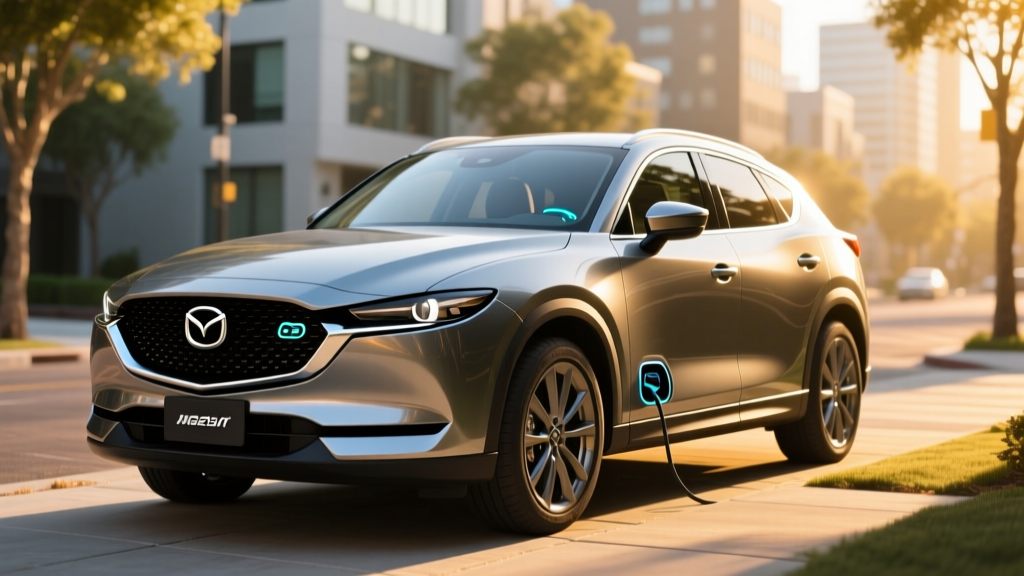
If you have been searching for mazda cx 50 hybrid lease deals, you are likely weighing a practical compact SUV that sips fuel without demanding a lifestyle change. The Mazda CX-50 Hybrid pairs Mazda's rugged exterior design with a Toyota-sourced hybrid powertrain — a collaboration that gives buyers proven efficiency without the plug-in requirement or range anxiety of a full EV. For 2026, Mazda continues to position the CX-50 Hybrid as a mid-tier option between the turbocharged gas CX-50 and pricier plug-in competitors, making lease promotions an attractive path to get behind the wheel without a long-term commitment.
This guide breaks down everything you need before signing a lease: real-world MPG, powertrain specs, battery warranty coverage, tax credit eligibility, and how the CX-50 Hybrid stacks up against PHEVs and BEVs in its class.
What Powers the CX-50 Hybrid: Toyota's Proven System Under a Mazda Skin
The CX-50 Hybrid uses a conventional hybrid (HEV) architecture — not a plug-in hybrid (PHEV). That means you never need to plug it in. The system recovers energy through regenerative braking and the gasoline engine to keep a small battery charged automatically.
| Specification | Detail |
|---|---|
| Engine | 2.5L inline-4 Atkinson-cycle |
| Electric Motor | Permanent-magnet synchronous (front axle) |
| Combined System Output | 219 horsepower |
| Transmission | eCVT (electronically controlled continuously variable) |
| Drivetrain | AWD (electronic rear-axle torque distribution) |
| Hybrid Battery | ~1.6 kWh nickel-metal hydride (NiMH), sealed |
| Plug-In Required? | No — self-charging HEV |
| Towing Capacity | 1,500 lbs (hybrid trims) |
This is the same hybrid system found in the Toyota RAV4 Hybrid, which has accumulated millions of real-world miles across two generations. Mazda tuned the throttle mapping, steering weight, and regenerative braking feel to match its brand character, but the core engineering is Toyota's. For a leaseholder, this is a positive: you are getting one of the most field-tested hybrid systems on the road without owning the vehicle long enough to worry about out-of-warranty battery replacement.
Fuel Economy: EPA Ratings and Real-World MPG
The headline number for any hybrid buyer is fuel economy. Here is what the EPA rates the 2026 CX-50 Hybrid at, per fueleconomy.gov:
| Driving Cycle | MPG |
|---|---|
| City | 39 MPG |
| Highway | 37 MPG |
| Combined | 38 MPG |
Compared to the non-hybrid CX-50 with the base 2.5L engine (28 MPG combined), the hybrid delivers roughly 35% better fuel economy. At current national gas prices averaging around $3.20/gallon, a driver covering 15,000 miles annually saves approximately $550–$700 per year versus the gas model.
HEV vs. PHEV vs. EV: Which Powertrain Fits Your Situation?
The CX-50 is only available as a conventional hybrid (HEV) — Mazda does not offer a PHEV variant. If you want plug-in capability in a similar Mazda, you would look at the CX-70 PHEV or CX-90 PHEV, which are larger and more expensive vehicles. Here is how the three powertrain types compare for a buyer cross-shopping in this segment:
| Factor | HEV (CX-50 Hybrid) | PHEV (e.g., RAV4 Prime) | BEV (e.g., Ioniq 5) |
|---|---|---|---|
| Plug-In Required? | No | Yes (for EV range) | Yes |
| Electric-Only Range | 0 miles (EV assist only) | ~42 miles | ~300 miles |
| Combined MPG / MPGe | 38 MPG | 38 MPG (gas) / 94 MPGe (electric) | 114 MPGe |
| Fuel/Energy Cost (15k mi/yr) | ~$1,260/yr (gas) | ~$600–$900/yr (mixed) | ~$500–$750/yr (electric) |
| Home Charging Needed? | No | Recommended (Level 2) | Essential (Level 2) |
| Starting MSRP (approx.) | $35,395 | $44,000+ | $42,000+ |
| Federal Tax Credit (§30D) | Not eligible | Up to $7,500 (if eligible) | Up to $7,500 (if eligible) |
- You do not have reliable access to home or workplace charging (apartment, street parking, no garage outlet).
- You want better fuel economy without changing your refueling habits.
- You prefer a lower monthly lease payment than a PHEV or EV demands.
- Your daily commute is longer than 40 miles, making PHEV electric-only range insufficient.
- You have a garage with a 240V outlet and a short commute (under 40 miles).
- You want to maximize fuel savings and qualify for the §30D federal tax credit.
- You are willing to pay a higher upfront price for lower per-mile energy costs.
2026 Mazda CX-50 Hybrid Lease Deals: What to Expect
Lease terms for the CX-50 Hybrid vary by region, dealer inventory, and Mazda's national incentive programs, which rotate monthly. Here is a framework for evaluating any CX-50 Hybrid lease offer you encounter:
Typical Lease Structure
- Term: 36 months is the standard; 24-month leases carry higher monthly payments but allow faster turnover.
- Mileage allowance: 10,000 or 12,000 miles/year are standard. At 38 MPG, a 12,000-mile/year lease uses roughly 316 gallons annually — a meaningful savings over the gas model's ~429 gallons.
- Money factor: Equivalent to the interest rate on a lease. A competitive money factor in 2026 is approximately 0.0025 (equivalent to ~6% APR). Mazda Financial Services occasionally offers subsidized money factors on hybrid trims to boost adoption.
- Residual value: Hybrids tend to hold value well due to strong used-market demand. Expect a 36-month residual of 58–62% on the CX-50 Hybrid, which helps keep monthly payments lower than vehicles with steeper depreciation.
Sample Lease Payment Estimate
Based on a 2026 CX-50 Hybrid Preferred trim at $37,000 MSRP, a 36-month lease with 12,000 miles/year, $3,000 due at signing, and a 60% residual:
- Estimated monthly payment: $420–$480/month (before tax, varies by region and incentives)
- Compare to the gas CX-50 Preferred: typically $380–$430/month (lower MSRP but lower residual)
- The hybrid's stronger residual partially offsets its higher sticker price on a lease
Check Mazda's national offers page and local dealer inventory for current promotions. Mazda frequently runs loyalty cash (for returning Mazda owners) and conquest incentives (for buyers switching from competing brands), which can shave $500–$1,500 off the capitalized cost.
Pricing, Trims, and Tax Credit Eligibility
The 2026 CX-50 Hybrid is available across multiple trims. Here is the approximate MSRP ladder:
| Trim | Approx. MSRP |
|---|---|
| Select Hybrid | $35,395 |
| Preferred Hybrid | $37,395 |
| Premium Hybrid | $40,595 |
| Premium Plus Hybrid | $43,095 |
Federal Tax Credit: Not Eligible
The CX-50 Hybrid is a conventional HEV, not a plug-in vehicle. Under current IRS §30D rules, only plug-in electric vehicles (PHEVs and BEVs) with sufficient battery capacity qualify for the federal clean vehicle credit. The CX-50 Hybrid's small ~1.6 kWh battery does not meet the minimum 7 kWh threshold, and it cannot be plugged in. This means:
- No $7,500 federal tax credit (not eligible by design)
- No point-of-sale transfer option
- Some states may offer minimal hybrid incentives — check your state energy office
If the federal tax credit is a dealbreaker for you, consider the Mazda CX-90 PHEV (eligible for up to $7,500 depending on income, MSRP cap, and battery sourcing) or cross-shop plug-in competitors like the Toyota RAV4 Prime or Hyundai Tucson PHEV.
Battery Warranty, Reliability, and Replacement Cost
Hybrid battery longevity is consistently the top concern among first-time hybrid buyers. Here is what the data shows:
- Hybrid battery: 8 years / 100,000 miles (whichever comes first) — meets the federal minimum for hybrid/emission components. In CARB states (California, New York, Massachusetts, and others adopting California emissions standards), coverage extends to 10 years / 150,000 miles.
- Powertrain warranty: 5 years / 60,000 miles
- New vehicle limited warranty: 3 years / 36,000 miles
How Long Do Toyota-Sourced Hybrid Batteries Last?
Because the CX-50 Hybrid uses Toyota's hybrid system, we have extensive real-world data. Toyota Prius and RAV4 Hybrid batteries routinely last 150,000–200,000+ miles before significant degradation. The NiMH chemistry used in this system is less energy-dense than lithium-ion but extremely durable — it tolerates thousands of shallow charge-discharge cycles without the degradation concerns associated with deeper cycling in EVs.
Replacement Cost If Out of Warranty
If the hybrid battery fails outside the warranty window, replacement costs are far lower than an EV traction battery:
- New OEM hybrid battery: $2,500–$4,000 (installed)
- Refurbished/remanufactured battery: $1,500–$2,500 (installed)
- Individual cell replacement: Some specialist shops replace only failed cells for $500–$1,000
For comparison, a full EV battery replacement runs $10,000–$20,000+. The CX-50 Hybrid's small, proven NiMH pack is one of the lowest-risk battery ownership scenarios in the electrified vehicle market.
Reliability Ratings
Mazda as a brand consistently ranks in the top third of Consumer Reports reliability surveys, and the Toyota hybrid system underneath the CX-50 is arguably the most reliable electrified powertrain ever mass-produced. The CX-50 Hybrid carries no significant known failure modes beyond standard wear items.
Leasing vs. Buying the CX-50 Hybrid: The Financial Case
For many buyers, leasing the CX-50 Hybrid makes strategic sense. Here is why:
- Technology turnover: Hybrid and EV technology continues to advance rapidly. A 36-month lease lets you upgrade to a more efficient or more capable vehicle in 2029 without the hassle of selling or trading in.
- Battery risk mitigation: Your entire lease falls within the 8-year/100,000-mile hybrid battery warranty. You will never face an out-of-pocket battery replacement.
- Residual protection: If the used hybrid market softens (as more EVs enter the used market), the leasing company absorbs the depreciation — not you.
- Lower monthly outlay: Lease payments on the CX-50 Hybrid are typically $40–$80/month less than financing the same vehicle with a 60-month loan at current rates.
The tradeoff: you build no equity, you must stay within mileage limits, and you cannot claim any hypothetical future hybrid incentive that might emerge. But for a 3-year horizon, leasing is the lowest-risk path to driving a CX-50 Hybrid.
Pros and Cons at a Glance
- 38 MPG combined — 35% better than the gas CX-50
- No plug-in required — zero lifestyle change from a gas car
- Toyota-sourced hybrid system with exceptional reliability track record
- 219 HP provides confident merging and passing power
- Standard AWD on all hybrid trims
- Strong residual values keep lease payments competitive
- Full lease term covered under hybrid battery warranty
- Not eligible for the $7,500 federal §30D tax credit
- No electric-only driving mode — always uses some gasoline
- Towing limited to 1,500 lbs (gas turbo CX-50 tows 3,500 lbs)
- eCVT can produce a drone under hard acceleration
- Higher MSRP than the base gas CX-50 (~$4,000–$5,000 premium)
- Rear cargo space slightly reduced vs. gas model due to battery placement
Frequently Asked Questions
How many MPG does the 2026 Mazda CX-50 Hybrid get?
The EPA rates the CX-50 Hybrid at 39 MPG city, 37 MPG highway, and 38 MPG combined. In real-world mixed driving, expect 37–41 MPG. Highway-only trips above 70 mph may drop to 33–36 MPG, and cold weather reduces efficiency by 5–10%.
Does the CX-50 Hybrid need to be plugged in?
No. The CX-50 Hybrid is a conventional hybrid (HEV), not a plug-in hybrid (PHEV). The battery charges automatically through regenerative braking and the gasoline engine. You refuel only at gas stations, just like a conventional car.
Is there a plug-in hybrid (PHEV) version of the CX-50?
No. Mazda does not offer a CX-50 PHEV. If you want a Mazda plug-in hybrid, look at the larger CX-70 PHEV or CX-90 PHEV. For a compact PHEV competitor, consider the Toyota RAV4 Prime (42 miles electric-only, 94 MPGe) or the Hyundai Tucson PHEV (33 miles electric-only, 80 MPGe).
Does the CX-50 Hybrid qualify for any tax credit?
Not at the federal level. The IRS §30D clean vehicle credit applies only to plug-in vehicles (PHEVs and BEVs) with batteries of at least 7 kWh. The CX-50 Hybrid's ~1.6 kWh battery does not qualify. Some states may offer minor hybrid purchase incentives — check your state's energy office or AFDC state incentive database.
How reliable is the CX-50 Hybrid's battery?
The Toyota-sourced NiMH hybrid battery has one of the strongest reliability records in the automotive industry. These batteries routinely last 150,000–200,000+ miles. Mazda covers the hybrid battery for 8 years/100,000 miles (10 years/150,000 miles in CARB states), which fully covers any standard lease term.
What does it cost to replace the hybrid battery?
If replacement is needed outside warranty, expect $2,500–$4,000 for a new OEM battery installed, or $1,500–$2,500 for a refurbished unit. This is dramatically less than EV battery replacement ($10,000–$20,000+).
What is a good lease payment for the CX-50 Hybrid?
For a 2026 CX-50 Hybrid Preferred trim on a 36-month lease with 12,000 miles/year and $3,000 due at signing, a competitive payment is in the $420–$480/month range before tax. Payments vary by region, dealer, current Mazda incentives, and your credit tier. Always negotiate the capitalized cost (sale price) of the vehicle — not just the monthly payment.
Hybrid vs. PHEV vs. EV — which should I choose?
Choose the CX-50 Hybrid (HEV) if you lack home charging access and want better MPG without any habit changes. Choose a PHEV if you have a garage with a 240V outlet and a commute under 40 miles. Choose a full EV if you have reliable home charging, want the lowest per-mile energy cost, and are ready to plan around public charging on road trips.