Quick Verdict: The CX-30 Hybrid in 2026
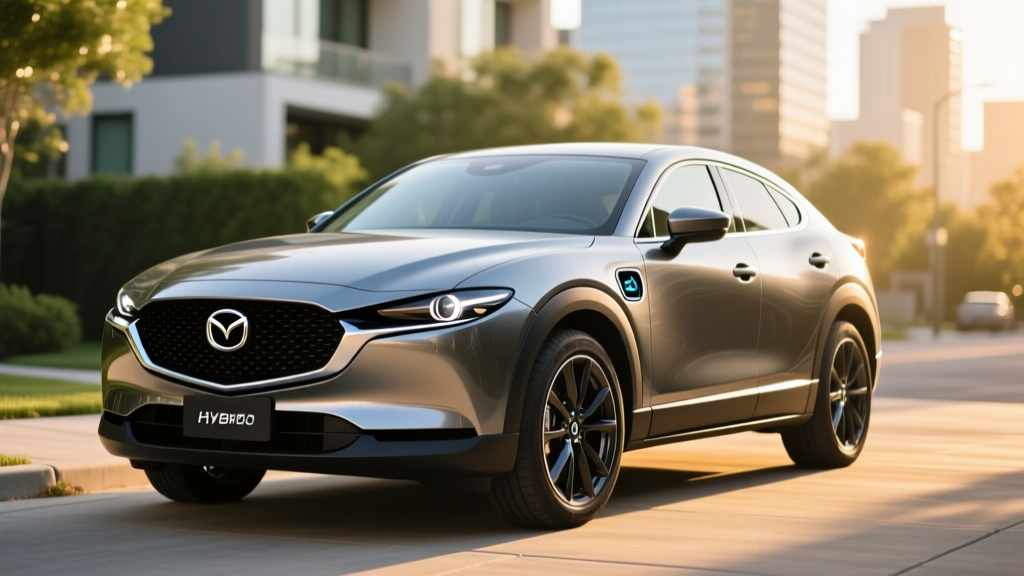
For 2026, Mazda continues to offer the CX-30 exclusively as a conventional hybrid (HEV) in select global markets, while the U.S. lineup remains powered by Mazda's turbocharged and naturally aspirated gasoline engines. If you've been searching for a CX-30 hybrid, here's what you need to know: Mazda has not introduced a plug-in hybrid (PHEV) or a widely available U.S.-market hybrid variant of the CX-30 as of the 2026 model year. However, hybrid versions sold in Europe and Asia-Pacific markets give us a clear picture of the powertrain's capabilities, efficiency, and what U.S. buyers might eventually see.
This guide breaks down the CX-30 Hybrid's EPA-equivalent fuel economy, real-world MPG expectations, powertrain details, battery longevity, and how it stacks up against going full EV or sticking with a conventional gas CX-30.
HEV vs PHEV: What Kind of Hybrid Is the CX-30?
Conventional Hybrid (HEV): The CX-30 Hybrid uses a small battery (typically 1–2 kWh) charged entirely by regenerative braking and the gasoline engine. You never plug it in. The electric motor assists during acceleration and low-speed driving, but the car cannot travel meaningful distances on electricity alone.
Plug-In Hybrid (PHEV): A PHEV carries a larger battery (typically 12–20 kWh) that you charge via a wall outlet or public charger. It can drive 25–45 miles on electricity alone before the gas engine takes over. The CX-30 is not currently offered as a PHEV in any market.
Bottom line: The CX-30 Hybrid is a self-charging HEV. No plug, no charging cable, no range anxiety — just improved fuel economy over the standard gas model.
Fuel Economy: EPA MPG and Real-World Numbers
Because the CX-30 Hybrid is not sold in the U.S., it does not carry official EPA fuel economy ratings. However, based on WLTP testing in Europe and real-world owner reports from hybrid markets, we can estimate equivalent EPA figures.
| Driving Condition | Estimated MPG (U.S. Equivalent) | Notes |
|---|---|---|
| City | 42–46 MPG | Hybrids excel in stop-and-go; regen braking recovers energy |
| Highway | 36–39 MPG | Less hybrid advantage at sustained speeds; aero drag dominates |
| Combined | 39–43 MPG | Blended driving; real-world owners report ~40 MPG average |
Real-world vs. sticker: Hybrids routinely exceed their combined rating in city-heavy driving because regenerative braking captures energy that a gas car wastes as heat. If your commute involves frequent stops, expect to see 44+ MPG. On long highway trips at 75 mph, expect the number to drop to the mid-30s. Cold weather (below 35°F) typically reduces hybrid efficiency by 5–10% as the engine runs more often to provide cabin heat.
For comparison, the 2026 U.S.-market CX-30 with the 2.5L turbo engine and AWD is rated at 22 city / 30 highway / 25 combined MPG — the hybrid nearly doubles city efficiency.
Powertrain Specs: Engine, Motor, and Combined Output
| Specification | CX-30 Hybrid (Global Market) |
|---|---|
| Engine | 2.0L inline-4 (Skyactiv-G or e-Skyactiv G) |
| Electric Motor | Integrated mild-hybrid / full-hybrid assist motor |
| Combined Horsepower | ~150–180 hp (varies by market/tune) |
| Transmission | CVT or 6-speed automatic (market-dependent) |
| Drivetrain | FWD standard; AWD available in select markets |
| Hybrid Battery Capacity | ~1.0–1.8 kWh (lithium-ion) |
| 0–60 mph (est.) | ~8.5–9.5 seconds |
| Plug-In Required? | No — self-charging HEV |
Mazda's hybrid strategy has historically leaned on partnerships — the global CX-30 Hybrid in some markets uses Toyota-sourced hybrid synergy drive components paired with Mazda's Skyactiv engines. This gives the powertrain proven reliability (Toyota's hybrid system has decades of real-world validation) while retaining Mazda's driving dynamics.
Battery Warranty, Lifespan, and Replacement Cost
Hybrid Battery Warranty: In markets where the CX-30 Hybrid is sold, Mazda typically provides a hybrid battery warranty of 8 years / 100,000 miles (some regions extend to 10 years). In the U.S., if Mazda introduces the hybrid variant, expect it to meet or exceed the industry-standard 8-year/100,000-mile hybrid component warranty mandated in California-emissions states.
Expected Battery Lifespan: Modern lithium-ion hybrid batteries in HEVs are designed to last 12–15 years or 150,000+ miles before significant degradation. Because HEV batteries are small and never deeply cycled (the system keeps them between ~40–80% state of charge), degradation is minimal compared to full EVs.
Replacement Cost: Based on comparable Mazda and Toyota hybrid battery replacements, expect a CX-30 Hybrid battery replacement to cost $2,000–$3,500 (parts and labor) if needed outside warranty. Refurbished units may be available for $1,200–$1,800.
Is the CX-30 Hybrid reliable? Mazda's conventional powertrains consistently earn above-average reliability scores from sources like Consumer Reports and J.D. Power. The hybrid system, particularly if it leverages Toyota-derived components, adds a layer of proven durability. Hybrid-specific failures (inverter, motor-generator) are rare in the first 100,000 miles. The main wear item remains the 12V auxiliary battery, which should be replaced every 4–5 years like any vehicle.
Pricing and Tax Credit Eligibility
Since the CX-30 Hybrid is not currently part of the U.S. model lineup, there is no official MSRP for American buyers. For reference, the 2026 U.S.-market CX-30 gas models start at approximately $26,500 (2.5 S base) and climb to $38,000+ for the Turbo Premium Plus. A hybrid variant, if introduced, would likely carry a $1,500–$2,500 premium over the equivalent gas trim, placing it in the $28,000–$35,000 range.
Federal tax credit: Under current IRS §30D rules, conventional hybrids (HEVs) do not qualify for the federal clean vehicle tax credit. Only plug-in hybrids (PHEVs) with at least 7 kWh of battery capacity and full battery-electric vehicles (BEVs) are eligible — and even then, they must meet MSRP caps ($80,000 for SUVs), buyer income limits, and critical-mineral/battery-sourcing requirements. The CX-30 Hybrid, as a self-charging HEV, is ineligible for the $7,500 credit.
Some states offer separate rebates for hybrids, but these are increasingly rare as incentive programs shift toward PHEVs and BEVs. Check your state's energy office or AFDC state law database for current local incentives.
CX-30 Hybrid vs. Gas CX-30 vs. Full EV: Which Fits You?
Choose the CX-30 Hybrid If:
- You want better fuel economy without changing your driving or charging habits
- Your commute is city-heavy with frequent stops (where hybrids shine)
- You don't have access to home or workplace charging
- You want a premium compact crossover with proven reliability
- You plan to keep the vehicle 8+ years and want lower fuel costs without EV complexity
Look at a PHEV or Full EV Instead If:
- You can install a Level 2 home charger and want electric-only daily driving
- You want to qualify for the $7,500 federal tax credit (PHEV/BEV only)
- Your daily commute is under 30 miles round-trip (a PHEV covers it on electricity alone)
- You want the lowest possible per-mile energy cost (~$0.04/mile on home electricity vs. ~$0.12/mile in a hybrid)
- You want one-pedal driving and instant torque — characteristics unique to plug-in electrified vehicles
Gas CX-30: Lowest upfront cost, simplest ownership. Best if you drive mostly highway miles and don't mind 25 MPG combined.
CX-30 Hybrid (HEV): ~40 MPG combined, no plug needed, $1,500–$2,500 premium. Best if you drive in the city and lack charging access.
PHEV alternative (e.g., Toyota RAV4 Prime, Hyundai Tucson PHEV): 30–42 miles electric-only, then 35+ MPG on gas. Best if you can charge at home and want tax-credit eligibility.
Full EV (e.g., Hyundai Ioniq 5, Tesla Model Y): 260–320 miles range, zero tailpipe emissions, lowest running costs. Best if you have reliable home charging and want maximum savings over 5+ years.
What This Means for U.S. Buyers in 2026
Mazda has been slower than competitors to electrify its U.S. lineup. The brand's first dedicated EV, the MX-30, saw limited availability and modest range. For 2026, Mazda's U.S. strategy centers on its turbocharged gasoline engines and a gradual rollout of mild-hybrid and plug-in models — but the CX-30 Hybrid remains a market-specific offering outside North America.
If you're a U.S. buyer set on a hybrid compact crossover in 2026, your closest alternatives include:
- Toyota RAV4 Hybrid: 41 city / 38 highway / 40 combined MPG, AWD standard, starts ~$33,000
- Honda CR-V Hybrid: 43 city / 36 highway / 40 combined MPG, starts ~$35,000
- Hyundai Tucson Hybrid: 38 city / 38 highway / 38 combined MPG, starts ~$34,000
- Kia Sportage Hybrid: 42 city / 44 highway / 43 combined MPG (FWD), starts ~$31,000
Each of these is a conventional HEV — no plug required — with proven hybrid reliability and widely available dealer networks.
Frequently Asked Questions
How many MPG does the CX-30 Hybrid get?
Based on global-market data and WLTP-to-EPA conversion, the CX-30 Hybrid delivers an estimated 42–46 MPG city, 36–39 MPG highway, and 39–43 MPG combined. Real-world city driving often exceeds the combined estimate thanks to regenerative braking.
Can the CX-30 Hybrid drive on electric power only?
Only for very short distances (typically under 1 mile) at low speeds, such as creeping through a parking lot. The battery is too small (~1–2 kWh) for meaningful electric-only range. This is normal for conventional hybrids — the electric motor assists the engine rather than replacing it.
Does the CX-30 Hybrid need to be plugged in?
No. The CX-30 Hybrid is a self-charging HEV. The battery is recharged through regenerative braking and the gasoline engine. You fuel it exactly like a conventional car.
Is the CX-30 Hybrid reliable?
Mazda's conventional powertrains rate above average for reliability, and the hybrid components (particularly if Toyota-derived) have extensive real-world validation. Expect the hybrid battery to last 12–15 years under normal use, backed by an 8-year/100,000-mile warranty.
Does the CX-30 Hybrid qualify for any tax credit?
No. Under current IRS §30D rules, conventional hybrids are not eligible for the federal clean vehicle tax credit. Only PHEVs and BEVs meeting battery-sourcing, MSRP, and income requirements qualify.
Will Mazda bring the CX-30 Hybrid to the U.S.?
As of the 2026 model year, Mazda has not announced a U.S. release for the CX-30 Hybrid. The brand's U.S. electrification strategy has focused on mild-hybrid assistance in larger models and the MX-30 EV. Industry watchers expect Mazda to prioritize PHEV variants of its larger SUVs (CX-70, CX-90) before bringing a CX-30 Hybrid stateside.
How much does a hybrid battery replacement cost?
Based on comparable hybrid systems, expect $2,000–$3,500 for a new CX-30 Hybrid battery replacement out of warranty. However, most hybrid batteries last the life of the vehicle — replacement is uncommon before 150,000 miles.