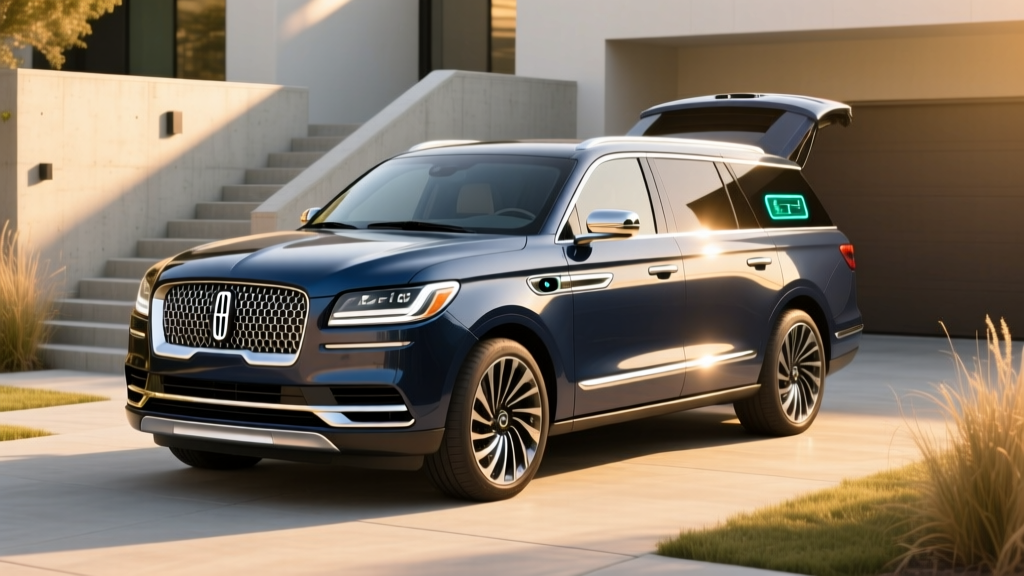
The full-size luxury SUV segment has been slow to electrify, but the 2026 Lincoln Navigator Hybrid changes that equation. Built on the redesigned Navigator platform introduced for the 2025 model year, this hybrid variant pairs Ford's 3.5-liter twin-turbo PowerBoost V6 with an electric motor to deliver meaningful fuel-economy gains over the standard gas-only Navigator — without asking buyers to plug in or change their driving habits.
If you've searched for a Lincoln Navigator hybrid and found conflicting information, you're not alone. Lincoln's messaging around this powertrain has evolved. Here's what you actually need to know about the 2026 model: real MPG numbers, how the hybrid system works, whether any tax credits apply, and whether this three-row luxury haulier makes more sense than a plug-in hybrid or full EV alternative.
What the Lincoln Navigator Hybrid Actually Is: HEV, Not PHEV
Let's clear this up immediately: the 2026 Lincoln Navigator Hybrid is a conventional hybrid (HEV), not a plug-in hybrid (PHEV). You do not plug it in. There is no electric-only driving range to manage, no home charger to install, and no range anxiety about finding a plug on a road trip.
HEV vs. PHEV — What's the Difference?
| Feature | HEV (Navigator Hybrid) | PHEV (e.g., Chrysler Pacifica Hybrid) |
|---|---|---|
| Plugs in? | No | Yes |
| Electric-only range | None (brief low-speed assist only) | Typically 20–40 miles |
| Battery size | ~1.5 kWh (small, self-charging) | 12–20 kWh (larger, plug-charged) |
| Federal tax credit (§30D) | Not eligible | Up to $7,500 if criteria met |
| Home charger needed? | No | Recommended for full benefit |
The Navigator Hybrid recovers energy through regenerative braking and engine operation, storing it in a small battery that assists during acceleration and low-speed driving. It's seamless — you just drive.
Powertrain Specs: Twin-Turbo V6 Meets Electric Motor
The Navigator Hybrid uses Ford's modular hybrid transmission, which integrates a 35 kW (47 hp) electric motor between the 3.5L twin-turbo V6 and the 10-speed automatic transmission. This is the same architecture proven in the Ford F-150 PowerBoost, adapted for Lincoln's luxury tuning.
| Specification | 2026 Lincoln Navigator Hybrid |
|---|---|
| Engine | 3.5L twin-turbo V6 + electric motor |
| Combined horsepower | ~430 hp |
| Combined torque | ~570 lb-ft |
| Transmission | 10-speed automatic (modular hybrid) |
| Hybrid battery | ~1.5 kWh lithium-ion |
| Drivetrain | RWD standard / AWD available |
| 0–60 mph (est.) | ~5.5 seconds |
| Towing capacity | Up to ~8,300 lbs (AWD) |
| Plugs in? | No (conventional HEV) |
The electric motor fills in torque at low RPM before the turbos fully spool, which makes the Navigator Hybrid feel noticeably more responsive from a stop than the gas-only model. It also allows the engine to shut off at stops and during light-load cruising, which is where the fuel savings come from.
Fuel Economy: EPA MPG and Real-World Expectations
This is the main reason buyers consider the Navigator Hybrid. The standard gas Navigator with AWD returns an EPA-estimated 16 city / 22 highway / 18 combined MPG. The hybrid powertrain pushes those numbers meaningfully higher, especially in city driving where regenerative braking and electric assist do the most work.
| Model | City MPG | Highway MPG | Combined MPG |
|---|---|---|---|
| 2026 Navigator (gas, AWD) | 16 | 22 | 18 |
| 2026 Navigator Hybrid (AWD) | 21 | 24 | 22 |
| Competitor: BMW X7 xDrive40i (mild hybrid) | 20 | 25 | 22 |
Source: fueleconomy.gov (EPA estimates). Actual mileage will vary.
Over a 15,000-mile year, the 4 MPG combined improvement over the gas model translates to roughly 85 fewer gallons consumed — about $280–$350 in fuel savings annually at $3.30/gallon premium. The hybrid premium on the Navigator's window sticker will take several years to recoup purely on fuel cost, which means this powertrain is as much about refinement and responsiveness as it is about savings.
Pricing, Trims, and Tax Credit Eligibility
The 2026 Lincoln Navigator Hybrid is available across multiple trim levels. Pricing starts in the mid-$90,000 range for the base Premiere hybrid and climbs past $120,000 for the fully loaded Black Label.
| Trim | Starting MSRP (est.) | Hybrid Availability |
|---|---|---|
| Premiere | ~$96,000 | Available |
| Reserve | ~$105,000 | Available |
| Black Label | ~$122,000 | Available |
Does the Navigator Hybrid Qualify for a Federal Tax Credit?
No. Under the IRS §30D Clean Vehicle Credit, only plug-in electric vehicles (BEVs and PHEVs) with a battery capacity of at least 7 kWh qualify for the federal tax credit of up to $7,500. The Navigator Hybrid's ~1.5 kWh battery is far below that threshold, and because it cannot be plugged in, it does not meet the statutory definition of a qualifying clean vehicle.
Some states offer their own incentives for conventional hybrids, but these are increasingly rare as state programs shift focus to plug-in vehicles. Check with your state's department of revenue or energy office for any local programs. A tax professional can confirm whether any credits apply to your specific situation.
Battery Warranty, Reliability, and Replacement Cost
This is where hybrid buyers have the most legitimate concern — and the most reassurance. The Navigator Hybrid's battery pack is small, works at moderate charge/discharge rates, and is managed by a sophisticated thermal system. These factors contribute to long battery life.
Hybrid Battery Warranty Coverage
- Federal mandate: All hybrid battery packs must carry a minimum warranty of 8 years / 100,000 miles (10 years / 150,000 miles in CARB states including CA, NY, MA, and others).
- Lincoln coverage: Lincoln covers the hybrid battery and related components for 8 years / 100,000 miles nationwide, matching the federal minimum.
- What's covered: Battery capacity loss below a defined threshold (typically 60–70% of original capacity), cell failures, and hybrid system electronics.
How Long Will the Hybrid Battery Last?
Real-world data from Ford's PowerBoost hybrid system (the same architecture) in the F-150 shows minimal degradation over 100,000+ miles. The small battery in a conventional HEV cycles far less aggressively than a PHEV or BEV battery — it rarely goes below 40% or above 80% state of charge, which dramatically extends cell life. Most hybrid batteries outlast the vehicle itself.
What Does Hybrid Battery Replacement Cost?
If the battery does fail outside warranty, expect a replacement cost in the range of $2,000–$4,000 for the hybrid battery pack (parts and labor). This is far less than a BEV or PHEV battery replacement because the pack is small (~1.5 kWh). Independent hybrid-battery repair shops can often replace individual cells for $500–$1,500, extending the pack's life at a fraction of a full replacement.
The powertrain (engine, transmission, hybrid motor) carries Lincoln's standard 5-year / 60,000-mile powertrain warranty. For longer peace of mind, Lincoln offers extended service plans that can cover hybrid-specific components beyond the factory warranty period.
Navigator Hybrid vs. Plug-In Hybrid vs. Full EV: Which Fits You?
The three-row luxury SUV segment now offers all three electrification paths. Here's how to decide:
Choose the Navigator Hybrid (HEV) If:
- You don't have access to home or workplace charging
- You want fuel savings without changing your routine
- You tow frequently and need the simplicity of gas-only refueling on long trips
- You want a smoother, more responsive powertrain without managing battery charge
Choose a Plug-In Hybrid (e.g., BMW X7 PHEV) If:
- You have home Level 2 charging and a commute under 30 miles
- You want electric-only daily driving but gas flexibility for road trips
- You qualify for the $7,500 federal tax credit and want to offset a higher purchase price
Choose a Full EV (e.g., Rivian R1S, Tesla Model X) If:
- You have reliable home charging and want zero tailpipe emissions
- Your daily driving is under 250 miles and you can plan around DC fast charging for road trips
- You want the lowest per-mile fuel cost (~$0.04–$0.06/mile on home electricity vs. ~$0.18–$0.22/mile on gas)
- You're ready to accept charging-curve planning on long trips
For the majority of luxury three-row SUV buyers who lack dedicated home charging or who regularly tow trailers over 5,000 lbs, the Navigator Hybrid occupies the most practical middle ground. You get measurable MPG improvement, better low-speed refinement, and zero lifestyle compromise.
Pros and Cons of the Lincoln Navigator Hybrid
Pros
- ~22 MPG combined — a 22% improvement over the gas model
- No plug-in required; no lifestyle change
- Electric motor fills turbo lag for smoother, faster launches
- 8-year / 100,000-mile hybrid battery warranty
- Strong towing capacity (~8,300 lbs) retained
- Proven PowerBoost architecture from F-150
Cons
- No federal tax credit eligibility
- Hybrid premium adds to an already expensive MSRP
- Fuel savings alone won't recoup the hybrid upcharge quickly
- Not a PHEV — no electric-only commuting range
- Highway MPG gains are modest (24 vs. 22)
- Full-size SUV footprint means parking and garage challenges
Ownership Costs: 5-Year Projection
Let's put real numbers on what owning the Navigator Hybrid costs compared to the gas-only model over five years and 75,000 miles:
| Cost Factor | Gas Navigator (AWD) | Navigator Hybrid (AWD) |
|---|---|---|
| Fuel (75k mi, $3.50/gal premium) | $14,583 | $11,932 |
| Estimated maintenance | $3,200 | $3,000 |
| Insurance (avg.) | $12,500 | $12,800 |
| 5-Year Running Cost | $30,283 | $27,732 |
| 5-Year Savings (Hybrid) | ~$2,551 | |
Estimates based on EPA combined MPG, national average premium fuel pricing, and industry insurance data. Your actual costs will vary by driving pattern, location, and coverage level.
The hybrid saves roughly $2,500 in running costs over five years. If the hybrid option adds $4,000–$6,000 to the window sticker, the break-even point lands around year seven to nine for most drivers. The value proposition is more about the driving experience — the smooth electric launch, the quiet engine-off stops, the reduced fuel-station visits — than pure payback math.
Frequently Asked Questions
How many MPG does the Lincoln Navigator Hybrid get?
The 2026 Lincoln Navigator Hybrid with AWD earns an EPA-estimated 21 city / 24 highway / 22 combined MPG. In real-world city driving with frequent stops, owners often see 23–25 MPG thanks to regenerative braking. Highway cruising at 75+ mph typically yields 21–22 MPG. See fueleconomy.gov for official EPA figures.
How far can the Navigator Hybrid go on electric only?
It can't — at least not in any meaningful sense. As a conventional hybrid (HEV), the Navigator Hybrid uses its electric motor for brief low-speed assist, stop/start engine-off, and acceleration boost. It does not have a plug or a usable electric-only driving range. If electric-only commuting is a priority, you need a PHEV or BEV.
Is the Lincoln Navigator Hybrid reliable?
The PowerBoost hybrid system underpinning the Navigator Hybrid has been in production since 2021 in the Ford F-150, with hundreds of thousands of units on the road. The system has proven durable, with no widespread battery or motor failures reported. Lincoln's 8-year/100,000-mile hybrid battery warranty provides additional security. The NHTSA and IIHS are the best sources for crash-test and reliability data as it becomes available for the 2026 model.
Does the Navigator Hybrid qualify for any tax credit?
Not at the federal level. The IRS §30D Clean Vehicle Credit requires a vehicle to have a battery capacity of at least 7 kWh and be capable of plug-in charging. The Navigator Hybrid's ~1.5 kWh battery and conventional HEV architecture do not meet these criteria. Some states may offer minor hybrid incentives — check with your state energy office or a tax professional.
What is the hybrid battery replacement cost?
Out-of-warranty replacement of the Navigator Hybrid's ~1.5 kWh battery pack runs approximately $2,000–$4,000 including labor. Individual cell repair can cost $500–$1,500 at a hybrid specialist. However, the battery is covered by an 8-year/100,000-mile warranty, and real-world data from the same Ford PowerBoost system shows these small HEV batteries rarely need replacement within the vehicle's normal lifespan.
Should I get the Navigator Hybrid or wait for a plug-in version?
Lincoln has not announced a Navigator PHEV as of early 2026. If you need a three-row luxury PHEV today, competitors like the BMW X7 xDrive50e offer plug-in capability with ~30 miles of electric range — but at a higher price and with reduced cargo space due to the larger battery. If you don't have home charging access, the Navigator Hybrid is the more practical choice now.