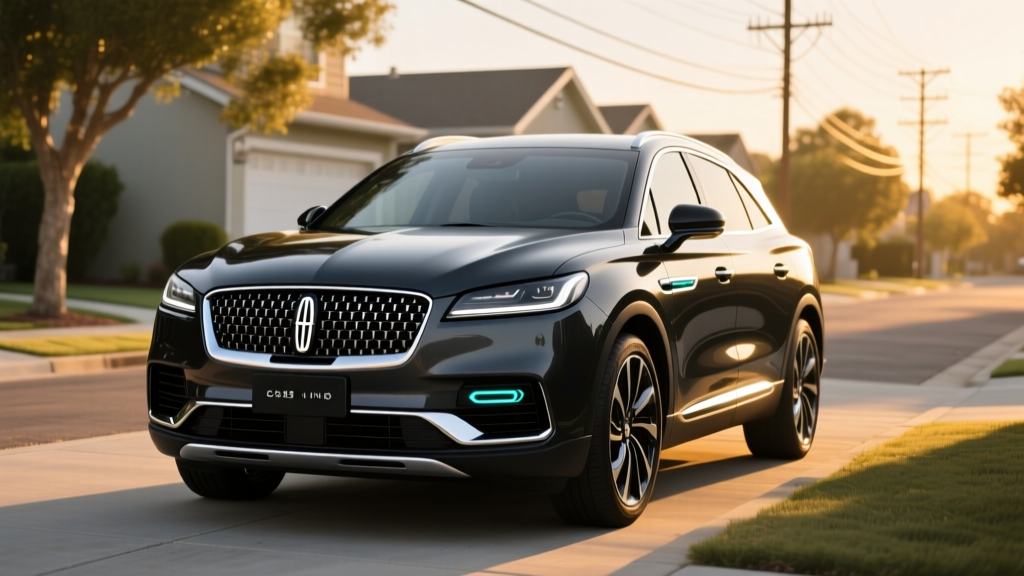
The Lincoln Nautilus occupies a specific niche: a luxury midsize crossover that prioritizes cabin serenity and highway comfort over sporty dynamics. For the 2025–2026 model years, Lincoln offers the Nautilus exclusively with a hybrid powertrain — no conventional gas-only variant, no plug-in hybrid option. If you're researching the Lincoln Nautilus hybrid MPG, you're likely weighing whether a standard hybrid (HEV) delivers enough efficiency for a vehicle in this price class, and how it compares to PHEV and full-EV alternatives.
This guide breaks down the Nautilus hybrid's EPA fuel economy, real-world efficiency, powertrain details, battery warranty, pricing, and tax-credit eligibility — with honest numbers and no marketing filler.
Lincoln Nautilus Hybrid MPG: EPA Ratings vs. Real-World Results
The 2025–2026 Lincoln Nautilus hybrid pairs a 2.0-liter turbocharged four-cylinder engine with an electric motor integrated into a continuously variable transmission (eCVT). Lincoln and the EPA rate it as follows:
| Metric | FWD | AWD |
|---|---|---|
| City MPG | 30 | 30 |
| Highway MPG | 31 | 29 |
| Combined MPG | 30 | 29 |
The Nautilus hybrid's near-identical city and highway ratings are unusual. Most hybrids skew heavily toward city efficiency. Lincoln's turbocharged engine and the eCVT's gearing keep highway numbers competitive, though the AWD system's added mechanical drag costs you 1 MPG combined.
HEV vs. PHEV: The Nautilus Is a Conventional Hybrid — Here's What That Means
This is the single most important distinction for Nautilus shoppers: the Lincoln Nautilus is a conventional hybrid (HEV), not a plug-in hybrid (PHEV).
| Feature | Nautilus (HEV) | Typical PHEV SUV |
|---|---|---|
| Plugs in to charge? | No — refuels with gas only | Yes — Level 1 or Level 2 |
| Electric-only range | Not applicable (motor assists only) | 20–40 miles typical |
| Battery size | ~1.1 kWh (small buffer) | 15–25 kWh |
| Home charging needed? | No | Yes, for EV-range benefit |
| Federal tax credit (§30D) | Not eligible | Up to $7,500 (if eligible) |
| Driving range | ~500+ miles per tank | ~400–550 miles (EV + gas) |
The Nautilus's small hybrid battery charges solely through regenerative braking and the gasoline engine. You never plug it in. You simply fill up at a gas station and drive. The electric motor smooths acceleration, enables low-speed electric-only creep in traffic, and recaptures braking energy — but it cannot propel the vehicle at highway speeds on electricity alone.
If you want plug-in capability with a Lincoln badge, you'd need to look at the Lincoln Corsair Grand Touring (PHEV) or consider a competitor like the BMW X5 xDrive50e. Lincoln does not currently offer a Nautilus PHEV variant.
Powertrain Specs: 2.0L Turbo Hybrid Details
| Specification | Detail |
|---|---|
| Engine | 2.0L turbocharged inline-4 |
| Engine output | ~238 hp / 270 lb-ft torque |
| Electric motor | Integrated into eCVT |
| Combined system output | ~310 hp |
| Transmission | eCVT (electronically controlled) |
| Drivetrain options | FWD standard, AWD available |
| Hybrid battery | ~1.1 kWh lithium-ion |
| 0–60 mph | ~6.5 seconds (est.) |
| Fuel tank | 17.2 gallons |
| Total driving range | ~500–515 miles (combined EPA) |
The combined 310 horsepower provides confident merging and passing power. The eCVT eliminates traditional shift shock, though it can produce a droning sensation under hard acceleration — a common hybrid trait that Lincoln has mitigated with aggressive cabin sound insulation. The Nautilus is among the quietest vehicles in its class, hybrid or otherwise.
How Does the Nautilus Hybrid Compare to EV and PHEV Alternatives?
Choosing between the Nautilus HEV, a PHEV competitor, or a full battery-electric vehicle (BEV) depends on your driving patterns, home charging access, and budget.
Choose the Nautilus HEV if: You want a luxury hybrid with zero charging hassle, primarily drive mixed city/highway, and don't have reliable home Level 2 charging access. The simplicity of gas-only refueling with 30 MPG combined is compelling for apartment dwellers or frequent road-trippers.
Choose a PHEV (e.g., BMW X5 xDrive50e) if: You have home charging, your daily commute is under 30 miles, and you want electric-only weekday driving with gas flexibility for weekend trips. Expect 30–40 miles of EV range and potential §30D tax credit eligibility.
Choose a full BEV (e.g., Genesis Electrified GV70, Tesla Model X) if: You have reliable home charging, want zero tailpipe emissions, and are ready to plan around DC fast-charging on road trips. Expect 250–300 miles of range and significantly lower per-mile energy costs.
Pricing, Trims, and Tax Credit Eligibility
The 2026 Lincoln Nautilus hybrid starts at approximately $59,995 MSRP for the base Premiere trim with FWD. Key trims include:
- Premiere (FWD): ~$59,995
- Premiere (AWD): ~$61,995
- Reserve (AWD): ~$67,000
- Black Label (AWD): ~$76,000+
Without the federal credit, the Nautilus's value proposition rests on its luxury content, hybrid efficiency, and Lincoln's warranty coverage rather than purchase-price incentives.
Hybrid Battery Warranty, Lifespan, and Replacement Cost
Coverage: 8 years / 100,000 miles (whichever comes first) for hybrid battery components, per federal emissions warranty requirements. In California Air Resources Board (CARB) states, coverage may extend to 10 years / 150,000 miles.
What's covered: Hybrid battery pack, electric motor, eCVT, and related power electronics.
Modern hybrid batteries are engineered for longevity. Toyota and Ford hybrid platforms (Lincoln's hybrid system shares architecture with Ford's) have demonstrated 150,000–200,000+ mile lifespans in real-world fleet use with minimal degradation. The Nautilus's ~1.1 kWh battery operates within a narrow state-of-charge window — it never fully charges or fully depletes — which dramatically reduces cell stress compared to full EV batteries that cycle through wider ranges.
If replacement is ever needed outside warranty, hybrid battery replacement typically costs $2,000–$4,000 for a vehicle in this class — far less than a full EV battery replacement ($10,000–$20,000+). Third-party rebuild services often bring the cost below $2,500.
| Factor | Nautilus HEV Battery | Typical EV Battery |
|---|---|---|
| Battery capacity | ~1.1 kWh | 75–100 kWh |
| Warranty | 8 yr / 100k mi | 8 yr / 100k mi |
| Expected lifespan | 150k–200k+ mi | 150k–200k+ mi (with degradation) |
| Replacement cost | $2,000–$4,000 | $10,000–$20,000+ |
| Degradation concern | Minimal (narrow SoC window) | Moderate (10–15% over 100k mi typical) |
Reliability and Safety Ratings
Lincoln's hybrid powertrain, derived from Ford's well-established hybrid architecture, has a strong reliability track record. The 2.0L EcoBoost engine and eCVT have been used across Ford and Lincoln products for multiple model years. The NHTSA has tested the Nautilus platform; check their site for the latest star ratings. The IIHS typically evaluates the Nautilus for Top Safety Pick eligibility — review their latest crash-test results before purchasing.
Common owner-reported concerns are minor: occasional infotainment software glitches (addressed via OTA updates) and the eCVT's characteristic drone under heavy acceleration. No widespread hybrid-system failures have been reported for this generation.
Pros, Cons, and Bottom Line
- 30 MPG combined in a luxury midsize SUV
- Exceptionally quiet cabin — best-in-class NVH
- No charging infrastructure required
- 310 combined hp with smooth eCVT delivery
- 500+ mile total range per tank
- 8-year / 100k-mile hybrid warranty
- No PHEV option — cannot drive on electric only
- Not eligible for $7,500 federal tax credit
- Starting near $60K — premium pricing
- eCVT drone under hard acceleration
- Highway MPG drops to 29 with AWD
- No DC fast charging (not applicable for HEV)
Frequently Asked Questions
How many MPG does the Lincoln Nautilus hybrid get?
The EPA rates the 2025–2026 Lincoln Nautilus hybrid at 30 city / 31 highway / 30 combined (FWD) and 30/29/29 (AWD). Real-world mixed driving typically yields 28–32 MPG, with highway-only trips at 75+ mph returning 26–28 MPG.
Can the Lincoln Nautilus drive on electric power only?
Only at very low speeds for brief distances (parking lots, traffic creep). The Nautilus is a conventional hybrid (HEV), not a plug-in hybrid. The electric motor assists the gas engine but cannot sustain highway speeds on electricity alone.
Does the Lincoln Nautilus hybrid qualify for any tax credit?
No. The federal §30D Clean Vehicle Credit applies only to plug-in vehicles (BEVs and qualifying PHEVs). The Nautilus HEV does not plug in and is not eligible. Some states may offer separate hybrid incentives — consult your state energy office or a tax professional.
How long will the Nautilus hybrid battery last?
Lincoln warranties the hybrid battery for 8 years / 100,000 miles (10 yr / 150k mi in CARB states). In practice, Ford/Lincoln hybrid batteries routinely exceed 150,000–200,000 miles. The small ~1.1 kWh pack operates in a narrow charge window, minimizing degradation.
What does it cost to replace the hybrid battery?
Out-of-warranty replacement typically costs $2,000–$4,000 — significantly less than a full EV battery. Third-party rebuild services can reduce cost further.
Is the Nautilus hybrid better than a full EV?
It depends on your situation. The Nautilus hybrid is better if you lack home charging, drive long highway routes frequently, or want zero range-planning hassle. A full EV is better if you have home Level 2 charging, want lower per-mile energy costs (electricity vs. premium gas), and prioritize zero tailpipe emissions. The Nautilus does not offer a PHEV middle ground.