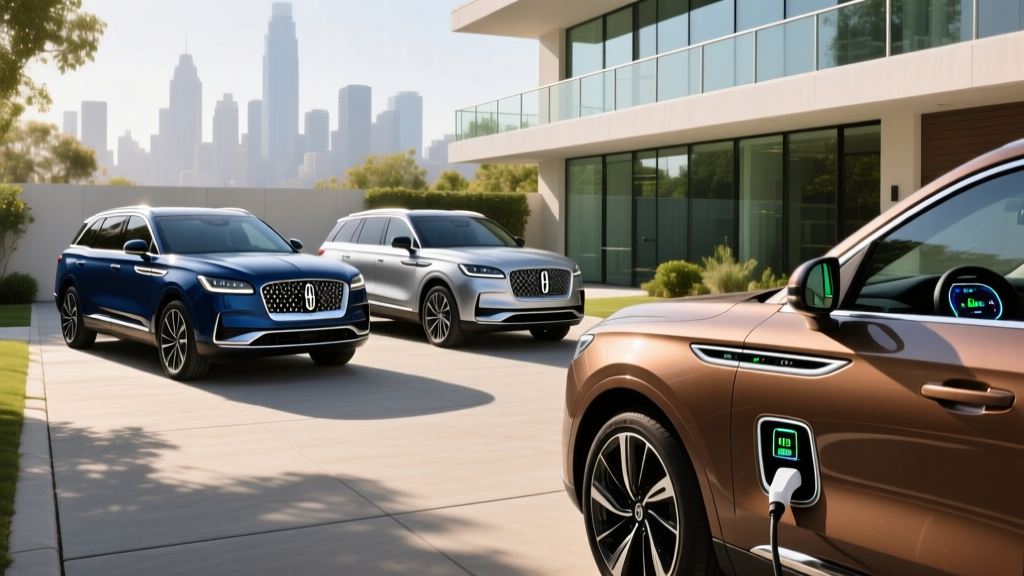
Lincoln has taken a measured approach to electrification, and for 2026 the brand's lineup includes one plug-in hybrid (PHEV) offering alongside conventional powertrains. If you're researching Lincoln hybrid vehicles, you're likely drawn to the brand's luxury cabin, ride quality, and American heritage — but want better fuel economy without committing fully to a battery-electric vehicle. This guide breaks down exactly what Lincoln offers in the hybrid space, with precise EPA data, real-world expectations, and ownership economics.
Understanding Lincoln's Hybrid Approach: HEV vs PHEV
Before diving into specific models, it's essential to distinguish between the two hybrid categories, because Lincoln's strategy hinges on this difference:
- Conventional Hybrid (HEV): Uses a small battery recharged entirely by the engine and regenerative braking. No plug, no external charging needed. The electric motor assists the gas engine to improve MPG. Lincoln currently does not offer a standalone HEV in its 2026 U.S. lineup.
- Plug-In Hybrid (PHEV): Carries a larger battery that you charge from a wall outlet or public charger. It delivers a meaningful electric-only driving range before the gas engine engages. Lincoln's sole hybrid offering — the Corsair Grand Touring — falls into this category.
This distinction matters for your daily routine: a PHEV rewards owners who can charge at home or work, effectively turning short commutes into zero-gas trips. If you can't plug in regularly, a PHEV still functions as a conventional hybrid but loses much of its efficiency advantage.
2026 Lincoln Corsair Grand Touring: The Hybrid in the Lineup
The Corsair Grand Touring is Lincoln's compact luxury PHEV, slotting between the Nautilus and Aviator in size. For 2026, it continues with the 2.5-liter inline-four Atkinson-cycle engine paired with an electric motor and a lithium-ion battery pack. Here's the complete spec breakdown:
| Specification | 2026 Corsair Grand Touring |
|---|---|
| Powertrain | 2.5L I-4 Atkinson + electric motor (PHEV) |
| Combined Horsepower | 266 hp |
| Battery Capacity | 14.4 kWh usable (lithium-ion) |
| EPA Electric-Only Range | 28 miles |
| EPA Combined Range (electric + gas) | ~430 miles |
| EPA MPGe (electric mode) | 78 MPGe |
| EPA MPG (gas-only, combined) | 33 MPG combined (34 city / 32 highway) |
| Level 2 Charging (240V) | ~3.5 hours (0–100%) |
| DC Fast Charging | Not supported |
| Drivetrain | eAWD (electric all-wheel drive) |
| 0–60 mph | ~7.0 seconds |
| Cargo Volume (rear seats up) | 24.2 cu ft |
| Starting MSRP | $52,990 (Grand Touring trim) |
Fuel Economy and Electric-Only Range: Real-World Expectations
The EPA rates the Corsair Grand Touring at 28 miles of electric-only range and 33 MPG combined once the battery is depleted. But how does that translate to real-world driving?
| Driving Scenario | Expected Efficiency |
|---|---|
| City driving (electric mode, full charge) | 25–28 miles electric; 0 gas used |
| City driving (hybrid mode, depleted battery) | 35–38 MPG (hybrids excel in stop-and-go) |
| Highway cruising (70+ mph, hybrid mode) | 29–31 MPG (aerodynamic drag reduces gains) |
| Cold weather (below 32°F, electric mode) | 20–23 miles electric (battery efficiency drops ~15–20%) |
| Cold weather (hybrid mode) | 28–30 MPG combined |
Key insight: Like most PHEVs, the Corsair Grand Touring actually tends to exceed its EPA city MPG rating in warm-weather stop-and-go driving, because regenerative braking recaptures energy that a gas car wastes as heat. Highway MPG runs closer to or slightly below the sticker. For owners who charge nightly and commute under 25 miles, monthly gas consumption can drop to near zero.
EPA Electric Range: 28 miles
Real-world expectation: 24–28 miles in mild weather with moderate speeds; 20–23 miles in freezing temperatures or at sustained highway speeds. Cabin heating draws heavily from the battery in winter.
Charging the Corsair Grand Touring: What You Need to Know
The Corsair Grand Touring charges exclusively via AC — there is no DC fast-charging capability, which is typical for PHEVs in this class. Here's what charging looks like in practice:
| Charging Level | Power | Time (0–100%) | Practical Notes |
|---|---|---|---|
| Level 1 (120V household outlet) | ~1.4 kW | ~10–11 hours | Overnight top-up; adequate if you drive <20 mi/day |
| Level 2 (240V home charger) | ~3.6 kW | ~3.5 hours | Recommended; full charge during work day or overnight |
| DC Fast Charge | N/A | N/A | Not supported — PHEV battery too small to benefit |
Practical recommendation: A Level 2 home charger (240V, 16–20 amp circuit) is strongly recommended for PHEV ownership. Installation typically costs $500–$1,500 depending on panel proximity and local permitting, but it transforms the Corsair into a daily electric commuter. Without regular plug-in charging, you're paying a premium for battery weight you're not utilizing.
Does the Lincoln Corsair Grand Touring Qualify for a Federal Tax Credit?
Under the current IRS §30D Clean Vehicle Credit rules, the Lincoln Corsair Grand Touring PHEV may qualify for a partial federal tax credit of up to $3,750, depending on battery component and critical mineral sourcing requirements. Here's the eligibility checklist:
- Battery capacity: Must be ≥7 kWh — Corsair's 14.4 kWh qualifies ✓
- MSRP cap: SUVs must be under $80,000 — Corsair Grand Touring at ~$52,990 qualifies ✓
- Buyer income cap: MAGI ≤$150,000 (single) / ≤$300,000 (joint) ✓
- North American final assembly: Assembled in the U.S. ✓
- Battery sourcing (critical minerals + components): Determines whether you receive $3,750 (one requirement met) or $7,500 (both met). Lincoln's sourcing has historically qualified for at least the partial credit, but verify current-year status at fueleconomy.gov before purchasing.
- Point-of-sale transfer: As of 2024+, you can transfer the credit to the dealer at purchase for an immediate price reduction rather than waiting for tax filing.
Important: Tax credit rules shift frequently based on Treasury guidance. Consult a tax professional and check the IRS's official clean vehicle credit page before finalizing your purchase. State incentives (e.g., California, Colorado, New York) may stack on top.
Battery Warranty, Reliability, and Replacement Costs
Lincoln PHEV Battery Warranty
Hybrid/EV battery component warranty: 8 years / 100,000 miles (whichever comes first), covering defects and capacity loss below ~70% of original capacity.
Powertrain warranty: 6 years / 70,000 miles.
Bumper-to-bumper: 4 years / 50,000 miles.
Reliability outlook: The 2.5L Atkinson-cycle engine used in the Corsair Grand Touring is shared with Ford's PHEV platform (Escape PHEV), which has accumulated years of real-world data. The powertrain is inherently simpler than a conventional automatic transmission — the eCVT power-split device has no fixed gears to wear. Hybrid batteries in this class have proven durable; NHTSA complaint data for the platform shows no systemic battery failure pattern.
Battery replacement cost: If the high-voltage battery fails outside warranty, expect a replacement cost in the range of $8,000–$12,000 (parts and labor) at a Lincoln dealer. However, total battery failure is rare before 150,000+ miles. More commonly, individual modules can sometimes be serviced. The 8-year/100,000-mile warranty provides substantial protection for the original owner.
Lincoln Hybrid vs. Full EV vs. Gas: Which Is Right for You?
Choose the Lincoln Corsair Grand Touring PHEV if:
- You can charge at home or work (Level 1 or Level 2)
- Your daily commute is under 28 miles round-trip (electric covers it)
- You want luxury-crossover comfort without range anxiety on road trips
- You're not ready for a full EV but want to reduce gas consumption significantly
- You value Lincoln's cabin materials, ride quality, and dealer network
Choose a full EV (e.g., Tesla Model Y, Genesis GV60, Cadillac Lyriq) if:
- You want zero gas use and zero oil changes
- You have reliable home charging and access to DC fast-charging networks
- Your road trips are planned around charging stops (or under 250 miles)
- You want maximum federal tax credit ($7,500) and lowest per-mile energy cost
Choose a conventional gas vehicle if:
- You have no access to any plug-in charging (apartment, street parking)
- You drive 400+ miles weekly in mostly highway conditions
- Upfront purchase price is the primary concern
Corsair Grand Touring PHEV — Pros
- 28 miles electric covers most daily commutes gas-free
- Premium Lincoln interior with excellent ride isolation
- eAWD standard — electric rear motor provides confident traction
- No range anxiety: 430+ mile total range for road trips
- Qualifies for partial federal tax credit (up to $3,750)
- 8-year/100,000-mile battery warranty
Corsair Grand Touring PHEV — Cons
- $52,990+ starting price is steep for a compact crossover
- No DC fast charging — road-trip electric top-ups aren't practical
- 28-mile electric range trails some rivals (Toyota RAV4 Prime: 42 mi)
- Cargo space slightly reduced vs. gas Corsair due to battery placement
- Charging takes 3.5 hours on Level 2 — slower than some PHEV competitors
What About the Rest of the Lincoln Lineup?
As of 2026, Lincoln does not offer hybrid or PHEV variants of the Nautilus, Aviator, or Navigator in the U.S. market. The Nautilus is available only with a 2.0L turbo four-cylinder or a 2.7L twin-turbo V6. The Aviator offers a twin-turbo V6. Lincoln's parent company, Ford, has signaled future electrification plans across its luxury division, but no additional Lincoln PHEVs or BEVs have been officially announced with confirmed on-sale dates.
If you specifically need a three-row luxury PHEV, you'll need to look outside Lincoln — competitors like the Volvo XC90 Recharge (35-mile electric range) or the BMW X5 xDrive50e (38-mile electric range) fill that niche. For a Lincoln loyalist wanting hybrid efficiency, the Corsair Grand Touring is currently the only option.
Frequently Asked Questions
How many MPG does the Lincoln Corsair Grand Touring hybrid get?
The EPA rates it at 33 MPG combined (34 city / 32 highway) in hybrid mode after the battery is depleted. In real-world city driving with frequent stops, owners often see 35–38 MPG thanks to regenerative braking. Highway driving at 75+ mph typically returns 29–31 MPG.
How far can the Lincoln Corsair PHEV go on electric only?
The EPA-rated electric-only range is 28 miles. In mild weather at moderate speeds, expect 25–28 miles. In freezing temperatures or at sustained highway speeds, expect 20–23 miles. Once depleted, the gas engine takes over seamlessly.
Do I have to plug in the Lincoln Corsair Grand Touring?
You don't have to — the vehicle will operate as a conventional hybrid if you never plug it in. However, you'll forfeit the 28-mile electric range and the efficiency benefits that justify the PHEV price premium. Plugging in is strongly recommended to get value from the system.
Is the Lincoln PHEV battery reliable, and what does replacement cost?
The 14.4 kWh lithium-ion battery is covered by an 8-year/100,000-mile warranty. The Ford-derived PHEV platform has demonstrated good battery longevity in field use. Out-of-warranty replacement, if ever needed, runs approximately $8,000–$12,000, but full battery failure before 150,000+ miles is uncommon.
Does the Lincoln Corsair Grand Touring qualify for any tax credit?
It may qualify for a partial federal tax credit of up to $3,750 under IRS §30D rules, depending on current battery-sourcing requirements. The vehicle meets the MSRP cap ($80,000 for SUVs) and North American assembly requirement. Buyer income must not exceed $150,000 (single) or $300,000 (joint filers). Verify current eligibility on fueleconomy.gov and consult a tax professional.
How long does it take to charge the Corsair Grand Touring at home?
On a standard 120V household outlet (Level 1), a full charge takes approximately 10–11 hours. On a 240V Level 2 home charger, it takes about 3.5 hours. A Level 2 installation is recommended for daily PHEV use and typically costs $500–$1,500 depending on your electrical panel setup.
Can I DC fast charge the Lincoln Corsair PHEV?
No. The Corsair Grand Touring does not support DC fast charging. This is common for PHEVs — the battery is small enough that AC charging at 3.6 kW refills it in a few hours, and DC infrastructure adds cost and weight that most PHEV buyers don't need.
Sources: EPA fuel economy data via fueleconomy.gov; IRS clean vehicle credit rules via irs.gov; Lincoln specifications via Lincoln Media Center.