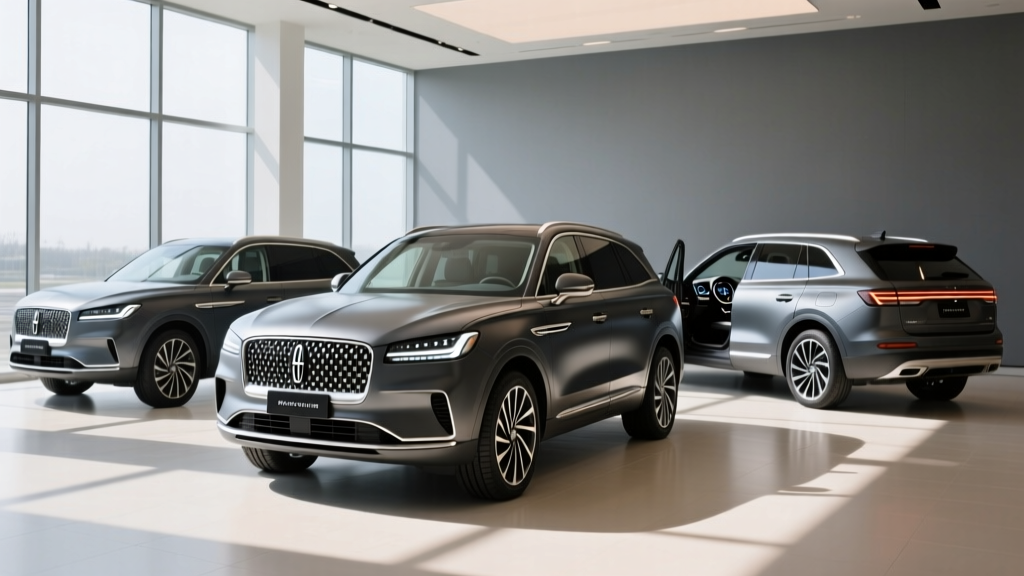
Lincoln occupies a specific niche in the electrified-SUV market: it's the only luxury brand still selling a plug-in hybrid compact SUV in the U.S. while simultaneously phasing out conventional hybrids across its lineup. If you're searching for a Lincoln hybrid SUV in 2026, you're essentially looking at one vehicle — the Corsair Grand Touring plug-in hybrid — and weighing it against the brand's turbocharged gas models and the broader luxury PHEV competition.
This guide breaks down exactly what Lincoln offers in the hybrid space for 2026, with precise EPA figures, real-world expectations, battery warranty details, and tax-credit eligibility so you can decide whether a Lincoln hybrid SUV fits your driveway.
Lincoln's 2026 Hybrid Strategy: PHEV Only
For the 2026 model year, Lincoln has streamlined its electrified offerings. The Corsair Grand Touring remains the sole plug-in hybrid in the Lincoln SUV lineup. The brand previously offered the Aviator Grand Touring PHEV, but that model was discontinued after the 2024 model year, and the conventional hybrid option on the Corsair (the standard HEV that was briefly available in earlier years) has also been dropped.
HEV vs. PHEV — What Lincoln Buyers Need to Know
| Feature | Conventional Hybrid (HEV) | Plug-In Hybrid (PHEV) |
|---|---|---|
| Plug in to charge? | No — regenerative braking only | Yes — Level 1 or Level 2 |
| Electric-only driving | Very short distances, low speed | Full EV mode for 25-35+ miles |
| Battery size | ~1-2 kWh | 14-20+ kWh usable |
| Tax credit eligible | No | Potentially (see §30D rules) |
| Lincoln availability 2026 | Not offered | Corsair Grand Touring |
The practical takeaway: if you want a Lincoln hybrid SUV that you can plug in, the Corsair Grand Touring is your only option. If you want a self-charging conventional hybrid from Lincoln, you'll need to look at the used market or consider competitors like the Lexus NX 350h.
2026 Lincoln Corsair Grand Touring: Full Powertrain Specs
The Corsair Grand Touring pairs a 2.5-liter Atkinson-cycle inline-4 engine with an electric motor integrated into the eCVT transmission, driving all four wheels through Lincoln's hybrid AWD system. Here are the exact numbers:
| Specification | 2026 Corsair Grand Touring |
|---|---|
| Powertrain | 2.5L i4 Atkinson + electric motor (eCVT AWD) |
| Combined horsepower | 266 hp (net system) |
| Engine output | 163 hp / 155 lb-ft |
| Electric motor output | ~131 hp (rear axle) |
| Battery (total / usable) | 14.4 kWh total / ~11.5 kWh usable |
| Battery chemistry | NMC (nickel manganese cobalt) |
| EPA electric-only range | 31 miles |
| Total combined range | ~430 miles |
| EPA MPGe (electric + gas) | 78 MPGe |
| EPA MPG (gas-only, after battery depletes) | 33 combined / 32 city / 33 highway |
| Level 1 charging (120V) | ~10-11 hours (0-100%) |
| Level 2 charging (240V, 32A) | ~3.5-4 hours (0-100%) |
| DC fast charging | Not supported |
| 0-60 mph | ~7.0 seconds |
| Cargo volume (behind rear seats) | 27.6 cu ft |
| Towing capacity | Not rated for towing |
MPG and Electric-Only Range: Real-World Expectations
The EPA numbers tell a strong story, but real-world PHEV efficiency depends heavily on your daily driving pattern. Let's separate the scenarios:
| Driving Scenario | EPA Sticker | Real-World Expectation |
|---|---|---|
| Electric-only range | 31 miles | 26-30 mi (warm); 20-24 mi (cold / highway) |
| City MPG (gas mode) | 32 mpg | 33-36 mpg (hybrids excel in stop-and-go) |
| Highway MPG (gas mode) | 33 mpg | 29-32 mpg (aerodynamic drag, higher speeds) |
| Combined MPG (gas mode) | 33 mpg | 31-34 mpg depending on route mix |
| MPGe (charge-depleting) | 78 MPGe | 70-80 MPGe if you charge daily |
The key insight: If your commute is under 25 miles round-trip and you charge nightly at home, you may use almost zero gasoline for daily driving. The Corsair Grand Touring functions as a short-range EV for errands and commutes, then seamlessly operates as a 33-MPG hybrid for longer trips. Owners who rarely charge will see fuel economy closer to the 33-MPG gas-mode figure — which is still excellent for a 4,300-lb luxury AWD crossover.
Cold weather (below 35°F) reduces electric-only range by roughly 20-30% due to battery resistance and cabin heating demands. In Minnesota or New England winters, plan on 20-24 electric miles rather than the EPA's 31.
Charging the Corsair Grand Touring at Home
Unlike a full BEV, the Corsair Grand Touring's relatively small 14.4 kWh battery makes home charging straightforward. You don't need a high-power wall connector — a standard Level 2 unit is more than sufficient.
| Charging Level | Power (kW) | Full Charge Time | Setup |
|---|---|---|---|
| Level 1 (120V outlet) | ~1.4 kW | 10-11 hours | Standard household outlet — works overnight |
| Level 2 (240V, 32A) | ~7.7 kW (vehicle-limited) | 3.5-4 hours | 240V outlet or wall charger; $500-$1,500 install |
| DC Fast Charge | N/A | N/A | Not equipped — CCS/NACS port not present |
The onboard charger is limited to approximately 7.7 kW, so even if you plug into a 48-amp Level 2 station, the Corsair will only draw what it can accept. A basic 32-amp Level 2 charger (like the ChargePoint Home Flex or Emporia Level 2) is the cost-effective sweet spot.
Cost to charge: At the national average electricity rate of ~$0.17/kWh (EIA), a full charge costs roughly $2.45 — enough for 25-30 electric miles. That equates to approximately $0.08-$0.10 per mile on electricity, versus $0.14-$0.16 per mile on premium gasoline at $3.80/gallon.
Pricing, Trims, and Tax Credit Eligibility
The 2026 Lincoln Corsair Grand Touring is positioned as a premium compact PHEV, with pricing that reflects its luxury ambitions:
| Trim | MSRP (est.) | Key Features |
|---|---|---|
| Grand Touring | $51,500 | PHEV powertrain, AWD, 13.2" touchscreen, Co-Pilot360, leather |
| Grand Touring Reserve | $56,500 | Revel audio, panoramic roof, 20" wheels, additional ADAS features |
Does the Corsair Grand Touring Qualify for the Federal Tax Credit?
This is where Lincoln PHEV buyers face a complex picture. Under IRS §30D rules for the Clean Vehicle Credit, plug-in hybrids with batteries of at least 7 kWh are technically eligible for a credit of up to $7,500 — but several strict conditions apply:
- MSRP cap: SUVs must have a base MSRP at or below $80,000 (the Corsair qualifies).
- Buyer income cap: AGI must not exceed $150,000 (single), $225,000 (head of household), or $300,000 (joint).
- Battery sourcing: Critical minerals and battery components must meet escalating percentage thresholds from qualifying trade partners. These requirements tighten annually.
- Final assembly: Vehicle must be assembled in North America (the Corsair is built in Louisville, KY — this requirement is met).
- Point-of-sale transfer: Eligible buyers can transfer the credit to the dealer at purchase for an immediate price reduction.
Reality check: Due to the battery-sourcing and critical-mineral requirements, many PHEVs — including the Corsair Grand Touring — may qualify for only a partial credit ($3,750) or none at all depending on the specific model year's supply chain compliance. Always verify the current status on fueleconomy.gov before purchasing, and consult a tax professional for your specific situation.
Battery Warranty, Reliability, and Replacement Costs
Lincoln Corsair Grand Touring Battery Warranty
Hybrid battery coverage: 8 years / 100,000 miles (whichever comes first), with a capacity-retention threshold of 70% in most states. In California Air Resources Board (CARB) states, hybrid battery warranty extends to 10 years / 150,000 miles.
Hybrid components: The electric motor, inverter, and eCVT are covered under the same 8-year/100,000-mile hybrid component warranty.
Reliability outlook: Ford and Lincoln's 2.5L Atkinson-cycle hybrid powertrain (shared with the Ford Escape PHEV) is one of the most proven PHEV systems on the market, with over a decade of real-world deployment. The eCVT design eliminates traditional transmission wear points — there are no clutch packs or torque converters to fail.
Battery replacement cost: If the high-voltage battery degrades beyond the warranty threshold or fails after coverage expires, a replacement battery pack for the Corsair Grand Touring currently runs approximately $8,000-$12,000 (parts and labor). However, PHEV batteries experience less stress than full BEV batteries because the usable window is smaller and the engine shares the load. Most hybrid batteries outlast the vehicle itself.
12V battery note: Like all modern Lincolns, the Corsair Grand Touring also has a standard 12V auxiliary battery that powers electronics. This is a separate maintenance item (replacement every 4-6 years, ~$250-$400) and is unrelated to the hybrid traction battery.
Corsair Grand Touring vs. the Competition
The Lincoln Corsair Grand Touring competes in a narrow segment of luxury compact PHEVs. Here's how it stacks up against the closest alternatives:
| Spec | Lincoln Corsair Grand Touring | BMW X3 xDrive30e | Lexus NX 450h+ |
|---|---|---|---|
| Powertrain type | PHEV | PHEV | PHEV |
| Combined HP | 266 hp | 292 hp | 304 hp |
| EV-only range | 31 mi | ~35 mi | 37 mi |
| Gas MPG (combined) | 33 mpg | ~28 mpg | 36 mpg |
| Battery capacity | 14.4 kWh | ~19.7 kWh | 18.1 kWh |
| DC fast charging | No | No | No |
| AWD | Yes (standard) | Yes (standard) | Yes (standard) |
| Starting MSRP | ~$51,500 | ~$57,000 | ~$59,000 |
| Hybrid battery warranty | 8 yr / 100k mi | 8 yr / 80k mi | 10 yr / 150k mi |
The Corsair undercuts both the BMW and Lexus on price while offering competitive electric-only range. The Lexus NX 450h+ wins on efficiency and warranty length; the BMW offers more performance. The Lincoln's advantage is its value proposition: a luxury PHEV starting under $52,000 with a well-known, proven powertrain.
Who Should Buy the Lincoln Corsair Grand Touring?
Choose the Lincoln Corsair Grand Touring if:
- You have home charging (even a 120V outlet works for overnight PHEV charging).
- Your daily commute is under 30 miles and you want EV-like daily driving without range anxiety on road trips.
- You want a luxury compact SUV under $55,000 with PHEV capability.
- You value a proven, low-stress hybrid powertrain over cutting-edge EV tech.
- You want AWD standard in a luxury PHEV.
Look elsewhere if:
- You want 40+ miles of electric range (consider the Lexus NX 450h+ or BMW X3 xDrive30e).
- You need DC fast charging for apartment/condo living without home charging.
- You want a full EV experience (consider the Cadillac Lyriq, Genesis GV70 EV, or Tesla Model Y).
- You need a third row or more cargo space (the Corsair is a compact crossover).
- You prioritize sporty driving dynamics over comfort (the BMW X3 is more engaging).
Hybrid vs. PHEV vs. Full EV: Which Fits You?
Lincoln shoppers cross-shopping powertrains should consider this decision tree:
Conventional hybrid (HEV): Best for drivers who can't charge at home and want better MPG without any behavior change. Lincoln doesn't offer one in 2026, but the Lexus NX 350h (39 MPG combined) fills this role.
Plug-in hybrid (PHEV) — the Corsair Grand Touring: Best for drivers with home charging who want electric commuting most days but need gas-engine flexibility for road trips, towing routes, or areas with sparse charging infrastructure. You get the best of both worlds: $0.08/mile daily driving and 430+ miles of total range.
Full battery EV (BEV): Best for drivers with reliable home charging who drive under 250 miles daily and want zero tailpipe emissions, minimal maintenance, and the lowest per-mile fuel cost. Downsides include higher purchase price, charging planning on road trips, and cold-weather range loss of 20-40%.
Pros
- 31 miles EV-only covers most daily commutes
- 33 MPG combined in gas mode beats most luxury competitors
- Standard AWD with no drivetrain compromise
- Proven 2.5L hybrid powertrain with strong reliability record
- Quiet, comfortable ride with premium Lincoln interior
- Competitive starting price for a luxury PHEV
- 8-year/100,000-mile hybrid battery warranty
Cons
- No DC fast charging — limits public charging utility
- Electric range (31 mi) trails Lexus NX 450h+ (37 mi)
- Full federal tax credit uncertain due to sourcing rules
- eCVT tuning prioritizes efficiency over acceleration feel
- Infotainment system lags behind BMW iDrive and Lexus Interface in responsiveness
- Limited to two trims — fewer personalization options
Frequently Asked Questions
How many MPG does the Lincoln Corsair Grand Touring get?
Once the battery is depleted, the Corsair Grand Touring operates as a conventional hybrid and achieves an EPA-rated 33 MPG combined (32 city / 33 highway). In real-world driving, expect 33-36 MPG in city conditions and 29-32 MPG on the highway. If you charge daily and drive under 30 miles, you may use very little gasoline at all.
How far can the Corsair Grand Touring go on electric power alone?
The EPA rates the Corsair Grand Touring at 31 miles of electric-only range. Real-world results vary: expect 26-30 miles in warm weather on mixed roads, and 20-24 miles in cold weather or sustained highway driving. The vehicle seamlessly transitions to hybrid mode once the battery is depleted — there's no range cliff.
Does the Lincoln Corsair Grand Touring qualify for a federal tax credit?
As a PHEV with a battery over 7 kWh assembled in North America, the Corsair Grand Touring is potentially eligible for the §30D Clean Vehicle Credit of up to $7,500. However, eligibility depends on battery-sourcing and critical-mineral requirements that change annually, as well as buyer income limits. Check fueleconomy.gov for the current status and consult a tax professional.
Is the Lincoln hybrid SUV reliable?
Yes. The 2.5L Atkinson-cycle hybrid system shared with Ford's Escape PHEV is one of the most road-tested PHEV powertrains in America. The eCVT has no traditional wear components (no clutch packs, bands, or torque converters), and the hybrid battery is warrantied for 8 years/100,000 miles (10 years/150,000 miles in CARB states). Long-term data on this powertrain consistently shows strong durability.
What does a replacement hybrid battery cost?
Out of warranty, a replacement high-voltage battery for the Corsair Grand Touring costs approximately $8,000-$12,000 including labor. However, PHEV batteries are less stressed than full-EV batteries due to smaller charge/discharge windows, and most hybrid batteries last the life of the vehicle. Battery failure before 150,000 miles is uncommon based on historical data from the Ford/Lincoln 2.5L hybrid platform.
Can I charge the Corsair Grand Touring on a regular household outlet?
Yes. Level 1 charging on a standard 120V outlet will fully recharge the battery in approximately 10-11 hours — perfectly adequate for overnight charging. If you want faster replenishment, a 240V Level 2 charger cuts the time to about 3.5-4 hours. DC fast charging is not available on this vehicle.
Is the Corsair Grand Touring better than a full EV?
It depends on your situation. If you have reliable home charging, drive under 250 miles daily, and have access to public fast charging for road trips, a full EV (like the Cadillac Lyriq or Tesla Model Y) offers lower running costs and less maintenance. The Corsair Grand Touring is better if you need gas-engine flexibility for frequent long trips, live in an area with poor charging infrastructure, or want a lower purchase price with the option of electric commuting.
Source data: fueleconomy.gov, Lincoln Media Center specifications, IRS §30D Clean Vehicle Credit guidelines at irs.gov. Pricing and credit eligibility reflect 2026 model-year information and are subject to change. Verify all figures with your dealer and tax advisor before purchasing.