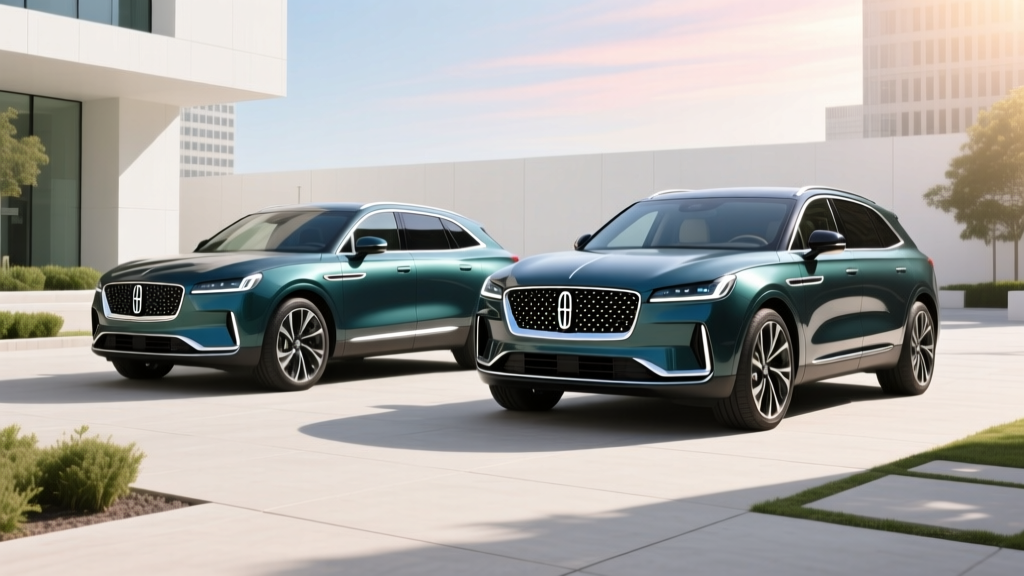
Lincoln takes a distinct approach to electrification. Rather than rushing to full battery-electric vehicles, the brand has invested heavily in plug-in hybrid (PHEV) variants of its most popular luxury SUVs. For 2026, the Lincoln hybrid lineup centers on two Grand Touring models: the compact Corsair Grand Touring and the midsize three-row Aviator Grand Touring. Both pair turbocharged engines with electric motors and usable battery packs, targeting buyers who want electric daily commuting without range anxiety on longer trips.
This guide covers every spec that matters — EPA MPG, electric-only range, battery size, charging logistics, powertrain output, pricing, tax-credit eligibility, and real-world ownership considerations. If you're researching Lincoln hybrid cars, here's the data you need to make a decision.
Lincoln's 2026 Hybrid Lineup: Corsair and Aviator Grand Touring
Lincoln currently offers two electrified models, both wearing the "Grand Touring" badge. Neither is a conventional hybrid (HEV) that simply recaptures braking energy — both are plug-in hybrids (PHEVs) with batteries large enough to drive on electricity alone for a meaningful distance before the gas engine takes over.
HEV vs. PHEV — What's the Difference?
Conventional Hybrid (HEV): Small battery (~1–2 kWh), recharged only by regenerative braking and the engine. Cannot plug in. Electric-only driving is limited to very low speeds and short distances. Think Toyota Prius.
Plug-In Hybrid (PHEV): Larger battery (13–18 kWh usable), can be plugged into a wall outlet or Level 2 charger. Delivers 20–30+ miles of electric-only driving before seamlessly switching to hybrid mode. This is what Lincoln offers.
Lincoln does not currently sell a conventional HEV or a fully electric BEV in the U.S. market. The Grand Touring PHEVs are the brand's electrified play, and they're aimed squarely at luxury buyers transitioning away from pure gasoline without committing to full electric.
2026 Lincoln Corsair Grand Touring: Range, MPG, and Powertrain
The Corsair Grand Touring is the more accessible of Lincoln's two PHEVs. It pairs a 2.5-liter four-cylinder engine with an electric motor integrated into the eCVT transmission, driving the front wheels (AWD is available on higher trims via a rear electric motor).
| Specification | 2026 Corsair Grand Touring |
|---|---|
| Combined Horsepower | 266 hp (combined system) |
| Engine | 2.5L iVCT 4-cylinder + electric motor |
| Battery (usable) | ~14.4 kWh (NMC lithium-ion) |
| EPA Electric-Only Range | 27 miles |
| EPA MPGe (electric+gas) | 80 MPGe combined |
| EPA MPG (gas-only hybrid mode) | 33 city / 32 hwy / 33 combined |
| Total Combined Range | ~430 miles |
| Level 2 Charge Time (0–100%) | ~3.5 hours at 7.2 kW |
| DC Fast Charging | Not available |
| 0–60 mph | ~7.0 seconds |
| Starting MSRP | $52,390 (Reserve trim) |
2026 Lincoln Aviator Grand Touring: Three-Row PHEV Power
The Aviator Grand Touring takes a fundamentally different powertrain approach. It pairs a twin-turbocharged 3.0-liter V6 with an electric motor for serious output — this is one of the most powerful PHEVs in the luxury midsize segment.
| Specification | 2026 Aviator Grand Touring |
|---|---|
| Combined Horsepower | 494 hp / 630 lb-ft torque |
| Engine | 3.0L twin-turbo V6 + electric motor |
| Battery (usable) | ~13.1 kWh (NMC lithium-ion) |
| EPA Electric-Only Range | 21 miles |
| EPA MPGe (electric+gas) | 56 MPGe combined |
| EPA MPG (gas-only hybrid mode) | 23 city / 24 hwy / 23 combined |
| Total Combined Range | ~460 miles |
| Level 2 Charge Time (0–100%) | ~3.5–4 hours at 3.6 kW |
| DC Fast Charging | Not available |
| 0–60 mph | ~5.5 seconds |
| Starting MSRP | $72,890 (Reserve trim) |
The Aviator's 21-mile electric range is shorter than the Corsair's, but that's the trade-off for a 5,600-pound three-row SUV with nearly 500 horsepower. For school runs, grocery trips, and short commutes, 21 miles of electric driving still covers a significant portion of daily mileage. Per fueleconomy.gov, the Aviator Grand Touring achieves 56 MPGe when regularly charged, compared to 23 MPG in hybrid-only mode — a stark difference that rewards consistent plug-in habits.
Fuel Economy in the Real World: EPA vs. Actual MPG
Hybrid and PHEV fuel economy depends heavily on driving patterns. Here's what Lincoln hybrid owners should expect versus the EPA sticker:
| Scenario | Corsair GT (EPA) | Corsair GT (Real-World Est.) | Aviator GT (EPA) | Aviator GT (Real-World Est.) |
|---|---|---|---|---|
| City (hybrid mode) | 33 MPG | 34–36 MPG | 23 MPG | 22–25 MPG |
| Highway (hybrid mode) | 32 MPG | 28–30 MPG | 24 MPG | 21–23 MPG |
| Combined (with daily charging) | 80 MPGe | 70–90 MPGe* | 56 MPGe | 45–60 MPGe* |
*MPGe varies dramatically based on how often you plug in. If you charge nightly and drive under 25 miles daily, your effective MPGe can far exceed the EPA estimate. If you never plug in, you'll see only the gas-only hybrid MPG figures.
The key insight: hybrids tend to exceed their EPA city rating because regenerative braking is most effective in stop-and-go traffic. Highway driving, by contrast, often underperforms the EPA number because there's less regen opportunity and higher aerodynamic drag. The Corsair's eCVT and the Aviator's 10-speed automatic both manage the gas-electric handoff smoothly, though the Aviator's weight shows at highway speeds.
Charging Your Lincoln PHEV: What You Need to Know
Neither the Corsair nor Aviator Grand Touring supports DC fast charging. This is typical for PHEVs with smaller batteries — the charge rate is limited to Level 1 (120V household) or Level 2 (240V).
| Charging Level | Power (kW) | Corsair (0–100%) | Aviator (0–100%) |
|---|---|---|---|
| Level 1 (120V outlet) | ~1.4 kW | ~10–11 hours | ~9–10 hours |
| Level 2 (240V, 32A) | ~7.2 kW | ~3.5 hours | ~3.5–4 hours |
For most PHEV owners, overnight Level 1 charging from a standard garage outlet is sufficient. A 14.4 kWh battery replenishes in about 10–11 hours on a 120V outlet, which fits neatly into a nightly routine. If you want faster turnaround — say, to charge between a morning commute and an afternoon errand — a Level 2 home charger cuts the time to roughly 3.5 hours.
The Aviator's onboard charger is limited to 3.6 kW even on Level 2, meaning it charges more slowly than the Corsair despite a similar battery size. This is worth noting if you plan mid-day top-ups.
Pricing, Trims, and Federal Tax Credit Eligibility
Lincoln positions the Grand Touring models as premium trims, so PHEV technology comes bundled with higher equipment levels.
| Model | Starting MSRP | Federal §30D Credit | Effective Price (if eligible) |
|---|---|---|---|
| Corsair Grand Touring Reserve | $52,390 | Up to $3,750 | ~$48,640 |
| Aviator Grand Touring Reserve | $72,890 | Up to $5,000 | ~$67,890 |
§30D Federal Tax Credit Rules for PHEVs (2026)
- Vehicle eligibility: Must be a new PHEV with ≥7 kWh battery capacity, assembled in North America, and under the MSRP cap ($80,000 for SUVs, $55,000 for sedans).
- Credit amount: Up to $7,500, split into two halves — $3,750 for battery component sourcing and $3,750 for critical minerals. PHEVs often qualify for one half but not both, depending on supply chain.
- Buyer income limits: AGI must not exceed $150,000 (single), $225,000 (head of household), or $300,000 (joint filing).
- Point-of-sale transfer: As of 2024+, eligible buyers can transfer the credit to the dealer at purchase, reducing the purchase price directly rather than waiting for a tax refund.
- Important: The Aviator's MSRP exceeds $55,000 but qualifies under the $80,000 SUV cap. The Corsair may be classified as a sedan or small SUV — verify with your dealer and IRS approved vehicle list.
Neither Lincoln PHEV qualifies for the full $7,500. Based on current battery sourcing requirements, expect $3,750–$5,000 depending on the specific model year's critical mineral compliance. Always verify eligibility on irs.gov before purchasing, as supply-chain changes can shift eligibility mid-year.
Battery Warranty, Lifespan, and Replacement Costs
Lincoln PHEV Battery Warranty
High-Voltage Battery Coverage: 8 years / 100,000 miles (whichever comes first)
Capacity Threshold: Lincoln warrants the battery to retain at least 70% of its original capacity during the warranty period. If degradation drops below this threshold, Lincoln will repair or replace the battery at no cost.
Hybrid System Components: The electric motor, power electronics, and eCVT/transmission are covered under the same 8-year/100,000-mile powertrain warranty.
PHEV battery degradation is generally a slower concern than with full EVs, simply because the battery is smaller and the vehicle's software manages charge/discharge cycles conservatively. Lincoln uses a "buffer" strategy — the usable 14.4 kWh in the Corsair is actually drawn from a gross capacity of roughly 17 kWh, meaning the system never charges to true 100% or discharges to true 0%. This protects long-term cell health.
Replacement cost if out of warranty: Based on current dealer parts pricing for comparable Ford/Lincoln PHEV battery packs, expect $6,000–$9,000 for a full high-voltage battery replacement, plus $1,000–$2,000 in labor. However, PHEV batteries in temperate climates with regular charging habits routinely last 150,000–200,000+ miles before significant degradation. Individual module replacement (rather than the full pack) is sometimes possible and less expensive.
For context, IIHS-rated Lincolns have historically performed well in long-term reliability surveys, and the hybrid powertrain components benefit from Ford's extensive experience with the eCVT architecture shared across the Escape and Lincoln Corsair platforms.
Lincoln Hybrid vs. Full EV vs. Gas: Which Is Right for You?
Decision Framework: Lincoln PHEV vs. Alternatives
Choose a Lincoln PHEV (Corsair or Aviator Grand Touring) if:
- You can charge at home (garage or driveway with outlet access)
- Your daily commute is under 25–30 miles round-trip
- You regularly take road trips exceeding 200 miles and don't want to plan around charging stops
- You want luxury features and a Lincoln dealer experience without going full electric
- You value the 494-hp output of the Aviator (few competitors match this in a three-row PHEV)
Choose a full EV (like a Tesla Model Y, BMW iX, or Cadillac Lyriq) if:
- You have reliable home Level 2 charging and your daily driving rarely exceeds 250 miles
- You want to eliminate oil changes, transmission fluid, and all gas-engine maintenance
- You're eligible for the full $7,500 federal tax credit on a qualifying BEV
- You prioritize the lowest per-mile energy cost (electricity is typically 3–5¢/mile vs. 12–18¢/mile for gas)
Choose a conventional gas vehicle if:
- You have no access to any form of plug-in charging (apartment, street parking)
- You drive primarily long highway routes where hybrid efficiency gains are minimal
- Upfront cost is a primary concern (PHEVs carry a $5,000–$10,000 premium over gas-only equivalents)
Pros and Cons: Lincoln's Hybrid SUVs
✓ Pros
- 27 miles (Corsair) / 21 miles (Aviator) of gas-free electric commuting
- No range anxiety — gas engine covers unlimited distance
- Aviator's 494 hp / 630 lb-ft is exceptional for a three-row PHEV
- Quiet, refined electric-only driving around town
- 8-year/100,000-mile hybrid battery warranty
- Eligible for partial federal tax credit ($3,750–$5,000)
- Lincoln's luxury interior, standard Co-Pilot360 driver-assist suite
✗ Cons
- No DC fast charging on either model
- Aviator's 3.6 kW onboard charger is slow for Level 2
- Premium pricing: $52K+ for Corsair, $73K+ for Aviator
- Electric-only range trails competitors (Toyota RAV4 Prime: 42 mi)
- Does not qualify for the full $7,500 federal credit
- Real-world highway MPG drops below EPA estimates
- Limited to two models — no sedan or larger SUV PHEV option
Frequently Asked Questions
How many MPG does the Lincoln Corsair hybrid get?
The 2026 Corsair Grand Touring achieves an EPA-estimated 33 MPG combined (33 city / 32 highway) when operating in hybrid mode after the battery is depleted. When regularly plugged in, it earns 80 MPGe combined, factoring in electric-only driving. In real-world city driving, owners often report 34–36 MPG thanks to regenerative braking efficiency in stop-and-go traffic.
How far can the Lincoln Aviator hybrid go on electric only?
The Aviator Grand Touring has an EPA-rated 21 miles of electric-only range. In real-world conditions, expect 17–19 miles on the highway and 22–24 miles in city driving. In cold weather below freezing, plan for 15–18 miles of electric range.
Do Lincoln hybrid cars need to be plugged in?
Yes — both the Corsair and Aviator Grand Touring are plug-in hybrids (PHEVs). While they will still operate as conventional hybrids if you never plug them in, you'll miss the electric-only range and the superior MPGe ratings. To get the full benefit, plug in nightly using a standard 120V outlet or a Level 2 charger.
Is the Lincoln hybrid battery reliable and what does replacement cost?
Lincoln's hybrid batteries are covered by an 8-year/100,000-mile warranty with a 70% capacity retention guarantee. PHEV batteries typically last 150,000–200,000+ miles before significant degradation. Out-of-warranty replacement costs approximately $6,000–$9,000 for the battery pack plus $1,000–$2,000 in labor. The Ford/Lincoln eCVT hybrid architecture has a strong reliability track record.
Does the Lincoln Corsair or Aviator hybrid qualify for a tax credit?
Both models may qualify for a partial federal tax credit under IRS §30D — typically $3,750 to $5,000 depending on battery sourcing compliance. Eligibility requires the buyer to meet income limits ($150K single / $300K joint), the vehicle to be under the MSRP cap ($80K for SUVs), and North American assembly. The credit can be applied at point of sale. Always verify current eligibility on irs.gov before purchase.
Can I DC fast charge a Lincoln PHEV?
No. Neither the Corsair nor Aviator Grand Touring has DC fast-charging capability. Charging is limited to Level 1 (120V, ~10–11 hours) and Level 2 (240V, ~3.5–4 hours). This is standard for most PHEVs, whose smaller batteries don't require the rapid charging infrastructure that full EVs depend on.
Lincoln hybrid vs. Toyota RAV4 Prime or Jeep Grand Cherokee 4xe?
The RAV4 Prime offers 42 miles of electric range and a lower starting price (~$44K) but lacks Lincoln's luxury interior and ride quality. The Jeep Grand Cherokee 4xe delivers 25 miles of EV range and serious off-road capability but has lower reliability ratings. The Lincoln PHEVs compete on refinement, power (especially the Aviator's 494 hp), and dealership experience rather than maximum electric range.
Sources: EPA fuel economy data via fueleconomy.gov, Lincoln manufacturer specifications, IRS §30D tax credit guidance via irs.gov. All figures reflect 2026 model year data available at time of publication. Verify pricing and credit eligibility with your dealer and tax professional before purchase.