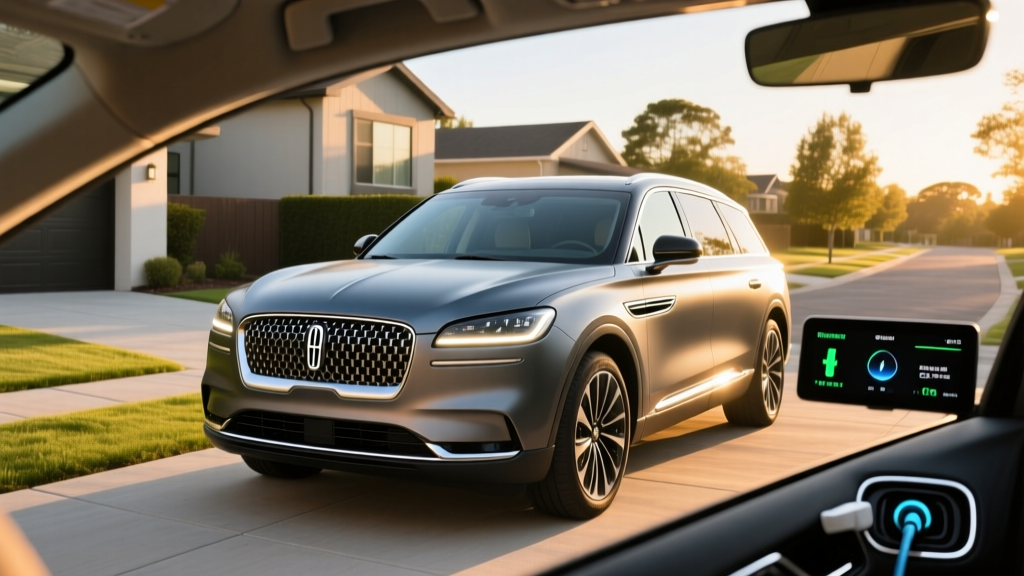
The Lincoln Aviator Grand Touring occupies a narrow lane: a three-row luxury SUV with a plug-in hybrid powertrain that promises electric-only commuting and 494 combined horsepower. For 2026, Lincoln continues the Grand Touring as the electrified flagship of the Aviator lineup, pairing a twin-turbo V6 with an electric motor and a modest battery pack. It's a compelling proposition for luxury buyers who want EV-like around-town driving without fully committing to a battery-electric vehicle — but the execution comes with real trade-offs that spec sheets don't always reveal.
This guide breaks down exactly what the 2026 Aviator Grand Touring delivers in range, efficiency, charging practicality, and total ownership cost — with the numbers that matter when you're writing the check.
HEV vs PHEV: What the Aviator Grand Touring Actually Is
Lincoln sells the Aviator with two distinct powertrains, and the distinction matters for your wallet and your daily routine:
Standard Aviator (HEV-like mild hybrid)
The base Aviator uses a 3.0L twin-turbo V6 producing 400 hp and 415 lb-ft of torque. While it incorporates a 48-volt mild-hybrid system for stop-start smoothness and minor efficiency assist, it cannot drive on electric power alone. You never plug it in. Think of it as a gas SUV with hybrid-adjacent refinement, not a true hybrid.
Aviator Grand Touring (PHEV)
The Grand Touring adds a 13.6 kWh lithium-ion battery pack and a 100-kW electric motor integrated into the 10-speed automatic transmission. Combined output jumps to 494 horsepower and 630 lb-ft of torque. You can plug it in, charge it, and drive roughly 21 miles on electricity alone before the gas engine takes over. This is a true plug-in hybrid electric vehicle (PHEV).
The difference is not subtle. The standard Aviator is a powerful luxury SUV. The Grand Touring is that same SUV with a genuine electric commute mode and substantially more torque. If you're reading this article, you're likely considering the PHEV — so let's dig into what living with it actually looks like.
Electric Range, Total Range, and Efficiency Numbers
The EPA rates the 2026 Aviator Grand Touring at 21 miles of electric-only range. That figure is modest by modern PHEV standards — the Toyota RAV4 Prime manages 42 miles, and the BMW X5 xDrive50e achieves 38 miles — but it reflects the Aviator's substantial curb weight (over 5,200 lbs) and the relatively compact 13.6 kWh battery pack.
EPA Electric Range: 21 miles
Real-World Expectation: 16–19 miles in mixed driving; as low as 13–15 miles in cold weather (below 40°F) or sustained highway speeds above 65 mph. The battery's usable capacity is approximately 11.2 kWh after accounting for the buffer that protects long-term health.
Once the battery depletes, the Aviator Grand Touring operates as a conventional hybrid, with the EPA rating it at 23 MPG combined (22 city / 25 highway) in charge-sustaining mode. That's a meaningful improvement over the standard Aviator's 20 MPG combined, but it won't be mistaken for a Prius.
| Mode | City | Highway | Combined |
|---|---|---|---|
| Electric-only (MPGe) | 56 MPGe combined | ||
| Charge-sustaining (MPG) | 22 | 25 | 23 |
| Standard Aviator (MPG) | 17 | 24 | 20 |
Real-world MPG note: PHEVs are notoriously sensitive to driving habits. If you charge nightly and your commute is under 20 miles, you may use almost no gasoline for weeks. If you regularly drive 60+ miles without charging, expect charge-sustaining MPG closer to 20–21 on the highway, where the Aviator's aerodynamic drag and weight work against it. Source: fueleconomy.gov.
Total combined range: With a full charge and a full 23.2-gallon fuel tank, the Grand Touring can cover approximately 450–480 miles before needing both a plug and a pump.
Powertrain Deep Dive: 494 HP and How It Gets There
The Grand Touring's powertrain is the Aviator's party trick. The 3.0L twin-turbocharged V6 alone produces 400 hp and 415 lb-ft. The electric motor adds 100 kW (134 hp) and substantial low-end torque, bringing the combined output to 494 hp and 630 lb-ft. That torque figure is particularly useful — it's available almost instantly from the electric motor, giving the Grand Touring a thrust that the standard Aviator can't match off the line.
| Specification | Value |
|---|---|
| Combined Horsepower | 494 hp |
| Combined Torque | 630 lb-ft |
| Engine | 3.0L Twin-Turbo V6 |
| Electric Motor | 100 kW (134 hp) |
| Battery Capacity | 13.6 kWh (lithium-ion) |
| Usable Battery | ~11.2 kWh |
| Electric Range (EPA) | 21 miles |
| Transmission | 10-speed automatic |
| Drivetrain | Rear-wheel drive (AWD optional) |
| 0–60 mph (est.) | ~5.5 seconds |
| Towing Capacity | 5,600 lbs (with tow package) |
| Cargo (behind 3rd row) | 18.3 cu ft |
Lincoln offers the Grand Touring in rear-wheel drive and all-wheel drive configurations. The AWD system is a conventional mechanical setup — not an electrically driven rear axle as you'd find in some competing PHEVs — so there's no dedicated EV-mode AWD capability. The 10-speed automatic handles gear changes smoothly, though the transition from electric-only to hybrid mode can produce a faint but perceptible shudder under light acceleration.
Charging: Level 1, Level 2, and the DC Fast-Charging Gap
Here's where the Aviator Grand Touring reveals its PHEV-era limitations. The onboard charger is rated at 7.2 kW, which is competitive for a PHEV. However, the Grand Touring does not support DC fast charging. This is standard for most PHEVs in this class — the battery is simply too small to justify the cost and weight of DC charging hardware — but it's worth understanding the implications.
| Charging Level | Power | Time (0–100%) | Where You'll Use It |
|---|---|---|---|
| Level 1 (120V outlet) | ~1.4 kW | ~8–9 hours | Standard household outlet; overnight |
| Level 2 (240V) | Up to 7.2 kW | ~2.0–2.5 hours | Home wallbox, workplace, public Level 2 |
| DC Fast Charging | Not supported | N/A | N/A |
Practical takeaway: A Level 2 home charger is strongly recommended. At 7.2 kW, a full charge takes roughly two hours — fast enough that you could charge during a midday break if you have workplace charging. Level 1 charging works but is slow; you'll gain roughly 5–6 miles of electric range per hour on a standard 120V outlet. If your daily commute exceeds 12 miles round-trip, Level 1 alone won't keep the battery topped up.
For home Level 2 installation, budget $500–$1,200 for a quality 32-amp or 40-amp wallbox (ChargePoint Home Flex, Emporia Level 2, or similar), plus $500–$2,000 for electrician labor depending on your panel's proximity to the garage and whether a 240V circuit already exists. If your home has a 200-amp electrical panel with spare capacity, installation is usually straightforward. Older homes with 100-amp panels may require an upgrade — a $1,500–$3,000 job that's worth factoring into your purchase decision.
Pricing, Trims, and Tax Credit Eligibility
The 2026 Aviator Grand Touring starts at approximately $69,590 MSRP (including destination), with the Black Label Grand Touring reaching roughly $84,000. That positions it above the BMW X5 xDrive50e ($73,800) but below the Porsche Cayenne E-Hybrid ($91,000+).
Federal §30D Tax Credit — Does the Aviator Grand Touring Qualify?
- MSRP cap: SUVs must be under $80,000 MSRP. The base Grand Touring qualifies; Black Label trims may exceed the cap.
- Buyer income limits: AGI must not exceed $150,000 (single), $225,000 (head of household), or $300,000 (joint filers).
- Battery sourcing requirements: A percentage of critical minerals and battery components must be sourced from the U.S. or free-trade-agreement partners. Lincoln's supply chain compliance varies by production batch — verify the specific VIN on the fueleconomy.gov tax credit lookup tool before purchasing.
- Point-of-sale transfer: If eligible, the credit (up to $7,500) can be applied as a down-payment reduction at the dealership rather than waiting for tax filing.
- Final authority: IRS rules change. Confirm eligibility with a tax professional and the official IRS §30D guidance before relying on the credit in your budget.
Do not assume the Grand Touring qualifies for the full $7,500 credit. Battery component and critical mineral sourcing rules under the Inflation Reduction Act have disqualified several PHEVs and EVs since 2024, and Lincoln's supply chain status should be verified per-VIN at the time of purchase.
Battery Longevity, Warranty, and Replacement Cost
PHEV battery anxiety is understandable but largely overstated for modern vehicles. The Aviator Grand Touring's 13.6 kWh pack is lithium-ion chemistry (likely NMC — nickel manganese cobalt — given its energy density requirements in a relatively small package). Lincoln provides a robust warranty:
Hybrid/EV Component Warranty: 8 years / 100,000 miles (whichever comes first)
Coverage includes: High-voltage battery pack, electric motor, power electronics, and associated control modules.
Capacity threshold: Ford/Lincoln typically warrants the battery to retain at least 70% of original capacity during the warranty period. If degradation exceeds 30%, the battery will be repaired or replaced at no cost.
Real-world degradation data: PHEV batteries experience less stress than full EV batteries because they operate in a narrower state-of-charge window (the vehicle's software prevents full 0% or 100% usage to protect longevity). Based on data from similar Ford/Lincoln PHEV platforms (Escape PHEV, Corsair Grand Touring), expect approximately 8–12% capacity loss over 8 years of typical use. That translates to roughly 18–19 miles of electric range after eight years, down from 21 — noticeable but not crippling.
Out-of-warranty replacement cost: If the battery fails after the warranty expires, replacement currently runs $8,000–$12,000 including parts and labor at a Lincoln dealership. This is a meaningful expense, but the 8-year/100,000-mile warranty window covers the vast majority of ownership periods. For comparison, the standard Aviator's transmission or turbocharger repairs can be similarly expensive — every powertrain carries risk past its warranty.
Reliability and Ownership Considerations
The Aviator platform (shared with the Ford Explorer) has a mixed reliability track record. The standard Aviator has drawn complaints for build-quality inconsistencies, electrical gremlins, and turbo-related issues in earlier model years (2020–2022). The Grand Touring adds complexity — a high-voltage system, electric motor, and additional cooling circuits — which introduces more potential failure points.
That said, the hybrid-specific components (battery, motor, inverter) have proven durable across Ford's PHEV lineup. The risk is less about the hybrid system failing and more about the surrounding vehicle — infotainment bugs, suspension components, and interior trim quality — that has historically affected the Aviator nameplate.
Insurance costs run 10–15% higher than the standard Aviator, reflecting the Grand Touring's higher MSRP and repair complexity. Expect annual premiums in the $2,200–$3,000 range depending on your profile and location.
Maintenance is slightly lower than the gas-only Aviator thanks to regenerative braking (which extends brake pad life significantly) and the engine running fewer hours in electric-commute scenarios. Oil changes are still required but can stretch to 7,500–10,000-mile intervals if much of your driving is electric. Lincoln recommends following the Intelligent Oil-Life Monitor rather than a fixed schedule.
Who Should Choose the Aviator Grand Touring vs. a Full EV or Gas SUV?
Choose the Aviator Grand Touring if:
- Your daily commute is 15–20 miles round-trip and you can charge at home every night
- You need three rows and 5,600-lb towing capacity but want some electric driving
- You take regular road trips where charging infrastructure is unreliable
- You value the 630 lb-ft torque figure and luxury amenities over maximum efficiency
- You're not ready for full EV ownership but want to reduce fuel consumption and emissions
Choose a full EV (e.g., Rivian R1S, Tesla Model X) if:
- Your commute is longer than 21 miles and you want to drive entirely on electricity
- You have reliable home and workplace charging
- You want lower long-term maintenance costs and no gasoline engine to service
- You're comfortable planning road trips around DC fast-charging networks
Choose the standard Aviator (gas) if:
- You cannot install a Level 2 home charger
- Your budget is tighter and the $10,000+ Grand Touring premium doesn't pencil out
- You drive mostly highway miles where the PHEV advantage diminishes
The math matters. If you drive 15 miles round-trip, charge nightly, and pay $3.50/gallon for premium fuel, the Grand Touring's electric commute saves roughly $600–$900 per year in fuel costs compared to the standard Aviator. At that rate, the PHEV premium over a well-equipped standard Aviator Reserve (roughly $10,000–$12,000) takes 11–15 years to recoup through fuel savings alone. The Grand Touring is not a cost-saving play — it's a performance and refinement upgrade that happens to offer some electric capability.
Pros and Cons at a Glance
Pros
- 630 lb-ft of torque delivers effortless acceleration and confident highway merging
- Genuine electric-only mode for short commutes eliminates local emissions
- Three-row seating and 5,600-lb towing in a PHEV package
- 8-year / 100,000-mile hybrid component warranty provides peace of mind
- 7.2 kW Level 2 charging is quick for a PHEV (full charge in ~2 hours)
- Luxury interior with available 30-way Perfect Position seats and Revel Ultima audio
Cons
- 21-mile electric range trails competitors (RAV4 Prime: 42 mi; X5 xDrive50e: 38 mi)
- No DC fast charging — impractical for en-route charging on road trips
- $69,590+ starting price; Black Label exceeds $80,000 tax-credit MSRP cap
- Charge-sustaining MPG of 23 is only marginally better than the gas Aviator's 20
- Platform reliability concerns from earlier model years linger
- PHEV premium takes 11+ years to recoup through fuel savings alone
- Heavy curb weight (5,200+ lbs) reduces efficiency and increases tire wear
Frequently Asked Questions
How many MPG does the Lincoln Aviator Grand Touring get?
The EPA rates the 2026 Aviator Grand Touring at 56 MPGe in electric mode and 23 MPG combined (22 city / 25 highway) once the battery is depleted and the vehicle operates in charge-sustaining hybrid mode. Real-world highway driving at 75+ mph typically yields 20–21 MPG in hybrid mode.
How far can the Aviator Grand Touring go on electric only?
The EPA rates it at 21 miles of electric-only range. In real-world conditions — with climate control running, moderate acceleration, and temperatures between 50–80°F — expect 16–19 miles. In cold weather (below 40°F), range drops to approximately 13–15 miles due to battery chemistry limitations and cabin heating demands.
Does the Aviator Grand Touring qualify for the federal EV tax credit?
It may qualify for up to $7,500 under IRS §30D, but eligibility depends on the specific vehicle's battery sourcing compliance, the buyer's adjusted gross income (caps at $150K single / $300K joint), and the MSRP staying under the $80,000 SUV cap. The base Grand Touring typically clears the MSRP cap; Black Label trims may not. Always verify with the fueleconomy.gov credit lookup and a tax professional before purchasing.
Is the Aviator Grand Touring reliable, and what does a battery replacement cost?
The hybrid-specific components (battery, motor, electronics) have proven durable across Ford/Lincoln's PHEV lineup, and they're backed by an 8-year / 100,000-mile warranty. The broader Aviator platform has had some build-quality complaints in earlier years. Out-of-warranty battery replacement runs approximately $8,000–$12,000 if needed after the warranty period, though most owners will sell or trade the vehicle before reaching that point.
Should I get the Grand Touring PHEV or a full electric SUV?
If your daily commute is under 20 miles, you can charge at home, and you regularly need three rows or towing capacity on road trips where charging is sparse, the Grand Touring is a practical bridge. If your commute is longer, you have robust charging access, and you want to eliminate gasoline entirely, a full EV like the Rivian R1S or Kia EV9 will deliver far greater electric range (250–300+ miles) and lower operating costs.
Can the Aviator Grand Touring DC fast charge?
No. Like most PHEVs, the Grand Touring supports only Level 1 (120V) and Level 2 (240V, up to 7.2 kW) AC charging. A full Level 2 charge takes approximately 2–2.5 hours. DC fast charging is not available, which is typical for PHEVs with batteries under 20 kWh.