Quick Verdict: The UX 250h Delivers Where Hybrids Shine Most
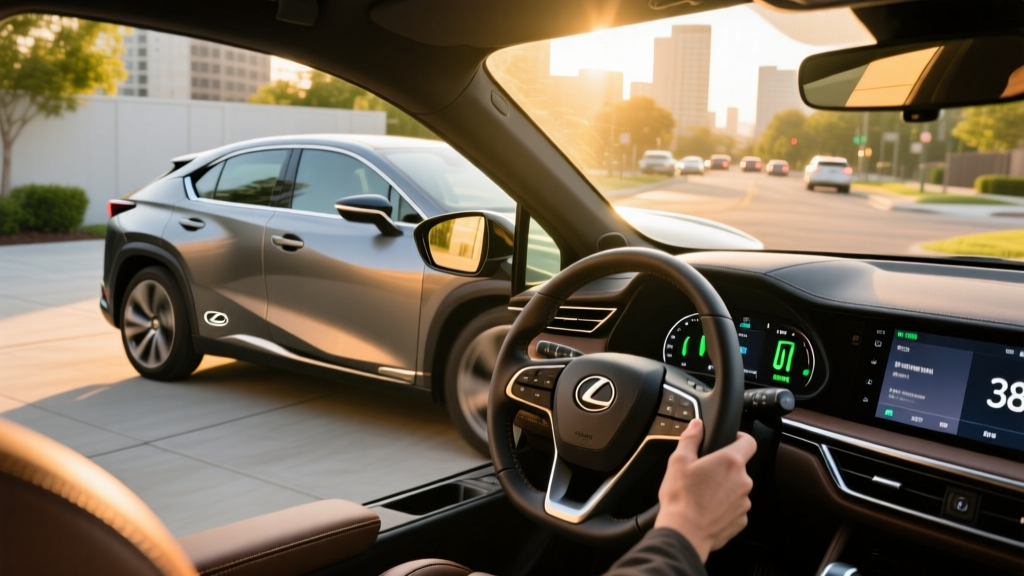
The 2026 Lexus UX 250h is a conventional hybrid electric vehicle (HEV) — not a plug-in — and that distinction matters for buyers cross-shopping this subcompact luxury crossover. You never plug it in. You never hunt for a charger. You simply fill up with gas and let the hybrid system do the efficiency work. The result is an EPA-estimated 42 MPG combined, making it one of the most fuel-efficient luxury crossovers on the market.
But EPA stickers don't tell the whole story. In this guide, we'll reconcile the official numbers with real-world driving data, examine the UX 250h's powertrain, break down long-term reliability and battery warranty coverage, and help you decide whether this HEV, a plug-in hybrid (PHEV), or a full battery-electric vehicle (BEV) fits your lifestyle.
How Many MPG Does the Lexus UX Hybrid Get?
The 2026 Lexus UX 250h pairs a 2.0-liter four-cylinder engine with two electric motor-generators and a continuously variable transmission (eCVT). Here's the official EPA breakdown from fueleconomy.gov:
| Metric | Value |
|---|---|
| City MPG | 43 MPG |
| Highway MPG | 41 MPG |
| Combined MPG | 42 MPG |
| Annual Fuel Cost (est.) | ~$1,350 (15,000 mi/yr, $3.50/gal) |
| Fuel Type | Regular Unleaded (87 octane) |
Hybrid vehicles like the UX 250h often exceed their EPA city rating in stop-and-go traffic because regenerative braking recaptures energy that a gas-only car wastes as heat. In real-world testing by owners and automotive reviewers, the UX 250h regularly returns 40–45 MPG in mixed city driving.
Highway driving is a different story. At sustained 70–80 mph speeds, the electric motor contributes less and the 2.0L engine does most of the work. Expect highway-only trips to yield 37–40 MPG. In cold weather (below freezing), fuel economy typically drops 5–10% as the engine runs more frequently to provide cabin heat and warm up the catalytic converter.
Bottom line: If your commute is mostly urban or suburban, you'll likely see 43–46 MPG. If you're a highway-heavy driver, plan for 38–40 MPG.
HEV vs. PHEV: Why the UX 250h Is a Conventional Hybrid
Lexus does not currently offer a plug-in hybrid (PHEV) variant of the UX. The UX 250h is strictly an HEV — a self-charging hybrid that recovers energy through regenerative braking and the gasoline engine. Here's how the two hybrid types compare:
| Feature | HEV (Lexus UX 250h) | PHEV (e.g., Toyota RAV4 Prime) |
|---|---|---|
| Plug-in charging? | No — self-charging | Yes — plug into Level 1/2 outlet |
| Battery size | ~1.4 kWh (small NiMH/Li-ion) | 18.1 kWh (larger Li-ion) |
| Electric-only range | None (EV assist only, low-speed) | 42 miles (EPA) |
| Fuel economy (gas mode) | 42 MPG combined | 38 MPG combined (after battery depleted) |
| Federal tax credit | Not eligible | Up to $7,500 (§30D, subject to eligibility) |
| Ideal for | No home charging access; simplicity | Home charging + short commute |
The UX 250h's small hybrid battery (roughly 1.4 kWh usable) exists solely to buffer energy between the engine and motors. It enables engine-off coasting at low speeds and provides torque assist during acceleration, but it cannot propel the car on electricity alone for any meaningful distance. If you want electric-only commuting, you'll need to look at a PHEV or a full BEV.
Powertrain Specs: What's Under the Hood
| Specification | Value |
|---|---|
| Engine | 2.0L inline-4 Atkinson-cycle |
| Engine output | 143 hp / 139 lb-ft torque |
| Electric motors | 2 motor-generators (MG1 + MG2) |
| Combined system horsepower | 181 hp |
| Drivetrain | AWD (e-AWD: rear motor drives rear axle) |
| Transmission | eCVT (planetary gearset, no belts) |
| 0–60 mph | ~7.6 seconds |
| Hybrid battery | ~1.4 kWh, lithium-ion |
| Driving modes | Normal, Eco, Sport, EV (low-speed, short distance) |
The e-AWD system is worth noting: unlike mechanical AWD with a driveshaft, the UX 250h uses a dedicated rear-axle electric motor (MG2 rear) that engages only when traction is needed. This means zero drivetrain parasitic loss during normal cruising — a key reason the AWD model loses virtually no fuel economy compared to a hypothetical FWD variant.
The Atkinson-cycle engine sacrifices some low-end torque for superior thermal efficiency. Combined with the eCVT's seamless gear ratio management, the result is a powertrain that prioritizes smoothness and economy over sporty acceleration. The 7.6-second 0–60 time is adequate for merging and passing but won't thrill enthusiasts.
Pricing, Trims, and Tax Credit Eligibility
| Trim | Starting MSRP |
|---|---|
| UX 250h Base | $38,750 |
| UX 250h Premium | $41,450 |
| UX 250h F SPORT Design | $43,950 |
| UX 250h Luxury | $46,200 |
Federal tax credit: The UX 250h does not qualify for the IRS §30D Clean Vehicle Credit. That credit applies only to plug-in electric vehicles (BEVs and PHEVs) meeting battery sourcing, critical mineral, MSRP cap, and buyer income requirements. Because the UX 250h is a conventional HEV with no plug-in capability, it falls outside §30D eligibility entirely.
Some states and utilities offer rebates or incentives for hybrid vehicles, but these vary widely by jurisdiction. Check your state's energy office or local utility for current programs. Always consult a tax professional for personalized guidance on incentives.
Reliability and Hybrid Battery Warranty
Lexus covers the UX 250h's hybrid battery for 10 years or 150,000 miles (whichever comes first) under the Hybrid System Warranty. The broader Hybrid System components — including the inverter, motor-generators, and eCVT — are also covered for 8 years / 100,000 miles under federal emissions warranty requirements.
Lexus (and parent company Toyota) has the deepest track record in hybrid technology of any automaker, with over 25 years of hybrid production since the original Prius. The UX 250h's hybrid system uses proven, conservative engineering — the battery is deliberately kept within a narrow state-of-charge window (roughly 40–80%) to minimize degradation. This is why Toyota/Lexus hybrid batteries routinely last 150,000–200,000+ miles without replacement.
Battery replacement cost: If the hybrid battery does fail outside of warranty, a replacement typically costs between $2,000 and $4,000 for parts and labor at a dealership. Independent hybrid specialists often offer refurbished battery packs for $1,200–$2,000. For context, this is a fraction of the cost of a full BEV traction battery replacement ($10,000–$20,000+).
According to reliability data aggregated by automotive reviewers and owner surveys, the UX 250h scores well above average for the luxury subcompact SUV segment. The powertrain carries minimal complexity risk — no turbocharger, no traditional automatic transmission, no clutch packs in the eCVT.
Who Should Choose the UX 250h vs. a PHEV or Full EV?
Decision Framework
Choose the Lexus UX 250h (HEV) if:
- You lack access to home or workplace charging (apartment, street parking)
- You want luxury-crossover comfort with minimal fuel cost and zero behavior change
- Your daily driving is a mix of city and highway with no single pattern
- You value long-term reliability and low maintenance costs
- You don't want to think about charging, range, or battery degradation
Choose a PHEV (e.g., Toyota RAV4 Prime, BMW X5 xDrive50e) if:
Choose a full BEV (e.g., Tesla Model Y, Hyundai Ioniq 5) if:
- You have home charging and want the lowest per-mile fuel cost
- You want maximum performance, cargo space, and technology
- You're ready to plan around DC fast-charging on road trips
- You want zero tailpipe emissions and the strongest tax-credit eligibility
The UX 250h occupies a specific niche: luxury-badge buyers who want crossover practicality, exceptional fuel economy, and absolutely zero charging hassle. It won't match a BEV's per-mile energy cost (electricity at ~$0.04/mile vs. the UX's ~$0.09/mile at 42 MPG and $3.50/gal), but it eliminates range anxiety and charging infrastructure dependency entirely.
Pros and Cons at a Glance
✓ Pros
- 42 MPG combined — best-in-class for luxury subcompact crossovers
- No plug-in required — zero behavior change from a gas car
- Standard e-AWD with no fuel-economy penalty
- 10-year / 150,000-mile hybrid battery warranty
- Runs on regular 87-octane fuel
- Lexus reliability and resale value track record
✗ Cons
- No electric-only driving range (not a PHEV)
- No federal tax credit eligibility
- Modest 181 hp — not a performance-oriented crossover
- Compact rear seat and cargo area (17.1 cu ft behind rear seats)
- Infotainment system lags behind rivals in responsiveness
- Starting price above $38K with no credit offset
Frequently Asked Questions
Does the Lexus UX hybrid need to be plugged in?
No. The UX 250h is a conventional hybrid (HEV). It charges its small battery through regenerative braking and the gasoline engine. You never plug it in — just fill up with gas as you would with any other car.
How far can the UX 250h go on a full tank?
With a 10.6-gallon fuel tank and 42 MPG combined, the UX 250h delivers approximately 445 miles of total range per fill-up. In city-heavy driving where real-world MPG can exceed 44, some owners report 470+ miles between stops.
Is the Lexus UX hybrid reliable long-term?
Yes. Toyota/Lexus hybrid systems have an industry-leading reliability record spanning 25+ years. The UX 250h's eCVT has no friction bands or clutch packs to wear out, and the hybrid battery is kept in a conservative charge window to maximize lifespan. Most Lexus hybrid batteries last well beyond 150,000 miles.
What does hybrid battery replacement cost for the UX 250h?
Out-of-warranty replacement runs $2,000–$4,000 at a dealer. Refurbished packs from independent hybrid specialists cost $1,200–$2,000. Given the 10-year/150,000-mile warranty, most original owners will never face this cost.
How does the UX 250h MPG compare to a full EV's energy cost?
At 42 MPG and $3.50/gallon, the UX 250h costs roughly $0.083 per mile in fuel. A comparable BEV charging at the national average of $0.16/kWh and consuming 3.5 miles/kWh costs about $0.046 per mile — roughly 45% less. Over 5 years and 75,000 miles, that's a fuel-cost difference of approximately $2,800 in the EV's favor. However, the BEV buyer must account for potentially higher insurance premiums, home charger installation ($500–$2,000), and public charging costs on road trips.
Does the UX 250h qualify for any tax credit in 2026?
The UX 250h does not qualify for the federal §30D Clean Vehicle Credit, which is limited to plug-in vehicles. Check your state's energy office for any local hybrid incentives, and consult a tax professional for personalized advice. IRS rules are available at irs.gov.