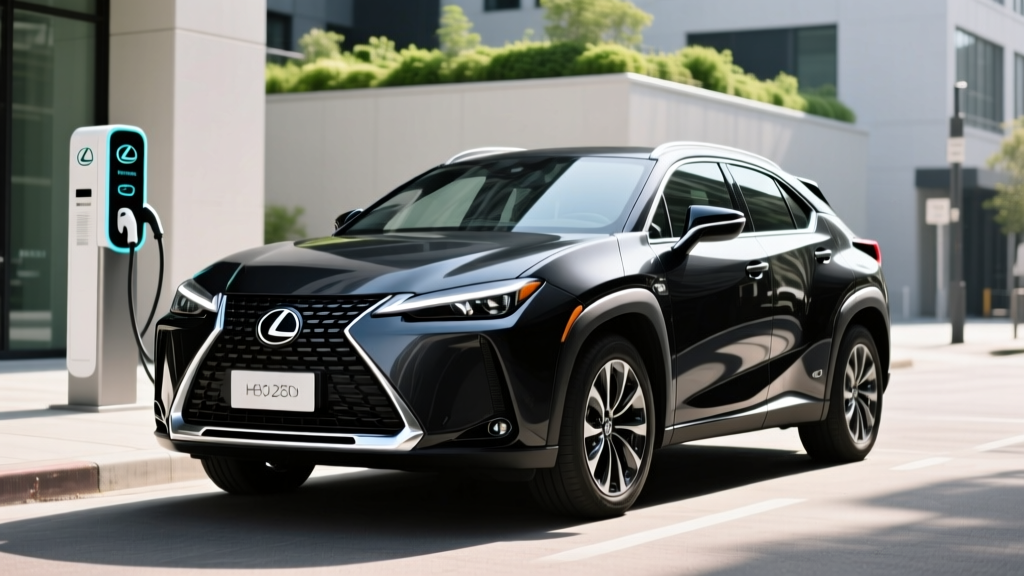
Quick Verdict: The Lexus UX 250h Hybrid SUV at a Glance
The 2026 Lexus UX 250h hybrid SUV occupies a precise niche: a luxury subcompact crossover that prioritizes fuel efficiency, refinement, and long-term reliability over outright performance or cargo volume. With an EPA-estimated 42 MPG combined, standard all-wheel drive, and Lexus's proven hybrid synergy drive system, the UX 250h delivers on its core promise — premium daily commuting with minimal fuel stops. But it also carries trade-offs that buyers need to weigh honestly: modest acceleration, a compact rear seat, and no plug-in hybrid variant to access electric-only driving or federal tax credits.
This guide breaks down the exact specifications, real-world fuel economy expectations, powertrain details, battery longevity, pricing, and the decision framework for whether the UX 250h is your ideal electrified vehicle — or whether a PHEV or full BEV better fits your driving pattern.
| Specification | 2026 Lexus UX 250h |
|---|---|
| Powertrain | 2.0L 4-cyl + 2 electric motors (AWD) |
| Combined Horsepower | 181 hp |
| 0–60 mph | 7.2 seconds (est.) |
| EPA MPG (City / Hwy / Combined) | 43 / 41 / 42 |
| Fuel Tank | 10.6 gallons |
| Total Range | ~445 miles |
| Drivetrain | AWD (E-Four electronic) |
| Hybrid Battery | NiMH, ~1.4 kWh (self-charging) |
| Cargo Volume (rear seats up) | 21.7 cu ft |
| Starting MSRP | ~$39,340 (Premium trim) |
| Federal Tax Credit | Not eligible (§30D requires plug-in) |
| Hybrid Battery Warranty | 10 years / 150,000 miles |
HEV vs PHEV vs EV: Where the UX 250h Fits
A common source of confusion among shoppers evaluating the Lexus UX 250h hybrid SUV is whether it can plug in. It cannot. The UX 250h is a conventional hybrid electric vehicle (HEV), meaning its battery recharges exclusively through regenerative braking and the gasoline engine. There is no charging port, no electric-only driving mode, and no plug-in variant offered for the 2026 model year.
| Feature | HEV (UX 250h) | PHEV (e.g., Lexus NX 450h+) | BEV (e.g., Tesla Model Y) |
|---|---|---|---|
| Plugs in? | No | Yes | Yes |
| Electric-only range | 0 miles | ~37 miles | ~310 miles |
| Gasoline engine | Yes (primary) | Yes (backup) | No |
| Federal tax credit | None | Up to $7,500* | Up to $7,500* |
| Home charging needed | No | Recommended | Required |
| Best for | No plug access, city driving | Short commute + road trips | Home charging + low running cost |
*§30D federal tax credit eligibility depends on MSRP caps ($80,000 for SUVs), buyer income limits, battery critical-mineral sourcing requirements, and point-of-sale transfer rules per current IRS guidelines. Consult a tax professional.
The UX 250h is purpose-built for buyers who want hybrid efficiency without changing their fueling routine. If you have access to home or workplace Level 2 charging and a commute under 40 miles, a PHEV like the NX 450h+ or a full BEV will deliver lower per-mile energy costs. But if you live in an apartment, park on the street, or simply want zero behavior change, the self-charging HEV architecture is the pragmatic choice.
Fuel Economy: EPA Ratings and Real-World MPG
The 2026 Lexus UX 250h carries EPA estimates of 43 MPG city, 41 MPG highway, and 42 MPG combined, according to fueleconomy.gov. These figures place it among the most efficient luxury crossovers available, rivaling some non-luxury compact hybrids.
| Driving Scenario | EPA Estimate | Real-World Expectation |
|---|---|---|
| City (stop-and-go) | 43 MPG | 44–47 MPG (hybrids excel here) |
| Highway (70+ mph) | 41 MPG | 37–39 MPG (aero drag, less regen) |
| Combined | 42 MPG | 40–43 MPG (mixed driving) |
| Cold weather (below 32°F) | — | 36–39 MPG (engine runs more for heat) |
Why real-world city MPG often exceeds the EPA sticker: Conventional hybrids recapture kinetic energy during braking and low-speed driving, which is exactly what city traffic provides. The UX 250h's electric motors handle initial acceleration from stops, keeping the gasoline engine off for extended periods in traffic. Many owners report 45+ MPG in warm-weather urban commuting.
Highway reality check: At sustained speeds above 70 mph, the aerodynamic drag of any crossover increases fuel consumption, and the hybrid system has fewer opportunities to recapture energy. Expect highway trips to return 37–39 MPG in moderate temperatures, dropping further in winter or mountainous terrain.
With a 10.6-gallon fuel tank, total range sits around 445 miles in mixed driving — fewer than some competitors with larger tanks, but sufficient for most daily needs and manageable on road trips with standard rest stops.
Powertrain and Performance: 181 hp with AWD
The UX 250h pairs a 2.0-liter inline-4 Atkinson-cycle gasoline engine with two front-mounted electric motor-generators and a separate rear electric motor for all-wheel drive. Combined system output is 181 horsepower. The rear axle is driven purely by the electric motor — there is no mechanical driveshaft connecting the engine to the rear wheels. Lexus calls this E-Four electronic AWD.
Acceleration to 60 mph takes approximately 7.2 seconds. This is adequate for merging and passing but not sporty. The continuously variable transmission (eCVT) delivers smooth, linear power without gear-shift interruptions, though it can produce a droning sensation under hard acceleration — a characteristic of all power-split hybrid systems.
Where the UX 250h shines dynamically is low-speed responsiveness. Electric torque fills the gap below 2,000 RPM, making the crossover feel punchy from stoplights and in parking-lot maneuvers. The AWD system engages the rear motor automatically when slip is detected, providing confident traction in rain and light snow without the fuel-economy penalty of a mechanical AWD system.
Battery Longevity, Warranty, and Replacement Cost
Hybrid Battery Warranty: 10 years or 150,000 miles (whichever comes first), covering defects and capacity loss below usable thresholds. This applies in all 50 states for the 2026 model year.
The UX 250h uses a nickel-metal hydride (NiMH) hybrid battery pack with approximately 1.4 kWh of total capacity. Unlike the large lithium-ion packs in PHEVs and BEVs, this small battery is designed for frequent shallow charge-discharge cycles rather than deep cycling. Toyota and Lexus have refined this NiMH hybrid architecture over more than 25 years since the original Prius, and long-term reliability data is extensive.
Expected lifespan: Real-world evidence from Lexus and Toyota hybrids suggests NiMH battery packs routinely last 150,000–200,000+ miles before significant degradation. Many first-generation Prius and RX 400h vehicles exceeded 200,000 miles on their original hybrid batteries. The UX 250h's battery management system keeps the pack within a narrow state-of-charge window (roughly 40–80%), which dramatically reduces cell stress.
Replacement cost if out of warranty: A replacement hybrid battery pack for the UX 250h typically ranges from $2,000 to $3,500 (parts and labor) at a Lexus dealership. Third-party remanufactured packs can reduce this to $1,500–$2,500. This is a fraction of the $8,000–$20,000+ cost associated with large BEV battery replacements, and the hybrid pack rarely fails catastrophically — individual modules can sometimes be replaced rather than the entire pack.
12V auxiliary battery: Like all modern hybrids, the UX 250h also has a conventional 12V battery for electronics and startup. This typically requires replacement every 4–6 years at a cost of $200–$350 — standard automotive maintenance unrelated to the hybrid system.
Pricing, Trims, and Tax Credit Eligibility
The 2026 Lexus UX 250h starts at approximately $39,340 for the Premium trim, including destination charge. Key trims and pricing:
| Trim | Starting MSRP | Key Features |
|---|---|---|
| Premium | $39,340 | 12.3" touchscreen, wireless CarPlay/Android Auto, Lexus Safety System+ 3.0 |
| Premium Plus | $42,540 | Power moonroof, heated/ventilated front seats, power liftgate |
| F SPORT Handling | $44,640 | Adaptive variable suspension, F SPORT seats, 18" wheels |
| Luxury | $47,240 | Leather-trimmed seats, premium audio, head-up display |
Federal tax credit: The Lexus UX 250h hybrid SUV does not qualify for the IRS §30D Clean Vehicle Credit. This credit applies exclusively to plug-in electric vehicles (PHEVs and BEVs) with batteries of at least 7 kWh that meet MSRP, income, and critical-mineral sourcing requirements. Because the UX 250h is a self-charging HEV with no plug, it falls outside the credit's scope entirely.
State incentives: Some states offer modest rebates or HOV-lane access for hybrid vehicles, though these programs have largely shifted focus to PHEVs and BEVs. Check your state's energy or environmental agency for current programs — availability and amounts vary by jurisdiction.
Total cost of ownership advantage: Where the UX 250h recoups its premium over non-luxury hybrids is in fuel savings and depreciation. At 42 MPG combined versus a typical 28 MPG luxury gas crossover, the UX 250h saves roughly $600–$800 per year in fuel costs for a driver covering 12,000 miles annually (assuming $3.50/gallon). Lexus also consistently leads luxury brands in resale value retention, partially offsetting the lack of a tax credit.
Reliability and Safety Ratings
Lexus ranks at or near the top of every major reliability study. In J.D. Power's Vehicle Dependability Study, Lexus has consistently placed in the top three brands for over a decade. The UX 250h benefits from a mature powertrain architecture shared with the Toyota Corolla Hybrid and Prius, meaning parts availability and technician familiarity are strong.
The UX 250h comes standard with Lexus Safety System+ 3.0, which includes:
- Pre-Collision System with Pedestrian Detection
- Lane Departure Alert with Steering Assist
- Lane Tracing Assist (SAE Level 2 driver assistance — driver must remain engaged)
- Dynamic Radar Cruise Control (full-speed adaptive)
- Road Sign Assist
- Automatic High Beams
Important clarification: Lane Tracing Assist and Dynamic Radar Cruise Control together provide hands-on-wheel lane-centering and speed management. This is SAE Level 2 driver assistance, not autonomous driving. The driver must maintain awareness and control at all times.
For crash-test ratings, check the latest results from IIHS and NHTSA, as the UX has earned strong marks in prior model years, including IIHS Top Safety Pick designation when equipped with specific headlights.
Who Should Buy the UX 250h — And Who Should Look Elsewhere
Pros
- 42 MPG combined — top-tier for luxury crossovers
- Standard AWD without fuel-economy penalty
- Proven hybrid reliability with 10yr/150k battery warranty
- No plug-in required — zero behavior change
- Strong resale value and low maintenance costs
- Refined, quiet cabin at city speeds
Cons
- No EV mode, no plug-in option, no tax credit
- Modest 181 hp — not a performance crossover
- Compact rear seat and 21.7 cu ft cargo limit utility
- Small 10.6-gal tank means more frequent fill-ups
- eCVT drone under hard acceleration
- Premium price vs. Toyota Corolla Cross Hybrid (similar powertrain, ~$10K less)
Choose the Lexus UX 250h if: You want a luxury badge, live without plug-in access, commute primarily in urban or suburban traffic, and prioritize fuel savings and long-term reliability over acceleration and cargo space.
Choose a PHEV instead if: You have home Level 2 charging, a commute under 40 miles, and want electric-only daily driving with the option of gas for road trips — plus potential federal tax credit eligibility. Consider the Lexus NX 450h+ or Toyota RAV4 Prime.
Choose a full BEV instead if: You have reliable home charging, want zero gasoline dependency, seek the lowest per-mile energy cost, and are ready to plan around DC fast charging on road trips. Consider the Tesla Model Y, Hyundai Ioniq 5, or Ford Mustang Mach-E.
Frequently Asked Questions
How many MPG does the Lexus UX 250h get?
The 2026 UX 250h is EPA-rated at 43 MPG city, 41 MPG highway, and 42 MPG combined. In real-world city driving, many owners achieve 44–47 MPG thanks to the hybrid system's regenerative braking. Highway driving at 70+ mph typically returns 37–39 MPG.
Does the Lexus UX 250h plug in?
No. The UX 250h is a conventional hybrid (HEV). Its battery recharges through regenerative braking and the gasoline engine. There is no charging port and no plug-in hybrid version is offered for 2026.
Is the Lexus UX 250h hybrid reliable, and what does battery replacement cost?
Lexus hybrid powertrains are among the most reliable in the industry, backed by 25+ years of Toyota hybrid engineering. The hybrid battery is warranted for 10 years/150,000 miles. Out-of-warranty replacement typically costs $2,000–$3,500, and many packs last 200,000+ miles. The smaller 12V auxiliary battery costs $200–$350 to replace every 4–6 years.
Does the Lexus UX 250h qualify for any tax credit?
No. The federal §30D Clean Vehicle Credit applies only to plug-in vehicles (PHEVs and BEVs). As a self-charging HEV, the UX 250h is not eligible. Some states may offer minor hybrid incentives — check your state's energy agency for current programs.
How does the UX 250h compare to the Toyota Corolla Cross Hybrid?
Both use Toyota's 2.0L hybrid AWD system, but the UX 250h offers a luxury interior, more sound insulation, the Lexus Safety System+ 3.0 suite, and a premium infotainment experience. The Corolla Cross Hybrid delivers similar MPG (42 combined) and starts around $29,000 — roughly $10,000 less. The UX 250h is the refinement and badge upgrade; the Corolla Cross Hybrid is the value play.
Is the UX 250h good in snow?
The E-Four electronic AWD system provides competent traction in light to moderate snow by independently powering the rear axle with an electric motor when front-wheel slip is detected. It is not a substitute for winter tires in severe conditions, but it outperforms FWD-only crossovers in typical winter commuting.