The Only Lexus Hybrid SUV 7 Seater: Meet the TX Lineup
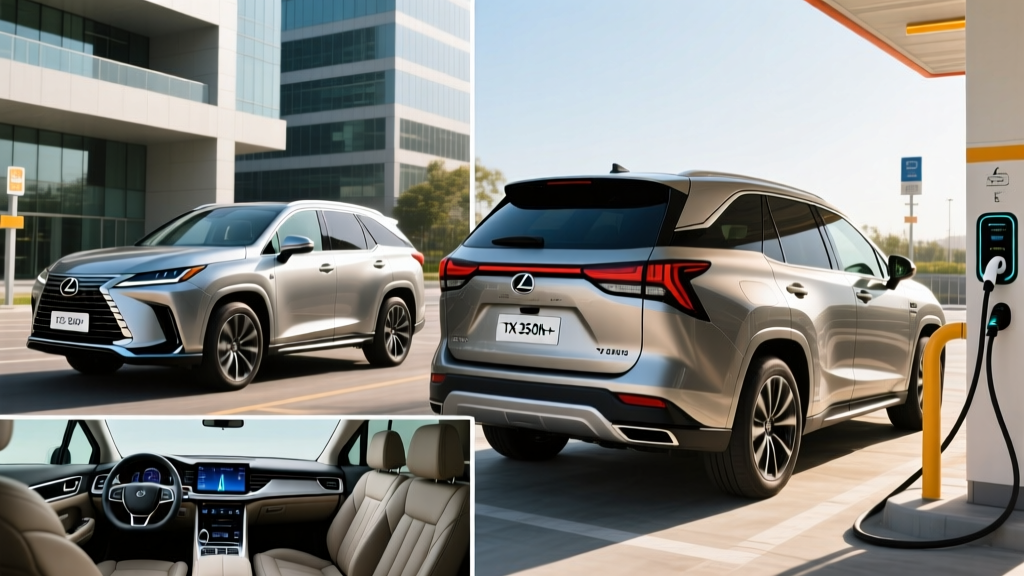
If you need three rows, Toyota reliability, and electrified efficiency without committing to a full battery-electric vehicle, the Lexus TX is currently the only Lexus hybrid SUV 7 seater on the market. Introduced for the 2024 model year and refreshed through 2026, the TX replaces the aging RX L and slots above the midsize RX as Lexus's dedicated family hauler. It shares its platform with the Toyota Grand Highlander, which means genuine third-row usability — not the token jump seats found in many luxury crossovers.
For 2026, Lexus offers two electrified TX variants: the TX 500h (a conventional hybrid, or HEV) and the TX 550h+ (a plug-in hybrid, or PHEV). Both seat up to seven with captain's chairs in the second row (or six with a second-row bench in lower trims), but they serve fundamentally different ownership patterns. Understanding which one fits your daily driving is the key to this purchase.
HEV vs PHEV: What's the Actual Difference?
Before comparing specs, it's critical to understand the distinction — confusing these two powertrains is the most common mistake hybrid shoppers make.
TX 500h — Conventional Hybrid (HEV)
- No plug required. The battery recharges through regenerative braking and the gasoline engine.
- Smaller battery (~1.4 kWh usable) — assists the engine but cannot drive on electric power alone for meaningful distances.
- Lower upfront cost and simpler ownership — no home charging setup needed.
- Best for: drivers who want better fuel economy without changing their refueling habits.
TX 550h+ — Plug-In Hybrid (PHEV)
- Plugs in to charge. Requires a Level 1 (120V) or Level 2 (240V) home charger for full benefit.
- Larger battery (18.1 kWh usable) — enables genuine electric-only driving for daily commutes.
- Higher upfront cost but potential tax-credit eligibility and lower per-mile operating cost on short trips.
- Best for: drivers with home charging and a daily commute under 33 miles who still want road-trip flexibility.
If you cannot install a home charger or don't have reliable workplace charging, the PHEV's larger battery becomes dead weight you're paying for but not using. Stick with the HEV.
Fuel Economy: EPA MPG and Real-World Numbers
The TX 500h and TX 550h+ use different EPA testing cycles. The HEV reports standard MPG; the PHEV reports MPGe (miles per gallon equivalent) when running on electricity and MPG when the battery is depleted. Here's how they compare:
| Metric | TX 500h (HEV) | TX 550h+ (PHEV) |
|---|---|---|
| EPA City MPG | 27 mpg | 34 mpg (charge-depleted) |
| EPA Highway MPG | 28 mpg | 34 mpg (charge-depleted) |
| EPA Combined MPG | 27 mpg | 34 mpg (charge-depleted) |
| Combined MPGe (electric) | N/A | 65 MPGe |
| EPA Electric-Only Range | N/A | 33 miles |
| Total Combined Range | ~530 miles | ~440 miles (EV + gas) |
| Fuel Tank Capacity | 17.2 gallons | 14.5 gallons |
Source: fueleconomy.gov — EPA estimates. Your mileage will vary with driving style, temperature, and terrain.
Real-World MPG: What Owners Actually See
Toyota and Lexus hybrids historically exceed EPA city estimates in real-world stop-and-go driving because regenerative braking recovers energy that gas cars waste as heat. TX 500h owners commonly report 29–31 mpg in city-heavy commutes. Highway driving at 75+ mph tends to drop to 24–26 mpg, as the boxy three-row SUV shape creates significant aerodynamic drag.
For the TX 550h+, the real advantage isn't the charge-depleted MPG (which is still excellent for a 5,000-lb SUV) — it's the electric-only range. If your daily round-trip commute is under 33 miles and you charge nightly, you may not visit a gas station for weeks. In cold weather (below 30°F), expect electric-only range to drop to roughly 25–27 miles due to battery chemistry limitations and cabin heating demands.
Powertrain and Performance Specs
| Specification | TX 500h (HEV) | TX 550h+ (PHEV) |
|---|---|---|
| Engine | 2.4L turbocharged 4-cylinder | 3.5L naturally aspirated V6 |
| Electric Motors | Front + rear (eAxle) | Front + rear (eAxle) |
| Combined Horsepower | 366 hp | 406 hp |
| Combined Torque | 406 lb-ft | 400 lb-ft |
| Transmission | 6-speed automatic | eCVT |
| Drivetrain | AWD (DIRECT4) | AWD (E-Four) |
| 0–60 mph | ~5.9 seconds | ~5.7 seconds |
| Towing Capacity | 5,000 lbs | 5,000 lbs |
| Battery Capacity | ~1.4 kWh (NiMH) | 18.1 kWh (lithium-ion) |
| Seating Capacity | 6 or 7 | 6 or 7 |
The TX 500h's turbocharged 2.4L delivers its torque low in the rev range, making it feel punchy around town despite the smaller engine. The TX 550h+ pairs its V6 with more powerful electric motors for a combined 406 hp — the most powerful TX variant and genuinely quick for a three-row family SUV. Both come standard with all-wheel drive.
PHEV Charging: What to Expect
The TX 550h+ charges via a J1772 connector (AC only). Here are the realistic charging times:
- Level 1 (120V household outlet): ~12–14 hours from empty to full. Plugging in overnight recovers most of the 33-mile range, but it's slow.
- Level 2 (240V, 32A home charger): ~3.5–4 hours from empty to full. This is the practical minimum for daily PHEV ownership.
- DC Fast Charging: Not supported. The TX 550h+ does not have a CCS or NACS DC fast-charge port. This is typical for PHEVs — the battery is small enough that Level 2 is sufficient.
If you're installing a Level 2 home charger specifically for the TX 550h+, budget $500–$1,500 for a quality 32A–48A unit (ChargePoint Home Flex, Emporia Level 2, or Wallbox Pulsar Plus) plus $300–$1,500 for electrician installation depending on your panel's proximity to the garage and whether a panel upgrade is needed.
Pricing, Trims, and Tax Credit Eligibility
Here's the 2026 MSRP breakdown for both TX hybrid variants:
| Trim | TX 500h MSRP | TX 550h+ MSRP |
|---|---|---|
| Premium | $64,990 | $72,090 |
| Premium+ | $68,590 | $75,690 |
| Luxury | $73,190 | $80,290 |
| F SPORT Handling (500h only) | $68,990 | N/A |
Prices include destination. Source: Lexus USA
Does the Lexus TX Qualify for a Federal Tax Credit?
This is where the HEV and PHEV diverge sharply:
- TX 500h (HEV): Does NOT qualify for the federal §30D clean vehicle tax credit. Conventional hybrids are excluded — the credit applies only to plug-in vehicles with ≥7 kWh of battery capacity.
- TX 550h+ (PHEV): Qualifies for up to $7,500 under §30D, provided all eligibility requirements are met. As of 2026, the PHEV qualifies because it meets critical-mineral and battery-component sourcing thresholds. However, buyer income caps apply ($300K joint / $225K head of household / $150K single) and the MSRP must not exceed $80,000 for SUVs. The Luxury trim at $80,290 may push above the cap depending on options — verify the exact window-sticker MSRP before purchasing.
- Point-of-sale transfer: As of 2024 and continuing in 2026, you can transfer the credit to the dealer at purchase, reducing your out-of-pocket cost immediately rather than waiting to claim it on your tax return. Confirm with your tax professional (IRS clean vehicle credits).
After the $7,500 credit, a TX 550h+ Premium effectively costs $64,590 — nearly identical to the TX 500h Premium's $64,990 sticker. That math makes the PHEV compelling if you can charge at home.
Battery Warranty, Reliability, and Replacement Costs
Hybrid Battery Warranty
Lexus covers the hybrid battery in both the TX 500h and TX 550h+ for 10 years or 150,000 miles (whichever comes first) in all 50 states. This applies to both the small HEV traction battery and the larger PHEV battery. If the battery drops below a specified capacity threshold (typically ~70% state of health for the PHEV), Lexus will repair or replace it under warranty at no cost.
Long-Term Reliability
Lexus consistently ranks at or near the top of J.D. Power and Consumer Reports reliability surveys, and the hybrid powertrain is a core competency — Toyota has been building hybrids since the 1997 Prius. The TX's hybrid components (electric motors, power-control unit, battery) are proven technology, not first-generation experiments.
For the TX 500h, the nickel-metal hydride (NiMH) traction battery is small and stressed minimally. Real-world data from Toyota/Lexus HEVs shows these batteries routinely lasting 150,000–200,000+ miles with minimal degradation.
For the TX 550h+, the lithium-ion PHEV battery will degrade over time like all lithium cells. Expect roughly 10–15% capacity loss over 10 years under normal use (daily charging to 100%, moderate temperatures). That translates to electric-only range dropping from 33 miles to roughly 28–30 miles after a decade — still very usable.
Battery Replacement Cost
Out-of-warranty hybrid battery replacement costs:
- TX 500h (HEV): $2,500–$4,000 for the NiMH traction battery. Given its minimal stress, most owners will never need this.
- TX 550h+ (PHEV): $8,000–$12,000 for the 18.1 kWh lithium-ion pack. This is a more significant expense, though it's unlikely before 150,000+ miles.
The 10-year/150,000-mile warranty substantially reduces this risk for most ownership periods.
Who Should Choose the TX Hybrid — and Who Should Look Elsewhere?
Reasons to Choose the Lexus TX Hybrid
- Genuine three-row seating for 6–7 adults (not just children in the third row)
- Class-leading reliability reputation and 10-year hybrid battery warranty
- 27–34 MPG combined in a 5,000-lb SUV — dramatically better than gas-only competitors
- PHEV version enables gas-free commuting under 33 miles with road-trip flexibility
- $7,500 federal tax credit on the PHEV makes it price-competitive with the HEV
- 5,000-lb towing capacity covers most boat and utility trailers
- Lexus Safety System+ 3.0 standard (adaptive cruise, lane-keep, pre-collision)
Reasons to Look Elsewhere
- MSRP starts at $65K+ — significantly more than the Toyota Grand Highlander Hybrid (~$47K)
- No DC fast charging on the PHEV (fine for daily use, limiting on road trips)
- Third-row cargo space is limited when all seats are in use (~14 cu ft)
- No full-EV variant exists — if you want zero gasoline, look at the Rivian R1S or Tesla Model X
- HEV version gets no federal tax credit
- Premium fuel recommended for the turbocharged 2.4L in the TX 500h
Decision Framework: Which TX Is Right for You?
- Choose the TX 500h (HEV) if: You can't charge at home, you drive more than 60 miles daily, or you want the lowest purchase price without tax-credit paperwork.
- Choose the TX 550h+ (PHEV) if: You have home Level 2 charging, your daily commute is under 33 miles round-trip, and you qualify for the §30D tax credit (income under caps, MSRP under $80K).
- Choose a full EV (Rivian R1S, Kia EV9) instead if: You have reliable home and workplace charging, your daily driving exceeds 250 miles only a few times per year, and you want zero tailpipe emissions and lower maintenance costs.
- Choose the Toyota Grand Highlander Hybrid instead if: Budget is the priority — you get the same platform and similar MPG for ~$18K less, minus the luxury badge and some sound insulation.
Frequently Asked Questions
How many MPG does the Lexus TX hybrid get?
The TX 500h HEV achieves an EPA-estimated 27 mpg combined (27 city / 28 highway). The TX 550h+ PHEV achieves 34 mpg combined when the battery is depleted, plus 65 MPGe when running on electricity. Real-world city driving often exceeds EPA estimates by 2–4 mpg in Toyota/Lexus hybrids due to regenerative braking efficiency.
How far can the TX 550h+ go on electric only?
The EPA rates the TX 550h+ at 33 miles of electric-only range. In real-world conditions — moderate temperatures, mixed city/highway at 45–55 mph — expect 30–33 miles. In cold weather (below 30°F) or at sustained highway speeds above 65 mph, that drops to approximately 25–27 miles.
Does the Lexus TX hybrid need to be plugged in?
Only the TX 550h+ PHEV needs to be plugged in to realize its electric-range benefit. The TX 500h is a conventional hybrid that charges its own battery through regenerative braking and the engine — you never plug it in. Driving the PHEV without ever plugging it in works (it functions as a very efficient hybrid), but you're paying for battery capacity you're not using.
Is the Lexus TX hybrid reliable?
Lexus ranks consistently at or near the top of J.D. Power Vehicle Dependability Studies and Consumer Reports brand reliability ratings. The hybrid powertrain technology is mature — Toyota has produced millions of hybrids since 1997. The hybrid battery is covered for 10 years/150,000 miles, which exceeds most ownership periods. The IIHS has not yet crash-tested the TX as of early 2026, but the platform sibling (Grand Highlander) performed well in testing.
What does it cost to replace the hybrid battery?
The TX 500h's NiMH hybrid battery replacement runs approximately $2,500–$4,000 out of warranty. The TX 550h+ lithium-ion PHEV battery replacement is more expensive at $8,000–$12,000. Both are covered under Lexus's 10-year/150,000-mile hybrid battery warranty, making this a low-probability expense during typical ownership.
Does the Lexus TX hybrid qualify for any tax credit?
The TX 500h (conventional hybrid) does not qualify for any federal tax credit. The TX 550h+ (plug-in hybrid) qualifies for up to $7,500 under the §30D Clean Vehicle Credit, subject to buyer income limits ($300K joint, $150K single), MSRP caps ($80K for SUVs), and battery-sourcing requirements. The credit can be transferred to the dealer at point of sale to reduce your purchase price immediately. Always verify current eligibility on irs.gov before purchasing, as rules can change.
How does the TX compare to the Toyota Grand Highlander Hybrid?
Both share the same TNGA-K platform and offer three-row seating. The Grand Highlander Hybrid starts around $47,000 and gets a slightly better 36 mpg combined (EPA) thanks to its smaller, lighter body and less powerful powertrain (245 hp vs 366 hp). The TX adds Lexus luxury appointments, more sound insulation, a more powerful turbocharged hybrid system, and available PHEV powertrain — at a ~$18K premium. If luxury and power matter, the TX wins. If value and efficiency are priorities, the Grand Highlander is the pragmatic choice.