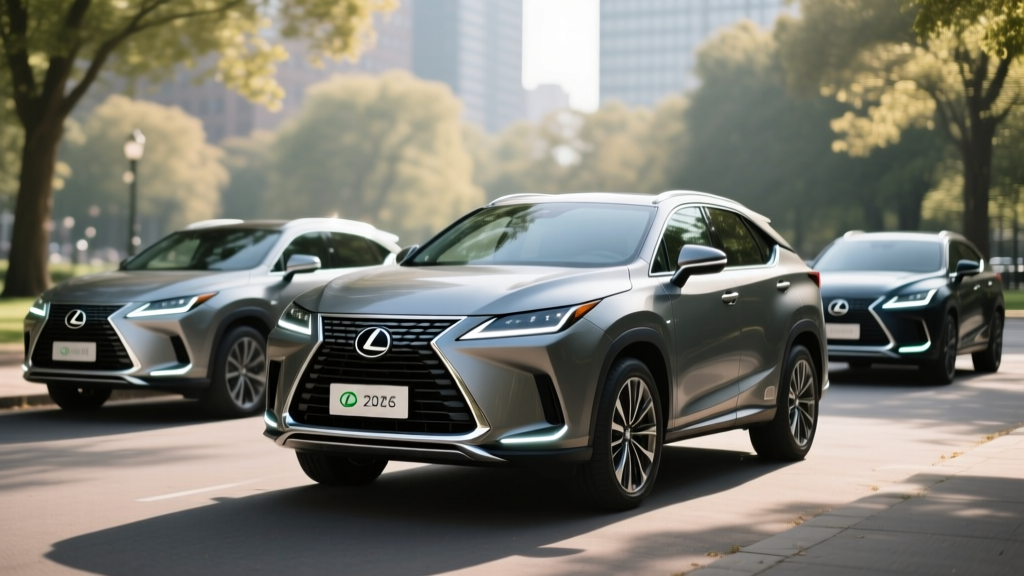
Lexus has built its reputation on hybrid powertrains longer than almost any other luxury brand. For 2026, the Lexus SUVs hybrid lineup spans four nameplates — the compact UX 300h, the midsize NX 350h and NX 450h+, the popular RX 350h and RX 450h+, and the three-row TX 500h. Each blends a gasoline engine with electric motors, but the details matter: some are conventional hybrids (HEVs) you never plug in, while others are plug-in hybrids (PHEVs) that drive 37+ miles on electricity alone before the engine wakes up.
This guide breaks down every 2026 Lexus SUVs hybrid model with exact EPA MPG figures, PHEV electric-only range, powertrain specs, pricing, tax-credit eligibility, and real-world ownership insights so you can pick the right one.
HEV vs PHEV: Which Lexus Hybrid Is Which?
Before diving into individual models, the single most important distinction in the Lexus SUVs hybrid range is the difference between a conventional hybrid and a plug-in hybrid.
| Feature | Conventional Hybrid (HEV) | Plug-In Hybrid (PHEV) |
|---|---|---|
| Plug in to charge? | No — charges via regenerative braking and engine | Yes — plug in for full electric range |
| Battery size | ~1–2 kWh (small buffer) | ~18 kWh usable |
| Electric-only driving | Brief low-speed assist only | 37–38 miles at highway speeds |
| EPA fuel economy | Measured in MPG combined | MPGe (electric phase) + MPG (hybrid phase) |
| Federal tax credit | Not eligible (§30D excludes HEVs) | Up to $7,500 if sourcing/income rules met |
| 2026 Lexus models | UX 300h, NX 350h, RX 350h, TX 500h | NX 450h+, RX 450h+ |
If you lack access to a home charger or a reliable Level 2 outlet, an HEV is the pragmatic choice — you simply fuel up with gasoline and the hybrid system handles the rest. If you can charge at home or at work, a PHEV lets you complete most daily commutes on electricity while keeping a gas engine for longer road trips.
The 2026 Lexus SUVs Hybrid Lineup at a Glance
| Model | Type | Powertrain | Combined HP | EPA MPG (City/Hwy/Comb) | PHEV EV Range | Starting MSRP |
|---|---|---|---|---|---|---|
| UX 300h | HEV | 2.0L I4 + 2 motors (FWD) / 3 motors (AWD) | 196 hp | 43 / 41 / 42 | — | $39,390 |
| NX 350h | HEV | 2.5L I4 + 3 motors (AWD e-CVT) | 240 hp | 41 / 37 / 39 | — | $44,665 |
| NX 450h+ | PHEV | 2.5L I4 + 3 motors (AWD e-CVT) | 304 hp | 38 comb (hybrid) / 84 MPGe | 37 mi | $49,565 |
| RX 350h | HEV | 2.5L I4 + 3 motors (AWD e-CVT) | 246 hp | 37 / 34 / 36 | — | $52,810 |
| RX 450h+ | PHEV | 2.5L I4 + 3 motors (AWD e-CVT) | 304 hp | 35 comb (hybrid) / 83 MPGe | 37 mi | $64,710 |
| TX 500h | HEV | 2.4L turbo I4 + 2 motors (DIRECT4 AWD) | 366 hp | 27 / 28 / 27 | — | $66,810 |
Source: EPA fueleconomy.gov and Lexus USA specifications. Prices are base MSRP before destination; actual dealer pricing may vary.
Fuel Economy Deep Dive: EPA Numbers and Real-World MPG
Lexus hybrids are engineered to maximize city efficiency, where regenerative braking and low-speed electric assist shine. That means real-world city MPG often exceeds the EPA sticker — especially in stop-and-go traffic where the engine shuts off frequently.
| Model | EPA City | EPA Highway | EPA Combined | Real-World Expectation |
|---|---|---|---|---|
| UX 300h | 43 | 41 | 42 | City: 44–47 mpg; Hwy: 38–40 mpg |
| NX 350h | 41 | 37 | 39 | City: 42–45 mpg; Hwy: 34–36 mpg |
| NX 450h+ (hybrid mode) | 38 | 37 | 38 | City: 39–41 mpg; Hwy: 35–37 mpg |
| RX 350h | 37 | 34 | 36 | City: 38–40 mpg; Hwy: 31–33 mpg |
| RX 450h+ (hybrid mode) | 35 | 34 | 35 | City: 36–38 mpg; Hwy: 32–34 mpg |
| TX 500h | 27 | 28 | 27 | City: 25–28 mpg; Hwy: 26–29 mpg |
Highway driving is where hybrids lose their advantage relative to city use. At sustained 70–80 mph speeds, the gasoline engine does nearly all the work and aerodynamic drag dominates. Expect highway fuel economy to land 2–4 mpg below the EPA city figure on most models.
The TX 500h, as the largest and heaviest model with a turbocharged engine tuned for performance (366 hp), delivers modest hybrid efficiency — think of it as a powertrain that prioritizes acceleration and towing over fuel savings. If maximum MPG is the goal, the UX 300h at 42 mpg combined is the clear efficiency leader.
PHEV Electric-Only Range: NX 450h+ and RX 450h+
The two plug-in models in the Lexus SUVs hybrid lineup — the NX 450h+ and RX 450h+ — share a similar architecture: an 18.1 kWh lithium-ion battery pack (nickel-metal hydride chemistry has been phased out for PHEV models) paired with a 2.5-liter four-cylinder engine and three electric motors for standard all-wheel drive.
| Spec | NX 450h+ | RX 450h+ |
|---|---|---|
| Usable battery capacity | ~14.5 kWh (of 18.1 kWh total) | ~14.5 kWh (of 18.1 kWh total) |
| EPA electric-only range | 37 miles | 37 miles |
| EPA MPGe (electric phase) | 84 MPGe | 83 MPGe |
| Total range (EV + gas) | ~545 miles | ~520 miles |
| Level 2 charge time (0–100%) | ~3.0 hours at 6.6 kW | ~3.0 hours at 6.6 kW |
| DC fast charging | Not supported | Not supported |
| Onboard charger | 6.6 kW | 6.6 kW |
A critical limitation: neither PHEV supports DC fast charging. You can only charge via Level 1 (120V household outlet, ~9 hours to full) or Level 2 (240V, ~3 hours). This means public fast-charging networks like Electrify America or Tesla Superchargers are irrelevant for these vehicles — home or workplace Level 2 charging is where you'll refuel.
In real-world driving, the 37-mile EPA electric range holds up reasonably well in moderate temperatures (50–80°F) with mixed city/suburban use. In cold weather (below 30°F), expect that range to drop to roughly 28–32 miles due to cabin heating demands and reduced battery efficiency. Highway-only electric driving at 75 mph may yield 30–33 miles.
Lexus Hybrid Battery Warranty
All 2026 Lexus hybrids and PHEVs carry a hybrid battery warranty of 10 years or 150,000 miles (whichever comes first), transferable to subsequent owners. This covers the high-voltage traction battery against defects and excessive capacity loss. The hybrid system components (inverter, electric motors, control module) are also covered for 8 years / 100,000 miles.
For PHEV models, the §30D federal tax credit requires the battery to meet critical-mineral and battery-component sourcing thresholds set by the IRS. Verify current eligibility at irs.gov.
Powertrain Performance: Horsepower and 0–60 Times
Lexus hybrid SUVs aren't typically purchased for straight-line speed, but the PHEV models and the turbo-hybrid TX 500h deliver genuinely quick acceleration thanks to instant electric-motor torque.
| Model | Engine | Combined HP | Torque (lb-ft) | 0–60 mph (est.) | Drivetrain |
|---|---|---|---|---|---|
| UX 300h | 2.0L I4 | 196 | ~155 | 7.9 sec | FWD or AWD |
| NX 350h | 2.5L I4 | 240 | ~176 | 7.2 sec | AWD (e-CVT) |
| NX 450h+ | 2.5L I4 | 304 | ~266 | 6.0 sec | AWD (e-CVT) |
| RX 350h | 2.5L I4 | 246 | ~233 | 7.4 sec | AWD (e-CVT) |
| RX 450h+ | 2.5L I4 | 304 | ~266 | 6.2 sec | AWD (e-CVT) |
| TX 500h | 2.4L turbo I4 | 366 | 406 | 5.9 sec | DIRECT4 AWD |
The TX 500h's DIRECT4 all-wheel-drive system uses a rear electric motor ("e-Axle") to continuously vary torque distribution between front and rear, improving both traction and handling dynamics. It's the only Lexus hybrid SUV with a turbocharged engine, which explains the 406 lb-ft of torque — a figure useful for the TX's 5,000-lb towing capacity.
Pricing, Trims, and Federal Tax Credit Eligibility
Here's where the distinction between HEV and PHEV matters for your wallet. Under current IRS §30D rules, conventional hybrids (HEVs) do not qualify for any federal clean-vehicle tax credit. Only the PHEV models — the NX 450h+ and RX 450h+ — are potentially eligible.
| Model | Base MSRP | Top Trim MSRP (est.) | §30D Tax Credit Potential |
|---|---|---|---|
| UX 300h | $39,390 | $47,500 | Not eligible (HEV) |
| NX 350h | $44,665 | $56,000 | Not eligible (HEV) |
| NX 450h+ | $49,565 | $61,500 | Up to $7,500* |
| RX 350h | $52,810 | $65,000 | Not eligible (HEV) |
| RX 450h+ | $64,710 | $76,000 | Up to $7,500* |
| TX 500h | $66,810 | $78,500 | Not eligible (HEV) |
*The §30D credit is subject to multiple requirements for 2026:
- MSRP cap: SUVs must be under $80,000 MSRP. Both Lexus PHEVs qualify at base; fully loaded RX 450h+ trims may approach the cap.
- Buyer income cap: Modified AGI must not exceed $150,000 (single), $225,000 (head of household), or $300,000 (joint).
- Battery sourcing: A percentage of critical minerals and battery components must be sourced from the U.S. or FTA partners. These thresholds increase annually. Check the latest IRS guidance before purchase.
- Point-of-sale transfer: You can elect to transfer the credit to the dealer at purchase, reducing your out-of-pocket cost directly — rather than waiting to claim it on your tax return.
Because battery-sourcing rules tighten each year, a PHEV that qualified for the full $7,500 in 2024 may qualify for only $3,750 or nothing in 2026 depending on where its battery cells and minerals originate. Always confirm with your dealer and a tax professional before relying on the credit.
Reliability, Battery Longevity, and Replacement Cost
Lexus consistently ranks at or near the top of dependability studies from J.D. Power and Consumer Reports, and its hybrid powertrains are a major reason why. Toyota/Lexus has produced hybrids since the 1997 Prius, and the institutional knowledge shows: hybrid system failures are rare, and the planetary-gear e-CVT transmission has no belts, clutches, or bands to wear out.
For the high-voltage battery, Lexus's 10-year / 150,000-mile warranty is among the strongest in the industry. Real-world data from Lexus and Toyota hybrids suggests that nickel-metal hydride and lithium-ion hybrid batteries typically retain 85–90% of their original capacity after 150,000 miles when the vehicle is maintained normally.
If a hybrid battery does require replacement out of warranty, costs vary by model:
- UX 300h / NX 350h / RX 350h (HEV): $2,500–$4,500 for the traction battery pack (smaller capacity, lower cost).
- NX 450h+ / RX 450h+ (PHEV): $6,000–$9,000 for the larger 18.1 kWh pack.
- TX 500h: $3,500–$5,500 (moderate-size pack with turbo-hybrid system).
These are ballpark figures from dealer and independent hybrid-repair sources; actual costs depend on labor rates and whether refurbished packs are available. In practice, the vast majority of Lexus hybrid owners will sell or trade the vehicle long before a battery replacement becomes necessary.
Hybrid vs PHEV vs Full EV: Which Fits Your Life?
Choose a Lexus HEV (UX 300h, NX 350h, RX 350h, TX 500h) if:
- You don't have reliable access to a Level 2 charger at home or work
- You want maximum simplicity — no charging cables, no apps, no range planning
- You drive mostly in the city, where hybrid efficiency peaks
- You want Lexus reliability with a lower purchase price than a PHEV or EV
Choose a Lexus PHEV (NX 450h+, RX 450h+) if:
- You can install or access a Level 2 (240V) charger for daily use
- Your daily commute is under 35 miles round-trip (cover it entirely on electricity)
- You want to reduce gasoline consumption without committing to a full EV
- You may qualify for the §30D tax credit, narrowing the price gap with the HEV
Consider a full EV instead if:
- You want zero tailpipe emissions and minimal drivetrain maintenance
- You have home charging and your daily driving is within EV range
- You want access to DC fast charging for road trips (neither Lexus PHEV supports DCFC)
- Models like the Tesla Model Y, Hyundai Ioniq 5, or BMW iX better fit your tech and charging-speed priorities
Pros of Lexus SUVs Hybrid
- Best-in-class reliability track record for hybrid systems
- UX 300h delivers 42 MPG combined — exceptional for a luxury SUV
- 10-year / 150,000-mile hybrid battery warranty
- PHEV models offer 37 miles EV range plus 500+ total range
- Smooth, quiet e-CVT operation with no shift shock
- Strong resale value across the Lexus lineup
Cons of Lexus SUVs Hybrid
- No DC fast charging on PHEV models — limits public charging utility
- TX 500h's 27 MPG combined is modest for a hybrid (turbo performance trade-off)
- HEV models ineligible for federal tax credits
- Infotainment system less advanced than some competitors
- PHEV pricing premium of $5,000–$12,000 over equivalent HEV trims
- Electric-only range of 37 miles trails some rivals (e.g., Toyota RAV4 Prime at 42 mi)
Frequently Asked Questions
How many MPG does the most efficient Lexus hybrid SUV get?
The 2026 UX 300h leads the lineup at 42 MPG combined (43 city / 41 highway) per the EPA. In real-world city driving with frequent stops, owners commonly report 44–47 MPG. The larger NX 350h achieves 39 MPG combined, and the RX 350h delivers 36 MPG combined.
How far can a Lexus PHEV SUV drive on electric power alone?
Both the NX 450h+ and RX 450h+ are EPA-rated at 37 miles of electric-only range. In moderate weather with city and suburban driving, you can expect to match or slightly exceed that figure. In cold weather or at sustained highway speeds, plan for 28–33 miles of EV range before the gasoline engine engages.
Do Lexus hybrid SUVs need to be plugged in?
Conventional hybrid (HEV) models — the UX 300h, NX 350h, RX 350h, and TX 500h — do not plug in. They recharge their small batteries through regenerative braking and the gasoline engine. Only the PHEV models (NX 450h+, RX 450h+) benefit from being plugged into a Level 2 charger to unlock their full electric-only range.
Is the Lexus hybrid battery reliable, and what does replacement cost?
Lexus hybrid batteries are among the most reliable in the industry, backed by a 10-year / 150,000-mile warranty. Most owners never need a replacement. If one is needed out of warranty, HEV battery packs run $2,500–$5,500 and PHEV packs run $6,000–$9,000 depending on the model.
Do any Lexus hybrid SUVs qualify for the federal tax credit?
Only the PHEV models (NX 450h+ and RX 450h+) are potentially eligible for the §30D federal clean-vehicle tax credit of up to $7,500. Eligibility depends on your income, the vehicle's MSRP (under $80,000 for SUVs), and battery-component and critical-mineral sourcing requirements that tighten each year. Confirm current eligibility at irs.gov and with a qualified tax professional. Conventional HEV models are not eligible.
Which Lexus hybrid SUV has the most cargo space?
The TX 500h offers three-row seating and the most cargo volume in the lineup, with approximately 97 cubic feet behind the front seats. The RX models provide roughly 46 cu ft behind the front row, and the NX models offer around 47 cu ft. The UX 300h is the most compact at approximately 21.7 cu ft behind the rear seats.
Can a Lexus PHEV tow, and how does it compare to the HEV versions?
The NX 450h+ is rated to tow up to 2,000 lbs, and the RX 450h+ up to 3,500 lbs. The TX 500h leads the lineup at 5,000 lbs thanks to its turbo-hybrid powertrain. PHEV models generally match or slightly exceed their HEV counterparts in towing capacity due to the added electric-motor torque.