The Lexus SUV Plug-In Hybrid Lineup for 2026
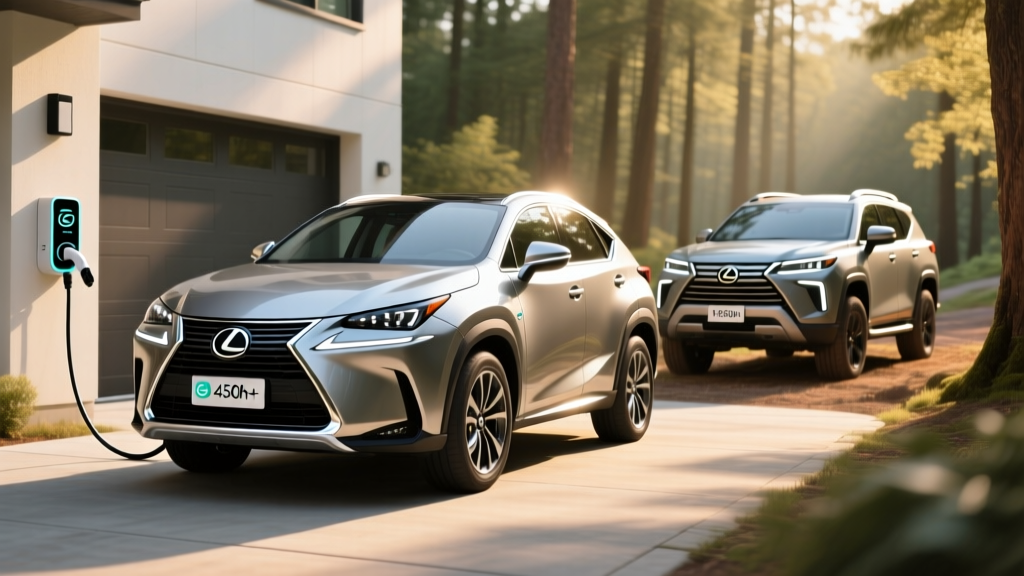
Lexus offers two plug-in hybrid SUVs in the US market: the compact NX 450h+ and the three-row TX 550h+. Both pair a gasoline engine with a larger battery pack than their conventional-hybrid siblings, enabling 30+ miles of electric-only driving before the engine takes over. For buyers who want electric commuting without range anxiety on longer trips, the Lexus SUV plug-in hybrid lineup occupies a specific middle ground between a standard hybrid and a full battery-electric vehicle.
This guide breaks down exact EPA figures, real-world expectations, battery specs, charging logistics, pricing, and federal tax credit eligibility for both models — so you can decide which (if either) fits your driving pattern.
HEV vs PHEV: What's the Difference in the Lexus Lineup?
Lexus sells both conventional hybrids and plug-in hybrids across its SUV range. The distinction matters for your wallet and your daily routine.
| Feature | Conventional Hybrid (HEV) | Plug-In Hybrid (PHEV) |
|---|---|---|
| Battery size | ~1–2 kWh | 18.1 kWh (NX) / 20.2 kWh (TX) |
| Electric-only range | None (EV assist only) | 33–37 miles EPA |
| Plug-in charging | Not required or possible | Required to access EV range |
| Level 1 (120V) charge | N/A | ~10–12 hours |
| Level 2 (240V) charge | N/A | ~2.5–4 hours |
| DC fast charging | N/A | Not available on either model |
| Federal tax credit (§30D) | Not eligible | Potentially up to $7,500* |
| Example models | NX 350h, TX 500h | NX 450h+, TX 550h+ |
*Eligibility depends on income, MSRP, and battery sourcing rules. See tax credit section below.
The key takeaway: if you never plan to plug in, a conventional Lexus hybrid like the NX 350h (39 MPG combined) will serve you well. But if you have home or workplace charging and a commute under 35 miles, the PHEV versions let you drive most weekdays on electricity alone — with the gas engine as backup for road trips.
NX 450h+: Compact Lexus SUV Plug-In Hybrid
The NX 450h+ is the brand's best-selling plug-in hybrid and one of the few luxury compact PHEV SUVs with meaningful electric-only range. It shares its powertrain architecture with the Toyota RAV4 Prime but in a more refined package.
| Specification | NX 450h+ (2026) |
|---|---|
| Powertrain | 2.5L 4-cyl + 2 electric motors (AWD) |
| Combined horsepower | 304 hp |
| Battery capacity | 18.1 kWh (lithium-ion) |
| EPA electric-only range | 37 miles |
| EPA MPGe (EV mode) | 84 MPGe combined |
| EPA MPG (hybrid mode, after battery) | 36 MPG combined |
| 0–60 mph | 6.0 seconds |
| Max Level 2 charge rate | 6.6 kW |
| Level 2 charge time (0–100%) | ~2.5 hours |
| DC fast charging | Not supported |
| Base MSRP (Luxury trim) | ~$60,700 |
| Battery warranty | 10 years / 150,000 miles |
Real-World Range and MPG
The EPA rates the NX 450h+ at 37 miles of electric-only range. In real-world driving, expect 32–35 miles in mixed suburban/highway conditions and closer to 28–30 miles in sustained highway driving above 65 mph or in temperatures below 40°F. Cold weather reduces lithium-ion efficiency and cabin heating draws significant power, cutting EV range by 15–25%.
Once the battery depletes, the NX 450h+ operates as a conventional hybrid at 36 MPG combined (38 city / 33 highway per the EPA). Lexus hybrids tend to meet or slightly exceed EPA city figures in real-world stop-and-go driving thanks to aggressive regenerative braking. Highway MPG may fall 1–2 MPG below the sticker at sustained 75+ mph speeds.
Source: fueleconomy.gov — Lexus NX 450h+
TX 550h+: Three-Row Lexus SUV Plug-In Hybrid
The TX 550h+ is the only three-row plug-in hybrid SUV Lexus offers, targeting families who need seating for six or seven but want electric commuting capability.
| Specification | TX 550h+ (2026) |
|---|---|
| Powertrain | 3.5L V6 + electric motors (AWD) |
| Combined horsepower | 406 hp |
| Battery capacity | 20.2 kWh (lithium-ion) |
| EPA electric-only range | 33 miles |
| EPA MPGe (EV mode) | 76 MPGe combined |
| EPA MPG (hybrid mode, after battery) | 29 MPG combined |
| 0–60 mph | 5.7 seconds |
| Max Level 2 charge rate | 6.6 kW |
| Level 2 charge time (0–100%) | ~4 hours |
| DC fast charging | Not supported |
| Base MSRP (Luxury trim) | ~$75,800 |
| Battery warranty | 10 years / 150,000 miles |
Real-World Range and MPG
The TX 550h+ carries a heavier body and a larger vehicle footprint, which trims its electric-only range to 33 miles EPA. Expect 28–31 miles in real-world mixed driving, and 24–27 miles in cold weather or loaded with passengers and cargo.
In hybrid mode after the battery depletes, the TX 550h+ returns 29 MPG combined (28 city / 29 highway). For a 5,000-lb three-row SUV, that's competitive — compare it to the gas-only TX 350 at 23 MPG combined. Over 15,000 miles/year, the hybrid-mode fuel savings alone are meaningful, and the electric-only miles compound the benefit if you charge daily.
Source: fueleconomy.gov — Lexus TX 550h+
Charging the Lexus Plug-In Hybrids: What You Need to Know
Neither the NX 450h+ nor the TX 550h+ supports DC fast charging. This is a deliberate engineering choice — the battery packs are small enough that Level 2 charging fully replenishes them in a few hours, which covers overnight home charging and workplace top-ups.
| Charging Level | Power | NX 450h+ (0–100%) | TX 550h+ (0–100%) | Miles of EV Range Added per Hour |
|---|---|---|---|---|
| Level 1 (120V outlet) | ~1.4 kW | ~10–12 hours | ~12–14 hours | ~3–4 miles |
| Level 2 (240V, 32A) | 6.6 kW | ~2.5 hours | ~4 hours | ~12–14 miles |
| DC Fast Charge | N/A | Not supported | N/A | |
Home charging setup: A dedicated 240V Level 2 circuit (NEMA 14-50 or hardwired) is the practical path. Installation typically costs $500–$1,500 depending on panel proximity and local permitting, plus $300–$700 for a quality Level 2 EVSE (ChargePoint Home Flex, Emporia Level 2, or similar). If your electrical panel is maxed out, a panel upgrade can add $1,500–$3,000.
Cost per charge: At a national average electricity rate of $0.16/kWh, fully charging the NX 450h+ costs about $2.90 and the TX 550h+ about $3.23. That's roughly $0.08–$0.11 per electric mile — compared to $0.15–$0.20 per mile in a comparable gas SUV at $3.50/gallon.
Pricing, Trims, and Federal Tax Credit Eligibility
Both Lexus PHEVs carry premium price tags, but the federal tax credit can partially offset the cost — if you meet all requirements.
Current Pricing (2026 Model Year)
- NX 450h+ Luxury: ~$60,700 MSRP (plus destination)
- NX 450h+ Premium: ~$63,000 MSRP
- TX 550h+ Luxury: ~$75,800 MSRP
- TX 550h+ Premium: ~$79,000 MSRP
Federal Tax Credit (§30D) — Key Rules
- Maximum credit: Up to $7,500 (split between battery components and critical minerals)
- MSRP cap: SUVs must be ≤$80,000 MSRP — both models qualify on most trims, but loaded TX 550h+ Premium packages may exceed the cap
- Buyer income cap: AGI ≤$150,000 (single), ≤$225,000 (head of household), ≤$300,000 (joint)
- Battery sourcing: Critical minerals and battery components must meet phased-in percentages from US or FTA-partner countries — this requirement tightens annually and may reduce the credit to $3,750 or $0 depending on the specific model year's supply chain compliance
- Point-of-sale transfer: Eligible buyers can apply the credit as a down payment reduction at the dealer (effective 2024+)
Important: Lexus plug-in hybrids have faced variable credit eligibility as battery sourcing rules tighten. Before purchasing, verify the specific vehicle's credit status on the fueleconomy.gov tax credit lookup and consult a tax professional. Never assume a flat $7,500 credit applies — the actual amount depends on sourcing compliance in the model year you buy.
Battery Warranty, Reliability, and Replacement Costs
Lexus Hybrid Battery Warranty: 10 years or 150,000 miles (whichever comes first), covering defects and capacity loss below a specified threshold (typically 70% of original capacity). This applies to both the NX 450h+ and TX 550h+ traction batteries.
Lexus (and parent company Toyota) has the longest track record in hybrid powertrains of any automaker — over 25 years since the original Prius. The brand's hybrid reliability ratings consistently rank at or near the top in J.D. Power and Consumer Reports data.
Battery degradation reality: Lexus PHEV battery packs are designed with conservative charge/discharge buffers. The usable 18.1 kWh (NX) and 20.2 kWh (TX) figures already exclude top and bottom buffer zones that protect the cells from deep cycling. Expect 8–12% total capacity loss over the first 100,000 miles based on historical Toyota/Lexus hybrid data — meaning your 37-mile EV range might become 33–34 miles after a decade. This is gradual and rarely noticeable month-to-month.
Replacement cost if out of warranty: A Lexus PHEV traction battery replacement currently runs $8,000–$12,000 including labor. This is significantly less than a full BEV battery replacement ($15,000–$25,000+) because the pack is much smaller. However, given Lexus's hybrid reliability history and the 10-year warranty, most original owners will never face this cost.
NX 450h+ vs TX 550h+: Which Lexus Plug-In Hybrid Fits You?
| Category | NX 450h+ | TX 550h+ |
|---|---|---|
| Best for | Commuters, couples, small families | Families needing 3 rows |
| EV range | 37 mi EPA | 33 mi EPA |
| Hybrid MPG | 36 combined | 29 combined |
| Horsepower | 304 hp | 406 hp |
| Cargo (behind 2nd row) | 22.7 cu ft | 57.6 cu ft |
| Seating | 5 passengers | 6–7 passengers |
| Starting MSRP | ~$60,700 | ~$75,800 |
| Towing capacity | 2,000 lbs | 5,000 lbs |
Choose the NX 450h+ if: Your daily commute is under 35 miles, you don't need a third row, you prioritize fuel efficiency and a lower purchase price, and you want the best electric range in the Lexus PHEV lineup.
Choose the TX 550h+ if: You regularly carry more than five passengers, need 5,000-lb towing, want V6 power, and can accept slightly lower EV range and MPG in exchange for three-row versatility.
Choose a full EV instead if: You have reliable home charging, your daily driving rarely exceeds 250 miles, you want zero gasoline maintenance, and you're ready to plan around DC fast charging on road trips. Consider the Tesla Model Y, Hyundai Ioniq 5, or BMW iX.
Choose a conventional hybrid (NX 350h / TX 500h) instead if: You cannot charge at home or work. A PHEV you never plug in is just a heavier, more expensive hybrid — you'll pay extra for battery capacity you never use.
Pros and Cons of Lexus Plug-In Hybrid SUVs
Pros
- 33–37 miles of electric-only range covers most commutes
- No range anxiety — gas engine provides 400+ total miles
- Excellent reliability track record from Toyota/Lexus hybrid systems
- 10-year/150,000-mile battery warranty
- 304–406 hp provides confident acceleration
- Level 2 charging fully replenishes in 2.5–4 hours
- Potential $7,500 federal tax credit (eligibility varies)
Cons
- No DC fast charging — limits road-trip EV utility
- Premium pricing ($60K–$79K) before incentives
- Tax credit eligibility uncertain due to battery sourcing rules
- EV range drops 15–25% in cold weather
- Heavier than conventional hybrid versions, reducing hybrid-mode MPG slightly
- 6.6 kW max charge rate is modest — fine for overnight, slow for midday top-ups
Frequently Asked Questions
How many MPG does the Lexus SUV plug-in hybrid get?
After the electric range depletes, the NX 450h+ returns an EPA-rated 36 MPG combined (38 city / 33 highway). The TX 550h+ returns 29 MPG combined (28 city / 29 highway). In electric-only mode, they're rated at 84 MPGe and 76 MPGe respectively. Real-world hybrid-mode MPG tends to meet or slightly beat EPA city estimates in stop-and-go traffic.
How far can the Lexus plug-in hybrid go on electric only?
The NX 450h+ achieves 37 miles EPA electric-only. The TX 550h+ achieves 33 miles EPA. Real-world figures are typically 28–35 miles depending on temperature, speed, and terrain. Total combined range (electric + gas tank) exceeds 450 miles in the NX and 420 miles in the TX.
Does the Lexus plug-in hybrid qualify for a tax credit?
Both models may qualify for up to $7,500 under the IRS §30D federal tax credit, but eligibility depends on your income (≤$300K joint), the vehicle's MSRP (≤$80K for SUVs), and battery component/critical mineral sourcing requirements that tighten each year. Check IRS.gov clean vehicle credits and the specific VIN on fueleconomy.gov before purchasing. The credit can be transferred to the dealer at point of sale as a price reduction.
Is the Lexus plug-in hybrid reliable? What about battery replacement?
Lexus/Toyota hybrid systems have the strongest long-term reliability record in the industry. The traction battery is warranted for 10 years / 150,000 miles. Out-of-warranty replacement runs $8,000–$12,000, but historical data suggests most Lexus hybrid batteries last well beyond 150,000 miles with minimal degradation. The smaller battery in a PHEV (vs a full EV) also means lower replacement cost if it ever becomes necessary.
Do I need to plug in a Lexus plug-in hybrid?
To access the electric-only range, yes — you need to plug in via a standard 120V outlet (slow, ~10+ hours) or a 240V Level 2 charger (recommended, 2.5–4 hours). If you never plug in, the vehicle still operates as a conventional hybrid using the gas engine, but you're carrying the weight and cost of a battery you're not utilizing. If you can't charge regularly, a conventional Lexus hybrid (NX 350h, TX 500h) is a better financial choice.
Hybrid vs PHEV vs EV — which should I choose?
Conventional hybrid (HEV): Best if you can't charge at home, drive long distances frequently, and want maximum MPG with zero behavior change. Plug-in hybrid (PHEV): Best if you have home/work charging and a commute under 35 miles but also take regular road trips where EV charging infrastructure is sparse. Full EV: Best if you have reliable home charging, mostly drive under 250 miles daily, want the lowest per-mile fuel cost, and are comfortable planning DC fast-charge stops on longer trips.
Can the Lexus PHEV fast-charge on road trips?
No. Neither the NX 450h+ nor the TX 550h+ supports DC fast charging. On road trips, you'll drive in hybrid mode using gasoline. This is actually practical — you simply fill up at any gas station and keep driving. The tradeoff is that you can't top up the battery at highway charging stations to regain EV miles during a trip.