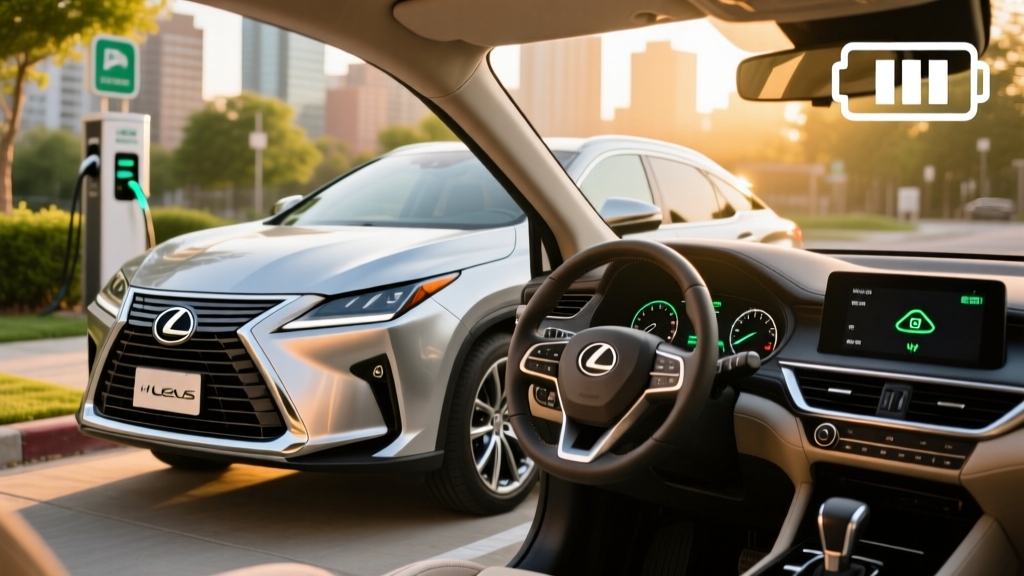
The 2017 Lexus RX 450h occupies a specific niche in the electrified-vehicle landscape: a luxury midsize SUV that sips fuel without asking its owner to plug in, change driving habits, or worry about charging infrastructure. Nearly a decade after its debut, this fourth-generation RX hybrid remains one of the most sought-after vehicles on the used market, and for good reason. With a combined EPA rating of 30 MPG, 308 combined horsepower, and Lexus's reputation for long-term reliability, the 2017 RX 450h is a case study in what conventional hybrid (HEV) technology does best.
This guide breaks down every number a prospective used buyer needs — from real-world fuel economy and battery longevity to current ownership costs and how the RX 450h stacks up against plug-in hybrids and full battery-electric vehicles available today.
HEV vs PHEV vs EV: Where the RX 450h Fits
Before diving into specs, it is essential to understand what the 2017 RX 450h is — and what it is not. This is a conventional hybrid (HEV), sometimes called a self-charging hybrid. It pairs a gasoline engine with electric motors and a small battery that recharges through regenerative braking and the engine itself. There is no plug, no electric-only driving range to manage, and no charging station dependency.
| Feature | HEV (RX 450h) | PHEV (e.g., current RX 500h+ equivalent) | BEV (e.g., Tesla Model X) |
|---|---|---|---|
| Plug-in required? | No | Yes (optional benefit) | Yes (mandatory) |
| Electric-only range | None (motor assists engine) | Typically 25–40 mi | 250–350+ mi |
| Battery size | ~1.6 kWh (NiMH) | ~18–22 kWh (Li-ion) | 75–100+ kWh (Li-ion) |
| Fuel/energy source | Gasoline only | Gasoline + grid electricity | Grid electricity only |
| Tailpipe emissions | Reduced vs gas-only | Zero in EV mode | Zero |
| Home charger needed? | No | Recommended for EV benefit | Essential |
Lexus did not offer a plug-in variant of the fourth-generation RX (2016–2022) in the United States. The RX 450h was the sole electrified option until the redesigned 2023 RX introduced the RX 500h (performance hybrid) and RX 450h+ (plug-in hybrid). If you are shopping the 2017 model year specifically, you are looking at a pure HEV.
Fuel Economy: EPA Ratings and Real-World MPG
The headline number for the 2017 RX 450h is its EPA-estimated combined fuel economy. Here is the full breakdown, sourced from fueleconomy.gov:
| Driving Cycle | EPA Estimate | Real-World Expectation |
|---|---|---|
| City | 31 MPG | 30–33 MPG (hybrids often beat EPA in city) |
| Highway | 28 MPG | 25–28 MPG (less regen benefit at sustained speed) |
| Combined | 30 MPG | 27–31 MPG depending on driving mix |
Conventional hybrids like the RX 450h tend to exceed their EPA city estimate in stop-and-go traffic, where regenerative braking recovers the most energy and the electric motor handles low-speed propulsion. Highway driving is the opposite story: at 70–80 mph, the gasoline engine does most of the work, and aerodynamic drag dominates. Expect highway fuel economy to dip to the mid-to-high 20s, particularly with all-wheel drive engaged or with a full cargo load.
For comparison, the gas-only 2017 RX 350 AWD is rated at 19 city / 26 highway / 22 combined — making the 450h roughly 36% more efficient in combined driving. Over 15,000 annual miles, that translates to approximately 120 fewer gallons of fuel per year, or roughly $400–$500 in annual savings at $3.50/gallon.
Powertrain and Performance Specs
| Specification | 2017 Lexus RX 450h |
|---|---|
| Engine | 3.5L V6 Atkinson-cycle |
| Engine output | 262 hp @ 6,000 rpm / 247 lb-ft @ 4,800 rpm |
| Electric motors | Front: 123 kW / Rear: 50 kW (AWD models) |
| Combined system output | 308 hp |
| Transmission | eCVT (electronically controlled continuously variable) |
| Drivetrain | AWD standard (electric rear axle, no mechanical driveshaft) |
| 0–60 mph | 7.7 seconds (Car and Driver tested) |
| Hybrid battery | ~1.6 kWh, Nickel-Metal Hydride (NiMH) |
| Curb weight | ~4,775 lbs |
| Towing capacity | 3,500 lbs (when properly equipped) |
The RX 450h uses Toyota's Hybrid Synergy Drive system with a key distinction: the AWD model (which is the only configuration sold in the US) employs a separate rear-mounted electric motor rather than a mechanical driveshaft connecting front and rear axles. This "e-AWD" system provides torque to the rear wheels during acceleration and low-traction situations, improving stability without the weight and friction losses of a traditional AWD system.
The Atkinson-cycle V6 sacrifices some low-end torque for greater thermal efficiency — the engine's intake valve stays open longer during the compression stroke, effectively reducing displacement while maintaining the power stroke. Combined with the instant torque from the electric motors, the result is smooth, adequate acceleration that never feels strained in normal driving.
Battery Longevity, Warranty, and Replacement Cost
The single most common question from used hybrid buyers concerns the traction battery. The 2017 RX 450h uses a Nickel-Metal Hydride (NiMH) battery pack — a chemistry Toyota/Lexus has deployed in millions of hybrids since the late 1990s. NiMH is less energy-dense than modern lithium-ion but is remarkably durable and thermally stable.
Factory Hybrid Battery Warranty
When new, the 2017 RX 450h's hybrid battery was covered by Lexus for 8 years / 100,000 miles (whichever comes first) in most states, and 10 years / 150,000 miles in California and states that adopted California Air Resources Board (CARB) emissions standards. As of 2026, most original 8-year warranties have expired unless the vehicle was purchased late in the model year or had low mileage. However, the 10-year CARB-state warranty may still apply to qualifying vehicles.
Real-world battery lifespan: NiMH packs in Toyota/Lexus hybrids routinely last 150,000–200,000+ miles before significant capacity loss. Degradation in a conventional hybrid is far less consequential than in a BEV because the battery is small and the system is designed to operate within a narrow state-of-charge window (typically 40–80%), which dramatically reduces stress on the cells. Many RX 450h examples have surpassed 200,000 miles on the original battery with minimal fuel-economy loss.
Replacement cost: If the hybrid battery does fail, a new OEM replacement from Lexus typically costs between $3,500 and $5,500 including parts and labor at a dealership. Independent hybrid specialists often offer reconditioned or remanufactured packs for $2,000–$3,500. Third-party options and individual cell-module replacements can bring costs below $1,500 for mechanically inclined owners. This is a fraction of the $10,000–$20,000+ battery replacement costs associated with large BEV packs.
Pricing, Tax Credits, and Ownership Economics
As a used vehicle in 2026, the 2017 RX 450h is no longer eligible for the federal §30D new clean vehicle tax credit (that credit applied only to qualifying new purchases and was never available for conventional hybrids regardless — the §30D credit requires plug-in capability with a minimum battery capacity of 7 kWh). The RX 450h's ~1.6 kWh NiMH pack does not meet this threshold.
However, buyers should be aware of current incentives:
- Federal used EV credit (§25E): Up to $4,000 for qualifying used plug-in EVs and fuel-cell vehicles priced under $25,000. The RX 450h, as a conventional HEV, does not qualify.
- State-level incentives: A handful of states offer rebates or HOV-lane access for hybrids, but these vary widely and change frequently. Check your state's energy office or DMV for current programs.
- Insurance and maintenance: The RX 450h generally carries moderate insurance premiums for a luxury SUV. Maintenance costs are lower than the gas RX 350 over time due to regenerative braking reducing brake-pad wear and the absence of a traditional starter motor, alternator, or accessory belt.
Used-market pricing (2026 estimates): A well-maintained 2017 RX 450h with 70,000–100,000 miles typically lists between $22,000 and $30,000 depending on trim (base vs. F Sport vs. Luxury), condition, mileage, and region. Lower-mileage examples under 50,000 miles can command $32,000+.
Who Should Choose the RX 450h Over a PHEV or EV?
Choose the 2017 RX 450h (HEV) if:
- You lack access to home or workplace charging (apartment, street parking)
- You want lower fuel costs without any behavioral change — no plugging in, no route planning
- You drive a mix of city and highway miles and value consistent efficiency
- You want a proven, low-risk used luxury SUV with strong resale value
- Your daily commute is unpredictable in distance (no range planning needed)
Choose a PHEV (e.g., newer RX 450h+, RAV4 Prime) if:
- You can charge at home and have a short daily commute (under 35 miles) to drive mostly on electricity
- You want zero-emission local driving with gas-engine flexibility for road trips
- You're buying new or certified pre-owned and can leverage current tax credits
Choose a full BEV (e.g., Tesla Model Y, Genesis GV70 Electrified) if:
- You have reliable Level 2 home charging
- You want zero tailpipe emissions and the lowest per-mile energy cost
- You're ready to plan longer road trips around DC fast-charging infrastructure
The RX 450h's strongest argument in 2026 is its infrastructure independence. For buyers who cannot install a home charger, who live in areas with sparse public charging, or who simply want to refuel at any gas station and go, a conventional hybrid remains the most practical form of vehicle electrification. The fuel savings are real, the complexity is minimal, and the ownership experience is virtually identical to a gas car — just with fewer fuel stops.
Reliability and Known Issues
The fourth-generation RX platform (2016–2022) is widely regarded as one of the most reliable vehicles in the luxury midsize SUV segment. IIHS named the 2017 RX a Top Safety Pick, and Lexus consistently ranks at or near the top of J.D. Power's Vehicle Dependability Study.
Known issues specific to the 2017 RX 450h are few but worth noting for used buyers:
- Hybrid system inverter coolant pump: A small number of owners have reported inverter coolant pump failures, which can trigger hybrid-system warning lights. Replacement costs approximately $800–$1,200.
- 12V auxiliary battery drain: Like many modern vehicles, the RX 450h can experience 12V battery drain if left sitting for extended periods. This is the standard 12V battery (not the hybrid traction battery) and is a routine replacement item (~$200–$300).
- Infotainment system: The 2017 RX uses Lexus's Remote Touch Interface (RTI) joystick controller, which is widely criticized for being difficult to use while driving. This is a usability complaint, not a reliability issue, but it affects daily satisfaction.
- Brake actuator assembly: Some Toyota/Lexus hybrids of this era have had recalls related to the brake actuator. Check the NHTSA recall database with the specific VIN to confirm all recall campaigns have been performed.
Pros and Cons at a Glance
Pros
- 30 MPG combined — excellent for a 4,775-lb luxury AWD SUV
- No plug-in required; zero lifestyle change vs. gas car
- Proven NiMH hybrid battery with 200,000+ mi real-world lifespan
- 308 hp provides confident highway merging and passing
- Strong reliability record and high resale value
- Smooth, quiet ride with excellent cabin insulation
- Standard AWD with electric rear axle (no fuel-economy penalty)
Cons
- No electric-only driving capability — always burns some gasoline
- Dated infotainment system with frustrating joystick controller
- No federal tax credit eligibility (new or used)
- Higher used purchase price than gas-only RX 350
- Rear visibility compromised by thick C-pillars
- eCVT drone under hard acceleration (no fixed gear ratios)
- Original 8-year hybrid battery warranty likely expired by 2026
Frequently Asked Questions
How many MPG does the 2017 Lexus RX 450h get?
The EPA rates the 2017 RX 450h at 31 MPG city, 28 MPG highway, and 30 MPG combined. Real-world results typically range from 27–31 MPG depending on driving conditions. City-heavy commutes often yield results above the EPA estimate due to regenerative braking, while sustained highway driving at 75+ mph tends to return 25–27 MPG.
Does the 2017 RX 450h need to be plugged in?
No. The RX 450h is a conventional hybrid (HEV), not a plug-in hybrid (PHEV). Its small NiMH battery charges exclusively through regenerative braking and the gasoline engine. You simply fill it with gasoline like any other car.
How long does the hybrid battery last in the RX 450h?
Toyota/Lexus NiMH hybrid batteries commonly last 150,000–200,000+ miles. Because the system keeps the battery within a narrow state-of-charge window (roughly 40–80%), cell stress is minimized. Many RX 450h owners report original batteries functioning well past 180,000 miles with negligible fuel-economy degradation.
What does it cost to replace the RX 450h hybrid battery?
A new OEM battery from Lexus costs approximately $3,500–$5,500 installed. Remanufactured packs from independent hybrid shops run $2,000–$3,500. Individual cell-module repairs can cost under $1,500. Compared to BEV battery replacements ($10,000–$20,000+), hybrid battery service is relatively affordable.
Does the 2017 RX 450h qualify for any tax credit?
No. As a conventional hybrid, the RX 450h does not qualify for the federal §30D new vehicle credit (which requires plug-in capability and ≥7 kWh battery) or the §25E used clean vehicle credit. Some states may offer minor incentives for hybrids, but these vary by jurisdiction. Consult IRS.gov and your state energy office for current rules.
Is the 2017 RX 450h more reliable than a used EV?
Both have strong reliability arguments. The RX 450h benefits from decades of Toyota hybrid-system refinement and a simple NiMH battery. Used EVs eliminate engine, transmission, and exhaust maintenance but introduce concerns about battery degradation and charging-equipment compatibility. For buyers without home charging access, the RX 450h is the lower-risk choice.
What is the difference between the RX 450h and the newer RX 450h+?
The RX 450h+ (introduced for the 2023 model year) is a plug-in hybrid with a larger lithium-ion battery (~18.1 kWh), approximately 37 miles of electric-only range, and the ability to charge from a wall outlet. The 2017 RX 450h is a conventional hybrid with no plug-in capability and no electric-only mode. They share the hybrid philosophy but serve different use cases.
The 2017 Lexus RX 450h remains one of the smartest used purchases in the electrified-vehicle market. It delivers meaningful fuel savings, avoids the infrastructure dependencies of plug-in vehicles, and carries the reliability pedigree that has defined the RX nameplate for over two decades. For buyers who want electrification without complication, this hybrid SUV continues to make a compelling case.