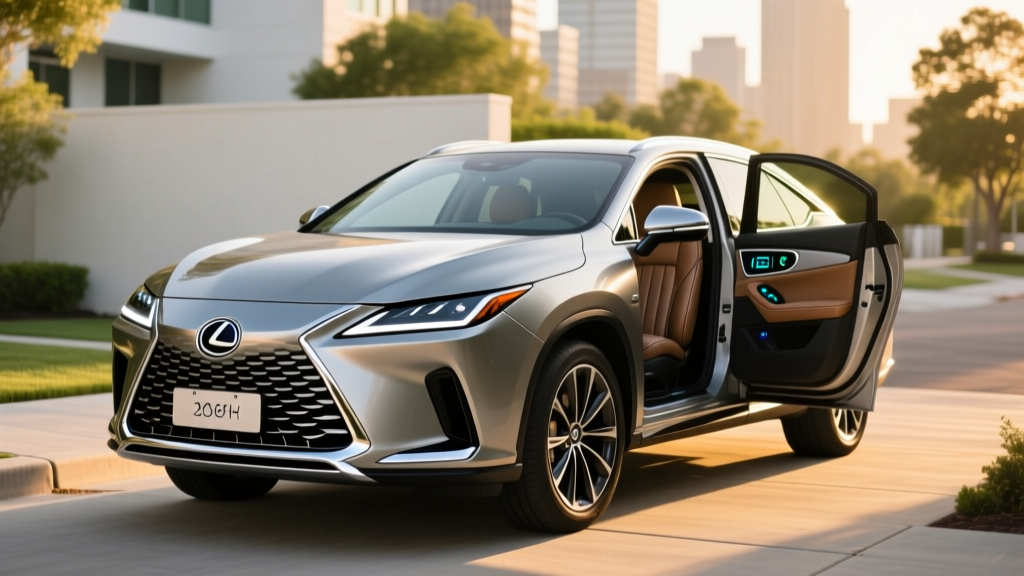
The midsize luxury SUV segment has no shortage of electrified options, but the Lexus RX 350h occupies a specific niche: buyers who want premium comfort, proven hybrid efficiency, and zero charging hassle. For 2026, the RX 350h continues as the conventional hybrid (HEV) variant of Lexus's best-selling nameplate, sitting below the plug-in hybrid RX 500h and the turbocharged RX 350 in the lineup. If you're researching the RX 350 hybrid for your next purchase, this guide covers every number that matters — from real-world MPG to battery longevity and total cost of ownership.
2026 Lexus RX 350h: Quick Verdict
The RX 350h pairs a 2.5-liter four-cylinder engine with Lexus's fourth-generation hybrid system to produce 366 combined system horsepower and an EPA-estimated 36 MPG combined. It requires no plug, no charging station hunting, and no behavior change from a conventional gas car. Starting at $52,750 (including destination), it undercuts the RX 500h PHEV by roughly $10,000 while delivering nearly identical city fuel economy. The trade-off: no electric-only driving mode and no eligibility for the federal §30D EV tax credit. For luxury SUV buyers who lack home charging access but want meaningful fuel savings, the RX 350h remains one of the most rational choices on the market.
| Specification | Value |
|---|---|
| Powertrain | 2.5L inline-4 + 2 electric motors (AWD) |
| Combined Horsepower | 366 hp |
| EPA Fuel Economy (City / Hwy / Combined) | 37 / 34 / 36 MPG |
| Fuel Tank Capacity | 17.2 gallons |
| Total Driving Range | ~619 miles (EPA est.) |
| 0–60 mph | 7.4 seconds (est.) |
| Drivetrain | Electronic AWD (eAWD) |
| Cargo Volume (behind rear seats) | 29.6 cu ft |
| Towing Capacity | 3,500 lbs |
| Base MSRP (Premium trim) | $52,750 |
| Hybrid Battery Warranty | 10 years / 150,000 miles |
HEV vs PHEV: Where the RX 350h Fits
Lexus offers the RX in three electrified configurations for 2026, and understanding the distinction is essential before you visit a dealer:
| Attribute | RX 350h (HEV) | RX 500h (PHEV — announced) | RX 350 (Gas Turbo) |
|---|---|---|---|
| Type | Conventional Hybrid | Plug-In Hybrid | Gasoline Only |
| Needs Plug-In Charging? | No | Yes | No |
| Electric-Only Range | None | ~37 miles (est.) | None |
| Combined MPG / MPGe | 36 MPG | ~35 MPG / ~65 MPGe | 25 MPG |
| System Horsepower | 366 hp | ~503 hp (est.) | 275 hp |
| Starting MSRP | $52,750 | $63,550 | $49,850 |
| Federal Tax Credit (§30D) | Not eligible | Up to $7,500 (if qualified) | Not eligible |
Conventional hybrid (HEV): The RX 350h's small nickel-metal hydride (NiMH) traction battery recharges entirely through regenerative braking and the gasoline engine. You never plug it in. The electric motors assist during acceleration and enable brief low-speed electric-only coasting, but there's no meaningful EV range.
Plug-in hybrid (PHEV): The RX 500h carries a larger lithium-ion battery pack (approximately 18.1 kWh usable) that you charge via a Level 2 home charger or public station, providing roughly 37 miles of electric-only driving before the gas engine engages. It qualifies for the federal §30D tax credit if you meet income, MSRP, and battery-sourcing requirements.
Fuel Economy: EPA Numbers and Real-World MPG
The EPA rates the 2026 RX 350h at 37 MPG city, 34 MPG highway, and 36 MPG combined. These figures hold across all trim levels because the powertrain is identical.
| Driving Condition | EPA Estimate | Real-World Expectation |
|---|---|---|
| City | 37 MPG | 36–40 MPG (hybrids excel in stop-and-go) |
| Highway | 34 MPG | 30–34 MPG (aero drag limits regen benefit) |
| Combined | 36 MPG | 33–37 MPG |
| Cold Weather (below 32°F) | — | 28–32 MPG (engine runs more for cabin heat) |
Like all Toyota/Lexus hybrids, the RX 350h tends to exceed its EPA city estimate in real-world stop-and-go driving because regenerative braking recaptures energy that a conventional car wastes as brake heat. Highway driving is the opposite story: at sustained 70–80 mph speeds, the gasoline engine does most of the work and aerodynamic drag reduces efficiency. In mixed suburban driving with moderate temperatures, owners commonly report 35–38 MPG on the trip computer.
At 36 MPG combined with a 17.2-gallon tank, the RX 350h delivers approximately 619 miles of total range — enough to drive from Los Angeles to San Francisco and back on a single tank. Compare that to the gas-only RX 350 at roughly 430 miles per fill-up, and the hybrid's advantage becomes tangible on road trips and daily commutes alike.
Powertrain and Driving Performance
The RX 350h's hybrid powertrain consists of a 2.5-liter Atkinson-cycle inline-four producing approximately 189 hp on its own, supplemented by two electric motor-generators — one driving the front axle and a second powering the rear axle for electronic all-wheel drive (eAWD). Combined system output is 366 hp, which is a substantial figure for a comfort-oriented luxury SUV.
The eAWD system doesn't use a mechanical driveshaft to the rear wheels. Instead, the rear electric motor engages automatically when the system detects front-wheel slip, during hard acceleration, or through certain corners. This means the RX 350h handles rain and light snow competently, though it isn't designed for off-road use.
Acceleration to 60 mph takes approximately 7.4 seconds — brisk enough for confident highway merging but not sporty by performance-SUV standards. The continuously variable transmission (eCVT) keeps the engine in its most efficient rpm range, which means you'll hear a drone under hard acceleration. In normal driving, the cabin remains well-insulated from powertrain noise, consistent with Lexus's luxury positioning.
Regenerative braking is moderate — Lexus does not offer a true one-pedal driving mode as you'd find in a full BEV. The brake pedal feel is among the better hybrid implementations, with a fairly linear transition between regenerative and friction braking.
Pricing, Trims, and Tax Credit Eligibility
The 2026 Lexus RX 350h is available in four trims, all sharing the same hybrid powertrain:
- Premium: $52,750 — 14-inch touchscreen, wireless Apple CarPlay/Android Auto, heated/ventilated front seats, power liftgate
- Premium+: $55,750 — adds panoramic moonroof, 21-inch wheels, ambient lighting
- Luxury: $59,250 — semi-aniline leather, heated rear seats, head-up display, Mark Levinson audio
- F SPORT Handling: $57,500 — sport-tuned suspension, F SPORT seats, aluminum pedals, unique styling
All prices include the $1,350 destination charge. Options like the Technology Package (advanced parking assist, panoramic view monitor) and Premium Paint add $1,000–$3,000 depending on trim.
Does the RX 350h Qualify for a Federal Tax Credit?
No. The RX 350h is a conventional hybrid (HEV), not a plug-in vehicle. The IRS §30D Clean Vehicle Credit applies only to battery electric vehicles (BEVs) and plug-in hybrids (PHEVs) with a minimum battery capacity of 7 kWh that meet critical-mineral and battery-component sourcing requirements. The RX 350h's small NiMH battery does not meet these thresholds.
If federal tax incentives are a priority, the RX 500h PHEV may qualify for up to $7,500 under §30D, subject to:
- Buyer AGI limits: $300,000 (joint), $225,000 (head of household), $150,000 (single)
- MSRP cap: $80,000 for SUVs
- Battery sourcing requirements (critical minerals and component manufacturing)
- Point-of-sale transfer option (dealer applies credit at purchase)
Always verify current-year eligibility on fueleconomy.gov and consult a tax professional before relying on credit amounts.
Hybrid Battery Longevity, Warranty, and Replacement Cost
Lexus Hybrid Battery Warranty: 10 years or 150,000 miles (whichever comes first), covering defects and capacity loss below a specified threshold. In California and states adopting CARB standards, the warranty extends to 10 years / 150,000 miles for all hybrid components.
The RX 350h uses a nickel-metal hydride (NiMH) traction battery — the same chemistry Toyota and Lexus have refined over nearly three decades of hybrid production. NiMH packs are less energy-dense than lithium-ion but are exceptionally durable and thermally stable. Real-world data from Lexus RX 400h and RX 450h predecessors shows these batteries routinely lasting 150,000–200,000+ miles before any capacity-related service is needed.
If replacement is required out of warranty, expect the following costs:
- New OEM battery pack: $3,000–$5,000 (parts + labor at a Lexus dealer)
- Refurbished/remanufactured pack: $1,500–$2,500 (independent hybrid specialists)
- Individual module replacement: $300–$800 (if only specific cells have degraded)
For context, the vast majority of RX 350h owners will never replace the hybrid battery within typical ownership periods of 5–8 years. Lexus's 10-year/150,000-mile warranty provides substantial coverage, and the proven track record of Toyota's hybrid synergy drive system is one of the strongest reliability signals in the industry.
Reliability and Ownership Costs
Lexus consistently ranks at or near the top of reliability surveys from J.D. Power, Consumer Reports, and RepairPal. The RX nameplate specifically has a long history of above-average dependability, and the hybrid variant adds fewer failure points than you might expect — the eCVT has no traditional clutch packs or bands to wear, and regenerative braking extends the life of friction brake pads (many owners report 80,000+ miles on original pads).
Estimated annual maintenance costs for the RX 350h run $400–$600 — lower than the turbocharged RX 350 because the hybrid system reduces strain on the engine and brakes. Lexus includes two years of complimentary scheduled maintenance (oil changes, tire rotations, inspections) with every new purchase.
Insurance premiums for the RX 350h typically run 5–10% higher than the gas RX 350 due to the higher MSRP and hybrid-system repair costs after a collision. Shop quotes from multiple carriers; some insurers offer hybrid/EV discounts.
Pros
- 36 MPG combined with no plug-in requirement
- 366 hp provides confident acceleration
- 10-year / 150,000-mile hybrid battery warranty
- Proven Lexus reliability and resale value
- 619-mile total range eliminates fuel stops on long trips
- Quiet, comfortable cabin with 14-inch touchscreen standard
Cons
- No electric-only driving mode
- Not eligible for federal §30D tax credit
- eCVT drone under hard acceleration
- Rear cargo space slightly reduced vs. gas RX 350 (29.6 vs. 32.1 cu ft)
- Premium fuel recommended for best performance
- Starting price ~$2,900 more than gas RX 350 base
RX 350h vs. Full EV vs. Gas: Which Should You Choose?
Choose the RX 350h (HEV) if:
- You cannot install a Level 2 home charger (apartment, condo, street parking)
- You take frequent long road trips and don't want to plan around DC fast chargers
- You want 35+ MPG without changing any driving or fueling habits
- Reliability and resale value are top priorities
Choose the RX 500h (PHEV) if:
- You have home Level 2 charging and a commute under 37 miles
- You want electric-only daily driving with gas-engine backup for road trips
- You qualify for the §30D tax credit (income and sourcing requirements met)
- You're willing to pay ~$10,800 more upfront (before credit)
Choose a full BEV (e.g., Tesla Model X, BMW iX, Genesis GV80 EV) if:
- You have reliable home charging and want zero tailpipe emissions
- Your daily driving is under 250 miles and you can plan road-trip charging
- You want maximum §30D credit ($7,500) and lowest per-mile fuel cost
- You're comfortable with faster depreciation and higher insurance premiums
Choose the gas RX 350 if:
- Upfront price is the primary concern (~$2,900 less than the 350h)
- You drive mostly highway miles where the hybrid advantage shrinks
- You plan to keep the vehicle under 5 years and want the lowest monthly payment
Frequently Asked Questions
How many MPG does the Lexus RX 350h hybrid get?
The EPA rates the 2026 RX 350h at 37 MPG city, 34 MPG highway, and 36 MPG combined. In real-world suburban and city driving, many owners report 35–40 MPG depending on conditions. Highway-only driving at 75+ mph may drop to 30–32 MPG.
Does the RX 350h need to be plugged in?
No. The RX 350h is a conventional hybrid (HEV). Its battery recharges through regenerative braking and the gasoline engine. You fuel it exactly like a standard car — no charging cable, no plug, no charging station required.
Is the Lexus RX 350h reliable, and what does a battery replacement cost?
Lexus hybrid systems have a decades-long track record of exceptional reliability. The hybrid battery is warranted for 10 years / 150,000 miles. Out-of-warranty replacement costs $3,000–$5,000 for a new OEM pack, but most packs last well beyond 150,000 miles. The eCVT transmission and electric motors have very few wear components.
Does the RX 350h qualify for any federal or state tax credit?
The RX 350h does not qualify for the federal §30D Clean Vehicle Credit because it is not a plug-in vehicle. Some states and utilities offer small rebates for conventional hybrids — check your state energy office or local utility. If tax credits are important, consider the RX 500h PHEV, which may qualify for up to $7,500 federally.
How does the RX 350h compare to the gas RX 350 in fuel costs?
At 36 MPG combined versus 25 MPG combined for the gas RX 350, and assuming $3.70/gallon premium fuel with 15,000 miles driven annually, the RX 350h saves approximately $925 per year in fuel — roughly $4,625 over five years. That nearly offsets the hybrid's higher MSRP premium.
What is the difference between the RX 350h and RX 500h?
The RX 350h is a conventional hybrid (no plug, no EV range, 36 MPG, $52,750). The RX 500h is a plug-in hybrid (charges via plug, ~37 miles EV range, more horsepower, ~$63,550, potentially eligible for federal tax credit). Both use variations of Lexus's hybrid system, but the 500h has a much larger battery and more powerful electric motors.