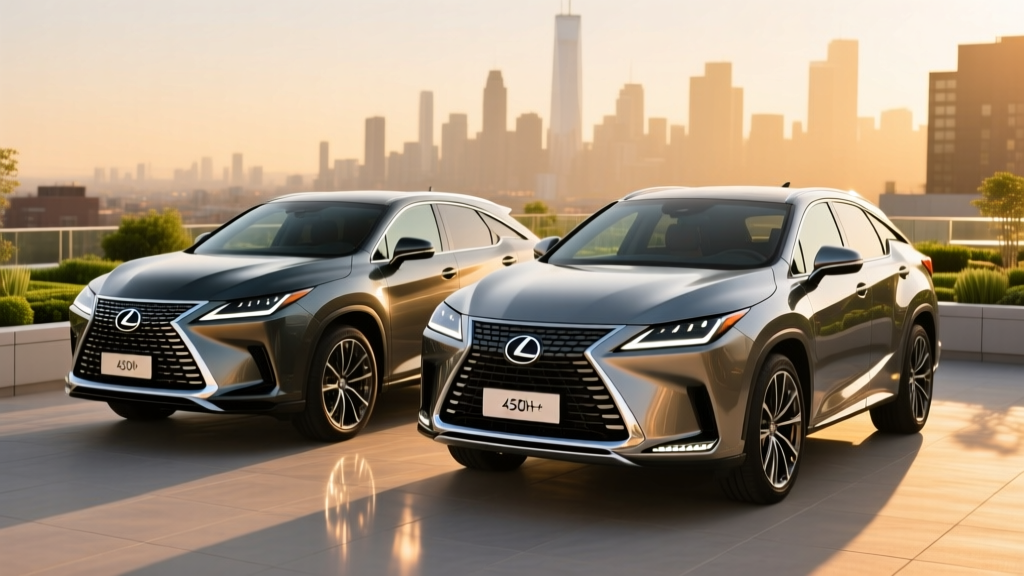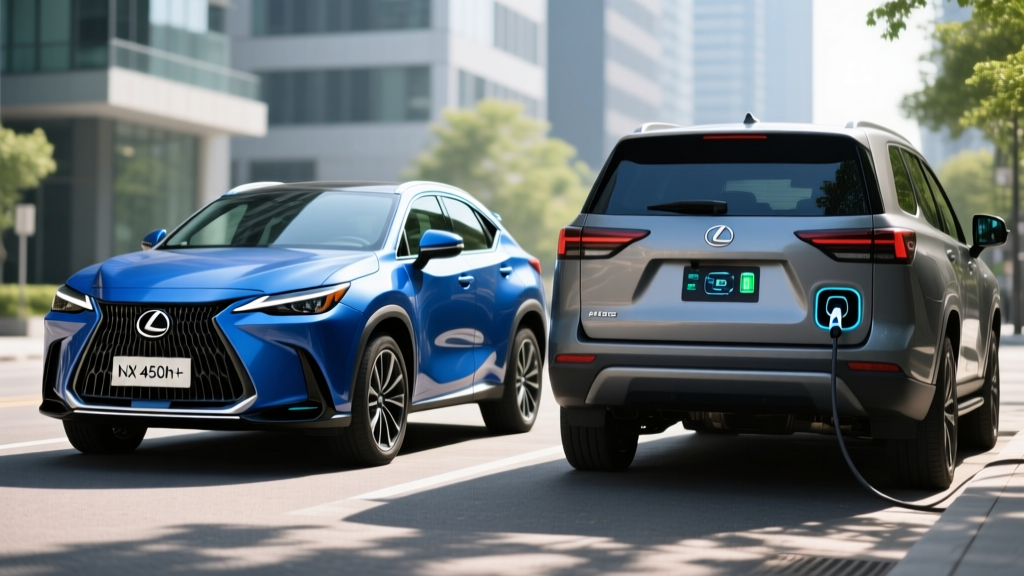
If you want Lexus luxury without committing to a full battery-electric vehicle, the brand's plug-in hybrid lineup offers a compelling middle ground. As of 2026, Lexus offers two plug-in hybrid (PHEV) models in the U.S. market: the compact luxury NX 450h+ and the three-row TX 550h+. Both pair Toyota's proven hybrid synergy system with a battery large enough for meaningful electric-only commuting — and both avoid the range-anxiety problem entirely.
This guide breaks down exact EPA figures, real-world MPG expectations, charging requirements, pricing, and federal tax credit eligibility so you can decide whether a Lexus plug-in hybrid fits your garage.
Lexus Plug-In Hybrid vs. Conventional Lexus Hybrid: What's the Difference?
Before diving into specs, it's critical to understand the distinction between a Lexus PHEV and a standard Lexus HEV (hybrid electric vehicle). Lexus sells many conventional hybrids — like the RX 500h, ES 300h, and UX 250h — that never plug in. A PHEV has a larger battery, a charge port, and an electric-only driving mode.
| Feature | Lexus HEV (e.g., RX 350h) | Lexus PHEV (e.g., NX 450h+) |
|---|---|---|
| Plug-in charging | No — self-charging via regen | Yes — Level 1/Level 2 AC charging |
| Battery size | ~1.0–2.4 kWh | 18.1 kWh (NX) / 20.0 kWh (TX) |
| Electric-only range | 0.5–1 mi at low speed | 33–37 mi at highway-capable speeds |
| Gasoline engine | Yes — always available | Yes — kicks in when battery depletes |
| Federal tax credit (§30D) | No | Eligible — up to $7,500 (subject to rules) |
| Price premium over gas model | ~$2,000–$4,000 | ~$8,000–$12,000 |
The bottom line: if your commute is under 35 miles and you can charge at home, a Lexus PHEV lets you drive electric most days while keeping a gas engine for road trips. If you can't charge at home, a conventional HEV makes more sense — you'll still get excellent MPG without the plug-in premium.
2026 Lexus NX 450h+: Specs, Range, and Real-World MPG
The NX 450h+ is Lexus's compact luxury PHEV, competing with the BMW X3 xDrive30e and Volvo XC60 Recharge. It's the more popular of the two Lexus plug-in hybrid models, and for good reason: 304 combined horsepower, standard AWD, and a genuinely usable electric range.
| Specification | Value |
|---|---|
| Powertrain | 2.5L 4-cyl + 2 electric motors (AWD) |
| Combined HP | 304 hp |
| 0–60 mph | 6.0 seconds |
| Battery (usable) | 18.1 kWh (lithium-ion) |
| EPA EV range | 37 miles |
| EPA combined MPG (hybrid mode) | 38 MPG |
| EPA city / highway MPG | 38 city / 37 highway |
| MPGe (EV mode) | 84 MPGe |
| Total range (EV + gas) | ~460 miles |
| Max AC charge rate | 3.3 kW (Level 2) |
| DC fast charging | Not supported |
| Charge time (120V Level 1) | ~12 hours (0–100%) |
| Charge time (240V Level 2) | ~4.5 hours (0–100%) |
| Base MSRP | $53,990 |
NX 450h+ Charging: What You Need at Home
The NX 450h+ uses a J1772 connector for AC charging. It does not support DC fast charging — a common limitation among PHEVs, which prioritize battery longevity over rapid charging. At 3.3 kW, a full charge takes about 4.5 hours on a Level 2 home charger (240V, 16A). This is perfectly adequate for overnight charging but means you can't top up quickly on a road trip.
If you install a dedicated 240V Level 2 charger at home — expect $600–$1,800 for equipment and electrician labor depending on panel capacity — you'll wake up to a full battery every morning. A standard 120V outlet works but requires a full 12 hours, making it impractical as a daily strategy.
2026 Lexus TX 550h+: The Three-Row Plug-In Hybrid
The TX 550h+ is Lexus's largest PHEV, a three-row luxury SUV aimed at families who want electric commuting without sacrificing cargo capacity or towing. It shares its platform with the gasoline TX 350 but pairs a 3.5L V6 with Lexus's hybrid system.
| Specification | Value |
|---|---|
| Powertrain | 3.5L V6 + electric motors (AWD) |
| Combined HP | 406 hp |
| 0–60 mph | 5.9 seconds |
| Battery (usable) | ~20.0 kWh (lithium-ion) |
| EPA EV range | 33 miles |
| EPA combined MPG (hybrid mode) | 29 MPG |
| EPA city / highway MPG | 28 city / 29 highway |
| MPGe (EV mode) | 76 MPGe |
| Total range (EV + gas) | ~420 miles |
| Max AC charge rate | 6.6 kW (Level 2) |
| DC fast charging | Not supported |
| Charge time (240V Level 2) | ~3.5 hours (0–100%) |
| Base MSRP | $72,990 |
The TX 550h+ improves on the NX with a 6.6 kW onboard charger — roughly twice the charging speed — meaning a full overnight charge takes under four hours. The trade-off: a heavier vehicle with a larger engine yields lower hybrid-mode MPG. Still, 29 MPG combined for a 4,800-lb three-row SUV is genuinely impressive.
Does a Lexus Plug-In Hybrid Qualify for the Federal Tax Credit?
Both the NX 450h+ and TX 550h+ are eligible for the IRS §30D Clean Vehicle Credit — but the actual amount you receive depends on several factors that change annually. Here's the current framework for 2026:
- Maximum credit: Up to $7,500 ($3,750 for critical minerals + $3,750 for battery components)
- MSRP cap: SUVs must be under $80,000 — both models qualify at base, but heavily optioned TX 550h+ trims may exceed the cap
- Buyer income cap: AGI must not exceed $150,000 (single), $225,000 (head of household), or $300,000 (joint filers)
- Battery sourcing: Critical minerals and battery components must meet escalating domestic/free-trade-partner thresholds — Toyota has worked to localize supply chains, but verify at purchase
- Point-of-sale transfer: You can transfer the credit to the dealer at purchase for an immediate price reduction, or claim it on your tax return
Because sourcing requirements tighten each year, the exact credit amount can shift. Always verify current eligibility on IRS.gov and confirm with your dealer before signing. Some states offer additional rebates — check your state's energy office for specifics.
Battery Warranty, Reliability, and Replacement Cost
Lexus's hybrid reliability record is among the strongest in the industry, inherited from Toyota's two decades of Prius engineering. The PHEV battery in the NX 450h+ is a proven design shared with the Toyota RAV4 Prime — a vehicle that has demonstrated minimal degradation in real-world ownership. Most Lexus hybrid batteries last well beyond the warranty period; replacement is rare before 150,000 miles.
If you do need a replacement out of warranty, expect $6,000–$9,000 for the battery pack (parts and labor). However, individual module replacement or reconditioning can reduce this to $2,000–$4,000 at a specialist shop. Given the 10-year/150,000-mile warranty coverage, most original owners will never face this cost.
Who Should Choose a Lexus Plug-In Hybrid?
Choose a Lexus PHEV If:
- Your daily commute is under 35 miles round-trip
- You can install a Level 2 charger at home (garage or driveway)
- You take frequent road trips where EV charging infrastructure is sparse
- You want luxury features without the $80K+ price of a full-electric luxury SUV
- You want to reduce fuel consumption by 60–80% on weekdays
Consider a Full EV or HEV Instead If:
- Full EV: You want zero tailpipe emissions, have reliable home charging, and drive under 250 miles daily (consider Lexus RZ or Tesla Model Y)
- HEV: You can't charge at home, live in an apartment, or want the lowest purchase price with no plug-in hassle
- Gas: You drive very few miles annually and the hybrid premium won't pay back in fuel savings
Decision Framework
NX 450h+ — Best for couples or small families wanting a compact luxury PHEV with strong electric range and 38 MPG hybrid efficiency. Ideal if you want the RAV4 Prime's proven powertrain in a premium package.
TX 550h+ — Best for families needing three rows who still want electric commuting. The 6.6 kW charger and 406 hp make it the most capable Lexus PHEV, but the $73K+ price limits tax credit eligibility on loaded trims.
Real-World MPG: What Owners Actually Report
EPA figures are a starting point, but Lexus hybrids consistently perform well in real-world driving. Here's what to expect:
| Model | EPA Combined | Real-World City | Real-World Highway | Cold Weather (below 32°F) |
|---|---|---|---|---|
| NX 450h+ (hybrid mode) | 38 MPG | 38–42 MPG | 34–36 MPG | 32–35 MPG |
| TX 550h+ (hybrid mode) | 29 MPG | 28–31 MPG | 26–28 MPG | 24–27 MPG |
Hybrids shine in city driving, where regenerative braking and engine-off coasting maximize efficiency. Highway driving is where the EPA numbers tend to be slightly optimistic, especially at speeds above 70 mph. Cold weather reduces EV range by 20–30% and slightly lowers hybrid MPG due to engine warm-up cycles and cabin heating demand.
Data from fueleconomy.gov confirms the NX 450h+ at 38 MPG combined and 84 MPGe in EV mode. Owner-reported figures on Fuelly and similar platforms cluster around 35–40 MPG in hybrid mode, validating the EPA estimates as realistic.
Lexus Plug-In Hybrid FAQ
How many MPG does a Lexus plug-in hybrid get?
The NX 450h+ achieves 38 MPG combined (38 city / 37 highway) in hybrid mode after the battery depletes. The TX 550h+ gets 29 MPG combined (28 city / 29 highway). In EV mode, the NX delivers 84 MPGe and the TX delivers 76 MPGe.
How far can the Lexus NX 450h+ go on electric only?
The EPA rates the NX 450h+ at 37 miles of electric-only range. Real-world range varies: expect 30–37 miles in mild weather city driving, 25–28 miles at sustained highway speeds, and 25–30 miles in extreme cold. The TX 550h+ offers 33 miles EPA-rated.
Can I charge a Lexus PHEV at a DC fast charger?
No. Neither the NX 450h+ nor TX 550h+ supports DC fast charging. They use J1772 AC charging only — 3.3 kW for the NX and 6.6 kW for the TX. This is standard for most PHEVs; the batteries are too small to benefit from DC fast charging, and omitting it reduces weight and cost.
Is the Lexus plug-in hybrid reliable?
Yes. Lexus (and parent company Toyota) has the strongest hybrid reliability track record in the industry. The NX 450h+ powertrain is shared with the RAV4 Prime, which has demonstrated excellent long-term durability. The hybrid battery carries a 10-year/150,000-mile warranty.
What does it cost to replace a Lexus PHEV battery?
Out-of-warranty replacement runs $6,000–$9,000 for a full pack. However, most batteries last well beyond the warranty period, and module-level repair can cost $2,000–$4,000. Given the 10-year/150,000-mile coverage, most owners never face this expense.
Does the Lexus NX 450h+ qualify for the $7,500 federal tax credit?
It is eligible for up to $7,500 under IRS §30D, but your actual credit depends on your AGI (income caps apply), the vehicle's MSRP (must be under $80,000 for SUVs), and current battery sourcing rules. Verify eligibility at IRS.gov and confirm with your dealer before purchase.
Should I buy a Lexus PHEV or a full EV like the Lexus RZ?
If you have home charging, drive under 220 miles daily, and want zero tailpipe emissions, the Lexus RZ 450e (220-mile range, $54,000) is worth considering. If you frequently drive longer distances, lack reliable public charging access, or want the flexibility of a gas engine for road trips, the NX 450h+ PHEV is the more practical choice in 2026.