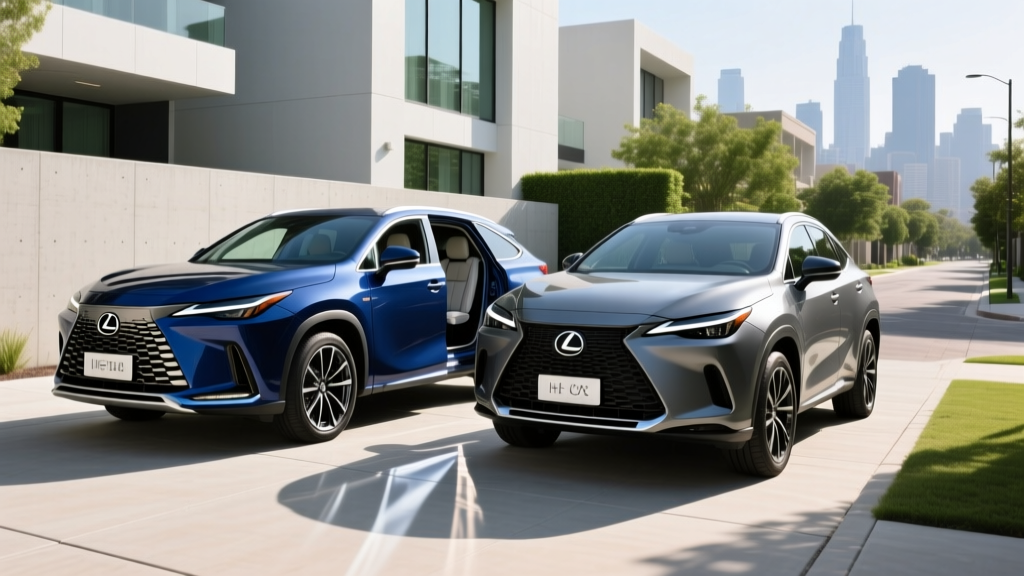
Lexus has carved a distinct niche in the electrified-luxury market by doubling down on hybrids rather than rushing to full battery-electric vehicles. For 2026, the brand offers two Lexus plug-in hybrids in the U.S.: the midsize TX 550h+ three-row SUV and the compact NX 450h+. Both pair a gasoline engine with a sizable battery pack you can recharge from a wall outlet, delivering 30+ miles of electric-only driving before seamlessly reverting to hybrid operation.
This guide breaks down exactly what each model delivers — EPA range, real-world MPG, battery specs, charging times, pricing, and whether either qualifies for the federal §30D tax credit — so you can decide if a Lexus PHEV fits your garage or if a conventional hybrid or full EV makes more sense.
Lexus Plug-In Hybrids vs. Conventional Lexus Hybrids: What's the Difference?
Before diving into specs, it's critical to separate Lexus's plug-in hybrids (PHEVs) from its conventional hybrids (HEVs). Both use a gas engine plus electric motor, but they operate very differently day to day.
HEV vs. PHEV at a Glance
| Feature | Conventional Hybrid (HEV) | Plug-In Hybrid (PHEV) |
|---|---|---|
| Plug in to charge? | No — charges via regenerative braking and engine | Yes — plug in for full electric range |
| Electric-only range | 1–2 miles at low speed | 30–37 miles (EPA) |
| Battery size | ~1–2 kWh | 18–20+ kWh usable |
| Federal tax credit | No (some qualify for used-EV credit) | Up to $7,500 if sourcing/income rules met |
| Best for | Drivers without home charging | Drivers who can charge at home overnight |
Lexus sells several conventional HEVs — the RX 350h, ES 300h, LC 500h, and others — that never need plugging in. The TX 550h+ and NX 450h+ are the only Lexus models with a plug and a meaningful electric-only range.
2026 Lexus NX 450h+: Compact Luxury PHEV Specs
The NX 450h+ is the more established of the two Lexus plug-in hybrids, sharing its powertrain architecture with the Toyota RAV4 Prime. It's a compact luxury SUV aimed at buyers who want electric commuting during the week and gas flexibility for weekend trips.
| Spec | Value |
|---|---|
| Powertrain | 2.5L 4-cyl + 2 electric motors (AWD) |
| Combined HP | 304 hp |
| Battery (usable) | ~18.1 kWh lithium-ion |
| EPA electric-only range | 37 miles |
| EPA MPGe (EV mode) | 84 MPGe combined |
| EPA MPG (hybrid mode) | 36 city / 33 highway / 35 combined |
| Total combined range | ~550 miles (EV + gas) |
| 0–60 mph | 6.0 seconds |
| Level 2 charge time (0–100%) | ~3 hours at 6.6 kW (240V) |
| DC fast charging | Not available |
| Base MSRP | ~$59,900 (Premium trim) |
| Federal §30D credit | Up to $7,500 (subject to sourcing/income rules) |
| Hybrid battery warranty | 10 years / 150,000 miles |
2026 Lexus TX 550h+: Three-Row PHEV for Families
Introduced for the 2024 model year, the TX 550h+ is the only three-row plug-in hybrid luxury SUV in its class. It fills a gap for families who need six- or seven-passenger seating but still want electric commuting capability.
| Spec | Value |
|---|---|
| Powertrain | 3.5L V6 + electric motors (DIRECT4 AWD) |
| Combined HP | 406 hp |
| Battery (usable) | ~20.5 kWh lithium-ion |
| EPA electric-only range | 33 miles |
| EPA MPGe (EV mode) | 76 MPGe combined |
| EPA MPG (hybrid mode) | 29 city / 28 highway / 29 combined |
| Total combined range | ~470 miles |
| 0–60 mph | 5.7 seconds |
| Level 2 charge time (0–100%) | ~3.5 hours at 6.6 kW (240V) |
| DC fast charging | Not available |
| Base MSRP | ~$74,900 (Premium trim) |
| Federal §30D credit | Up to $7,500 (subject to sourcing/income rules) |
| Hybrid battery warranty | 10 years / 150,000 miles |
The TX 550h+ uses Lexus's DIRECT4 all-wheel-drive system, which can independently torque-vector the rear electric motor for improved handling. The larger V6 and heavier curb weight explain the lower MPG figures versus the NX, but 29 MPG combined in a 5,000+ lb three-row SUV is genuinely impressive — a comparable gas-only luxury SUV in this class typically returns 19–22 MPG.
MPG and Efficiency: EPA vs. Real-World Numbers
| Model | City MPG | Hwy MPG | Combined MPG | EV Range | MPGe (EV) |
|---|---|---|---|---|---|
| NX 450h+ | 36 | 33 | 35 | 37 mi | 84 |
| TX 550h+ | 29 | 28 | 29 | 33 mi | 76 |
How many MPG do Lexus plug-in hybrids get? Once the battery is depleted, the NX 450h+ returns 35 MPG combined and the TX 550h+ returns 29 MPG combined. In real-world driving, both models tend to exceed their EPA city figures — a hallmark of Toyota/Lexus hybrid systems that rely heavily on electric assist at low speeds. Owners frequently report 37–40 MPG in city driving with the NX 450h+ and 30–32 MPG city in the TX 550h+.
Highway driving is where hybrids lose their advantage: at sustained 75–80 mph, expect the NX to deliver 31–33 MPG and the TX around 26–28 MPG. If most of your driving is highway commuting with no charging, a conventional hybrid like the RX 350h (36 MPG combined) may actually match the NX PHEV's gas-only efficiency at a lower purchase price.
Charging: What You Need to Know About Lexus PHEV Charging
Neither Lexus plug-in hybrid supports DC fast charging. This is a deliberate engineering choice — PHEV batteries are small enough that Level 2 charging at home fully replenishes them overnight, and adding DC fast-charge hardware would increase cost and weight for minimal benefit.
Both the NX 450h+ and TX 550h+ come with a 6.6 kW onboard charger. Here's what that means in practice:
- Level 1 (120V household outlet): ~1.4 kW — roughly 12–14 hours for a full charge. Usable in a pinch but impractical for daily use.
- Level 2 (240V, 32A circuit): 6.6 kW — full charge in approximately 3 hours (NX) or 3.5 hours (TX). This is the recommended home setup.
A Level 2 home charger installation typically costs $600–$2,000 depending on your electrical panel's proximity to the garage and whether a panel upgrade is needed. Since PHEV batteries are small, you don't need a 48A hardwired unit — a 32A plug-in Level 2 charger ($300–$500 for the hardware) is more than sufficient.
Preconditioning tip: Both models support scheduled charging and cabin preconditioning while plugged in. Setting a departure time warms or cools the cabin using grid power rather than battery power, preserving your full electric range when you leave — especially valuable in winter.
Federal Tax Credit: Do Lexus Plug-In Hybrids Qualify?
Under the current IRS §30D Clean Vehicle Credit rules, PHEVs can qualify for up to $7,500 — but eligibility depends on a web of requirements that change frequently:
- MSRP cap: SUVs must have an MSRP at or below $80,000. Both the NX 450h+ (~$59,900 base) and TX 550h+ (~$74,900 base) fall under this cap at base trims, but a fully loaded TX 550h+ could exceed it.
- Buyer income cap: Modified AGI must not exceed $150,000 (single), $225,000 (head of household), or $300,000 (joint filers).
- Battery sourcing: The credit splits into two halves — $3,750 for critical-mineral sourcing and $3,750 for battery-component manufacturing. Both must meet U.S./FTA-country thresholds that tighten annually.
- Point-of-sale transfer: As of 2024, you can transfer the credit to the dealer for an immediate price reduction rather than waiting to claim it on your tax return.
- Battery capacity: The vehicle must have at least 7 kWh of battery capacity — both Lexus PHEVs exceed this easily.
Because battery-sourcing rules tighten each year, a model that qualifies in 2025 may not qualify in 2026 for the full amount. Always verify current eligibility on fueleconomy.gov before purchasing, and consult a tax professional for your specific situation.
Reliability and Long-Term Ownership
Lexus consistently tops IIHS safety ratings and J.D. Power dependability studies, and the PHEV models benefit from the same engineering discipline. The NX 450h+ shares its core hybrid powertrain with the RAV4 Prime — a system that has been on the road since 2021 with minimal reported battery or inverter failures.
Key reliability factors for Lexus plug-in hybrids:
- Proven powertrain: Toyota's hybrid synergy drive is in its fourth generation. The e-CVT transmission has no traditional gears or clutch packs to wear out.
- Brake longevity: Regenerative braking handles most deceleration, so brake pads often last 80,000–100,000+ miles.
- No range-anxiety risk: If the battery degrades, you still have a fully functional hybrid — unlike a full EV, where severe degradation directly reduces your only propulsion source.
- Maintenance costs: No oil changes more frequently than a gas car (still recommended every 10,000 miles), no transmission fluid changes on the e-CVT, and fewer moving parts overall.
Hybrid vs. PHEV vs. EV: Which Lexus (or Electrified Vehicle) Fits You?
Decision Framework: Which Electrified Vehicle Is Right for You?
Choose a Lexus PHEV (NX 450h+ or TX 550h+) if:
- You can install a Level 2 charger at home
- Your daily commute is under 35 miles round-trip (you'll rarely use gas)
- You take regular road trips and don't want to plan around charging stations
- You want the federal tax credit but aren't ready to commit to a full EV
Choose a conventional Lexus HEV (RX 350h, ES 300h, etc.) if:
- You can't charge at home (apartment, street parking, no garage outlet)
- You want maximum simplicity — no plug, no charging routine
- Your daily mileage is higher and more variable
Choose a full EV (e.g., Tesla Model Y, Hyundai Ioniq 5, BMW iX) if:
- You want zero tailpipe emissions and minimal maintenance
- You have reliable home charging and access to DC fast chargers for road trips
- You want the strongest tax incentives and lowest per-mile fuel cost
- You're ready to plan longer trips around charging infrastructure
Pricing and Value: What Lexus Plug-In Hybrids Actually Cost
Here's how the two Lexus PHEVs stack up on price, including estimated post-credit figures:
| Model | Base MSRP | Est. Max §30D Credit | Effective Price (if eligible) |
|---|---|---|---|
| NX 450h+ Premium | $59,900 | $7,500 | ~$52,400 |
| TX 550h+ Premium | $74,900 | $7,500 | ~$67,400 |
At the effective price, the NX 450h+ becomes competitive with gas-powered luxury compact SUVs once you factor in fuel savings. Over five years at 12,000 miles/year and $3.50/gallon gas, an NX 450h+ owner charging at home could save $3,000–$5,000 in fuel versus a comparable gas-only luxury SUV.
Pros
- 33–37 miles electric-only covers most commutes
- No range anxiety — gas engine for road trips
- 10-year / 150,000-mile hybrid battery warranty
- Strong Lexus reliability and resale value
- Eligible for up to $7,500 federal credit (if sourcing rules met)
- Smooth, quiet electric driving in EV mode
Cons
- No DC fast charging
- Premium price vs. non-luxury PHEVs (RAV4 Prime, Tucson PHEV)
- Tax credit eligibility uncertain due to sourcing rules
- Electric range drops 20–30% in cold weather
- TX 550h+ fuel economy modest for a hybrid (29 MPG)
- Cargo space slightly reduced vs. gas-only counterparts
Frequently Asked Questions About Lexus Plug-In Hybrids
How far can Lexus plug-in hybrids go on electric only?
The NX 450h+ delivers an EPA-rated 37 miles of electric-only range, while the TX 550h+ provides 33 miles. In real-world conditions — especially cold weather or sustained highway speeds — expect 26–33 miles from the NX and 23–29 miles from the TX.
Do Lexus plug-in hybrids need to be plugged in?
To get the electric-only range and maximum efficiency, yes — you should plug in regularly. However, if you forget or can't plug in, both vehicles operate as conventional hybrids using regenerative braking and the gas engine to charge the battery. You'll just get lower overall MPG and no electric-only driving.
Is the Lexus PHEV battery reliable and what does replacement cost?
Lexus covers the hybrid battery for 10 years / 150,000 miles. Toyota/Lexus hybrid batteries have an outstanding track record, with most retaining 85%+ capacity well past 100,000 miles. Out-of-warranty replacement, while rare, typically runs $5,000–$8,000 installed.
Does a Lexus plug-in hybrid qualify for the $7,500 federal tax credit?
Both models can qualify for up to $7,500 under §30D, but eligibility depends on battery-component and critical-mineral sourcing requirements that tighten annually, plus buyer income caps and MSRP limits. Always check fueleconomy.gov for the latest qualifying list before purchasing.
Can I DC fast charge a Lexus PHEV on a road trip?
No. Neither the NX 450h+ nor the TX 550h+ supports DC fast charging. On road trips, you'll simply drive in hybrid mode using the gas engine — which is the point of a PHEV. There's no need to stop at charging stations on long trips.
Lexus PHEV vs. full EV: which is better for my situation?
If you can charge at home and your commute is under 35 miles, a Lexus PHEV lets you drive electric daily while keeping gas flexibility for road trips — no route planning required. A full EV makes more sense if you want the lowest per-mile cost, zero tailpipe emissions, and have reliable access to both home and public DC fast charging.