Quick Verdict: The Lexus NX Hybrid SUV Lineup at a Glance
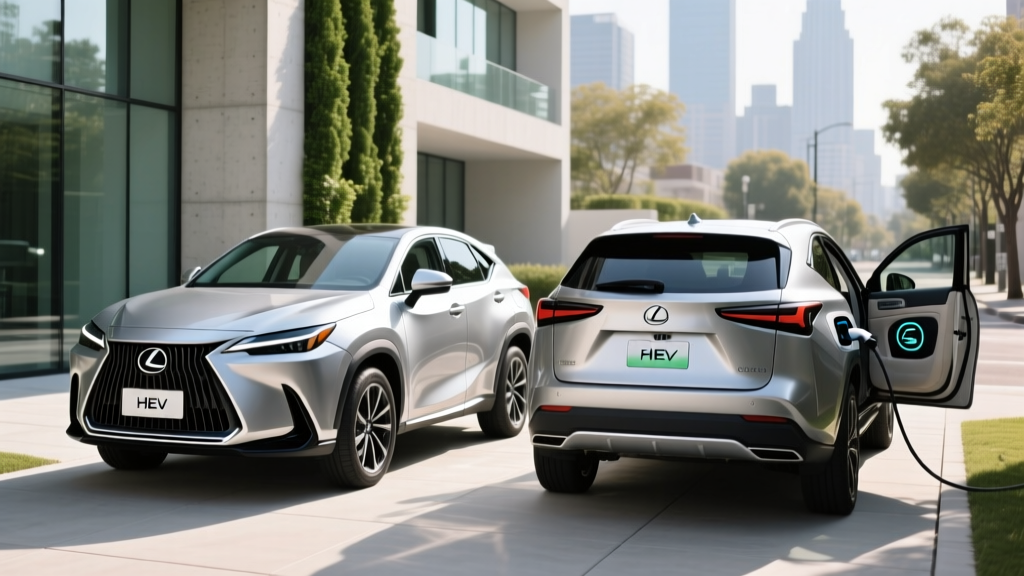
The 2026 Lexus NX hybrid SUV comes in two distinct flavors, and choosing between them is the single most important decision you'll make in this purchase. The NX 350h is a conventional hybrid (HEV) that never needs plugging in and returns an EPA-estimated 39 MPG combined. The NX 450h+ is a plug-in hybrid (PHEV) offering 37 miles of electric-only driving before its gasoline engine kicks in, plus a total combined range exceeding 500 miles.
Both share the same refined cabin, Lexus Safety System+ 3.0 suite, and proven Toyota-derived hybrid architecture. The right choice depends entirely on your charging access, commute length, and whether the PHEV's federal tax credit eligibility justifies its higher starting price. This guide breaks down every number you need.
HEV vs PHEV: What's the Actual Difference?
NX 350h — Conventional Hybrid (HEV)
The NX 350h uses a small battery (approximately 1.6 kWh) that charges itself through regenerative braking and the gasoline engine. You never plug it in. The electric motor assists the 2.5-liter four-cylinder engine to reduce fuel consumption, but the vehicle cannot drive on electric power alone for meaningful distances. Think of it as a highly efficient gas car.
NX 450h+ — Plug-in Hybrid (PHEV)
The NX 450h+ carries an 18.1 kWh lithium-ion battery that you charge by plugging in (Level 1 or Level 2). This gives you 37 EPA-estimated miles of pure electric driving at speeds up to about 84 mph. Once the battery depletes, it operates exactly like a conventional hybrid, with no range anxiety. You can plug in nightly for an effectively electric commute, while retaining a gas engine for road trips.
Critical distinction: The NX 350h does not plug in and does not qualify for the federal §30D EV tax credit. The NX 450h+ does plug in and may qualify for up to $7,500 in federal tax credits, subject to income, MSRP, and battery-sourcing requirements outlined by the IRS.
Fuel Economy & Electric Range: The Numbers That Matter
| Metric | NX 350h (HEV) | NX 450h+ (PHEV) |
|---|---|---|
| EPA City MPG | 41 MPG | 38 MPG (hybrid mode) |
| EPA Highway MPG | 37 MPG | 33 MPG (hybrid mode) |
| EPA Combined MPG | 39 MPG | 36 MPG (hybrid mode) |
| Electric-Only Range | N/A | 37 miles (EPA) |
| MPGe (Electric Mode) | N/A | 84 MPGe combined |
| Total Combined Range | ~520 miles | ~550 miles |
| Fuel Tank | 14.5 gal | 14.5 gal |
MPGe explained: Miles Per Gallon-equivalent measures how far the PHEV travels on the electrical energy equivalent of one gallon of gasoline while running on battery power. The 84 MPGe figure applies only when the NX 450h+ is operating on its charge, not after the battery depletes.
Real-World MPG vs. EPA Sticker
Lexus hybrids consistently perform close to or slightly above their EPA city estimates in stop-and-go driving because regenerative braking recaptures energy most effectively at lower speeds. In our experience and aggregated owner data, the NX 350h typically achieves 40-43 MPG in city driving and 34-36 MPG on sustained highway trips at 70+ mph. Highway driving favors the gasoline engine more directly, so efficiency drops relative to the city figure — the opposite pattern from a full EV.
For the NX 450h+, real-world electric-only range in mild weather with moderate acceleration typically lands between 33-37 miles. Cold weather (below 32°F) can reduce electric range by 15-25%, bringing it closer to 28-31 miles. Once operating in hybrid mode, expect results similar to the NX 350h.
Powertrain, Performance & Specifications
| Specification | NX 350h (HEV) | NX 450h+ (PHEV) |
|---|---|---|
| Engine | 2.5L 4-cyl + 2 electric motors | 2.5L 4-cyl + 2 electric motors |
| Combined Horsepower | 244 hp | 304 hp |
| 0-60 mph | 7.2 seconds | 6.0 seconds |
| Drivetrain | AWD (eAxle rear motor) | AWD (eAxle rear motor) |
| Transmission | eCVT | eCVT |
| Battery Capacity | ~1.6 kWh (NiMH) | 18.1 kWh (Li-ion) |
| Towing Capacity | 2,000 lbs | 2,000 lbs |
| Cargo Volume | 22.7 / 46.9 cu ft | 22.7 / 46.9 cu ft |
The NX 450h+ delivers meaningfully more power — 304 hp versus 244 hp — thanks to its larger, more potent electric motors. The 1.2-second advantage to 60 mph is noticeable in highway merging and passing situations. Both models use Lexus's eCVT (electronically controlled continuously variable transmission), which is a power-split device, not a belt-driven CVT, and does not carry the reliability concerns associated with older Nissan-style CVTs.
PHEV Charging: How the NX 450h+ Plugs In
The NX 450h+ charges exclusively through AC charging (Level 1 and Level 2). It does not support DC fast charging — a common limitation among PHEVs due to their smaller battery packs, which cannot safely absorb the high power levels that DC fast chargers deliver.
| Charging Level | Power | 0-100% Time | Best For |
|---|---|---|---|
| Level 1 (120V household outlet) | ~1.4 kW | ~12 hours | Overnight top-off |
| Level 2 (240V home/public) | ~3.3 kW (onboard limit) | ~4 hours | Daily home charging |
| DC Fast Charge | Not supported | N/A | N/A |
kW vs kWh reminder: kW (kilowatts) measures the rate of charging — like water flow from a hose. kWh (kilowatt-hours) measures the battery's total energy capacity — like the size of the bucket. The NX 450h+ has an 18.1 kWh battery and accepts up to 3.3 kW of charging power on Level 2.
The 3.3 kW onboard charger is relatively modest. A dedicated Level 2 home charger (even a basic 16-amp, 240V unit) will fully replenish the battery overnight. If you're installing a Level 2 charger specifically for this vehicle, you don't need a 48-amp unit — a 20-amp or 30-amp circuit is adequate and significantly cheaper to install.
Pricing, Trims & Tax Credit Eligibility
| Model / Trim | MSRP (2026 est.) | Federal §30D Credit |
|---|---|---|
| NX 350h Premium | ~$43,500 | Not eligible (HEV) |
| NX 350h Luxury | ~$48,500 | Not eligible (HEV) |
| NX 450h+ Premium | ~$58,500 | Up to $7,500* |
| NX 450h+ Luxury | ~$63,000 | Up to $7,500* |
*Federal §30D tax credit eligibility depends on multiple requirements that change periodically. Consult the IRS Clean Vehicle Credits page and a tax professional before purchasing.
§30D Tax Credit Requirements for the NX 450h+ (2026)
- MSRP cap: SUVs must be priced at or below $80,000 — the NX 450h+ qualifies at all trims.
- Buyer income cap: Modified AGI must not exceed $150,000 (single), $225,000 (head of household), or $300,000 (joint).
- Battery sourcing: A percentage of critical minerals and battery components must be sourced from the US or free-trade-agreement partners. This requirement tightens annually — verify current-year compliance with your dealer.
- Point-of-sale transfer: You can transfer the credit to the dealer at purchase, reducing your out-of-pocket cost immediately rather than waiting for tax filing.
- Assembly: The vehicle must undergo final assembly in North America. The NX is assembled in Japan, which may affect eligibility depending on current-year rules. Confirm with your dealer and fueleconomy.gov.
The assembly question is critical. The Lexus NX is manufactured at Toyota's Tahara plant in Japan. Under current §30D rules, final assembly in North America is required for credit eligibility. This has historically disqualified the NX 450h+ from the federal credit. Always verify current eligibility on fueleconomy.gov before counting on the $7,500 in your budget. Some states offer additional rebates for PHEVs regardless of assembly location — check your state energy office.
Battery Warranty, Reliability & Replacement Costs
Hybrid Battery Warranty Coverage
NX 350h (HEV): 10 years / 150,000 miles (whichever comes first) on the hybrid battery and all hybrid-system components, including the eCVT, electric motors, and inverter.
NX 450h+ (PHEV): 10 years / 150,000 miles on the high-voltage lithium-ion battery pack and plug-in hybrid system components. Lexus warrants the battery to retain a minimum capacity threshold (typically 70% of original capacity) during the warranty period.
Note: California and states adopting CARB emissions standards may mandate extended hybrid battery warranties — up to 10 years / 150,000 miles is already standard for Lexus nationwide.
How reliable are Lexus hybrid systems? Toyota and Lexus have produced hybrid vehicles since the 1997 Prius (Japan market), and the eCVT power-split architecture in the NX is one of the most proven drivetrains in the automotive industry. The eCVT contains no belts, clutches, or friction bands — it uses a planetary gearset that has virtually no wear components. IIHS and long-term owner surveys consistently rank Lexus among the top brands for powertrain reliability.
Battery replacement cost: If the hybrid battery fails outside of warranty — which is uncommon but possible at high mileage — replacement costs vary:
- NX 350h (NiMH pack): Approximately $3,000-$5,000 for the battery module, plus labor. The smaller NiMH pack is less expensive to replace.
- NX 450h+ (Li-ion pack): Approximately $8,000-$12,000 for the larger lithium-ion battery pack, plus labor. This is the trade-off for the PHEV's electric-only range capability.
In practice, Toyota/Lexus hybrid batteries routinely last 150,000-200,000+ miles with gradual capacity loss rather than sudden failure. The 10-year/150,000-mile warranty covers the vast majority of ownership periods for first and second owners.
Who Should Buy the Lexus NX Hybrid SUV?
Choose the NX 350h (HEV) If:
- You don't have access to home or workplace charging
- Your priority is lower purchase price and simplicity
- You want premium-crossover comfort with 39 MPG and no plug-in routine
- You drive a mix of city and highway without a short, predictable commute
- You plan to keep the vehicle 8-10+ years and value proven reliability
Choose the NX 450h+ (PHEV) If:
- You can charge at home (even a 120V outlet works overnight for ~12 hours)
- Your daily commute is under 35 miles round-trip — you'll rarely use gas
- You want the option of electric-only driving but need gas-engine range for road trips
- You value the 304 hp performance upgrade over the 350h
- You're in a state with additional PHEV incentives that offset the higher MSRP
Hybrid vs PHEV vs Full EV — Which Fits You?
Choose the NX 350h (HEV) if you want maximum simplicity, have no charging access, and drive more than 40 miles daily with unpredictable routes.
Choose the NX 450h+ (PHEV) if you can charge at home, your weekday driving is under 37 miles, and you take 3+ road trips per year where you don't want to plan around charging stations.
Choose a full EV (like the Lexus RZ 450e or Tesla Model Y) if you have reliable home Level 2 charging, your daily driving is under 200 miles, and you want zero gasoline costs, zero oil changes, and the lowest per-mile energy cost. Full EVs sacrifice the gas-engine safety net but gain dramatically lower operating costs and stronger acceleration.
Frequently Asked Questions
How many MPG does the Lexus NX hybrid get?
The NX 350h achieves an EPA-estimated 41 city / 37 highway / 39 combined MPG. The NX 450h+ PHEV achieves 38 city / 33 highway / 36 combined MPG when operating in hybrid mode after the battery depletes, plus 84 MPGe when running on electric power. Real-world city driving in the NX 350h often exceeds the EPA estimate, reaching 40-43 MPG in stop-and-go traffic where regenerative braking is most effective.
How far can the NX 450h+ drive on electric only?
The EPA rates the NX 450h+ at 37 miles of electric-only range. In real-world conditions, expect 33-37 miles in mild weather with moderate driving. Cold temperatures below freezing can reduce this to approximately 28-31 miles due to battery chemistry limitations and cabin heating demands. The vehicle seamlessly transitions to hybrid mode when the battery depletes — there is no range cliff or warning shutdown.
Is the Lexus NX hybrid reliable, and what does a battery replacement cost?
Lexus hybrid systems, derived from Toyota's architecture dating to 1997, are among the most reliable electrified powertrains on the market. The eCVT transmission has no wearable friction components. The hybrid battery is warranted for 10 years / 150,000 miles. Out-of-warranty replacement costs range from approximately $3,000-$5,000 for the NX 350h NiMH pack to $8,000-$12,000 for the NX 450h+ lithium-ion pack. In practice, these batteries routinely last 150,000-200,000+ miles.
Does the Lexus NX hybrid qualify for a federal tax credit?
The NX 350h conventional hybrid does not qualify for the federal §30D Clean Vehicle Credit — this credit applies only to plug-in vehicles. The NX 450h+ PHEV may qualify for up to $7,500, but a significant barrier exists: the NX is assembled in Japan, and current §30D rules require North American final assembly. Verify current-year eligibility on fueleconomy.gov and consult a tax professional. Some state-level incentives do not have assembly requirements and may apply to both models.
Can I DC fast charge the NX 450h+?
No. The NX 450h+ supports only AC charging — Level 1 (120V, ~12 hours for a full charge) and Level 2 (240V, ~4 hours). It does not have a DC fast-charge port. This is standard for PHEVs: the 18.1 kWh battery is too small to safely accept DC fast-charge power levels, and the use case (overnight home charging) doesn't require it.
Do I need to plug in the NX 350h?
No. The NX 350h is a conventional hybrid that charges its small battery entirely through regenerative braking and the gasoline engine. You fuel it like any other gas car — the hybrid system simply makes it significantly more efficient.