Lexus NX Hybrid MPG at a Glance: HEV vs. PHEV
The Lexus NX lineup offers two distinct hybrid paths: the conventional NX 350h (a self-charging hybrid) and the plug-in NX 450h+ (which you can charge from a wall outlet for pure electric driving). If you've been searching for Lexus NX hybrid miles per gallon data, the short answer is that the NX 350h delivers 39 MPG combined, while the NX 450h+ achieves 84 MPGe on electric power and 36 MPG combined once the battery depletes. But the real story depends on how you drive, where you charge, and what you expect from a premium compact SUV.
Let's unpack the numbers, the powertrain engineering, and the ownership realities so you can decide which NX hybrid—or whether a full EV—actually fits your life.
HEV vs. PHEV: What's the Difference?
NX 350h (HEV): A conventional hybrid. You never plug it in. A small battery recharges via regenerative braking and the gasoline engine. It can't drive on electric power alone for meaningful distances. Think of it as a more efficient gas car.
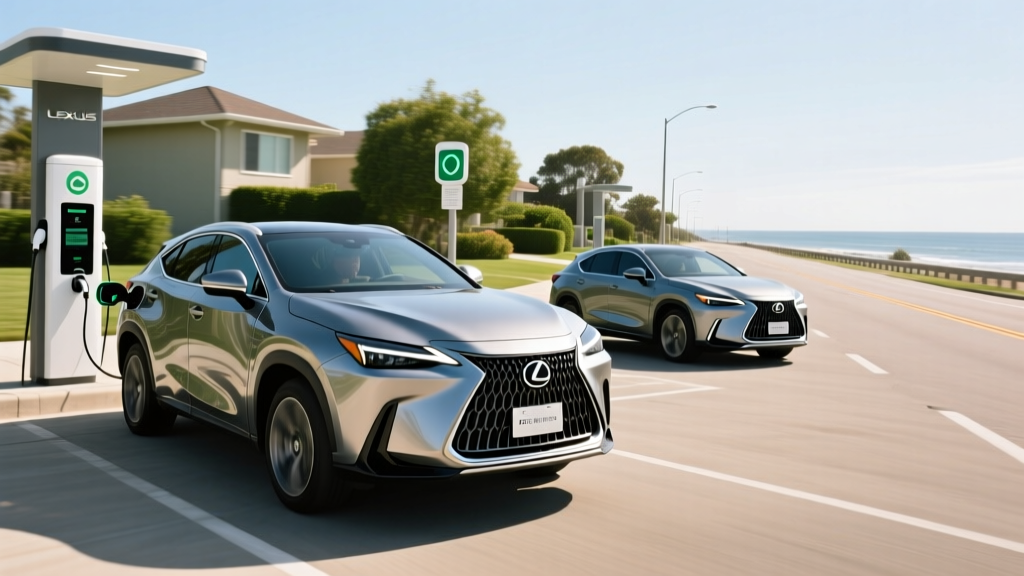
NX 450h+ (PHEV): A plug-in hybrid with a larger 18.1 kWh battery. Plug it in at home or at a public charger to get up to 37 miles of electric-only range. Once that battery depletes, it operates like a conventional hybrid.
EPA Fuel Economy: NX 350h and NX 450h+ by the Numbers
| Metric | NX 350h (HEV) | NX 450h+ (PHEV) |
|---|---|---|
| City MPG | 41 MPG | 38 MPG (hybrid mode) |
| Highway MPG | 37 MPG | 33 MPG (hybrid mode) |
| Combined MPG | 39 MPG | 36 MPG (hybrid mode) |
| Combined MPGe (electric) | N/A | 84 MPGe |
| Electric-only range | N/A | 37 miles |
| Total range (gas + electric) | ~560 miles | ~550 miles |
Source: EPA fueleconomy.gov
The NX 350h's 41 MPG city figure is remarkable for a luxury SUV. Hybrids typically exceed their EPA city estimates in stop-and-go traffic because regenerative braking recovers energy that a gas car wastes as heat. Highway driving is where the NX 350h dips slightly, since the electric motor contributes less at sustained high speeds.
Real-World MPG: What Owners Actually Report
EPA stickers are a starting point, not a guarantee. In real-world driving, NX 350h owners frequently report 40-43 MPG in mixed city and suburban driving, thanks to Toyota's fourth-generation hybrid system prioritizing electric-motor assist at low speeds. Highway-only road trips at 75 mph tend to yield 33-36 MPG, which is still strong for a 4,100-pound luxury crossover.
For the NX 450h+, the picture splits into two scenarios:
- Daily commuting under 37 miles (with home charging): You may use zero gasoline for weeks, effectively getting infinite MPG on your commute.
- Road trips beyond electric range: Once the battery depletes, expect 33-35 MPG combined—slightly below the NX 350h because the PHEV carries an additional ~350 pounds of battery mass.
Cold weather impacts both models. In temperatures below 30°F, expect a 10-15% reduction in fuel economy for the HEV and a 20-30% reduction in electric-only range for the PHEV (roughly 26-30 miles instead of 37). The NX 450h+ includes a battery heating system to mitigate extreme cold degradation, but physics still applies.
Powertrain Specs: What's Under the Hood
| Specification | NX 350h | NX 450h+ |
|---|---|---|
| Engine | 2.5L inline-4 | 2.5L inline-4 |
| Combined system horsepower | 240 hp | 304 hp |
| Electric motors | 2 (front + rear) | 2 (front + rear, higher output) |
| Drivetrain | AWD (e-AWD) | AWD (e-AWD) |
| Battery capacity (usable) | ~1.6 kWh (NiMH) | 18.1 kWh (lithium-ion) |
| 0-60 mph | 7.2 seconds | 6.0 seconds |
| Transmission | eCVT | eCVT |
Both models use Lexus's e-AWD system, where a dedicated rear electric motor powers the rear axle without a mechanical driveshaft. This provides confident traction in rain and light snow while eliminating drivetrain parasitic losses.
The NX 450h+ shares its plug-in powertrain architecture with the Toyota RAV4 Prime, though tuned for Lexus refinement. That 304 hp output makes it the quickest NX short of the turbocharged NX 350 F Sport.
NX 450h+ Charging: Battery, Speed, and Connector Details
The NX 450h+ carries an 18.1 kWh lithium-ion battery pack. Here's how charging works:
| Charging Level | Power | Time (0-100%) | Notes |
|---|---|---|---|
| Level 1 (120V household) | ~1.4 kW | ~12 hours | Standard outlet; overnight top-up only |
| Level 2 (240V, 16A) | 3.3 kW | ~5.5 hours | Included portable cord or wall unit |
| Level 2 (240V, 32A) | 6.6 kW | ~2.5 hours | Requires upgraded onboard charger |
| DC Fast Charge | N/A | N/A | Not supported |
Key limitation: The NX 450h+ does not support DC fast charging. This is typical for PHEVs—the battery is small enough that Level 2 charging suffices for overnight replenishment. If you need road-trip fast-charging capability, you're looking at a full BEV, not a PHEV.
For most PHEV owners, a Level 2 home charger (240V) is the sweet spot. Plug in when you get home, and the battery is full by morning. Public Level 2 chargers at workplaces or shopping centers can top up the battery during the day, extending your electric-only driving.
Pricing, Tax Credits, and Total Cost
For the current model year, pricing breaks down as follows:
- NX 350h: Starting MSRP approximately $42,100 (Premium trim), climbing to ~$49,000 for the Luxury trim.
- NX 450h+: Starting MSRP approximately $59,550 (Premium trim), reaching ~$64,000 fully loaded.
Federal Tax Credit Eligibility
Under current IRS §30D rules, the NX 450h+ PHEV may qualify for up to $3,750 in federal tax credits, depending on battery-component and critical-mineral sourcing requirements. The NX 350h (conventional HEV) does not qualify for any federal EV tax credit—it's not a plug-in vehicle.
Critical caveats for the §30D credit:
- Your modified adjusted gross income must not exceed $150,000 (single) or $300,000 (joint).
- The vehicle MSRP must not exceed $80,000 for SUVs (both NX trims clear this cap).
- Battery sourcing rules change annually—check the latest eligibility list at IRS.gov before purchasing.
- The credit can now be transferred to the dealer at point of sale, reducing your purchase price directly.
Some states offer additional PHEV rebates (California, Colorado, New York, among others). These vary by jurisdiction and change frequently—check your state energy office or AFDC state incentive database for current programs.
Reliability, Battery Warranty, and Replacement Cost
Lexus Hybrid Battery Warranty
Hybrid battery: 10 years / 150,000 miles (whichever comes first) — covers both the NX 350h and NX 450h+.
Powertrain warranty: 6 years / 70,000 miles.
Basic warranty: 4 years / 50,000 miles.
Lexus and Toyota have built the most proven hybrid track record in the industry. The hybrid synergy drive system in the NX 350h is a mature, fourth-generation design shared across millions of Toyota and Lexus vehicles. Battery failures within the warranty period are rare; out-of-warranty replacements for the NX 350h's smaller NiMH pack typically run $2,000-$3,500, while the NX 450h+ lithium-ion pack replacement can range from $6,000-$9,000 if needed well beyond the warranty window.
In practice, Toyota/Lexus hybrid batteries frequently last 150,000-200,000+ miles with gradual capacity loss rather than sudden failure. The NX 450h+ battery management system maintains a charge buffer (never allowing true 0% or 100% at the cell level), which significantly extends cycle life.
Lexus consistently ranks at or near the top in J.D. Power dependability studies and Consumer Reports reliability ratings. The NX specifically earns strong marks for build quality, electronics reliability, and powertrain durability.
Who Should Choose the NX Hybrid, a Full EV, or a Gas Car?
Choose the NX 350h (HEV) If:
- You want 39+ MPG without changing your fueling habits
- You don't have access to home or workplace charging
- You take frequent long road trips and don't want to plan around chargers
- You want Lexus reliability and a premium cabin at a lower entry price
- You live in an apartment or street-park with no charging option
Choose the NX 450h+ (PHEV) If:
- Your daily commute is under 37 miles round-trip
- You can install a Level 2 charger at home
- You want electric daily driving but gas flexibility for road trips
- You want 304 hp and the quickest NX in the lineup
- You want to reduce (but not eliminate) gasoline consumption
Consider a Full EV Instead If:
- You have reliable home charging and your daily driving is under 250 miles
- You want zero tailpipe emissions and the lowest per-mile energy cost
- You're ready to commit to the charging lifestyle (planning road trips around DC fast chargers)
- Models like the Tesla Model Y, Genesis Electrified GV70, or BMW iX better match your range and tech priorities
Frequently Asked Questions
How many MPG does the Lexus NX Hybrid get?
The Lexus NX 350h achieves 41 city / 37 highway / 39 combined MPG per the EPA. The NX 450h+ PHEV gets 36 MPG combined in hybrid mode and 84 MPGe when operating on electricity. In real-world driving, the NX 350h often exceeds 40 MPG in city and suburban conditions.
How far can the NX 450h+ go on electric only?
The EPA rates the NX 450h+ at 37 miles of electric-only range. In warm weather with moderate driving, owners report 35-38 miles. In cold weather (below 30°F), expect 26-30 miles due to battery chemistry limitations and cabin heating demands.
Do I have to plug in the NX 350h?
No. The NX 350h is a conventional hybrid (HEV). Its small battery charges through regenerative braking and the gasoline engine. You fuel it like any other car—just less often. The NX 450h+ is the model you plug in.
Is the Lexus NX Hybrid reliable?
Yes. Lexus ranks among the most reliable luxury brands, and the hybrid powertrain is proven across millions of Toyota/Lexus vehicles. The hybrid battery carries a 10-year/150,000-mile warranty. Real-world data shows these batteries routinely lasting 150,000+ miles.
What does a Lexus NX hybrid battery replacement cost?
Out of warranty, the NX 350h hybrid battery replacement runs approximately $2,000-$3,500. The NX 450h+ lithium-ion pack is more expensive at roughly $6,000-$9,000. However, failures before 150,000 miles are uncommon, and the 10-year warranty covers most ownership periods.
Does the Lexus NX Hybrid qualify for a tax credit?
The NX 450h+ PHEV may qualify for up to $3,750 under the federal §30D credit, subject to income limits ($300K joint / $150K single), MSRP caps, and battery-sourcing requirements that change annually. The NX 350h conventional hybrid does not qualify for any federal EV tax credit. State incentives may apply separately—check AFDC for your jurisdiction.
Hybrid vs. PHEV vs. EV — which is right for me?
If you can't charge at home, choose the HEV (NX 350h). If you can charge at home and commute under 37 miles, the PHEV (NX 450h+) gives you electric daily driving with gas flexibility. If you have home charging, drive under 250 miles daily, and want the lowest running costs and zero tailpipe emissions, consider a full EV like the Tesla Model Y or Hyundai Ioniq 5.