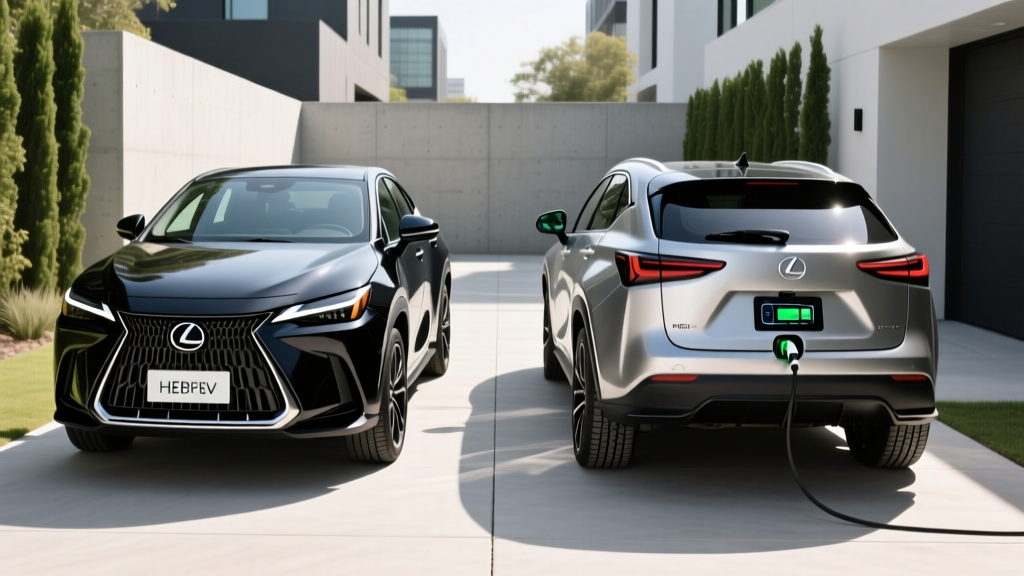
The Lexus NX lineup offers two distinct hybrid paths: the self-charging NX 350h and the plug-in NX 450h+. For buyers searching for an nx lexus hybrid, the choice comes down to one question — do you want maximum simplicity or the ability to drive on electricity alone for daily commuting? This guide breaks down every spec, from EPA fuel economy to battery warranty, so you can pick the right NX hybrid for your driving pattern.
HEV vs PHEV: What's the Difference?
NX 350h (HEV — Conventional Hybrid): Uses a gasoline engine paired with electric motors and a small battery. The battery recharges through regenerative braking and the engine. You never plug it in. It operates like a highly efficient gas car.
NX 450h+ (PHEV — Plug-in Hybrid): Pairs a gasoline engine with a larger 18.1 kWh battery you can plug in to charge. It delivers an EPA-rated 37 miles of electric-only driving before the gasoline engine engages, functioning as a conventional hybrid afterward.
2026 Lexus NX 350h: Fuel Economy and Powertrain
The NX 350h uses a 2.5-liter four-cylinder engine combined with front and rear electric motors through Lexus's fourth-generation hybrid system. Total system output is 244 horsepower, with all-wheel drive standard across all trims. The powertrain prioritizes smoothness and efficiency over acceleration urgency.
| Metric | Value |
|---|---|
| City MPG | 41 |
| Highway MPG | 37 |
| Combined MPG | 39 |
| Fuel Tank Capacity | 14.5 gallons |
| Total Driving Range | ~565 miles |
| 0–60 mph | 7.2 seconds |
| Drivetrain | AWD (standard) |
Real-World MPG: City vs Highway
Like most Toyota/Lexus hybrids, the NX 350h tends to exceed its EPA city rating in stop-and-go traffic, where regenerative braking recaptures energy constantly. Owners routinely report 42–44 MPG in urban driving. Highway cruising at 75+ mph, however, often yields 33–35 MPG — below the EPA sticker — because the small 2.5L engine works harder at sustained speed and the hybrid system provides less benefit without frequent deceleration. If your commute is mostly city and suburban, expect to beat the combined estimate. If you're a high-mileage highway driver, expect to fall slightly short.
2026 Lexus NX 450h+: Plug-in Hybrid Range and Charging
The NX 450h+ shares the same 2.5L engine but adds a significantly larger 18.1 kWh lithium-ion battery pack and more powerful electric motors. Combined system output jumps to 304 horsepower, making it the quickest NX variant. The defining feature is its electric-only driving capability.
| Specification | Value |
|---|---|
| Combined Horsepower | 304 hp |
| Battery Capacity | 18.1 kWh (lithium-ion) |
| EPA Electric-Only Range | 37 miles |
| MPGe (Electric + Gas) | 84 MPGe |
| Gas-Only Combined MPG | 36 MPG (after battery depletes) |
| Total Combined Range | ~550 miles |
| 0–60 mph | 6.0 seconds |
| Level 2 Charging Time (0–100%) | ~4 hours at 3.3 kW |
| DC Fast Charging | Not supported |
| Charge Port | J1772 |
How Far Can the NX 450h+ Go on Electric Only?
The EPA rates the NX 450h+ at 37 miles of electric-only range. In real-world conditions, that figure holds up well for city and suburban driving at moderate speeds — many owners report 35–40 miles on a charge in warm weather. Cold temperatures (below freezing) can reduce electric range by 15–25%, dropping it to roughly 28–32 miles. Highway driving at 70+ mph in EV mode also shortens range due to aerodynamic drag. For commutes under 30 miles round-trip with home charging, the NX 450h+ can operate as a daily EV, only engaging the gas engine on longer weekend trips.
Charging the NX 450h+
The NX 450h+ accepts Level 2 AC charging at up to 3.3 kW via a J1772 connector. A full charge from empty takes approximately 4 hours on a 240V home charger. On a standard 120V household outlet (Level 1), expect roughly 10–12 hours for a full charge — workable if you park overnight but slower than most PHEV competitors. The NX 450h+ does not support DC fast charging, which is typical for PHEVs with smaller battery packs. According to fueleconomy.gov, the 84 MPGe combined rating assumes regular plug-in charging; if you never plug in, you're simply driving a 36 MPG hybrid carrying extra battery weight.
Pricing and Tax Credit Eligibility
| Model / Trim | Starting MSRP |
|---|---|
| NX 350h Premium | $43,815 |
| NX 350h Luxury | $49,615 |
| NX 450h+ Premium | $60,605 |
| NX 450h+ Luxury | $64,155 |
Does the Lexus NX Hybrid Qualify for a Federal Tax Credit?
Under current IRS §30D Clean Vehicle Credit rules, the NX 450h+ (PHEV) may qualify for up to $3,750 — not the full $7,500 — depending on battery component and critical mineral sourcing requirements that tighten annually. The NX 350h (conventional HEV) does not qualify for any federal EV tax credit because it lacks plug-in capability.
Federal Tax Credit Checklist — NX 450h+
- Vehicle type: PHEV with ≥7 kWh battery (18.1 kWh — qualifies)
- MSRP cap: SUVs must be under $80,000 (NX 450h+ qualifies)
- Buyer income cap: $150K single / $225K head of household / $300K joint filers
- Battery sourcing: Critical mineral and component percentages must meet 2026 thresholds — verify with your dealer before purchase
- Point-of-sale transfer: Eligible buyers can apply the credit as a down payment reduction at the dealership
- Consult a tax professional — eligibility depends on your specific tax situation and current-year IRS rules
Battery Warranty, Reliability, and Replacement Cost
Lexus provides a 10-year / 150,000-mile hybrid battery warranty on both the NX 350h and NX 450h+, covering defects and capacity loss below a defined threshold. This is among the best in the luxury compact SUV segment and reflects Toyota/Lexus's deep institutional experience with hybrid powertrains spanning over two decades.
Is the Lexus NX Hybrid Reliable?
Lexus consistently ranks at or near the top of J.D. Power dependability studies, and the NX hybrid powertrain benefits from the same Toyota Hybrid System architecture proven across millions of vehicles. The 2.5L naturally aspirated engine is under-stressed compared to turbocharged competitors, which historically translates to long service life. The eCVT transmission has no conventional gears or clutch packs to wear out. Common owner-reported issues are minor — infotainment quirks rather than powertrain concerns.
Battery Replacement Cost
If the hybrid battery fails outside warranty, replacement costs are estimated at $3,000–$5,000 for the NX 350h and $6,000–$9,000 for the NX 450h+ due to the larger pack. However, Toyota/Lexus hybrid batteries have demonstrated exceptional longevity — many first-generation Prius and RX Hybrid batteries lasted 150,000–200,000+ miles with minimal degradation. The NX 450h+'s lithium-ion pack is newer technology, but Lexus's thermal management system and conservative state-of-charge buffering (the system never fully charges or fully depletes the pack) are designed to maximize cycle life.
NX 350h vs NX 450h+: Side-by-Side Comparison
| Attribute | NX 350h (HEV) | NX 450h+ (PHEV) |
|---|---|---|
| Powertrain Type | Conventional Hybrid | Plug-in Hybrid |
| Combined HP | 244 | 304 |
| 0–60 mph | 7.2 sec | 6.0 sec |
| EPA Combined MPG / MPGe | 39 MPG | 84 MPGe / 36 MPG gas-only |
| Electric-Only Range | N/A | 37 miles |
| Battery Size | ~1.6 kWh (NiMH) | 18.1 kWh (Li-ion) |
| Plug-In Required | No | Yes (to realize EV benefit) |
| DC Fast Charge | N/A | No |
| AWD | Standard | Standard |
| Starting MSRP | $43,815 | $60,605 |
| Federal Tax Credit | None | Up to $3,750 (if eligible) |
| Battery Warranty | 10 yr / 150,000 mi | 10 yr / 150,000 mi |
Hybrid vs PHEV vs Full EV: Which NX Fits You?
Choose the NX 350h (HEV) If:
- You don't have access to home or workplace charging
- You want zero behavior change — just fill up with gas and drive
- Your budget is under $50,000
- You drive a mix of city and highway and want consistent 38–42 MPG
- You want Lexus reliability without plug-in complexity
Choose the NX 450h+ (PHEV) If:
- You can charge at home (Level 2, 240V) or at work
- Your daily commute is under 35 miles round-trip
- You want EV-like daily driving with gas-engine freedom for road trips
- You value the 304 hp performance upgrade (6.0 sec 0–60)
- You want to reduce fuel consumption significantly without range anxiety
Consider a Full EV (e.g., Tesla Model Y, Hyundai Ioniq 5) If:
- You have reliable home Level 2 charging
- You want zero tailpipe emissions and minimal maintenance (no oil changes, no gas engine)
- Your typical trips fall within 250–320 miles, and you're comfortable planning DC fast-charge stops on road trips
- You want access to the full $7,500 federal tax credit (subject to §30D eligibility rules)
Pros and Cons: Lexus NX Hybrid Lineup
Pros
- Class-leading reliability reputation and 10-year hybrid battery warranty
- NX 350h achieves 41 MPG city without any plug-in behavior change
- NX 450h+ offers 37 miles EV range — enough for most daily commutes
- Standard AWD on all hybrid trims
- Quiet, refined ride quality befitting the Lexus brand
- Strong resale value — Lexus hybrids hold value better than most competitors
Cons
- NX 450h+ starts above $60K — a steep premium over the 350h
- 3.3 kW onboard charger is slow compared to PHEV rivals like the RAV4 Prime
- No DC fast charging on the 450h+ (limits on-the-go top-ups)
- Infotainment system, while improved, still lags behind German competitors in responsiveness
- NX 350h highway MPG drops below EPA estimate at sustained 75+ mph
- Federal tax credit for 450h+ may be limited to $3,750 depending on sourcing rules
Frequently Asked Questions
How many MPG does the Lexus NX hybrid get?
The NX 350h achieves an EPA-rated 41 city / 37 highway / 39 combined MPG. The NX 450h+ is rated at 84 MPGe when operating in combined electric-gas mode, and 36 MPG combined after the battery is depleted. Real-world city MPG for the 350h often exceeds the EPA estimate, while highway MPG at high speeds may fall 3–5 MPG short.
How far can the NX 450h+ drive on electric only?
The EPA rates the NX 450h+ at 37 miles of electric-only range. Real-world results typically range from 28 miles in cold highway driving to 40 miles in warm city conditions. For most commuters with home charging, this covers daily driving entirely on electricity.
Do I need to plug in the NX 350h?
No. The NX 350h is a conventional hybrid (HEV). Its small battery recharges through regenerative braking and the gasoline engine. You simply refuel at any gas station as normal. Only the NX 450h+ requires (and benefits from) plug-in charging.
Is the Lexus NX hybrid reliable, and what does a battery replacement cost?
Lexus hybrids are among the most reliable vehicles on the road, backed by a 10-year / 150,000-mile hybrid battery warranty. Out-of-warranty battery replacement is estimated at $3,000–$5,000 for the NX 350h and $6,000–$9,000 for the NX 450h+. However, Toyota/Lexus hybrid batteries routinely last 150,000+ miles without requiring replacement.
Does the Lexus NX hybrid qualify for any tax credits?
The NX 350h does not qualify for any federal tax credit. The NX 450h+ (PHEV) may qualify for up to $3,750 under the IRS §30D Clean Vehicle Credit, depending on battery sourcing requirements, buyer income limits, and MSRP caps. Always verify eligibility with your dealer and a tax professional before purchase, as sourcing thresholds change annually.
Can the NX 450h+ charge on public DC fast chargers?
No. The NX 450h+ only supports Level 1 (120V) and Level 2 (240V) AC charging via a J1772 connector. Maximum charge rate is 3.3 kW. DC fast charging is not available, which is typical for PHEVs with batteries under 20 kWh.
Is the NX 450h+ worth the $17,000 premium over the NX 350h?
It depends on your driving pattern. If you can charge at home and your commute is under 35 miles, the 450h+ effectively eliminates daily gasoline use, delivers 60 more horsepower, and may offset some cost via a partial tax credit. Over 5 years of mostly electric commuting, fuel savings can reach $3,000–$5,000. If you can't charge at home or drive mostly highway miles, the NX 350h delivers excellent efficiency at a far lower entry price.